
SenseTime Open Source SenseNova U1: Combining Understanding and Generation into a Single Brain

SenseTime open-sourced the native unified multimodal model **SenseNova U1**, based on its self-developed **NEO-unify** architecture, eliminating the visual encoder and VAE so that understanding, reasoning, and generation all run in the same representation space. The 8B version can rival closed-source large models such as **Qwen-Image 2.0 Pro** and **Seedream 4.5**.
SenseTime has Cut Out the "Middleman" in Multimodal Models
When SenseTime open-sourced the SenseNova U1 series at the end of April, there was some discussion in the community, but it’s only in recent weeks that more people have actually run the model hands-on and seen the mixed text-image output—downloads on HuggingFace have multiplied several times over in the past month, and the frequency of Discord posts with text-image mixed beta access codes has noticeably increased. This is worth highlighting separately because it solves an old problem: the disconnect between understanding and generation.
Anyone who’s worked on multimodal models knows that the traditional approach is basically a "relay race": a visual encoder (VE, such as CLIP or SigLIP) translates the image into tokens, the language model handles understanding and reasoning, and for image generation you throw it over to a diffusion model (with VAE). Three separate stages, each trained in its own silo, stitched together via adapters. This architecture is pragmatically sound from an engineering standpoint, but the ceiling is clear—image information gets compressed once during understanding, and during generation the semantics from the LLM’s hidden state have to be “translated” back into visual control signals; losses stack on losses.
This time, SenseNova U1 takes another path: NEO-unify architecture, throwing out both VE and VAE. Language and visual information share the same representation space, modeled from the ground up as a composite whole, with understanding and generation tasks completed within the same set of parameters.
It sounds like an idealized approach, but they actually got an 8B-scale model to perform at the level of comparable closed-source big models—which is interesting.
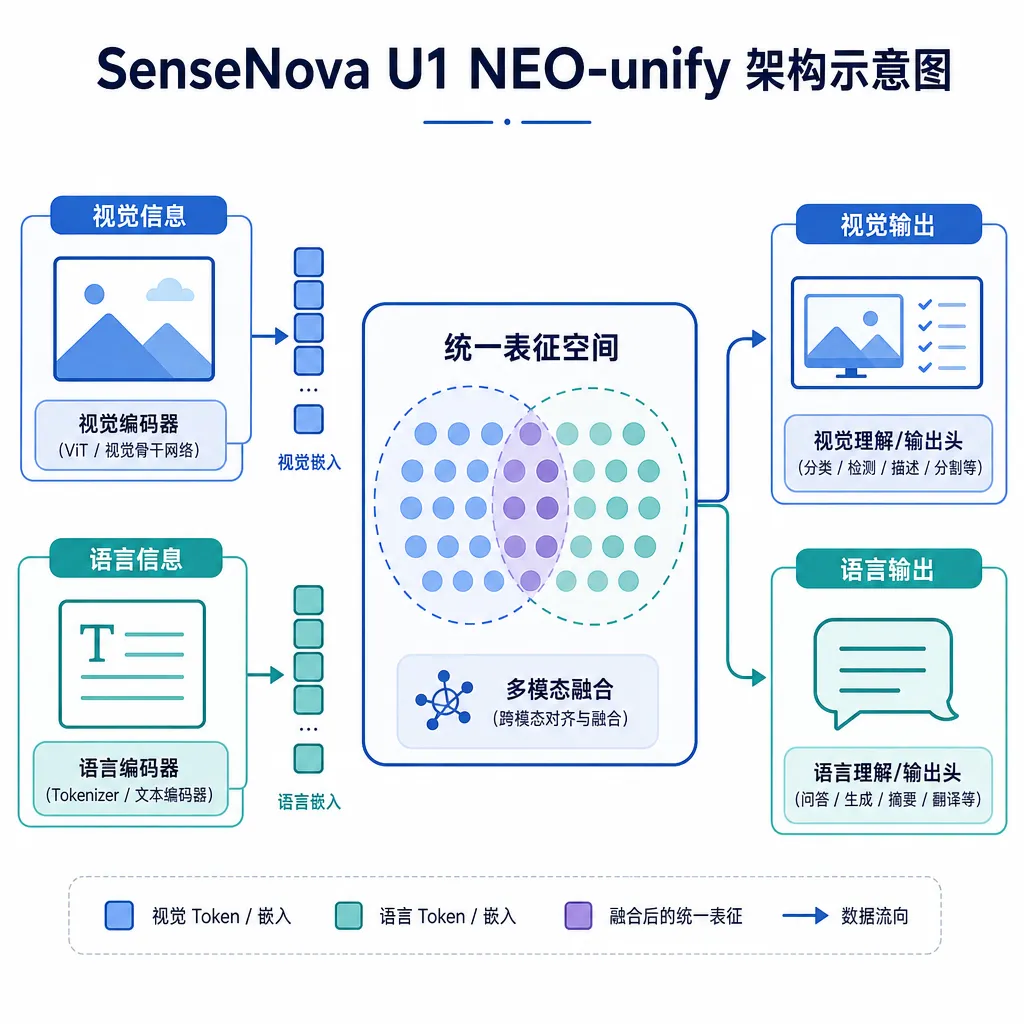
What Exactly Did NEO-unify Change?
We need to explain the architecture in detail here, otherwise it’s easy to conflate it with slogans like “unified multimodal.” SenseTime is not the only one touting "unified multimodal," but there are big differences in routes taken.
Roughly three approaches:
- Concatenation approach: Models like LLaVA, InternVL, Qwen-VL—visual encoder + LLM + optional diffusion head. Advantages are engineering maturity; disadvantages are either strong in understanding but weak in generation, or vice versa.
- Discrete token approach: VQ-quantize images into discrete tokens and mix them with text tokens for the Transformer, e.g., Chameleon, Emu3. Stronger unification, but image quality suffers—VQ reconstruction is inherently lossy.
- Native continuous approach: Images and text both use continuous representations, with no modality distinction at the architecture level. NEO-unify belongs here, and is more radical, eliminating even the VAE “compression-decompression” step.
SenseTime describes it as “the model doesn’t need to rely purely on stacking parameters to compensate for losses in intermediate conversions, but instead uses a unified internal representation to organize multimodal information more compactly and with higher density.” It sounds like PR talk, but there’s direct evidence—8B parameters matching closed-source models like Qwen-Image 2.0 Pro and Seedream 4.5 that are over ten times larger. If the information flow isn’t squashed or translated, parameter efficiency indeed improves greatly.
Analogy: traditional architecture is like a company where the "visual department" draws and the "language department" writes copy, communicating via PowerPoints; NEO-unify is like a full-stack designer whose mind sees text and images as one, and outputs the finished product directly. Without the meeting step, efficiency naturally increases.
Which Two Versions Were Open-Sourced?
The first batch open-sourced is the Lite series, two specs:
- SenseNova-U1-8B-MoT: Dense backbone, 8B fully activated parameters, suited for max quality and memory-rich environments.
- SenseNova-U1-A3B-MoT: MoE architecture, ~3B activated parameters, lower inference cost, good for large-scale deployment.
MoT is SenseTime’s own term (Mixture-of-Tokens, perhaps), core idea is unified representation + multimodal joint training. Both models share the same architecture with different backbone choices, covering capabilities like image understanding, text-to-image, image editing, spatial reasoning, and mixed text-image generation.
Repo links:
- GitHub:
OpenSenseNova/SenseNova-U1 - HuggingFace: SenseNova-U1 collection under
sensenova
Also released: 8-step LoRA accelerated version (SenseNova-U1-8B-MoT-LoRA-8step-V1.0.safetensors), cutting generation from 50 steps to 8—critical for deployment, since finishing a high-res infographic in 50 steps can take tens of seconds on a 3090, but with 8-step LoRA it’s near-instant.
What Does Testing Feel Like?
I ran it through a few typical scenarios—highlights below.
First type: complex infographics. Historically open-source models struggled here—text layout, icon placement, consistent color schemes. Native diffusion tends to blur half the text. SenseNova U1 exceeded expectations here—generated a 16:9 tech-style infographic (title, subtitle, three-column layout, icons + text mixed) with mostly clear text and reasonable proportions, reaching commercial template quality. Not perfect—long prompts over 1000 words sometimes miss details—but it’s already pulling ahead of similar open-source models.
Second type: mixed text-image creation. This is where NEO-unify shines. Example: asked to describe “how to cook medium-rare steak,” it would think + plan + output step-by-step, with each step paired with a matching image. The key is style consistency between images—things like cookware, lighting, plating stay stable across steps. Using traditional “LLM calls text-to-image API” methods, each call is independent sampling and style drifts markedly; U1 maintains context internally, so image coherence comes naturally.
SenseTime claims “industry’s first continuous mixed text-image creation output in a single model call”—not an exaggeration. Previously, to get this effect you’d need LLM script generation + text-to-image + style LoRA + ControlNet—a long and fragile engineering chain. U1 does it in one model run, greatly reducing failure probability.
Third type: image editing. Provide a cat image, prompt “make the fur color darker” and it precisely changes only the fur color, preserving composition and detail, avoiding the “redraw but sort of similar” awkwardness. This is again the advantage of unified representation—understanding “where is fur color” and generating “modified image” use the same set of representations, naturally aligned.
How to Run Locally
Repo uses uv for dependency management, smoother than pip:
git clone https://github.com/OpenSenseNova/SenseNova-U1.git
cd SenseNova-U1
uv sync
source .venv/bin/activate

# Download weights (ModelScope or HF)
modelscope download --model SenseNova/SenseNova-U1-8B-MoT \
  --local_dir ./SenseNova/SenseNova-U1-8B-MoT
Text-to-image:
python examples/t2i/inference.py \
  --model_path SenseNova/SenseNova-U1-8B-MoT \
  --prompt "A minimalist tech-style infographic, title SenseNova-U1..." \
  --width 2720 --height 1536 \
  --cfg_scale 4.0 --timestep_shift 3.0 --num_steps 50 \
  --output output.png
Image editing:
python examples/editing/inference.py \
  --model_path SenseNova/SenseNova-U1-8B-MoT \
  --prompt "Change the animal's fur color to a darker shade." \
  --image input.jpg \
  --cfg_scale 4.0 --img_cfg_scale 1.0 --num_steps 50 \
  --output output_edited.png --compare
8-step LoRA acceleration:
modelscope download --model SenseNova/SenseNova-U1-8B-MoT-LoRAs \
  "SenseNova-U1-8B-MoT-LoRA-8step-V1.0.safetensors" \
  --local-dir ./SenseNova/SenseNova-U1-8B-MoT-LoRAs/

python examples/t2i/inference.py \
  --model_path SenseNova/SenseNova-U1-8B-MoT \
  --lora_path ./SenseNova/SenseNova-U1-8B-MoT-LoRAs/SenseNova-U1-8B-MoT-LoRA-8step-V1.0.safetensors \
  --num_steps 8 --cfg_scale 1.0 \
  --jsonl examples/t2i/data/samples.jsonl \
  --output_dir outputs/
Memory-wise: FP16 inference on 8B-MoT starts at ~20GB; single 4090 can run it. A3B-MoT, due to MoE, has large total weights but small active set, slightly less inference memory pressure—good for server deployment.
Who Does It Compare With, and Differences
A subtle point this open-source release: SenseTime’s comparison is not with other open-source unified models but directly against closed commercial models. Qwen-Image 2.0 Pro and Seedream 4.5 are top-tier domestic text-to-image models, each tens of billions of parameters. SenseTime’s official charts show U1 Lite as “on par” in generation quality, with “significant advantage” in inference speed.
My tests and personal judgment:
- Photorealistic portraits / natural scenes: U1 Lite slightly weaker than Seedream 4.5—closed-source models still have advantages in skin texture and lighting detail.
- Infographics / layout / text rendering: U1 Lite leads—no open-source competitor currently.
- Image editing: U1 Lite and Qwen-Image-Edit are evenly matched, but U1’s semantic understanding is noticeably more precise.
- Continuous mixed text-image creation: U1 Lite is the only viable option currently.
So this open-source release is not just “another text-to-image model,” but significantly raises the open-source ceiling for mixed text-image and infographic generation, both essential commercial-use scenarios.
What Does This Mean?
Broadly: native unified multimodal has been pushed by academia for the past two years, but very slow to land in industry—main barriers being high training cost, huge data needs, instability. When Chameleon came out, many saw it as the direction, but performance wasn’t overwhelmingly better than concatenation; Emu3 took a similar route but the engineering barrier discouraged many teams.
SenseTime’s NEO-unify achieving SOTA, and generously open-sourcing, gives the community an engineering proof-of-concept that “native unification is viable.” This provides a reference for continued training, industry fine-tuning, and architecture borrowing.
On the smaller scale, for developers, three direct values:
- Mixed text-image capability can now fit into Agents—previously image-output-capable Agent chains were long and brittle; now one call gets it done.
- Infographics, tutorial images, long text-image creation now have an open-source solution.
- Spatial intelligence and physical reasoning have a foundation—SenseTime mentions plans for a robot embodiment brain, with U1 as the base.
OpenAI Hub is already integrating U1 and plans to offer a hosted U1 API, letting developers add a native unified multimodal option alongside GPT, Claude, Gemini, DeepSeek under the same key. For multimodal application makers, this means fewer platform switches and fewer SDKs—solid practical value.
SenseTime says they’ll continue to scale, releasing larger U1s. If NEO-unify maintains efficiency at bigger scale, native unification will likely become the mainstream form for next-generation multimodal—the concatenation approach’s comfort zone may only last a year or two.
References
- SenseNova-U1 Open-source Repo (GitHub) — Code, model weights download, inference examples
- SenseNova-U1 HuggingFace Collection — Model cards, LoRA acceleration weights
- linux.do shared mixed text-image beta examples — Community user tests of mixed text-image function
- Zhihu: SenseTime’s multimodal “efficiency monster” open-source hits SOTA — Technical detail and benchmark interpretation


