
Huawei Open-Sources Pangu 2.0: 505B Parameters Betting on Ascend, Yu Chengdong Aims to "Go from China's No. 1 to the World's No. 1"
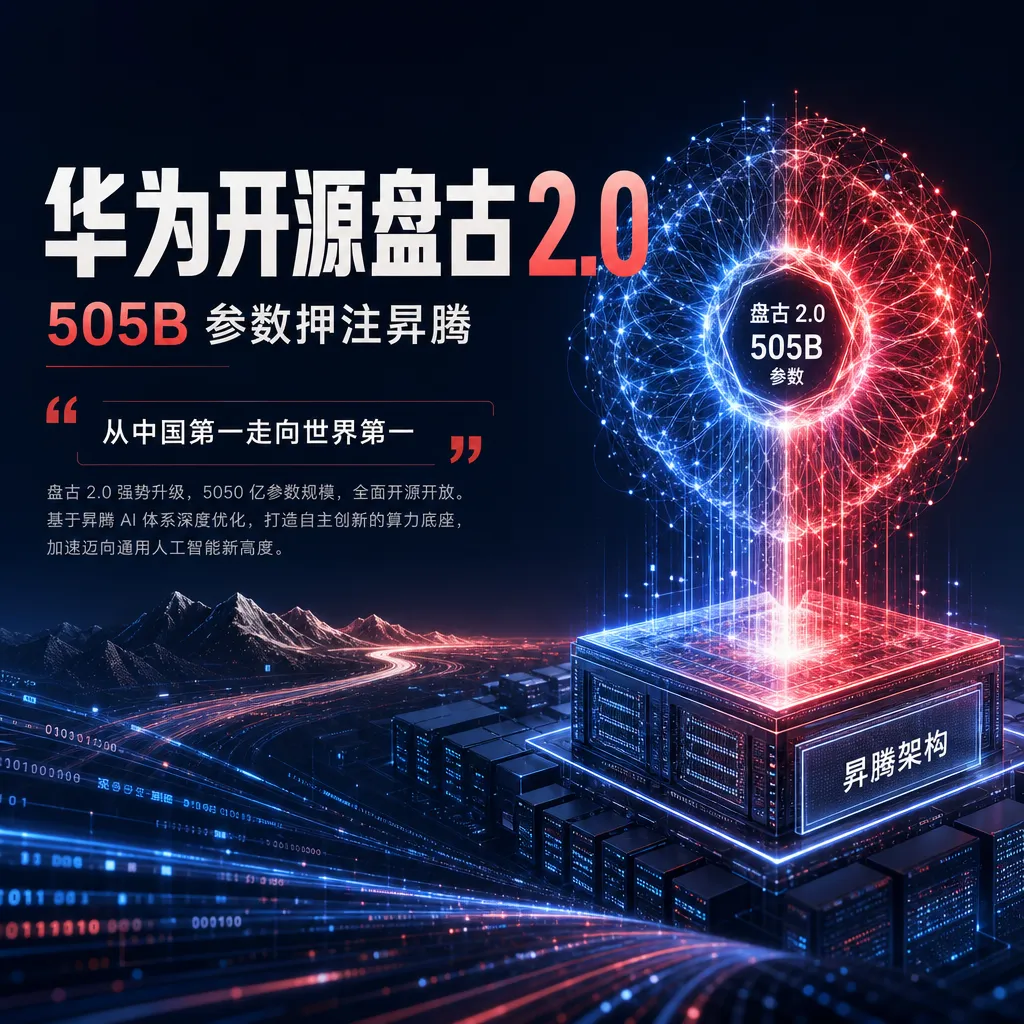
Huawei released the open-source Pangu openPangu 2.0 at HDC 2026, with the Pro version having a total of 505B parameters and 18B activated, specially optimized for Ascend computing power and the HarmonyOS ecosystem. Yu Chengdong admitted that "the available computing power is quite limited," but declared the ambition to take the world’s top spot.
At this afternoon’s Huawei Developer Conference HDC 2026, Yu Chengdong fully revealed the open-source Pangu project: openPangu 2.0 was officially released, with a maximum size of 505B parameters (18B activated), 512K context length, and starting June 30 seven major components will be open-sourced in batches — even the pre-training code, post-training code, and training operators will be released together.
The highlights aren’t all in the parameter table. On stage, Yu Chengdong stated, "In my dictionary for the rest of my life, there is no second place, only first place. We will go from China’s number one to the world’s number one." He candidly admitted, "The compute power reserved for Pangu is very limited because most Ascend compute power is given to other domestic companies" — these two remarks essentially lay bare Huawei’s current situation and posture in developing large models: compute resources are scarce, but the work must be done, and it must be done to be number one.
1. Parameter Table: Pro and Flash Dual Versions, Activation Volume Unusually Restrained
First, the hard specifications:
- openPangu 2.0 Pro: total parameters 505B, activated parameters 18B, MoE architecture
- openPangu 2.0 Flash: total parameters 92B, activated parameters 6B
- Context length: 512K (same for both versions)
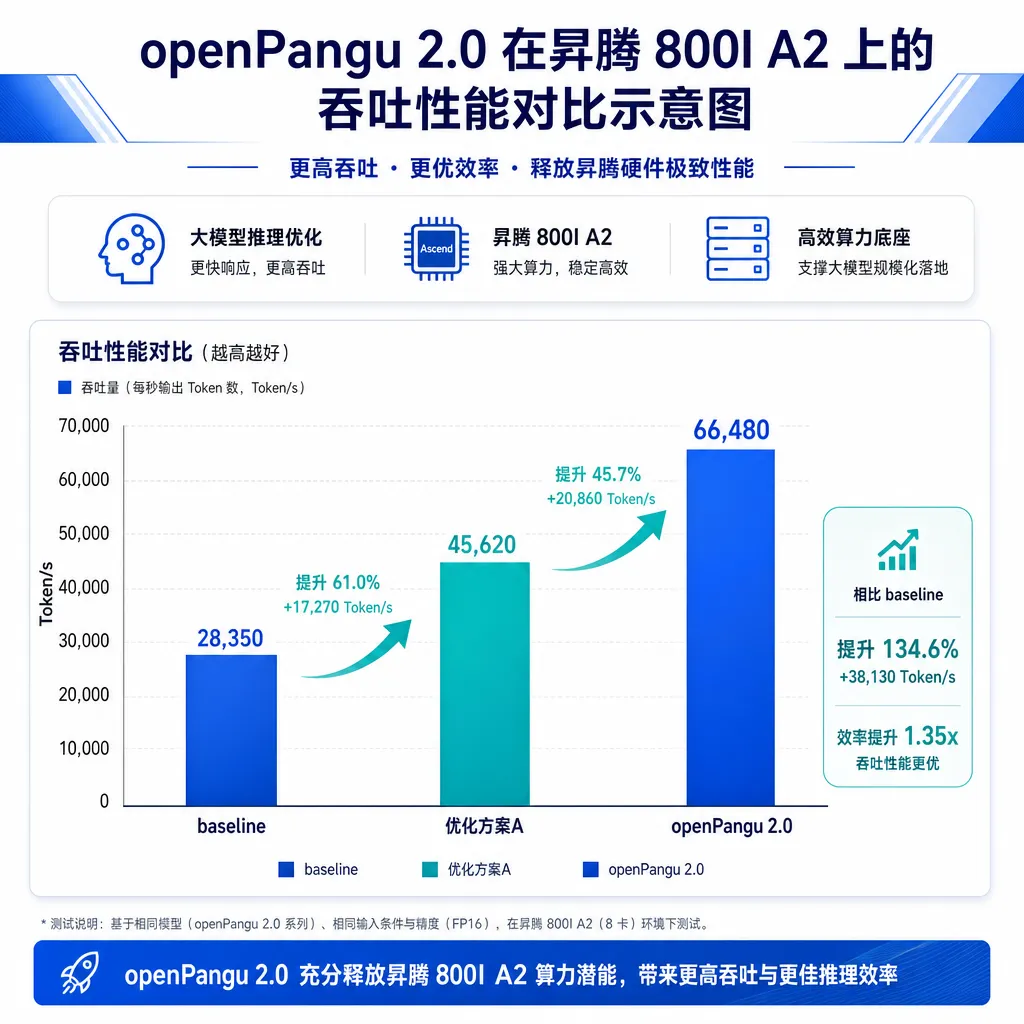
- Single-card throughput: twice that of mainstream open-source models on the Ascend platform
- Open-source schedule: Seven major components to be gradually released starting June 30, 2026
Looking at the numbers, 505B total parameters in 2026 is not especially shocking — DeepSeek, Qwen, Kimi have each pushed MoE scales into the trillion range this year. But note the activation volume: 505B total with only 18B activated, roughly 3.6% sparsity. This is quite aggressive, even sparser than last year’s DeepSeek-V3 with 671B/37B (5.5%) sparsity.
This design choice is directly related to Huawei’s tight compute supply. Smaller activation volume means lower per-token compute cost and higher throughput per card. Yu Chengdong said Huawei is “more focused on improving latency and throughput,” which translates to: I don’t have enough cards to run dense compute, so I have to squeeze every drop of utilization from each card.
The Flash version’s 92B/6B ratio works under the same logic. 6B activation fits comfortably on a single Ascend 800I A2, targeting deployment scenarios from device edge to near-edge, alongside HarmonyOS’s Agent pipeline.
2. Deep Ascend Binding: Where Single-Card 2x Throughput Comes From
Huawei repeatedly emphasized “single-card throughput twice that of mainstream open-source models.” This 2x didn’t appear out of thin air. Looking back at details disclosed in July last year when Huawei first open-sourced Pangu Pro MoE (72B/16B) clarifies their technical route:
1. MoGE Grouped Routing Architecture
Traditional MoE Top-K routing suffers from uneven expert activation — some devices bottleneck, others idle. Huawei’s solution: Mixture of Grouped Experts (MoGE) — forcibly split N experts into M groups, each bound to one device, and route to activate K/M experts per group.
This structured constraint trades some routing flexibility for strict load balance across devices. On Ascend hardware, which focuses on cluster collaboration, this trade-off is worth it — total inference latency in large models is always chokepointed by the slowest card.
2. Tensor Alignment to 256 for DaVinci Architecture
Ascend NPU’s DaVinci architecture uses 16×16 matrix compute units; tensors aligned to 256 fully feed the compute units. This optimization affects MFU (machine FLOPS utilization) by several percentage points.
3. Adaptive Pipeline Overlap and Layered Hybrid Parallelism
Internally packaged by Huawei as the Adaptive Pipe Overlap Mechanism. Combined with 16-way PP + 8-way TP + 4-way EP + 2-way VPP + 48-way DP parallel strategy, MFU reached 30% on clusters of 6000+ Ascend NPUs — a 58.7% improvement over pre-optimization.
4. KVTuner and MulAttention Fused Operators
KV cache compression + Ascend-targeted fused attention operator — end-to-end attention sped up 4.5×. These stem from engineering carried over from the Pangu Ultra MoE generation.
In short, the 2x throughput figure comes from an entire suite of software-hardware co-optimizations. That’s why Yu Chengdong said “openPangu 2.0 is more friendly to Ascend compute power” — without Ascend, a fair portion of these optimizations can’t be realized.
3. HarmonyOS Adaptation: Agent Tasks Are the True Target
Aside from parameters and throughput, another keyword repeated throughout the event was Agent: “Better suited to HarmonyOS, Agent tasks faster, more accurate, more efficient” — this is deliberate.
Huawei’s product matrix includes phones, tablets, in-car systems, and IoT; HarmonyOS is the underlying OS. In this ecosystem, device-side Agents are a natural focus: the user says something; the system must coordinate between devices, call APIs, read local data, execute actions. In such scenarios, bigger models aren’t necessarily better — they need to be:
- Low latency — user tolerance for device-side response time is only a few hundred ms
- Accurate multi-tool invocation — function calling accuracy directly determines whether the Agent can complete tasks
- Controlled resource usage — phones and car systems can’t spare you 80GB of VRAM
That’s why the Flash version only activates 6B — its target scenario is device-side or near-edge inference. The 512K context is also for long-chain Agent tasks: a complete multi-step operation may require packing the entire conversation history, tool call logs, and document snippets.
This positioning differs from Qwen3, DeepSeek-V3, and other purely cloud-based general models. Huawei’s Pangu from the start was never built for leaderboard glory, but to feed its own ecosystem.
4. Open-Source Strategy: Releasing Pre-Training Code Is a Signal
Of the seven components open-sourced from June 30, the most significant isn’t the model weights, but:
- Pre-training code
- Post-training code
- Training operators
These surpass the significance of the model itself. Pre-training code means external teams can re-train on their own data using Pangu’s architecture; post-training code means RLHF, DPO alignment process implementations are public; training operators mean the low-level kernels for large-model training on Ascend are no longer a black box.
For comparison: DeepSeek’s open source is thorough but never releases the complete training code; Qwen series releases weights but uses Alibaba’s internal Megatron fork. Huawei now revealing training-side elements resembles courting Ascend ecosystem developers — want to train on Ascend? Here’s a complete reference implementation.
The intent is clear: for Ascend to replace CUDA, hardware alone isn’t enough — it needs a software stack and model infrastructure. Open-sourcing Pangu provides a flagship example for the Ascend ecosystem.
5. Some Criticism
Alongside Huawei’s advantages, a few less polite points:
First, 505B scale in mid-2026 isn’t impressive. Domestic open-source iterations this year are extremely rapid, trillion-parameter models are commonplace. Pangu’s 505B specs alone can’t claim to match top open-source models. Yu Chengdong admits “compute is very limited,” a reasonable explanation, but it shows Huawei prioritized commercial customers in its compute allocation.
Second, “friendly to Ascend” is a double-edged sword. Single-card 2× throughput sounds great, but only if you run on Ascend. Most small developers still use NVIDIA — to what extent can Pangu’s optimizations carry over to CUDA? No public data yet.
Third, benchmarks unseen. The launch didn’t show MMLU, HumanEval, AIME scores. Given openPangu 2.0 is open-sourced only starting June 30, independent reviews won’t land until July. Until then, beyond “2× throughput,” the model’s intelligence level remains unknown.
Fourth, Yu Chengdong’s rallying style. “In my dictionary for the rest of my life, there is no second place, only first” — in Huawei’s tradition this isn’t unusual, but in the large-model field—driven by data, compute, algorithms, talent—mere rhetoric won’t suffice. To catch GPT-5, Claude 4 tier, Pangu has a long road.
6. What This Means for Developers
If you’re a developer on the Ascend platform, openPangu 2.0 is almost a must-see: complete training code + optimized operators + one of the largest domestic open-source MoEs — unmatched within the Ascend ecosystem.
If you’re an ordinary application-layer developer, Pangu 2.0 adds another option: 512K context + device-friendly Flash version is useful for Agent or long-document handling scenarios. Note that domestic mainstream API aggregation platforms are still integrating with Pangu; once open-sourced, platforms should launch quickly. OpenAI Hub will, as usual, list a compatible interface after model weights are public, letting you use it alongside GPT, Claude, Gemini, DeepSeek with the same key.
If you’re a model researcher, the most valuable read will be the soon-to-be-released technical report — the previous Pangu Ultra MoE report included many MoE training engineering details: MoGE routing, adaptive pipeline overlap, grouped AllToAll — directly applicable when training your own MoE model.
7. Finally
Huawei’s large-model journey began with Pangu 1.0 in 2021, making this a five-year path. There were ups and downs, but since Yu Chengdong took over in 2025, the pace has notably accelerated — open source, openness, focus on engineering efficiency — a departure from the prior research/industry-downstream emphasis.
openPangu 2.0 isn’t a launch that makes you exclaim “disruptive.” Its presence is more of a signal: Huawei has decided to earnestly make Pangu the flagship open-source project of the Ascend ecosystem and is willing to fully open the training stack. The long-term impact on domestic AI infrastructure could be far greater than the 505B figure itself.
As for “going from China’s number one to the world’s number one” — that will have to be proven by version numbers. When openPangu 3.0 and 4.0 arrive, we can look back at this 2026 launch to see if it was truly a turning point.
References
- Huawei releases openPangu 2.0 model: up to 505B parameters, Yu Chengdong admits compute power reserved for himself is limited - IT Home — HDC 2026 on-site report with complete openPangu 2.0 parameters and open-source plan
- Pushing for large models! Huawei’s Yu Chengdong says his dictionary has no second place, only first - IT Home — Full viewpoints from Yu Chengdong’s keynote
- Huawei open sources 718B-parameter large model - Zhihu — Background on Pangu’s prior open-source strategy


