
Tencent Cloud Cuts Prices Against the Trend: MiniMax-M3 Halved, Hy-MT2-Pro Input Price Down Nearly 70%
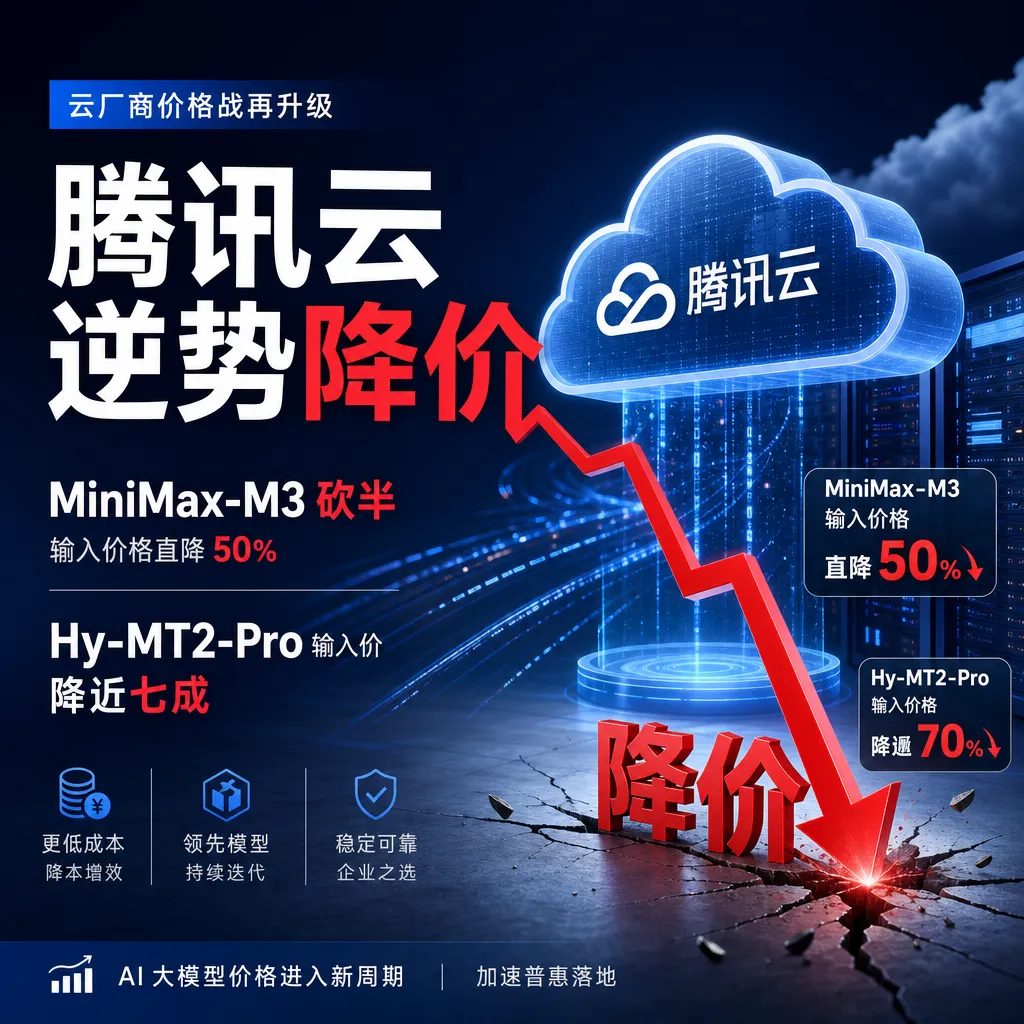
Starting June 12, Tencent Cloud TokenHub will reduce the Hy-MT2-Pro input price by 66.67% and the output price by 55.56%; starting June 15, MiniMax-M3’s inference input, output, and cache hit fees will all be cut in half. At a time when most of the industry has generally stopped lowering prices and even started raising them, Tencent's move is quite noteworthy.
Tencent Cloud issued a price adjustment announcement today, which is moderately good news for developers: the large-model service platform TokenHub is about to lower the API prices for two of its main models—Hy-MT2-Pro, starting today (June 12), input price down 66.67% and output price down 55.56%; MiniMax-M3, starting June 15, inference input, inference output, and cache hit fees all cut in half.
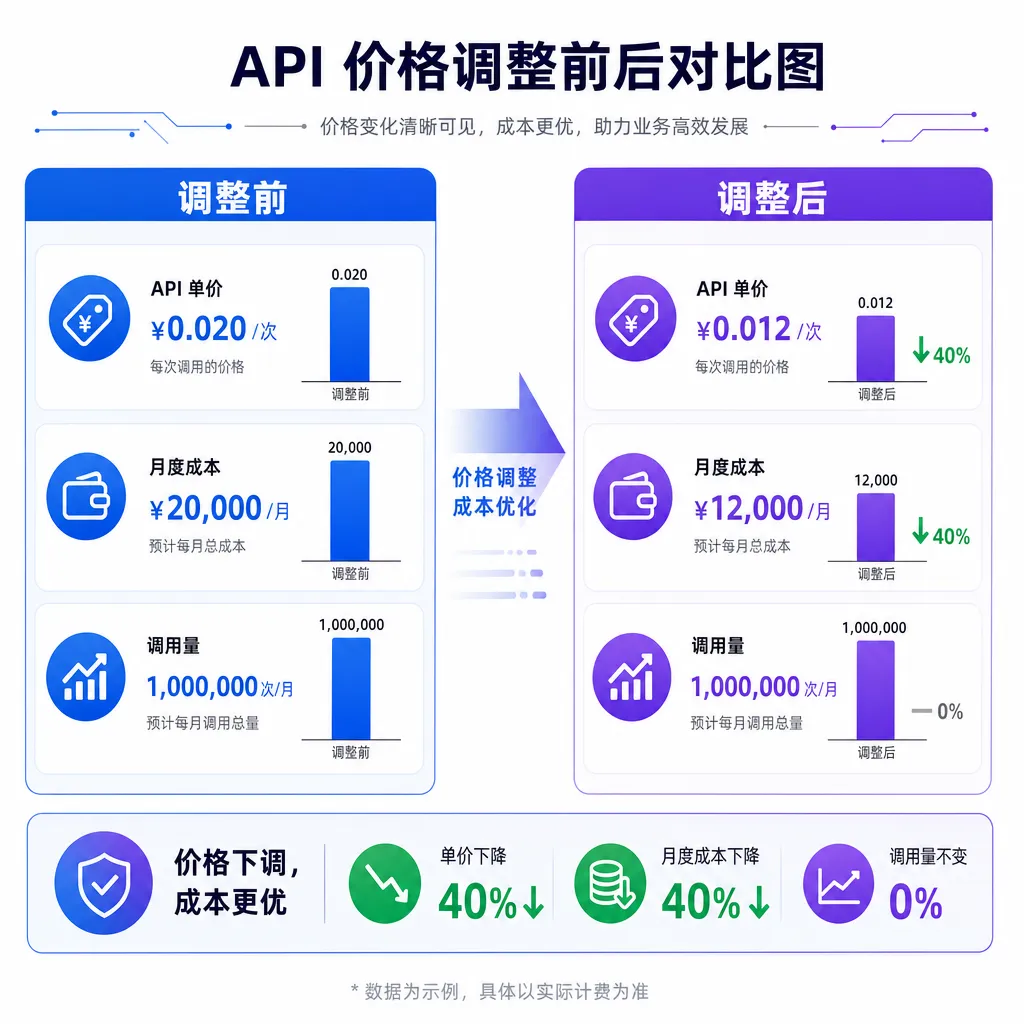
Based on TokenHub’s current price list, Hy-MT2-Pro was originally priced at ¥1.5 per million tokens for input and ¥4.5 per million tokens for output. After the adjustment, it’s roughly ¥0.5 for input and ¥2 per million tokens for output. This places it among the cheapest in the domestic mid-range Pro tier—cheaper than Alibaba’s Qwen-Plus non-thinking tier and on par with ByteDance’s Doubao 1.6 short-text tier. For MiniMax-M3, the official statement only says “all reduced by 50%” without disclosing the adjusted absolute price. But at that rate, it’s already competitive with hosted open-source model pricing.
The industry is raising prices—Tencent goes the other way
To understand the significance of this price cut, you need to zoom out.
In the fierce large-model price wars of 2024, the main players were ByteDance, Alibaba, Baidu, Tencent, and Zhipu, with input prices once driven down to just a few tenths of a yuan per million tokens. But after entering 2025, the industry took a sharp turn: DeepSeek canceled its night-time discounts in September, raising its lowest call price by 50%; Zhipu’s high-speed GLM-4.5 output hit ¥64 per million tokens; Moonshot’s Kimi K2 restored the high-speed tier to ¥64 in 128K long-text scenarios; and MiniMax-M1 inference models reached a maximum output price of ¥24.
Even Tencent made big hikes earlier. In March, Tencent Cloud’s AI agent development platform adjusted pricing for some Hunyuan models—HY2.0 Instruct and HY2.0 Think saw input/output price hikes mostly exceeding four-fold, with Tencent HY2.0 Instruct input going from ¥0.0008/1K tokens to ¥0.004505/1K tokens, a 463.13% increase. At the time, Caijing Lianhe’s headline read “Price hike up to 400%.”
So it’s clear: over the past two years, major domestic vendors have shifted API pricing strategy from “low price for volume” to “fine-grained tiering”—using stepped pricing, splitting “thinking” and “non-thinking” modes, and charging extra for ultra-long contexts to single out high-value users from mass pricing. Thus, Tencent’s decision to cut prices for two main models is a small countercurrent against the backdrop.
Why these two models
Choosing Hy-MT2-Pro and MiniMax-M3 for the cuts wasn’t random.
Hy-MT2-Pro is Tencent’s in-house mid-range Pro-tier Hunyuan model, presumably the Pro version of the second-generation MT (Multi-Task or Multi-modal Translation, etc.). In TokenHub’s price list, it has a unified rate regardless of input length—usually meaning the model has a moderate context window (about 32K tokens), aimed at high-frequency, stable, moderately complex tasks. After the cut, it’s clearly targeting heavy-use scenarios such as translation, content generation, and summarization. The 65%+ input cut, paired with a 55% output cut, makes it especially attractive for retrieval-augmented generation (RAG) scenarios which have “more input than output.”
MiniMax-M3 is a third-party flagship model hosted on Tencent Cloud. After MiniMax’s crazy ¥1/million tokens pricing era for abab-6.5s ended, newer Text-01 and M1 models have become more expensive. Tencent Cloud’s 50% cut here effectively uses platform subsidies to bring a third-party flagship back to an affordable level—a classic channel-competition move: if the MiniMax official price goes up, Tencent Cloud offers it cheaper.
This channel-lower-than-origin pricing is also visible with DeepSeek: on TokenHub, DeepSeek-V4-Flash’s cache hit rate is ¥0.02/million tokens from the official source, but ¥0.2/million tokens for the same model self-hosted by the platform. Both run in parallel, letting developers choose—original source for stability, platform for lower cost.
What this means for developers
From an API-using developer’s perspective, this price adjustment has several practical implications:
- Cache hit fees halved is more important than it appears. In scenarios like long system prompts, fixed few-shot templates, and agent workflows with “extremely high prefix repetition,” cache hit costs are the real bulk. Cutting them in half directly lowers monthly production bills.
- Larger cut in input than output is a distinct feature for Hy-MT2-Pro—input down 66.67%, output down 55.56%. Such asymmetry clearly encourages long-context inputs. In other words, Tencent wants you to use this for RAG, long-document processing, and large-block code reviews, rather than chat.
- Hy-MT2-Pro cuts take effect immediately, MiniMax-M3 in three days—this window lets you test things out. You can A/B test Hy-MT2-Pro now and decide main routing after the June 15 MiniMax-M3 adjustment.
Tencent’s plan: sell more Hunyuan
Keen developers may notice: Hy-MT2-Pro is in-house, MiniMax-M3 is third-party. Both get cuts, but Tencent’s cut for its own model is more aggressive—slashing input by two-thirds.
The logic is clear.
Hunyuan has been doing architectural cost optimizations. Hunyuan TurboS uses a Transformer + Mamba hybrid structure to reduce compute overhead for long sequences; since launching in March, its price has been low at ¥0.8 input/¥2 output per million tokens. As a newer-generation Pro-tier, Hy-MT2-Pro likely has even lower inference costs, hence the confidence to cut prices by over 60%.
Industry analysis from Zhidx also shows: Tencent is among the few major domestic firms still gradually lowering large-model API prices. From Hunyuan Turbo’s September 2024 launch price of ¥15 input/¥50 output per million tokens, it has dropped to ¥2.4/¥9.6, with TurboS even cheaper. This sustained lowering contrasts sharply with other vendors’ tiered price hikes.
Put simply, Tencent Cloud wants to secure the “default call” position in developers’ stacks. With OpenAI and Anthropic APIs stuck at $11–15 per million tokens, and subscriptions hitting $200/month, if domestic cloud providers also raise prices, developers have every reason to chase better value. Tencent Cloud, with TokenHub aggregation, Hunyuan, native DeepSeek supply, and the full MiniMax/Zhipu/Qwen lineup, has a much lower marginal cost of price cuts than a pure model provider like MiniMax.
The squeeze of token inflation and cost control
But the cuts don’t happen in isolation—they come at an odd moment: token usage is exploding, while vendors’ compute cost structures look worse.
Public data shows China’s daily token consumption exceeded 30 trillion by mid-2025; by February 2026, mainstream large models hit 180 trillion daily tokens—a sixfold increase in just over half a year. Last month Anthropic had to cancel unlimited usage for its $200/month Claude Code subscription because some users were running 24/7 agents costing “tens of thousands of dollars” per month each.
This creates a contradiction:
- On one hand, agents, long contexts, and multi-tool calls are pushing per-task token usage sky-high, so developers’ demand for price cuts is stronger than ever.
- On the other hand, model inference costs—GPU rental prices for H100s have stabilized at $2–3/hour—plus electricity, data licensing, and talent costs leave almost no margin to cut further.
So Tencent’s cuts are good for developers but are essentially “spreading costs via platform scale + subsidizing for market share.” How long this can last depends on whether Hy-MT2-Pro’s usage volume grows enough in upcoming quarters. If it merely attracts bargain hunters without converting them into stable enterprise orders, we’ll likely see a return to tiered pricing by next year.
Some practical tips
For developers currently choosing or migrating:
- If your workload heavily uses MiniMax-M3, get Tencent Cloud TokenHub integrated before June 15 so you can switch traffic on the day of the cut;
- Hy-MT2-Pro is great for light translation, content moderation, structured extraction—tasks with “more input than output”; after the cut, it’s highly competitive in the domestic Pro tier;
- If you build agents or RAG, watch cache hit costs closely—MiniMax-M3’s 50% cut will significantly lower long-prompt costs;
- Don’t look only at unit price—domestic vendors’ pricing is getting more complex, with input-length tiers, thinking/non-thinking modes, and concurrency limits all affecting real bills. Test with real traffic for a week before deciding your main routing.
For developers calling multiple models with one key, aggregation services like OpenAI Hub (openai-hub.com) can save the engineering costs of platform switching—especially if your app mixes GPT, Claude, Gemini, and domestic models, avoiding the need to maintain multiple SDKs and billing systems is its own form of cost reduction.
Wrap-up
The large-model price war script has become much more complicated post-2025. While vendors claim “intelligent service costs will keep going down,” in reality overseas flagship API prices are flat, subscriptions are heading to $200, and domestic vendors are applying tiered increases.
Against this backdrop, Tencent Cloud’s decisive price cuts for Hy-MT2-Pro and MiniMax-M3 are reassuring to developers—at least in the mid-tier model category, there’s still room for prices to fall. But don’t be too optimistic: the price ceiling for flagship models is far from softening.
References
(This article is compiled from Tencent Cloud TokenHub official announcements, and public reports from 36Kr, Caijing Lianhe, etc.)


