
Kimi K2.7 Code Open Source: Think 30% Less, Run More Accurately
Moonshot AI today open-sourced Kimi K2.7 Code, focusing on long-context programming instruction following and long-range tasks, with thinking tokens reduced by 30%. A 6x speed version will be launched on June 15.
Kimi K2.7 Code Open Source: 30% Less Thinking, More Stable Long-Range Programming
On June 12, Moonshot AI released Kimi K2.7 Code, hanging the model weights directly on Hugging Face, with the API opening the same day. It’s only been two months since the previous generation K2.6 was released in April, pushing SWE-Bench Pro up to match GPT‑5.4. This time, the version naming is noticeably restrained—not K3, just K2.7, with a clear “Code” suffix. The meaning is obvious: this release isn’t a general-purpose upgrade but a specialized evolution targeting programming scenarios.
If you’re a developer using Kimi Code Plan to write code, as of today the default model has been switched to K2.7 Code, without any action needed. But if you’re running non-programming tasks like scientific Q&A or long-form writing, the official recommendation is to switch back to K2.6—in other words, “use whichever is suitable,” which is far more honest than the usual “new model is stronger across the board” claims.
What’s Changed: 30% Less Thinking, More Doing
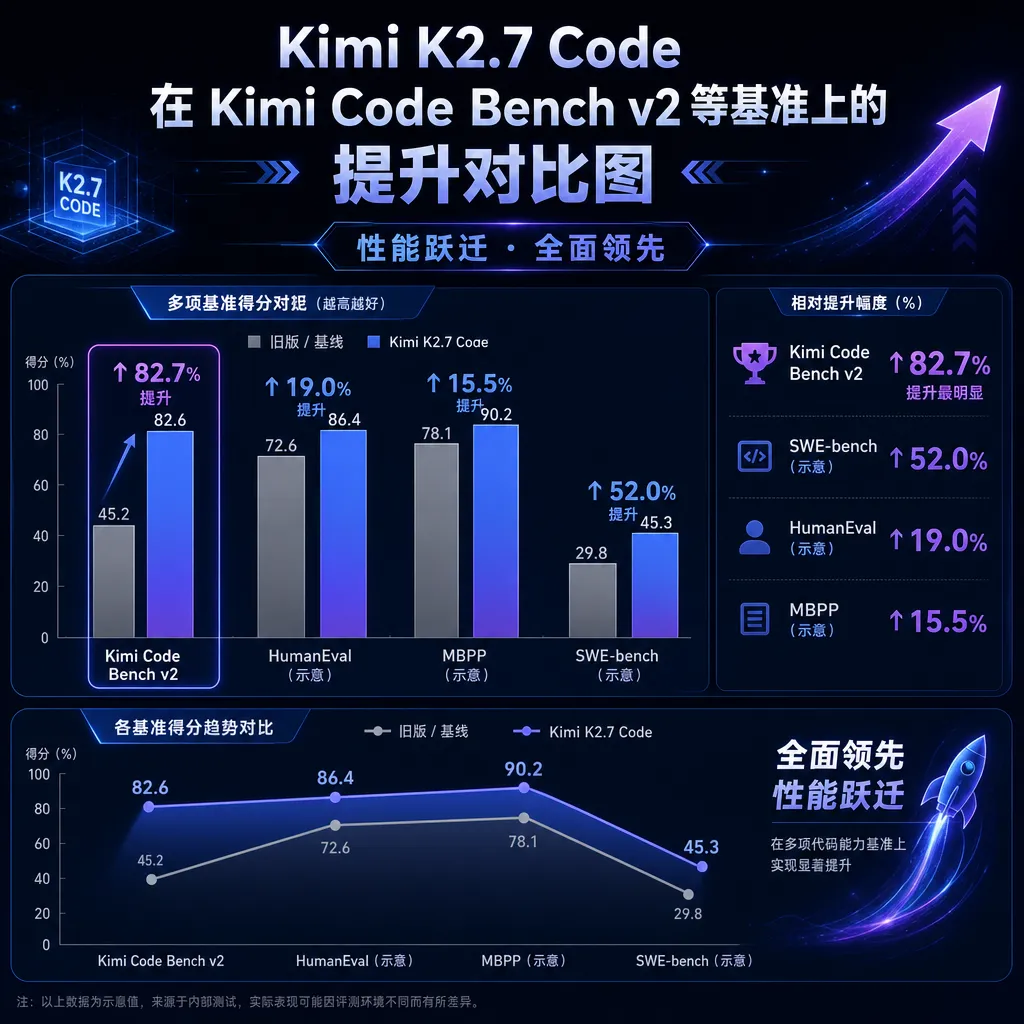
First, let’s look at the official numbers, compared against K2.6 on the same baseline:
- Kimi Code Bench v2: +21.8%
- Program-Bench: +11%
- MLS Bench Lite: +31.5%
- Kimi Claw 24/7 Bench / MCP Atlas / MCP Mark Verified: Agent autonomous execution ability around +10%
- Average thinking token consumption: -30%
The most noteworthy number isn’t the 31.5%, but the 30% reduction in token consumption.
Anyone who’s done agentic coding knows “overthinking” is one of the easiest pitfalls for thinking-mode models in long-range tasks. A request to fix a bug might prompt the model to spend 2,000 tokens guessing the entire codebase structure, then hypothesize every filename, before actually starting—when the real problem might be in line 10 of the first file. In API scenarios billed by token, this “thinking too much” translates directly into cost; in subscription-based environments like Kimi Code, it becomes waiting time and wasted context window.
K2.7 Code cuts this tendency by 30%. Combined with a 21.8% Kimi Code Bench v2 improvement, this means the model is not only more accurate but also more straightforward. For long-range programming tasks, this “less fluff” evolution is worth more than just boosting benchmark scores.
Why a “Code” Specialization Instead of K3
Moonshot AI’s version strategy this time is worth noting. K2.6 is already the flagship for all scenarios; K2.7 doesn’t directly replace it, but instead branches off with a Code suffix. This reflects a very practical engineering trade-off: the training objectives for general capabilities and programming-specialized capabilities become harder to reconcile the further you go.
Programming tasks have a few special attributes:
- Clear reward signals: If it runs, it’s right; if it doesn’t, it’s wrong—RL training yields very clean feedback.
- Strong long-range dependency: A true software engineering task may span dozens of files and tens of thousands of lines of context; traditional “single-round Q&A” training data can’t cover this.
- Dense tool usage: Reading files, running tests, calling LSP—each step can affect the next decision.
These three attributes mean that building a “stronger programming” model often requires compromises in general conversation and knowledge Q&A performance. Moonshot’s choice was to branch—K2.6 retains the general baseline, K2.7 Code pursues specialization to the extreme. Such a branching strategy has appeared among overseas companies for some time, but is still rather new in domestic open-source models.
By the way, K2.7 Code is trained on top of K2.6—as clearly stated on its Hugging Face model card: “a coding-specialized agentic model built on top of Kimi K2.6.” It’s not a new base model from scratch, but the result of large-scale long-range task post-training on K2.6. This also explains why the improvements are focused on programming and agent capabilities, while the official stance is conservative about other general abilities.
Must Use Thinking Mode—Disable It and It Errors Out
This is a fairly hardcore design: K2.7 Code must have Thinking Mode enabled to perform at its best.
- Via API, manually disabling thinking will return an error directly.
- Via Kimi Code, disabling thinking will automatically roll back to K2.6.
Such “you can’t turn thinking off” design isn’t common among domestic large models. The subtext is: the model’s training objectives and its runtime thinking process are deeply coupled; turning off thinking doesn’t yield a “faster K2.7” but an incomplete, unpredictable version. Moonshot simply banned this option at the product level.
For developers, this means you need to make a judgment at integration: if your scenario is extremely latency-sensitive and cannot accept the overhead of thinking, then K2.7 Code may not suit you—in such cases, either use K2.6 or wait for Monday’s high-speed version.
Pricing: Standard Version Unchanged, Cache Hit Price Quietly Higher
Here’s the price table:
| Item | K2.6 | K2.7 Code | Change | |---|---|---|---| | Input (1M tokens) | ¥6.5 | ¥6.5 | Unchanged | | Output (1M tokens) | ¥27 | ¥27 | Unchanged | | Cache-hit input | Previously lower | ¥1.3 | Slight rise |
Some forum users have complained this is a “slight price increase,” mainly because cache-hit input pricing was adjusted to ¥1.3/M. For those running agentic coding workflows, cache hits are the big cost—within a full editing session, system prompts, codebase index, and conversation history are repeatedly fed into context, with cache hit rates often exceeding 70%. This unit price adjustment means long-term bills will be slightly higher than during the K2.6 era.
However, given the 30% reduction in token consumption, the actual end-to-end cost may not have risen. Moonshot seems to be offsetting “cache price increase” with “thinking efficiency.”
See You Monday: 6× Speed High-Speed Version
This part launches on June 15, but the official announcement came today:
- Speed: In typical programming scenarios (median input length), output ~180 tokens/s; short context scenarios up to 260 tokens/s.
- Comparison: About 5–6× faster than the regular version.
- Price: 6× speed for 2× price.
This “6× speed for only 2× price” claim is Moonshot’s usual tactic—the K2 series already had turbo versions with essentially the same rollout. But the 180–260 tokens/s range can match the speed levels of top overseas inference-optimized platforms. For thinking-mode models, output speed is the core of agentic programming experience—watching the cursor stream code line-by-line vs. pausing for three seconds then dumping fifty lines at once are completely different experiences.
The official word is that inference resources for the high-speed version will gradually increase before the end of June; the implication—initial capacity is limited, so developers should get in early to enjoy it.
Broader View: The Open-Source Programming Model Track
Zooming out, the 2026 open-source programming model lineup is already crowded: DeepSeek V4 Flash uses a 1M context and near rock-bottom input pricing to wage a cost war; Qwen3.6‑plus takes the “longer, more detailed output” route; GLM‑5 stakes out the mid-tier; MiniMax M2.5 focuses on overall cost-effectiveness. The position of the Kimi K2 series has always been subtle—262K context, $1.09/M input (K2.5 data), placing it in the mid-to-high-end range.
K2.7 Code’s strategy is clear: it’s not competing with DeepSeek on input pricing or with GLM on overall performance; it’s differentiating in the long-range agentic coding niche. The distribution of benchmark improvements also reflects this—MLS Bench Lite’s +31.5% is the largest jump, and this benchmark is designed to evaluate real software engineering tasks, with high requirements for long-range dependency and tool usage. Agent benchmarks’ ~+10% improvement is also expected.
Put simply, Kimi is betting that the programming models developers will truly pay for are not exam-oriented models that just pass tests, but “software engineer-type” models that can reliably deliver in long contexts, multiple tool calls, and multi-step planning. Whether this judgment is correct will be seen in the coming months’ Kimi Code retention data.
How to Use K2.7 Code
Several options:
- Direct API Call: On the Kimi API platform (platform.kimi.com), specify
kimi-k2.7-code—note that Thinking must be enabled. - Kimi Code Plan: kimi.com/code—the default model has been upgraded, no configuration change needed.
- Membership Plans: Kimi members and enterprise members (including Kimi Code Plan privileges) can use it.
- Local Deployment: Pull weights from huggingface.co/moonshotai/Kimi-K2.7-Code and run yourself.
For developers wanting one key to call multiple models (Kimi, GPT, Claude, Gemini, DeepSeek side-by-side), OpenAI Hub is also integrating mainstream models, making switching convenient during agentic coding evaluations.
Some Thoughts
K2.7 Code isn’t the type of release that makes headlines for days—no flashy demo videos, no multimodal breakthroughs, even the naming is conservative. But from the practical perspective of the agentic coding track, it got several things right: reduced thinking token consumption, enforced thinking mode, specialized polishing for long-range tasks, and stable pricing. These are the metrics that developers already using programming models for productivity truly care about.
The remaining suspense is Monday. If the 6×-speed high-speed version can consistently hit 180–260 tokens/s and keep up with inference resource demand, then K2.7 Code will be quite competitive among domestic open-source programming models. If the resource pool can’t keep up, it’ll be like the previous K2 turbo—developers will have to scramble to use it.
A bi-monthly minor version iteration—Moonshot’s sense of rhythm and direction feels spot on this time.
References
- Moonshot AI open sources Kimi K2.7 Code programming model, previews 6× speed high-speed version for Monday – IT Home: Main release details and benchmark data summary
- moonshotai/Kimi-K2.7-Code – Hugging Face: Model weights and official model card, with training background explanation
- Kimi K2.7 Code programming model now available on Kimi Code and API platform – linux.do: Official launch announcement and pricing discussion
- Kimi K2.7 Code officially released, slight price increase – linux.do: Developer community observations on cache price changes
- Moonshot AI open sources Kimi K2.7 Code – linux.do: Open-source news and early community feedback


