
Xiaomi MiMo-V2 series goes offline on June 30, with V2.5 taking over completely
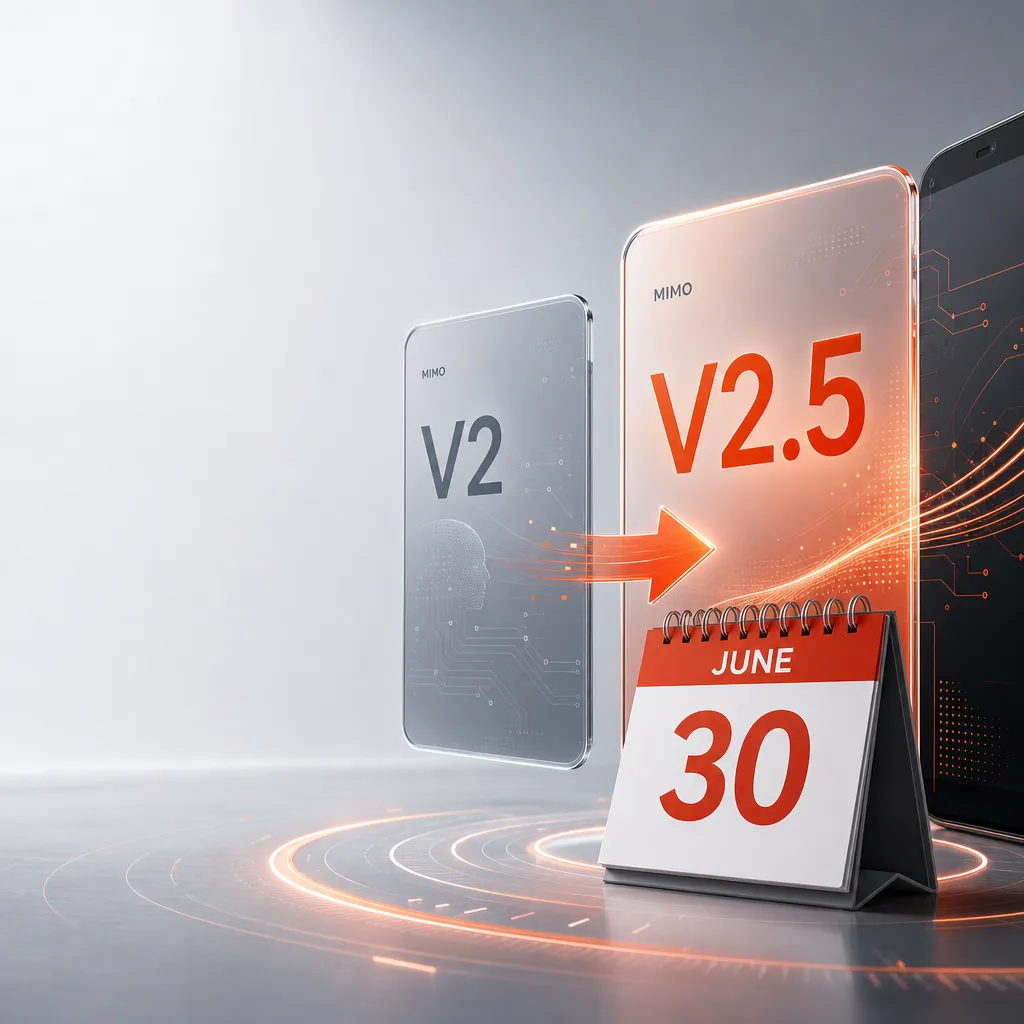
Xiaomi MiMo Open Platform announced that four models in the V2 series will be officially taken offline at midnight on June 30. Pro and Omni have been automatically routed to V2.5 since June 1, and developers need to complete the migration by the end of the month.
Xiaomi Sets Deadline for MiMo‑V2 Series: Midnight, June 30
Today, the Xiaomi MiMo Open Platform posted an offline notice — the four models in the MiMo‑V2 series, from mimo-v2-pro, mimo-v2-omni, mimo-v2-flash to mimo-v2-tts, will all be shut down at midnight on June 30, 2026. After that point, old model names will become completely invalid, and API requests using those names will return errors.
This had actually been hinted at the end of May. At that time, Lei Jun’s side took a softer line, saying only Pro and Omni would migrate first; now the announcement completes the schedule for Flash and TTS, meaning the entire V2 product line will be retired in one go. With only 18 days left until final shutdown, teams that haven’t acted need to schedule quickly.
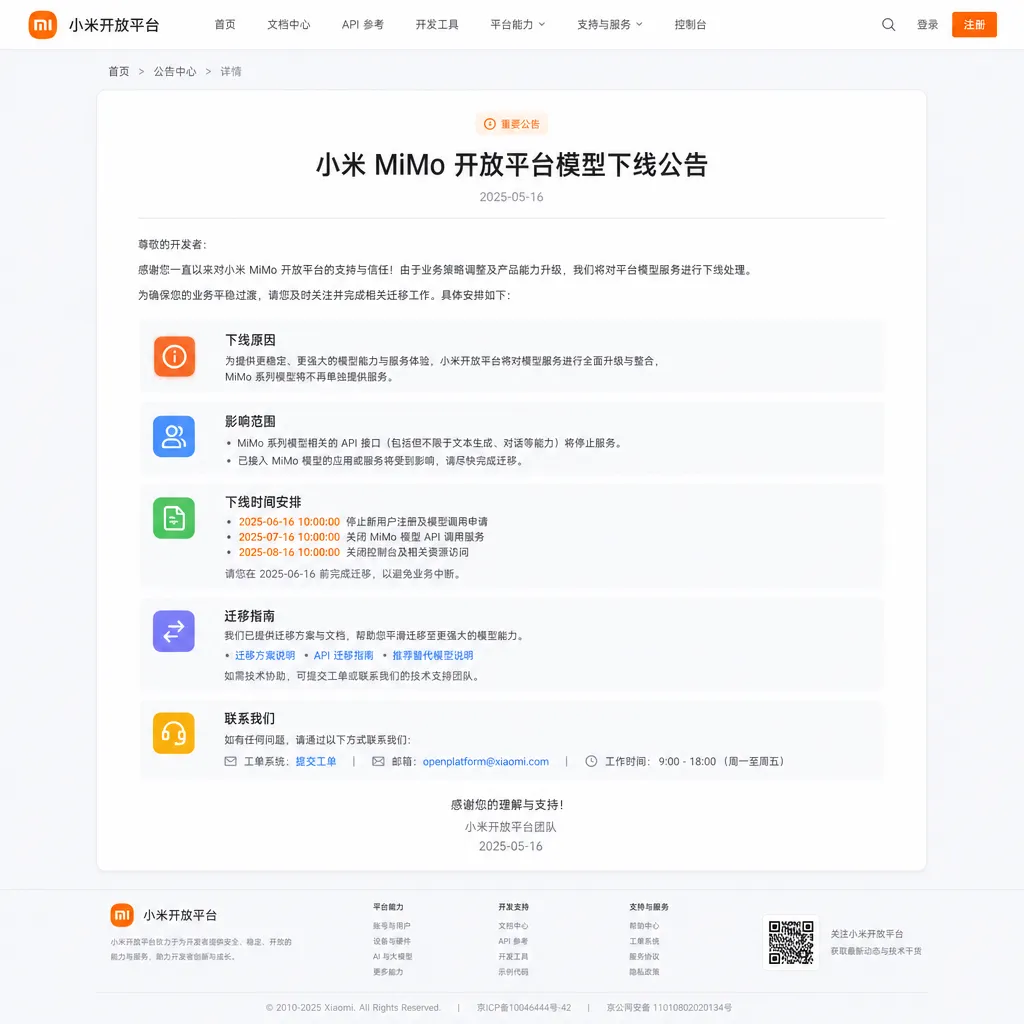
Timeline Breakdown: Two Phases, Short Transition Period
This time Xiaomi didn’t opt for a “hard cut,” but split traffic routing into two phases, with “system replacement” as a buffer for each phase. In simple terms: before the official offline date, old model names can still be called, but traffic has already been quietly routed to the new version, with pricing based on the new version.
First phase (already happened):
- mimo-v2-pro → mimo-v2.5-pro: Auto routed at midnight, June 1 Beijing time
- mimo-v2-omni → mimo-v2.5: Also switched at midnight, June 1
Second phase (one week later):
- mimo-v2-flash → mimo-v2.5: Auto routed at midnight, June 18
- mimo-v2-tts → mimo-v2.5-tts: Auto routed at midnight, June 18
Final cutoff time:
- Midnight, June 30: All old model names invalid; calling them will return errors
This cadence is relatively restrained for large model API vendors. OpenAI, when deprecating the text‑davinci series, only gave a few weeks’ notice; Anthropic’s discontinuation of older Claude versions was immediate. Xiaomi’s three‑step process — official announcement → auto routing → forced shutdown — gives developers almost a month, which is not overly harsh from a scheduling perspective.
Pro and Omni: Fully Compatible API Parameters, Almost Painless Migration
For teams already running mimo-v2-pro in production, the good news is the migration cost is basically zero. Xiaomi has stated clearly that these two models’ API parameters can fully adapt to the corresponding V2.5 versions; from a business standpoint, you only need to change the model name field from mimo-v2-pro to mimo-v2.5-pro, nothing else.
This “parameter alignment” approach essentially treats V2.5 as an upgraded capability version of V2, rather than something entirely new. From the user perspective, the biggest differences boil down to three points:
- New version pricing. The V2.5 series recently had a permanent price cut of 57%–99%, so in most scenarios bills will become cheaper after migration, avoiding any “upgrade and gouge” backlash.
- Maxed‑out inference performance. Xiaomi claims V2.5‑Pro’s UltraSpeed mode is the industry’s first to achieve 1000 tokens/s output speed on a 1‑trillion‑parameter model. As of June, this places it in the top tier among domestic closed or hybrid models, though you pay triple the price for a 10× output experience.
- Generational capability gap. V2.5 has significant improvements over V2 in long context, code, and multimodal reasoning, so migration generally won’t cause embarrassing “legacy business fails regression” situations.
For developers, if your SDK usage already configures the model name, it’s basically just changing an environment variable.
Flash and TTS: Watch Out for a Few Pitfalls
Compared to the painless Pro/Omni migration, Flash and TTS require a bit more care.
Flash routes to mimo-v2.5 (not -flash)
Note this detail in the announcement: mimo-v2-flash is auto routed to mimo-v2.5, not to a dedicated lightweight version in the V2.5 lineup. This means businesses originally relying on low latency and low unit cost Flash will change positioning after migration. If latency and pricing are critical, you may need to assess V2.5 main version’s response curve separately, or consider switching to another vendor’s lightweight model.
This also reflects Xiaomi’s strategic thinking for V2.5: using a unified main model to cover the original Pro/Omni/Flash tiers, differentiating via modes like UltraSpeed, rather than maintaining an independent Flash product line.
TTS voice mapping requires retesting
Speech is the part of this migration that demands the most caution. When mimo-v2-tts switches to mimo-v2.5-tts, the voice profile system changes — the new version no longer uses old voice IDs, but maps them differently based on cluster region:
- China cluster:
mimo_default→ mapped to Bingtang - Other clusters:
mimo_default→ mapped to mia
This regional differentiation is a bit like “one country, two voices,” but it has significant impact. If your product has overseas users, the same default voice ID will sound completely different in China vs. overseas clusters. You’ll need to align on the client side, or explicitly set the voice profile, avoiding awkward situations like “the same ad — domestic users hear a sweet girl, overseas users hear a different tone.”
TTS providers should complete the following before June 18:
- Change all code relying on
mimo_defaultto explicit voice profiles - Run voice mapping regression tests, focusing on emotion tags, pauses, and speed differences
- If you’ve fine‑tuned emotional TTS or prompt engineering, the new model may need retuning
Why Is Xiaomi Retiring V2 at This Time?
The answer is straightforward: V2.5 is not just “better,” it’s “good enough to not keep V2.”
When releasing V2.5 at the end of April, Xiaomi launched four models at once, two promised to be open‑source; in early May, V2.5‑Pro gained UltraSpeed mode — the 1‑trillion‑parameter, 1000 tokens/s combination was a first domestically; mid‑May saw an extreme price cut, bringing API prices near second‑tier models. After this triple strike, V2 was comprehensively outclassed in cost‑performance, performance, and context capability, so keeping it would only increase operational burden and user decision friction.
From a product perspective, the Xiaomi MiMo team was decisive in not letting V2 and V2.5 coexist long‑term. Many major model API providers keep a long list of old versions, confusing new users and making old users reluctant to migrate. Xiaomi’s fixed migration window forces decisions to converge on V2.5, which benefits platform evolution efficiency.
Domestic Large Model API Cadence Moving Toward Quarterly Updates
Looking beyond this event, you’ll find that in the first half of 2026, domestic large model API vendors have largely adopted a “quarterly update” rhythm:
- Tongyi Qwen series maintains monthly minor updates, quarterly main version changes
- DeepSeek’s V3 series is iterating frequently
- Zhipu GLM has similarly conducted multiple silent upgrades on main models
- Xiaomi’s V2 → V2.5 coincides with the two‑month mark after V2.5’s release
A main version every two months means developers can no longer hard‑code model names into business logic; CI also needs fallback auto‑adaptation, or when the next “forced routing + 30‑day shutdown” comes, you’ll be rushing to deploy hotfixes overnight.
For domestic AI application teams, the most important habit to cultivate this year is: treat model names as hot‑switchable config items, and connect through an aggregation layer by default. That’s the purpose of aggregation platforms like OpenAI Hub (openai-hub.com) — one key calls GPT, Claude, Gemini, DeepSeek, etc. with unified OpenAI format, so when vendors collectively retire old versions, at least you won’t have to modify code everywhere. Xiaomi’s MiMo V2.5 series is already live on OpenAI Hub, so requests previously going to V2 can use this migration window to consolidate connections.
Migration Recommendations for Developers
Organized by business type — just follow along:
Using Pro/Omni for text and multimodal reasoning:
- Immediately change model field to
mimo-v2.5-proormimo-v2.5 - Run regression tests for core scenarios, focusing on long context and complex reasoning
- Evaluate whether to enable UltraSpeed mode, weighing 3× price for 10× speed
Using Flash for low‑latency business:
- Switch before June 18, don’t wait for auto routing
- Test latency separately; consider diverting to another vendor’s lightweight model if necessary
- If in ToC high concurrency scenarios, pre‑stress test V2.5 main version’s tail latency
Using TTS for speech production:
- Immediately inventory all calls relying on
mimo_default - Change to explicit voice profile, don’t rely on default mapping
- Overseas business must test “mia” voice profile’s actual sound
- Rerun emotion, pause, and speed regressions
What all teams should do:
- Configure model names so next forced shutdown won’t require overnight code changes
- Add alerts to monitoring for “model name not in active list”
- Use an aggregation layer like OpenAI Hub for fallback — if a model errors, it can auto‑fallback
Summary
Xiaomi’s approach this time was fairly standard — a one‑month notice period, two phases of auto routing, painless for Pro/Omni users, minor pitfalls for Flash/TTS users that can be avoided in advance. The real lesson isn’t this shutdown itself, but that domestic large model API vendors are iterating at quarterly speed, and engineering practices on the developer side must keep pace.
Midnight on June 30 is a clear deadline, and time is short. Make the necessary changes and tests — don’t let a hard‑coded model name take your service offline in the middle of the night.
References
- Xiaomi MiMo‑V2 series models to be shut down June 30, Pro version already auto‑switched to V2.5 — IT House: IT House’s full report on the MiMo‑V2 shutdown announcement, including schedule details and voice mapping information


