
MiniMax-M3 Open Source: 428B Parameters Supporting Million-Token Context and Native Multimodality

On June 1, MiniMax released and open-sourced the M3 model, featuring 428B parameters, a self-developed sparse attention MSA architecture, 1M context length, and native multimodality. It is the first open-source model in China to simultaneously offer cutting-edge coding, ultra-long context, and native multimodality.
MiniMax-M3 Open Source: 428B Supports Million-Token Context — The Domestic Model’s “Three-Piece Suite” Is Finally Complete
On June 1, MiniMax launched M3 on its official website, and 11 days later the model weights were already available on HuggingFace and ModelScope — MiniMaxAI/MiniMax-M3, with 428B parameters, no “closed-source version” hidden away. Full weight release means full capability.
The signal here is more worth talking about than the model itself: By mid-2026, for the first time in the domestic open-source camp, there is a flagship that simultaneously achieves “cutting-edge Coding & Agentic”, “1M context length”, and “native multimodality”. The Qwen series has been chasing multimodality, DeepSeek has pushed reasoning and cost optimization to the extreme, but no one has achieved the “three-piece integration”. This time, MiniMax took that position.
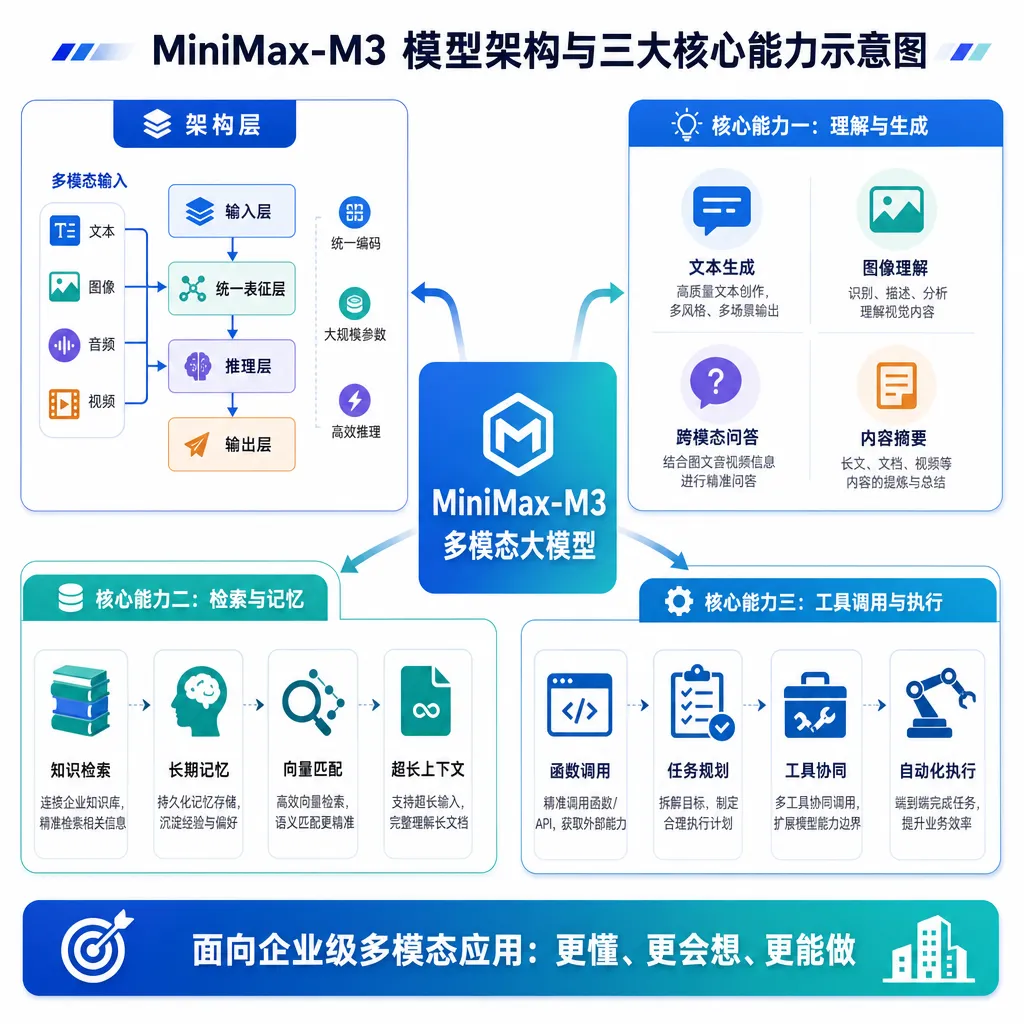
The Choice of 428B: Focus on Architecture, Not Parameter Count
Let’s do the math first. 428B in the 2026 context is quite delicate — not the largest, but more than enough. Compared to the top: GPT-5.5, Gemini 3.1 Pro, Claude Opus 4.7 — these closed-source SOTA models are rumored to be terascale MoE, so parameter comparisons are meaningless. Compared to the lower tier: Qwen3-Max, DeepSeek-V4, other open-source flagships are in the 500B~600B range, making M3 on the smaller end.
MiniMax didn’t go head-to-head on parameter size but placed its bet on its self-developed MSA (MiniMax Sparse Attention) architecture. This is M3’s technical foundation and the reason it dares to stretch the context window straight to 1M. Official data states that at a 1M context length, M3’s per-token computation is about 1/20 that of the previous generation (M2.7).
What does this mean? It means the 1M context is not just “can run” but “can be used.” In the past, many models’ long context was just a marketing number — the window marked at 1M or 2M, but when fed 500K tokens for real, either latency exploded, attention scattered, or the compute bill bankrupted you. MSA’s sparsification reduces the marginal cost of long contexts at the architecture level. This is the same idea as DeepSeek’s NSA and Kimi’s MoBA, though each took a different path.
Benchmark Results: Coding and Agent Performance Holds Up
Let’s look at key scores:
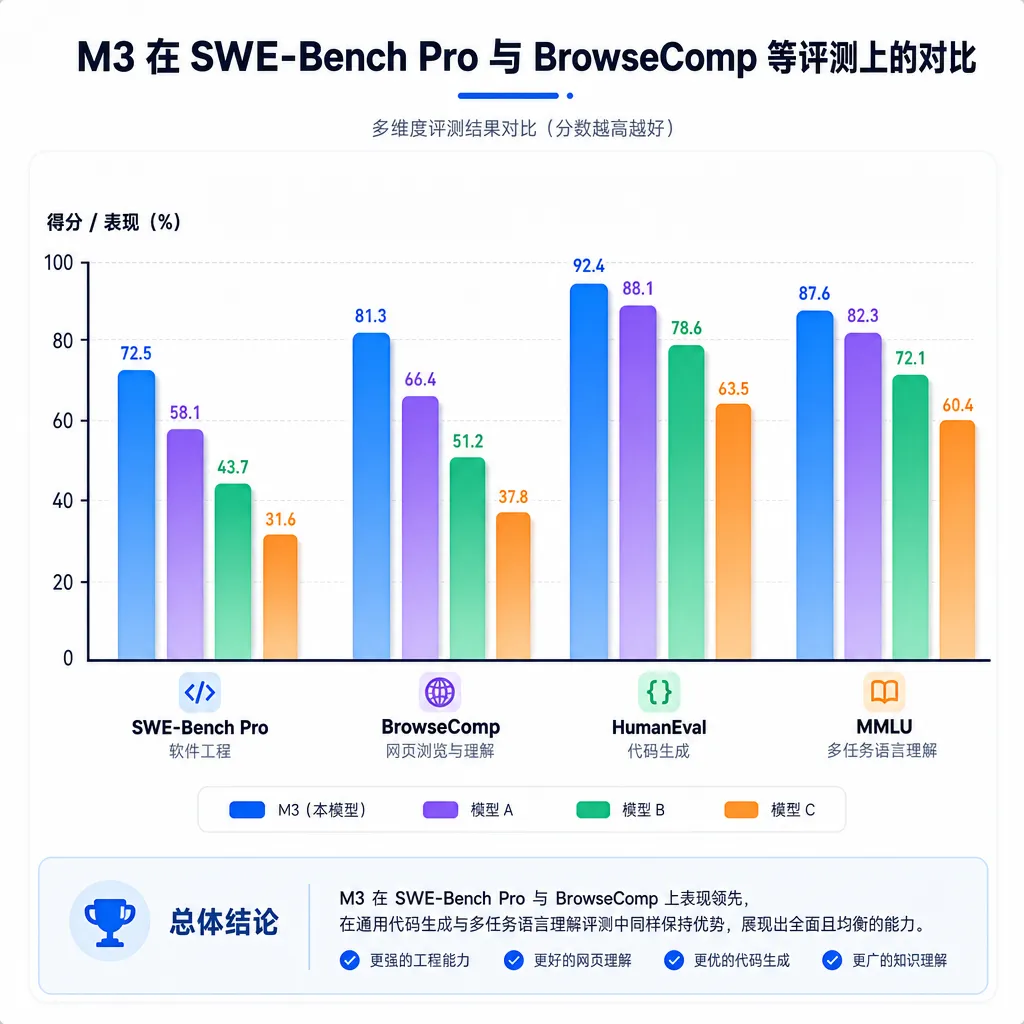
- SWE-Bench Pro: M3 outperforms GPT-5.5 and Gemini 3.1 Pro, close to Opus 4.7
- SVG-Bench: M3 outperforms Opus 4.7
- BrowseComp: M3 scores 83.5, compared to Opus 4.7’s 79.3
- OmniDocBench (multimodal document understanding): M3 outperforms Gemini 3.1 Pro
- Claw-Eval (end-to-end autonomous Agent): M3 has the highest score
- PostTrainBench: M3 scores 37.1, ranking third, behind Opus 4.7 (42.4) and GPT-5.5 (39.3)
The most valuable scores here are SWE-Bench Pro and BrowseComp. The former is real-world software engineering tasks; beating GPT-5.5 and Gemini 3.1 Pro here is rarely seen in open-source models these past two years. The latter tests agents’ autonomous browsing and information retrieval; 83.5 is right near the closed-source ceiling.
PostTrainBench’s 37.1 is actually more convincing — the benchmark’s mechanism is: give M3 four base models that have only undergone pretraining, then require it to autonomously complete data synthesis, training, evaluation, and iteration within 12 hours. No human intervention — M3 acts as its own “model trainer.” Ranking third shows its long-term task planning, tool use, and error recovery are systematically capable, not just leaderboard gaming.
That 12-Hour ICLR Paper Replication Demo Is Worth Mentioning
The most concrete case from MiniMax is this: give M3 an outstanding ICLR 2025 paper, Learning Dynamics of LLM Finetuning, and let it replicate it independently.
M3 ran continuously for nearly 12 hours, autonomously producing 18 commits and 23 experimental charts, successfully reproducing the core experiments.
Breaking down what’s needed for this task:
- Multimodality: Equations, flowcharts, and experimental plots in the paper must be understood — this is native multimodality at work.
- Long context: Paper + code repository + experiment logs need to fit into the window at once — 1M context is crucial infrastructure.
- Coding + Agent: A 12-hour long-thread execution requiring constant coding, experimenting, reading errors, tuning parameters, and submitting commits.
All three are required to complete the task; missing any breaks the chain. This is why MiniMax emphasizes “three-piece integration” — even stellar ability in one area won’t let an Agent run through without the others.
Multimodality: Mixed Training From Step 0
There’s one notable detail in the technical report: M3 did multimodal mixed training from Step 0, not training a language model first and then attaching a vision module.
This aligns with GPT-4o and Gemini’s native multimodality approach, but few open-source models take this route — most are still “LLM + Vision Encoder” stitched together. The native approach ensures high alignment of textual and visual semantic spaces, avoiding the gap where image description works well but understanding the relationship between image and text falters in tasks like Computer Use or video comprehension.
The cost is rewriting the data pipeline. MiniMax’s report specially mentions interleaved data — sequences where text and images naturally alternate — as more critical for performance than generally assumed. To digest such data, they scaled the training data to 100 trillion (100T) tokens.
What’s the scale of 100T? Llama 3 trained on ~15T tokens, Llama 4 is rumored to reach 30T. 100T means they’ve ingested nearly every crawlable, synthesizable, and licensable multimodal dataset on the internet.
Some Straight Talk: Who It’s For, Who It’s Not
A community comment I agree with: “You can’t compare with mainstream terascale models, but seeing this result with 428B is already impressive. Using small models to compete with giant models is irrational — they target different scenarios.”
My judgment is similar:
Scenarios M3 Fits
- Long document / large codebase analysis: 1M context + low compute cost allows processing entire repositories or hundreds-page PDFs without complex RAG.
- Automated Agent / Computer Use: BrowseComp and Claw-Eval scores show it’s stable in real environments.
- Enterprise on-prem deployment: Open source, fine-tunable, supports private clusters — ideal for finance, law, government sectors sensitive to data compliance.
- Multimodal document processing: OmniDocBench scores above Gemini 3.1 Pro — excels at invoices, spreadsheets, research reports with charts.
Scenarios M3 Might Not Beat Others
- Pure conversation / creative writing: Closed-source flagships still have the advantage here.
- Extremely complex reasoning / math competitions: PostTrainBench trails Opus 4.7 and GPT-5.5 by 5–6 points — the gap is real.
- Ultra-low-latency high-concurrency use: 428B deployment cost is not friendly; far heavier than 30B, 70B lightweight models.
Deployment Requirements and Ecosystem Support
Publishing 428B weights directly has real deployment thresholds. Rough estimate: FP8 inference needs ~8 H100/H200 GPUs; BF16 doubles that. The community will soon release GGUF, AWQ, MLX quantized versions, but until then, full runs are limited to enterprises and research institutes.
MiniMax offers both M3 and M3-highspeed APIs — same results, but the latter is faster, fully supports auto cache. For developers unwilling to handle deployment, calling the API directly or using an aggregator like OpenAI Hub (one key calls GPT/Claude/Gemini/DeepSeek/MiniMax, OpenAI-compatible) is much easier — especially for scenarios needing cross-model comparison.
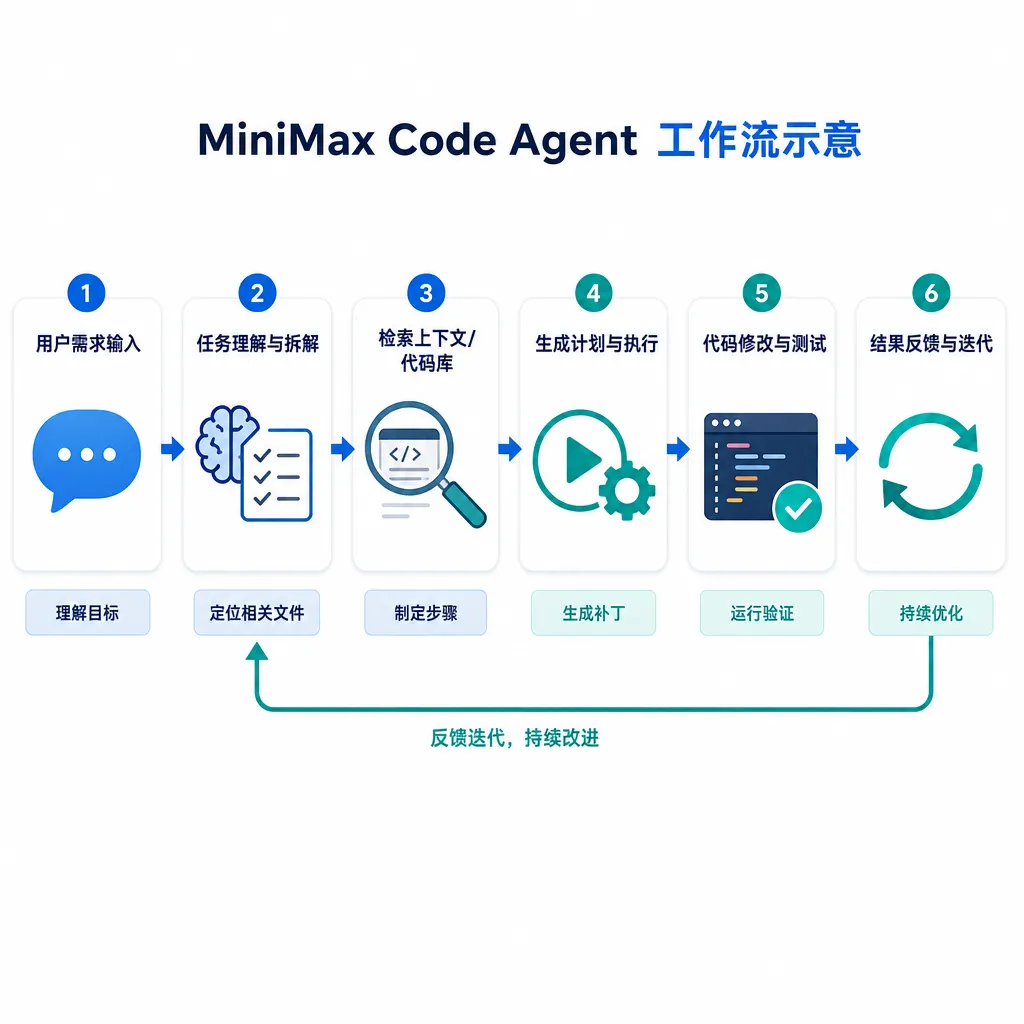
The accompanying MiniMax Code also got updated — an Agent product designed for and trained with M3 that can break large tasks into multi-stage, concurrent, dynamically adjustable workflows, driven by an Agent cluster. This approach mirrors Claude Code and Cursor Agent, but emphasizes “cluster collaboration.”
What It Means for Open Source
The landscape of open-source large models in 2026 is totally different from 2024. Two years ago, comparisons focused on smoother conversations and better Chinese; now it’s about Coding, Agent, long context, and multimodality — essentially, “can it actually get work done?”
M3’s release gives domestic open-source its first strong representative in the “Coding + Agent + long context + multimodality” intersection. It won’t replace Qwen or DeepSeek in their specialties, but it pushes the capability ceiling of open-source flagships forward.
Also notable is MiniMax’s stance: releasing flagship weights outright, without the usual “Pro version API-only” routine. In a 2026 where closed-source vendors are increasingly “API only,” few players still do this.
References
- MiniMaxAI/MiniMax-M3 · Hugging Face: M3 model weights, technical notes and usage docs
- MiniMax-M3 is open sourced with less than 500B parameters - linux.do: Community first discussions and hands-on feedback
- [Frontier News] MiniMax M3 Open Source, Full Capability Model with Only 428B - linux.do: Developer discussion of M3’s capabilities and applicable scenarios
- China’s first Frontier “Three-Piece” Open-Source LLM: Complete M3 Technical Breakdown - Zhihu: In-depth technical deconstruction of M3 architecture, training, and evaluation


