
Another enterprise-grade large model gateway is about to be open-sourced, and the competition in the track is heating up.

On Linux.do, a developer has announced plans to open source an enterprise-grade large model gateway. The architecture and requirements analysis have been completed, and the features are gradually improving. Following One-API, New-API, MixAPI, and Yingfei Gateway, there is now another player in this track.
Another Wheel, but This Time the Track Is Worth Competing On
On June 11, a developer posted a teaser on Linux.do: they were working on an enterprise-grade large model gateway, and since both the architecture design and requirements analysis had been completed, they went ahead and implemented the whole system. With features becoming increasingly complete, they were preparing for open source release. The post was short—no screenshots, no repository link, no roadmap—but still drew a wave of discussion.
On its own, this may not sound like much, but placing it in the context of 2026 sends a clear signal—the large model gateway track has reached the point of formal differentiation.
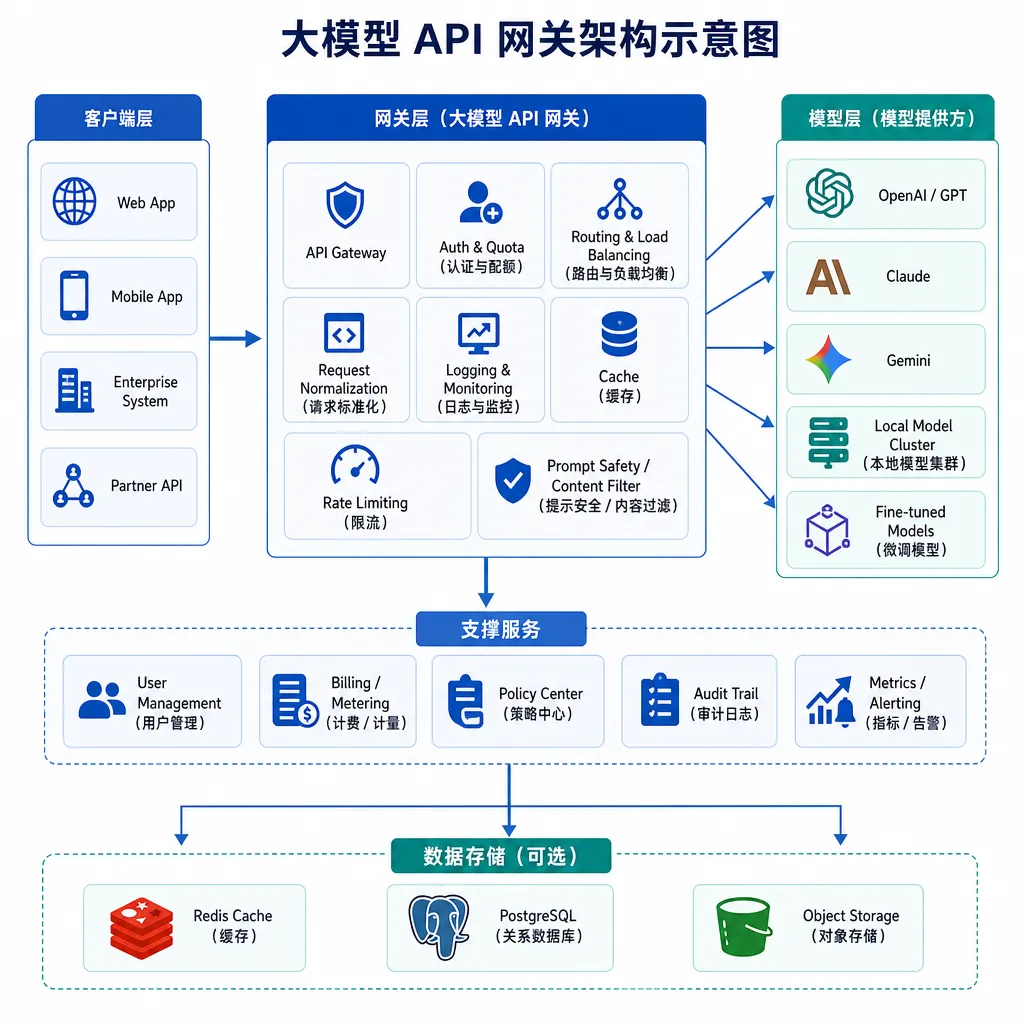
From One-API to Today — What’s Happened in the Gateway Track
Looking back at the timeline, the first open-source project to cause a stir was One-API, which addressed a simple problem: APIs from OpenAI, Claude, Wenxin, and Tongyi all had different formats. Developers didn’t want to integrate with each one separately, so a middle layer was built to convert them all into an OpenAI-compatible format. That project earned 24K+ stars on GitHub and essentially defined the shape of the first-generation large model gateway.
Next came New-API, which expanded on One-API by adding finer-grained channel management, billing, and secondary distribution. Later, MixAPI separated out the enterprise internal management scenario, dropping billing and recharge modules to focus on internal key management and channel distribution. In the second half of last year, Yingfei Network also open-sourced the traffic governance capabilities it had built over years of serving financial-sector clients, positioning it as the “enterprise-grade AI gateway standard.”
This progression makes a clear trend: gateway capabilities are shifting from “protocol conversion” to “traffic governance.” Early developers wanted “one key to call all models.” Now, enterprises want the full governance paradigm of traditional API gateways—SLA, rate limiting, auditing, canary release, failover—applied not to RESTful APIs but to LLM inference.
What Makes an “Enterprise-Grade” Gateway More Difficult than a “Personal” One
It’s easy to say “I want to make an enterprise-grade version,” but actually delivering one means tackling challenges that are an order of magnitude more complex. In my experience with companies running large model gateways in production, their biggest headaches have never been protocol adaption—they’ve been the issues below.
1. Stability of Long Connections and Streaming Responses
LLM SSE streaming responses are a world apart from normal HTTP requests. A single conversation might last 30 seconds to several minutes. In that time, the gateway must keep the connection alive, send heartbeats, handle upstream disconnects, handle client disconnects, and ensure accurate token-based billing. You can’t just drop in traditional Nginx reverse proxies—timeouts, buffer strategies, and memory handling all need reworking.
2. Failover Latency and Session State
Some references tout “failover latency < 100ms with session state preserved.” That sounds like marketing fluff, but it’s genuinely complex. If the upstream Claude API starts acting up, the gateway must switch to a backup route (e.g., another region or another vendor’s equivalent model) without breaking the SSE stream, all while keeping context consistent. That involves request replay, token count alignment, and unifying output formats across multiple APIs. If mishandled, users see gibberish or duplicate content.
3. Precision in Billing and Quotas
Large models bill by tokens, but each vendor’s tokenizer differs, as do their prompt caching discounts and tool call billing rules. If a gateway wants to support internal enterprise-level redistribution, it must measure at token-level precision—any inaccuracy costs either the provider or the user. New-API already does reasonably well here, but adding audit trails, department-based cost allocation, and quota alerts requires a redesigned data model.
4. Sub-Accounts, Permissions, and the Full Enterprise Governance Stack
Enterprises using large models inevitably ask: Who’s making calls? How many? Which prompts caused issues? Can we get a monthly report per department? Can we restrict a given team to GPT‑4o‑mini and not Opus? These needs weren’t covered in early One-API versions; they were driven by market demand later.
What Gap Could This Open Source Teaser Fill?
Back to the Linux.do teaser: the author hasn’t listed concrete capabilities yet, but from the comment “currently doing this kind of work, and since architecture and requirement analysis are mostly done” we can guess this follows a real enterprise scenario first, then open source path—not “open source first, then adapt to enterprise.”
These two paths produce very different outcomes: the former tends to have strong governance capabilities but weaker UI, docs, and community ecosystem; the latter often has flashier features but questionable production readiness. Among recent open-source gateways, Yingfei took the former route (applying financial client experience), while MixAPI took the latter (starting as SaaS, later opening the enterprise version).
If this developer can clearly present architecture diagrams, stress test results, and differences from existing One-API/New-API systems, they might carve out new territory. Points I personally look forward to:
- Native support for Anthropic and Gemini protocols (not compatibility-layer conversion)—this determines whether clients like Claude Code and Gemini CLI, which only talk native protocols, can connect directly.
- Concrete failover implementation—simple retry or hot switch with session state.
- Observability—completeness of Prometheus metrics and OpenTelemetry traces.
- Plugin mechanism—can enterprises add their own prompt injection, content moderation, and PII redaction?
These are areas existing open-source solutions haven’t nailed.
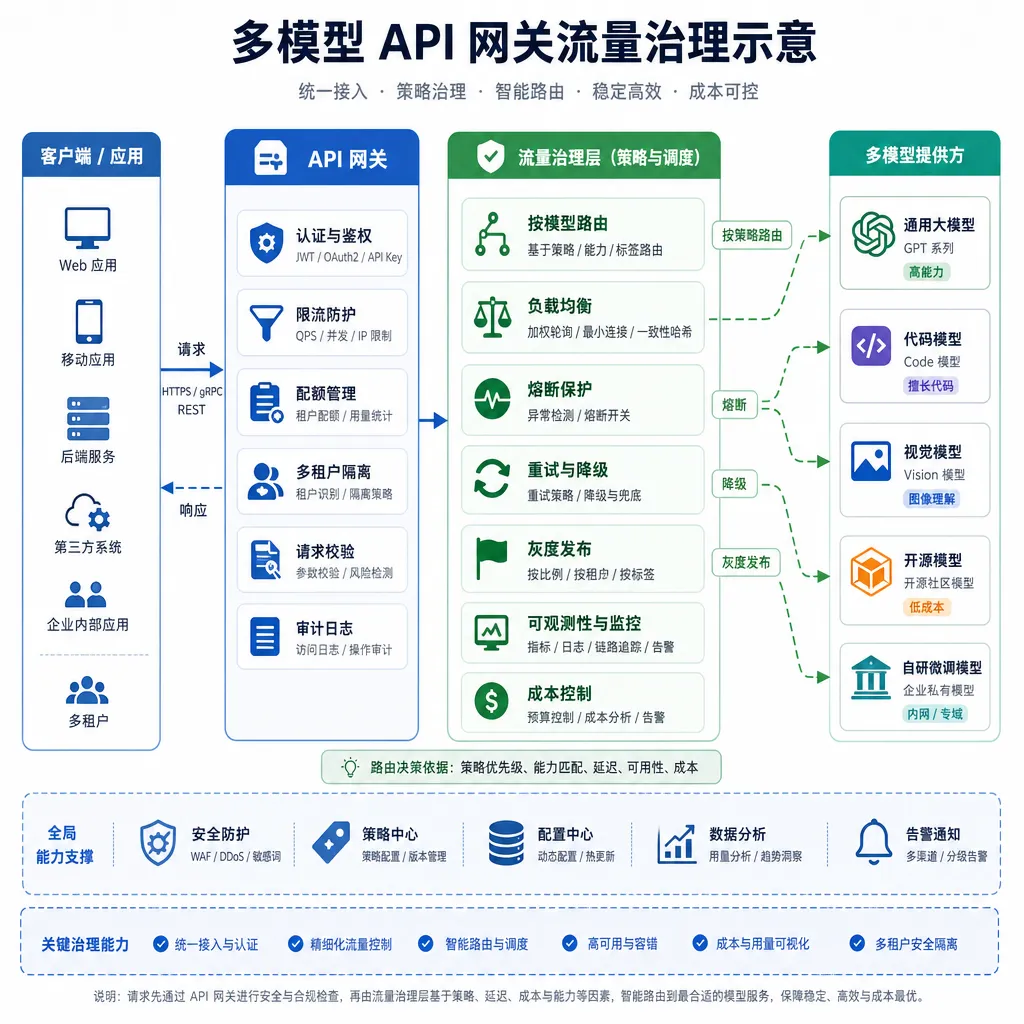
Why People Still Want to Build This in 2026
One might ask: Given that One-API has 24K stars, is the track already locked in?
I think the opposite. The large model gateway space today resembles the API gateway market around 2015, when Kong, Tyk, APISIX, and others emerged—leading to a multi‑player coexistence. The reason: enterprise needs vary too much. Some want extreme performance, some extreme flexibility, some just want stability. There’s no “one gateway fits all.”
For large model gateways, the divergence is even sharper:
- Individual developers want “one key for all models”; platforms like OpenAI Hub suffice—domestic direct connection, OpenAI format compatibility, no need to self‑host.
- Small/medium teams want “self‑hosted New‑API” to control cost and channel management.
- Large enterprises want “the full governance stack”—sub‑accounts, auditing, SLA, disaster recovery, integration with existing IAM/SSO.
- Regulated industries like finance/government want “private deployment + content moderation + full‑chain auditing”; this is where Yingfei positions itself.
No single project can satisfy all four categories. New players still have room—if they can be clearly better for one category.
A Few Points for Developers to Consider
If you’re choosing a large model gateway now, my suggestions are:
- Decide which category you’re in first. Don’t deploy an enterprise‑grade solution for a personal project; ops costs will be higher than you think. Don’t use a personal‑project solution in production; migrating when traffic spikes will be painful.
- Native protocol support matters a lot. Anthropic’s prompt caching, tool use beta, and computer use features are often absent in OpenAI‑compatible layers. If your app relies heavily on Claude, native protocol support is essential.
- Watch community activity. For teaser projects, I’d recommend starring and watching first, and only considering integration after the first release is out, issues are being answered, and docs are complete. The biggest risk in open source isn’t missing features—it’s the author abandoning it.
- Consider hybrid approaches. Use a self‑hosted gateway for governance in production, and for dev/test or low‑traffic scenarios, use an aggregation service like OpenAI Hub (one key to access GPT, Claude, Gemini, DeepSeek—no separate registrations). They’re not mutually exclusive.
Back to this open source teaser. The author hasn’t released the repo yet, so we can’t judge code quality. But the market needs more entrants— the better this gateway layer is, the more application‑level engineers can focus on business rather than infrastructure.
We’ll revisit once the actual release is out to see the differentiated capabilities.
References
- Plan to Open Source Enterprise‑Grade Large Model Gateway [Teaser] - Linux.do: Original teaser post, author’s background and open source plan.
- Yingfei AI Gateway Officially Open Source - Zhihu: Yingfei Network’s enterprise‑grade AI gateway based on financial sector experience.
- MixAPI-PRO - GitHub: Enterprise‑grade large model gateway project based on One-API/New-API, for comparison.


