
Google Drops Gemma 4 12B: Packing Multimodality into a 16GB Laptop
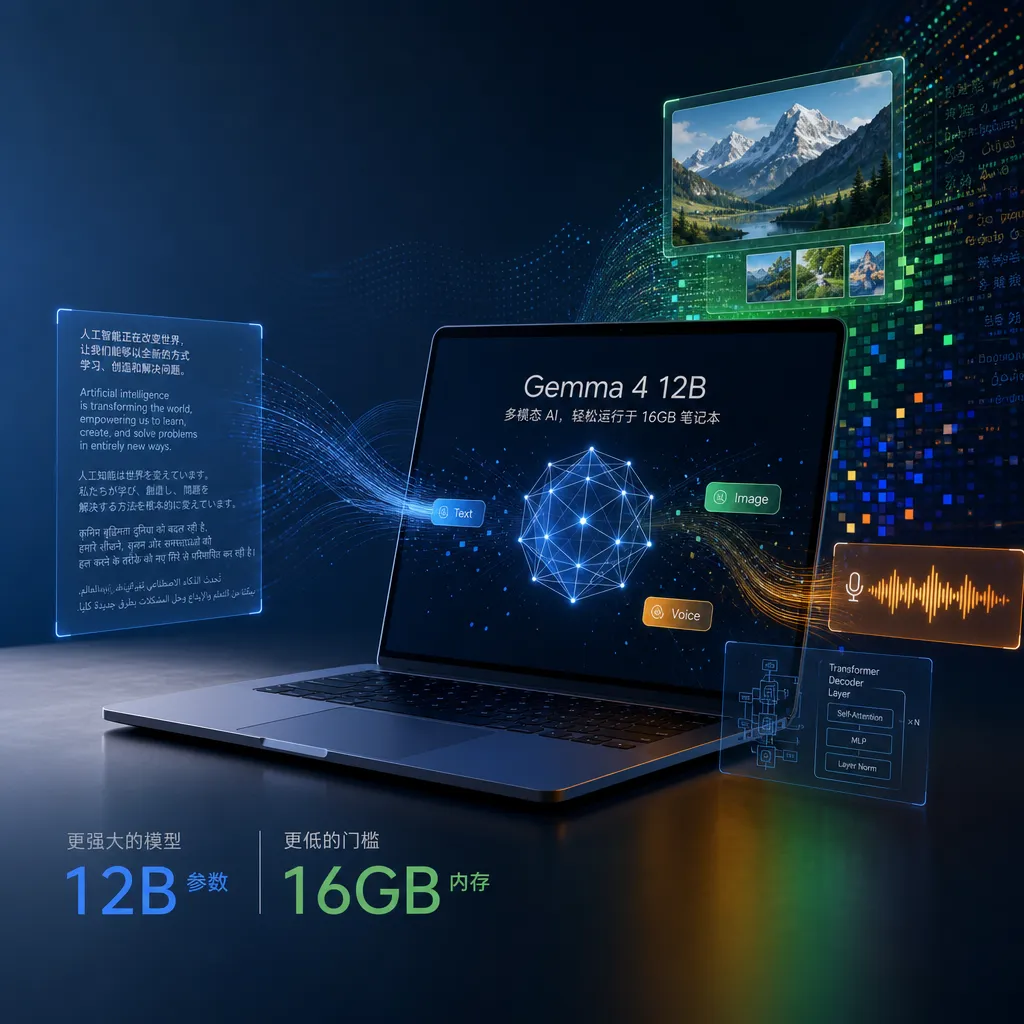
Google releases Gemma 4 12B, featuring a unified architecture without an encoder. With 12 billion parameters, it can run multimodal inference locally on a regular laptop, achieving performance close to the 26B MoE version while using less than half the memory.
Google Completes the Final Piece of the Gemma 4 Puzzle
On June 10, Google officially unveiled Gemma 4 12B — the newest and most crucial piece of the Gemma 4 family. The message is clear: previous models like E2B and E4B were aimed at phones and edge devices, the 26B MoE and 31B Dense were for workstations and servers, but the middle tier — i.e., the “ordinary laptop” most developers use daily — didn't have a proper option. The 12B model fills that gap.
According to Google’s official blog, as of this release, total downloads of the Gemma 4 family have surpassed 150 million. DeepMind is clearly serious about the open-source/open-access route.
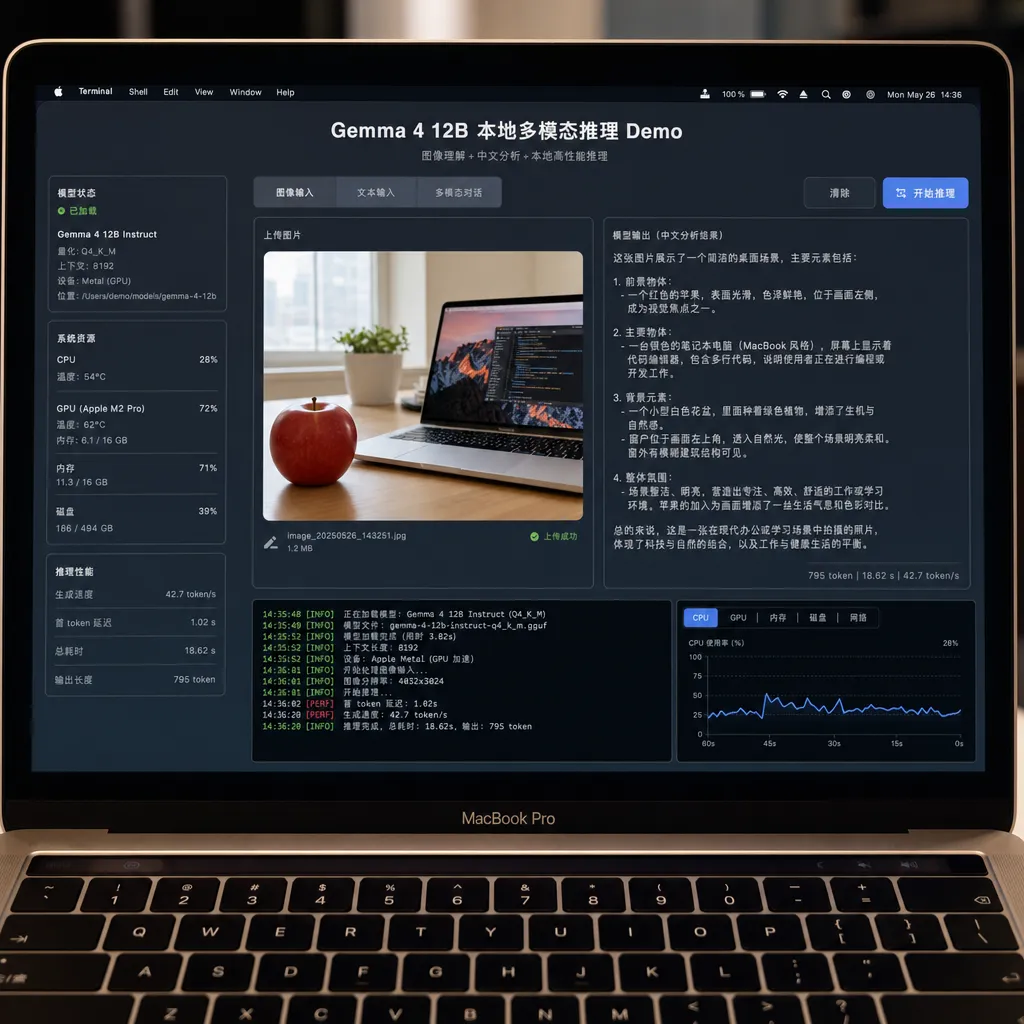
The Biggest Highlight: "Encoder-Free"
Let’s cover the tech first, then performance, and finally see what it can actually do.
You’re probably familiar with the traditional approach to multimodal models — add a vision encoder (e.g., ViT/SigLIP), add an audio encoder (e.g., Whisper’s encoder), first convert images and audio into token-like representations, then feed them to the LLM. The upside is clear modularity; the downsides are heavy VRAM usage, higher latency, and the need to cross-modal align twice.
Gemma 4 12B removes this layer. Google calls it Encoder-Free Architecture: visual and audio inputs pass through a very lightweight embedding module directly into the LLM backbone. There’s no standalone vision tower, nor a separate audio tower.
The engineering significance here is bigger than it sounds. Encoder-free has been tried before — a few papers from last year to this year explored it (in the Fuyu lineage), but Gemma 4 12B is the first open-source model to reach the “12B parameters, multimodal alignment, competitive benchmarks” level.
Another architectural detail worth noting: MTP (Multi-Token Prediction) drafter. Popularized by the DeepSeek-V3 wave, it’s essentially the model acting as its own speculative decoding draft model. Gemma 4 12B integrates this natively, dramatically reducing on-device inference latency — a must-have for running agents locally on laptops, where you can’t expect users to wait 5 seconds for every click.
Performance: 12B Reaching the Level of 27B or Even 70B Models
The benchmark figures Google shared are impressive. Some highlights:
- Reasoning, Math (AIME), Code: Surpasses the previous generation Gemma 3 27B, which is more than double the parameter size.
- GPQA and AIME (logic reasoning tests): Outperforms Llama 3 8B in the same parameter range, and even beats the 6× larger Llama 3 70B.
- Overall performance: Approaches Gemma 4 26B MoE while using less than half the VRAM.
The second point warrants a small asterisk — beating Llama 3 70B with 12B parameters on GPQA looks great, but Llama 3 is already last year’s news. The real rivals here are Qwen3 14B, Mistral’s latest dense models, and the small-size Llama 4. Google didn’t provide comparisons for these, which looks a bit like avoidance.
That said, one thing is solid: it runs on consumer laptops with 16GB RAM. This means M1/M2 MacBook Airs and mainstream Windows ultrabooks can handle it — not just loading it, but running agent workflows smoothly. This segment used to be dominated by 7B/8B models; 12B entering here with strong performance is a meaningful shift.
Deployment: Apple Ecosystem Gets Priority
For this release, Google clearly prioritized Apple Silicon for the local experience:
- Google AI Edge Gallery (macOS): Previously mobile-only, now available on desktop. Directly runs Gemma 4 12B on Apple Silicon GPU, with a sandboxed Python execution environment for generating scientific plots in-chat.
- Google AI Edge Eloquent (macOS): Focused on voice-interaction scenarios.
- LiteRT-LM CLI: A cross-platform command-line tool.
- LM Studio, Ollama: Third-party open-source tools supported it on day one.
- Hugging Face, Kaggle: Both pre-trained and instruction-tuned versions released under the Apache 2.0 license, enabling hassle-free commercial use.
The Apache 2.0 licensing deserves praise. Llama’s licensing has been criticized for being less than clean, so Gemma 4’s open release is a great win for enterprise adoption.
So, What’s It Actually Good For?
Truth be told, the local multimodal model space has been more hype than usage over the past two years. The reason is simple: either models were too weak to be useful, or hardware requirements were too high.
Gemma 4 12B hits a sweet spot in size, making several scenarios truly viable:
- Local Agents: Screenshot understanding + tool invocation + code execution, fully offline. Useful for privacy-sensitive industries (law, medical, finance) with strict compliance needs.
- Offline Document Processing: OCR for scans + table understanding + summary generation, all with one model.
- Audio Transcription + Understanding: Feed meeting recordings directly to the model without first running Whisper then an LLM.
- Education & Research Tools: The embedded Python-execution chat bubble is great for student data-visualization assignments.
That said, there’s a reality check: ecosystem is a persistent challenge for local models. Switching a cloud API is as simple as changing an endpoint; using a local model means managing downloads, quantization, hardware compatibility, and user experience. Ollama and LM Studio have lowered this barrier, but we’re still not at true “plug-and-play.”
How It Fits into the Gemma 4 Family
Here’s the full product line for clarity:
| Model | Positioning | Target Hardware | |-------|-------------|-----------------| | E2B | Ultra-edge | Phones, IoT | | E4B | Edge flagship | High-end phones, embedded devices | | 12B | Everyday laptops | Consumer laptops with 16GB RAM | | 26B MoE | Workstation | Desktop GPUs | | 31B Dense | Production | Servers, cloud |
Before 12B, this segment was empty. Now the lineup is complete: from 2B to 31B, from phones to servers, each hardware tier has a matching SKU. It’s a very “Google” approach — a product matrix strategy rather than relying on a single breakout product.
Things Left Unsaid
A bit of industry context to close.
Google’s pace in open-access model development has clearly accelerated this year. Gemma 4 launched in April, and by June the mid-tier gap is already filled, with the AI Edge toolchain updated in parallel. Compared to Meta’s Llama 4 rollout (criticized for delays and multiple postponements), DeepMind’s execution looks much cleaner.
However, for Chinese developers, the 12B size can feel awkward — Qwen3 has been aggressively competing in this range, and DeepSeek’s smaller models are coming in strong. Gemma 4 12B’s advantages lie in native multimodal support and mature on-device tooling; its disadvantage is Chinese-language capability. For Chinese scenarios, I’d recommend testing it on your own business data before deciding — don’t judge solely by benchmark numbers.
If you want to run head-to-head comparisons with mainstream models via cloud APIs, OpenAI Hub (openai-hub.com) lets you call GPT, Claude, Gemini, and DeepSeek with a single key, direct from within China, using an OpenAI-compatible format — far more reliable for real-world performance evaluation than trusting official leaderboard scores.
The model weights are already up on Hugging Face — worth a test run this weekend.
References
- iThome: Google unveils laptop-ready AI model Gemma 4 12B — Detailed Chinese-language media report on the launch, including benchmark data
- Hugging Face: google/gemma-4-12B model card — Official model card with usage info and multimodal capabilities
- Reddit r/LocalLLM: Google introduces Gemma 4 12B discussion thread — First-hand feedback from the local deployment community, including quantization discussions


