
A U.S. ban drops: Claude Fable 5 and Mythos 5 fully suspended for foreigners

Anthropic’s flagship models Fable 5 and Mythos 5, released just four days ago, have been ordered by the U.S. government to suspend access for all foreign users under export control regulations, regardless of whether they are located inside or outside the United States. The OAuth channel has also been affected.
Just four days after Anthropic put Claude Fable 5 and Mythos 5 on the table, the U.S. government put a knife to its throat.
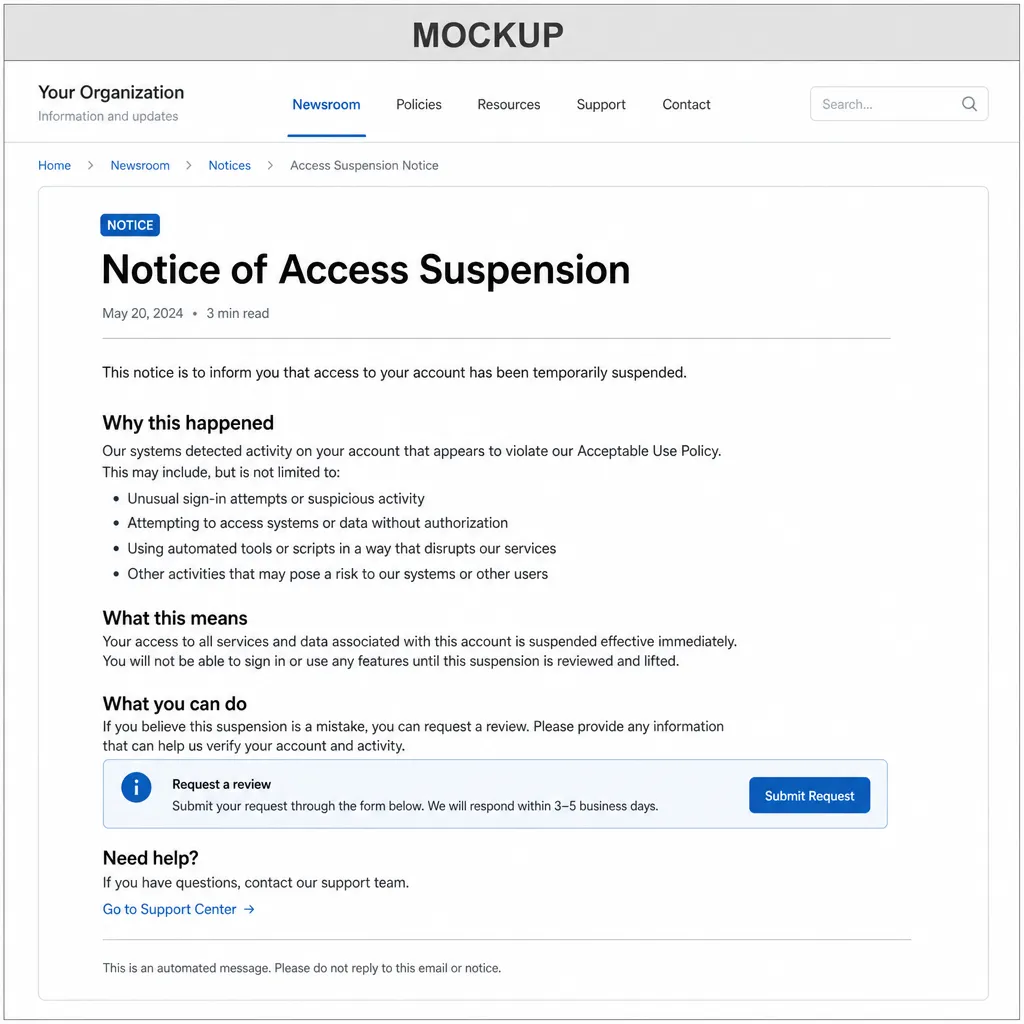
Late at night on June 12, Anthropic posted an unusually brief statement on its official website: the U.S. government has issued an export control directive requiring the suspension of all foreign nationals’ access to Fable 5 and Mythos 5 — regardless of whether these users are inside or outside the United States. In other words, if you are not a U.S. citizen or green card holder, these two models will be a black screen for you from today onward.
The news exploded on linux.do, where a bunch of developers using OAuth to connect to Claude Code fell into the pit together — the OAuth channel stopped working completely. A user from the Chinese community painted a vivid picture: “Hoh hoh hoh, even this can get messed up,” meaning even something like this could get botched in a spectacular way.
Flagship launch interrupted
To understand the impact of this ban, you first need to know what Fable 5 is.
When Anthropic released Fable 5 on June 9, it shook the entire field. Just 11 days after Claude Opus 4.8, Anthropic was calling for a global pause on frontier AI development while simultaneously flooring the gas pedal. Fable 5 scored 80.3% on SWE-bench Pro, leaving GPT-5.5’s 58–60% and Anthropic’s own Opus 4.8’s 50–55% far behind; on FrontierCode Diamond the gap was even wider — 29.3% versus GPT-5.5’s 5.7%, a whole order of magnitude difference.
Stripe’s case study went viral: migrating a 50-million-line Ruby codebase, Fable 5 handled it solo in one day — originally a two-month job for a whole team. Andrej Karpathy, newly recruited by Anthropic, unusually voiced his impulse to “stop reading the code entirely and just let it handle everything” — coming from him, that’s weighty praise.
Mythos 5 is the same base model without a safety helmet, dedicated to government and critical infrastructure partners under the Project Glasswing framework. Its destructive power shows in another direction: accelerating protein design workflows by 10 times, producing 9 potentially promising drug molecule candidates from 14 protein targets, and training a genomics model 100 times smaller than the comparable one just published in Science, but with better performance. On ExploitBench, it scored 78%, which Anthropic itself calls “the strongest cybersecurity capability on the planet.”
The problem lies precisely here. These two capability indicators — especially cybersecurity and biochemistry — are already sensitive areas on the U.S. export control list. Anthropic knew this, so the public version of Fable 5 was protected by three classifiers (cyber offense/defense, biochemistry, model distillation); once triggered, it would hand off processing to Opus 4.8.
But clearly, regulators thought the classifiers weren’t enough.
"Foreign national" cuts deep
The term “export control” is not new in the AI world. GPU exports, training chips, and model weights have been gradually brought under the EAR (Export Administration Regulations) framework over the past two years. But issuing a direct ban on an already online SaaS API, cutting access based on nationality, is a new move.
The key phrase in the statement is “any foreign national, whether inside or outside the United States.” This is harsh because it cuts off more than just overseas users:
- Foreign developers abroad: disconnected immediately, whether you are in Europe, Japan, Singapore, or China.
- Foreign engineers working in the U.S.: H1B, O1, L1 visa holders — literally included in the ban.
- OAuth route: Claude Code’s OAuth authentication was the first to go down. Some third-party editor plugins and IDE integrations are also affected.
- Resale channels via Bedrock, Vertex AI, Foundry: Anthropic didn’t explicitly say, but cloud vendors will likely follow for compliance.
This is completely different from past “restrict sales to certain countries” practices. It cuts by nationality instead of geography. To technically enforce this, Anthropic must implement stricter KYC (Know Your Customer) to bind account identity to nationality — a significant burden for a company whose core business model is “open API.”
What domestic developers can do
In reality, Chinese teams making Claude wrapper products, coding agents, or enterprise RAG have mostly switched to Fable 5 in recent days. This sudden ban means:
- Direct connection solutions are immediately cut. OAuth stops working, API keys will likely be reclaimed (Anthropic needs to audit accounts).
- Cloud resale paths like AWS Bedrock, Google Vertex can still be used short-term, but will likely tighten once compliance audits catch up.
- Enterprise contract customers, especially Chinese subsidiaries or Asia–Pacific offices of multinational companies with enterprise seats, enter a gray area — the account is under the U.S. headquarters, but the users are foreign employees. How to interpret that?
At times like this, domestic API aggregation layers become a buffer zone. For example, OpenAI Hub (openai-hub.com) is a platform that uses one key to call all mainstream models — GPT, Claude, Gemini, DeepSeek — all accessible in OpenAI-compatible format. When new models like Fable 5 go live, such platforms usually integrate them immediately; when policy causes supply cuts, they can at least provide developers with a transition path to Opus 4.8, GPT-5.5, or DeepSeek’s latest, preventing business from grinding to a halt.
Basic usage looks the same as before, straight in OpenAI format:
from openai import OpenAI

client = OpenAI(
    base_url="https://api.openai-hub.net/v1",
    api_key="<your_key>"
)

# During Fable 5 restrictions, smoothly switch to Opus 4.8 or GPT-5.5
resp = client.chat.completions.create(
    model="claude-opus-4.8",
    messages=[
        {"role": "user", "content": "Help me migrate this Ruby code to Go"}
    ]
)
print(resp.choices[0].message.content)
This isn’t an ad for OpenAI Hub — it’s the truth. Once a model enters the compliance grinder, the only way for application developers to ensure business continuity is not to put all your eggs in one basket.
Anthropic caught in an awkward pinch
This ban is an awkward turning point for Anthropic itself.
On May 28, it announced completion of a Series H funding round of USD 65 billion, with a valuation of USD 965 billion — surpassing OpenAI’s USD 852 billion. In early June there were rumors it had confidentially submitted an IPO filing to the SEC, with Morgan Stanley and Goldman Sachs confirmed as underwriters. By late April, it had an annualized revenue of USD 47 billion, with a monthly increase of USD 5 billion — the posture of an accelerated sprint towards IPO.
In its revenue structure, enterprise API calls are the absolute majority. Cutting access for foreign nationals means:
- Enterprise customers in overseas regions (Europe, Japan, Southeast Asia) face compliance review
- Non-U.S. engineers inside large multinationals can’t use Claude Code
- How will this revenue be disclosed in the prospectus? Will it be listed as a major risk?
Even more delicate — last month Anthropic co-signed a statement calling for global peers to slow frontier AI development, citing “Recursive Self-Improvement (RSI) is happening now.” Such doomer-toned policy lobbying was one of its political cards in Washington. But now, that card has resulted in regulators chopping at its own commercial foundations.
In its official statement, Anthropic gave no details, just saying it is “in discussions with the government seeking clarification.” Historically, such discussions usually last weeks to months and result in a refined version — e.g., allowing users from allied countries, permitting specific industry use cases, requiring identity verification on platform layers, etc.
A bigger issue on the table
The most important takeaway for developers isn’t that they temporarily can’t use Fable 5, but that it reveals a new trend: access to frontier models is shifting from “commercial product” to “strategic material.”
For years, the default assumption was that model APIs were like cloud services — globally usable if paid for. Chips were controlled hard currency; models were open soft goods. But Fable 5/Mythos 5’s capabilities in cybersecurity and biochemistry have triggered the U.S. government’s sensitivity to “dual-use technology” — in line with past controls on encryption algorithms and satellite image processing software.
Looking forward, some predictions:
- Top-tier models like GPT-6, Gemini 3 Ultra, if their metrics keep advancing, will likely be put under similar frameworks
- Open-source models (DeepSeek, Qwen, GLM, Llama series) will further rise in strategic value because they aren’t subject to API-level controls
- Domestic closed-source models (Doubao, Wenxin, Hunyuan, Kimi) will see enterprise customer return waves, especially companies with overseas business but concerned about compliance risk
- Multi-model aggregation layers will be repriced in value, because single-model policy risk now translates into actual business risk
The name Fable was chosen for “fable,” Mythos for “myth.” Ironically, just four days after release, they became a real-world case of regulators hitting pause. Anthropic’s story is about AI safety; the U.S. government’s is about export control; developers just want a stable API. Three parties each tell their own story, but the most hurt right now is the third party.
Where this goes next will depend on results of Anthropic’s talks with the Commerce Department’s BIS this week. We’ll continue to follow up.
References
- linux.do community discussion: Claude Fable no longer available — domestic developers’ first-hand reports of OAuth routes breaking
- Zhihu column: Breaking news! Mythical Claude 5 fully released after two months hidden — capability analysis of Fable 5 and Mythos 5 at release


