
Huawei Cloud grabs the first launch: Ascend runs MiniMax M3, 1M context implemented

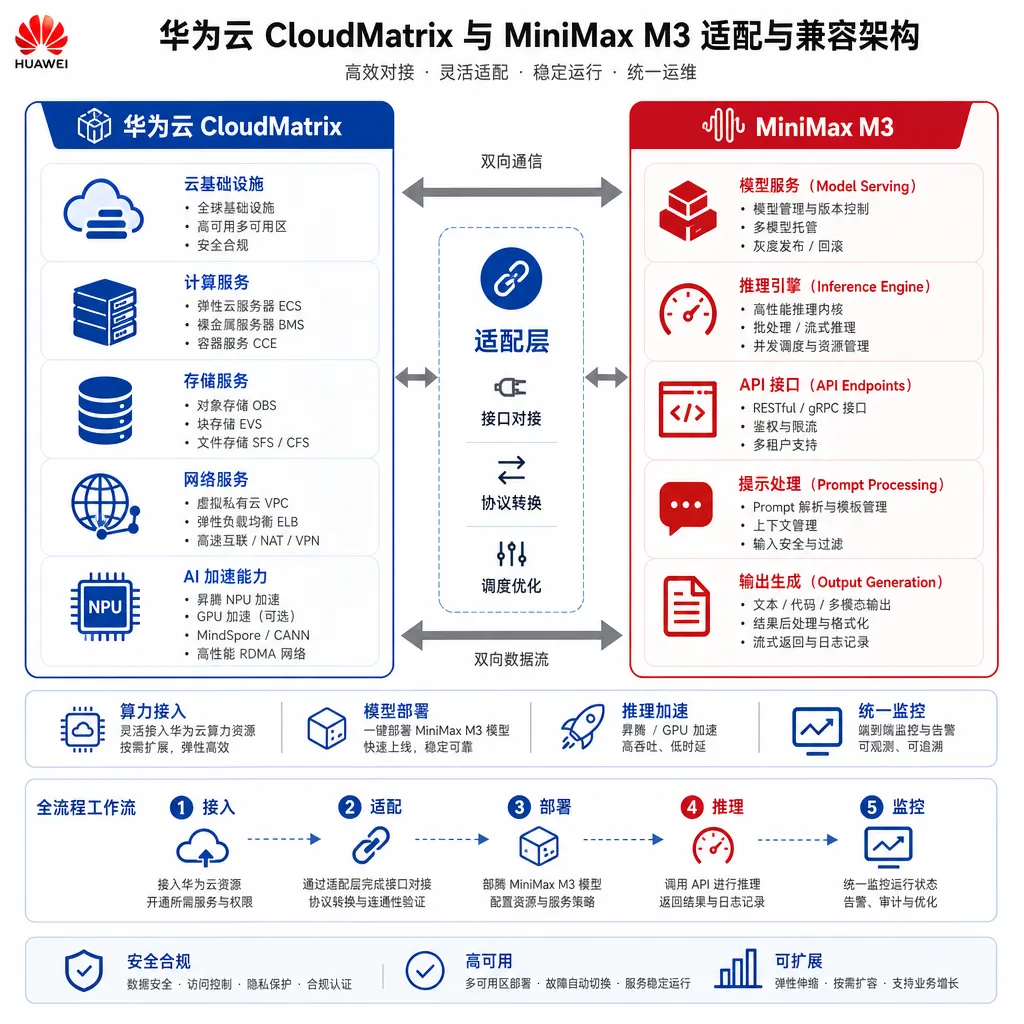
On June 12, Huawei Cloud CloudMatrix completed the open-source debut adaptation of MiniMax M3, providing token services for this next-generation native multimodal flagship model based on Ascend computing power. MSA sparse attention and MoE balancing have also been successfully run on Ascend.
Yesterday (June 12), Huawei Cloud announced that its CloudMatrix intelligent computing cloud service had completed the first open-source adaptation of MiniMax M3 — note the emphasis on “first,” meaning that as soon as M3 was open-sourced, the very first to get it running on domestic compute hardware and provide token services was Ascend.
In the current context, this is worth unpacking. On one side, we have MiniMax’s new flagship M3 launched in the first half of this year: native multimodal, 1M context, able to operate a computer desktop, and outperforming GPT‑5.5 and Gemini 3.1 Pro in coding; on the other, Huawei Cloud’s CloudMatrix, which had been in the works for over a year, finally securing its place on the frontline list of open-source model debuts. The collision of these two events carries more signal than either alone.
What kind of model is M3, exactly?
First, the model itself. From M1 onwards, MiniMax has taken the “long context + linear/sparse attention” path, and M3 elevates this approach to a new level — this time they’ve rolled out MSA (MiniMax Sparse Attention), a new sparse attention architecture supporting up to 1M tokens of context.
1M context isn’t novel anymore — Gemini already has it, Claude followed suit. But sparse attention works differently from Gemini’s engineering-optimization-focused “long but slow” approach: MSA sparsifies attention calculation at the architecture level, theoretically enabling more linear throughput and memory usage with long contexts. The trade-off is a much more complex KV cache access pattern; this explains Huawei Cloud’s later mention of “precise KV partitioning and continuous memory access strategies” — MSA isn’t plug-and-play; operators must be rewritten.
Now, looking at some official benchmark scores:
- SWE‑Bench Pro (Coding): M3 surpasses GPT‑5.5 and Gemini 3.1 Pro, approaching Anthropic Opus 4.7
- SVG‑Bench (Vector graphics generation): surpasses Opus 4.7
- OmniDocBench (Multimodal document understanding): surpasses Gemini 3.1 Pro
- Claw‑Eval (End-to-end agent evaluation): highest score
That Claw‑Eval highest score, combined with the official “desktop operation” description, basically shows MiniMax’s target here is agents. SWE‑Bench Pro approaching Opus 4.7 is rare among domestic open-source models — Opus 4.7 is virtually the ceiling for coding tasks today; hitting this level in open source means it’s viable for serious coding engineering scenarios.
As for the multimodal part, M3 supports image and video input; surpassing Gemini 3.1 Pro on OmniDocBench suggests the classic “document understanding + agent operation” combo. Putting this together, M3 is essentially a model aimed at “getting work done inside a computer” — reading screens, interpreting documents, writing code, clicking the mouse, all in one.
Where Ascend won this round
Regarding the “first adaptation” phrase, there are generally two interpretations externally: one is the PPT-friendly “can run a demo,” the other is genuinely launching an inference service that sells tokens to the public. This time Huawei Cloud took the latter route: CloudMatrix directly provides token compute support, meaning M3 runs on Ascend as a production-grade inference service.
Two hard technical tasks were tackled here:
1. MSA operators rewritten for Ascend
Running sparse attention on domestic accelerators, the biggest pain point is KV cache memory access. On GPU, mature PagedAttention and FlashAttention series exist as a foundation, but Ascend has long used its own CANN operator library — new architectures basically require writing from scratch.
The official statement cited two keywords: precise KV partitioning and continuous memory access strategy. The former corresponds to block management of different query-to-KV access patterns under sparse attention; the latter addresses the non-contiguous memory access caused by the sparse pattern — an engineering challenge unavoidable for MSA on any hardware, especially in 1M context scenarios where KV cache runs tens to hundreds of GB, and memory access efficiency directly determines TPS.
Getting this to run proves Huawei Cloud’s operator team has genuinely delved into MSA’s internals, not just performed simple translation.
2. MoE multi-card balance optimization
M3 uses a MoE architecture; uneven expert routing is a long-standing MoE inference problem — a few hot experts overloaded while most idle, dragging overall throughput down to the weakest link. Huawei Cloud mentioned doing MoE balance optimization on Ascend so expert modules can cooperate efficiently across cards.
The subtext here is CloudMatrix’s card-to-card interconnect. CloudMatrix 384’s architecture is Huawei Cloud’s answer to GB200 NVL72, emphasizing high-bandwidth intra-supernode links. MoE inference is highly sensitive to all-to-all communication; CloudMatrix’s design advantages shine in MoE scenarios. The sparse MoE + long context combo that M3 uses is practically tailor-made as a showcase for CloudMatrix.
Why this timing?
Looking back from mid‑2026, the cadence of domestic compute + open-source model bundling is becoming clearer:
- Early 2025: DeepSeek V3/R1 launched, first fits to Ascend, Hygon, Cambricon domestic cards announced intensively;
- Late 2025: Qwen3, GLM‑5 series successively adapted to Ascend;
- By 2026: the pace changed — no longer “adaptation weeks after release,” but synchronous first launch.
MiniMax choosing Huawei Cloud for the debut this time is practical: M3 is 1M context + multimodal + agent capabilities, and together these features drive inference costs far higher than ordinary chat models. MiniMax’s own API is one thing, but if many developers in China are to call it cheaply and reliably, CloudMatrix’s large-scale compute base is essential.
For Huawei Cloud, securing first launch rights for such a flagship open-source model is equivalent to a top-end stress test for CloudMatrix’s compute service — able to run MSA sparse attention, sustain MoE all-to-all, and handle 1M context KV memory. Passing all three means Huawei Cloud’s influence rises another tier when future open-source models seek Ascend adaptation.
Developer’s perspective: can it be used, and how?
Setting aside the grand narrative, frontline developers care most about a few things:
- Price: MiniMax hasn’t announced M3 token pricing yet; Huawei Cloud’s pricing is likely to follow MiniMax’s own. Given 1M context + MoE cost structures, long-context input pricing is expected to be higher than in the M2 era, but the sparse architecture should improve cost-effectiveness for longer prompts.
- Latency: Prefill speed with long prompts under MSA is the key metric. If Ascend can hit 60%–70% of same-generation GPU speeds here, that’s already sufficient for domestic agent applications.
- Ecosystem compatibility: M3 is open-source; weights will likely be posted on Hugging Face, so local deployment enthusiasts can wait for community quantized versions; those who don’t want to fuss with infrastructure can just use Huawei Cloud or MiniMax’s API.
A side note: OpenAI Hub has already integrated MiniMax M3 — with the same key you can switch between GPT, Claude, Gemini, and DeepSeek to M3, saving teams doing horizontal model comparisons in agent projects from having to open another account.
A quick assessment
The real highlight in this collaboration isn’t “Huawei Cloud adapted a new model” — we’ve seen too much of that in recent years. The focus is the combination of “first launch” + “token service” + “MSA operator-level adaptation”. This indicates:
- Domestic compute’s response time to cutting-edge open-source models has moved from “following” to “synchronous”;
- When model companies choose a first launch partner, architectures like CloudMatrix’s supernode design now qualify to compete alongside overseas clusters;
- The MoE + sparse attention + long-context combo — likely to dominate over the next year — has already been run through the entire pipeline on domestic hardware.
Whether M3 can truly stand firm in the open-source community remains to be seen — SWE‑Bench Pro’s scores look good, but whether it can reliably handle Opus‑level tasks in real code engineering will depend on user feedback once tools like Cursor and Cline integrate it. Regardless, this round has added a new variable worth watching in the second half of 2026’s open-source model adaptation race.
References
- ITHome: Huawei Cloud and MiniMax’s latest model M3 achieve first open-source adaptation, offering token compute support — original report on the adaptation news, including MSA architecture, benchmarks, and Ascend adaptation details


