
The Magic Atom Exchange will throw out two cards: VLA K02 and the world model Magic-Mix
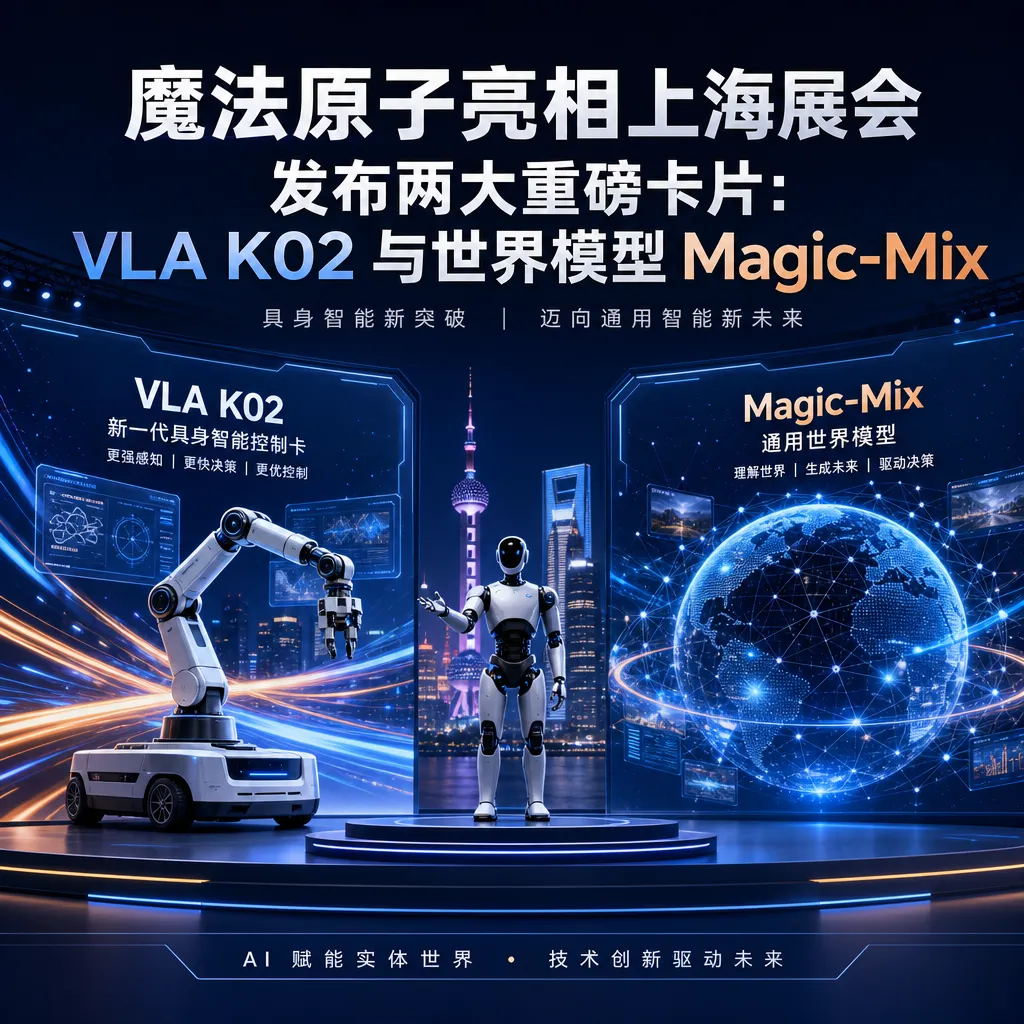
On June 13, the Shanghai International Technology Import and Export Fair concluded. Magic Atom publicly unveiled its self-developed Magic-VLA K02 large model and Magic-Mix world model for the first time in China, betting on the dual-wheel architecture of "VLA + world model" in an attempt to address the long-standing problem of insufficient generalization in embodied intelligence.
Magic Atom Unveils Two Cards at CSITF: VLA K02 and World Model Magic-Mix
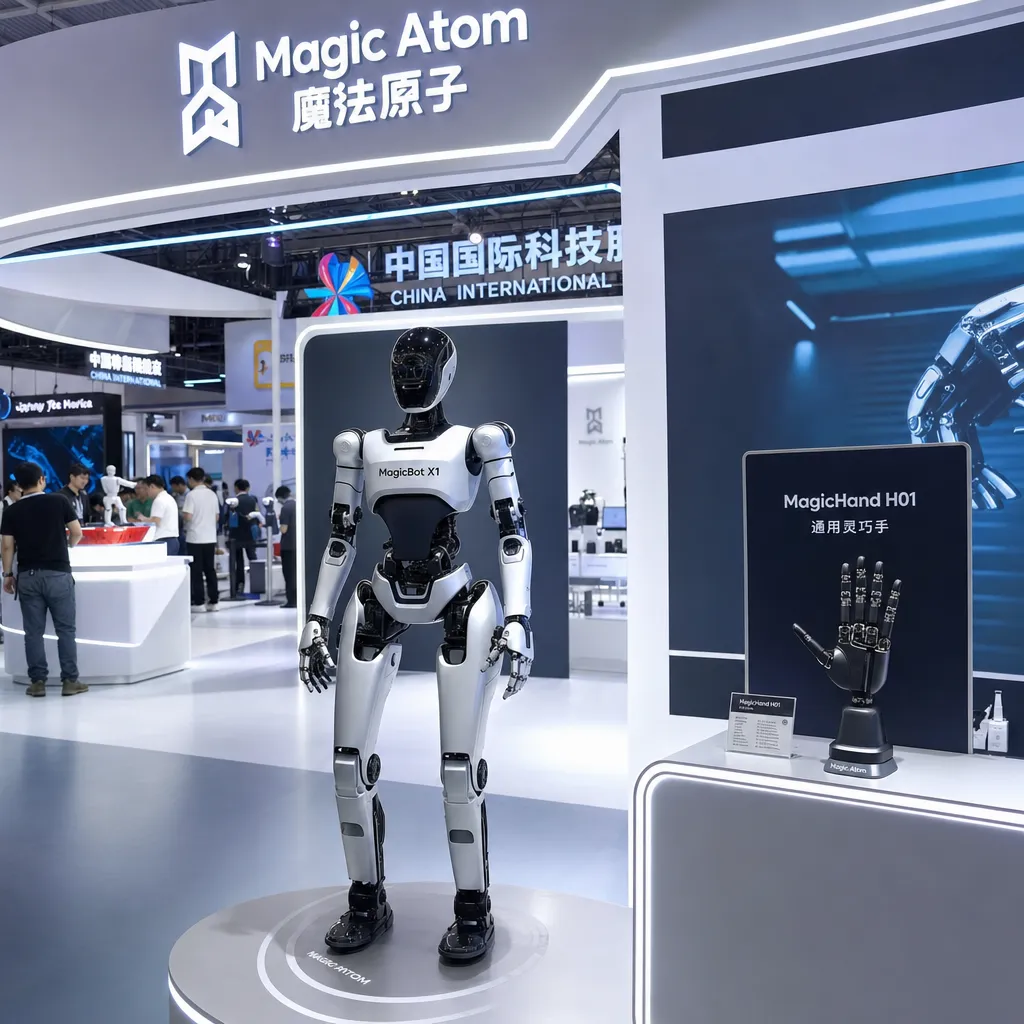
On June 13, the 12th China (Shanghai) International Technology Import and Export Fair (CSITF) concluded at the Shanghai World Expo Exhibition Center. Originally a trade-themed event, this year’s spotlight was stolen by a company just two and a half years old—Magic Atom (MagicLab)—who brought their full-stack technology matrix in its entirety, and for the first time in China revealed two of their most prized developments: their self-developed Magic-VLA K02 large model and the world model Magic-Mix.
Strictly speaking, Magic-Mix was not a global debut—it had already made an appearance at the Silicon Valley Embodied Intelligence Innovation Conference in late April. But VLA K02 was truly its first domestic appearance, and the fact that both models were unveiled together as a “combo” gave the event a strong technical narrative flavor.
1. Why the “VLA + World Model” Combination
Anyone working in embodied intelligence knows that over the past year, VLA (Vision-Language-Action) has almost become the industry’s default solution. From Google’s RT-2 to Figure’s Helix, and to various domestic humanoid robot companies, everyone is pushing hard to integrate vision-language-action end-to-end.
However, the VLA approach has an unavoidable ceiling—generalization. Models that flawlessly pass a coffee cup in demo videos may start glitching when faced with a different cup, lamp, or table. The fundamental issue is that VLA learns “how to move” from data, without truly understanding “why the world works this way.” When the environment changes and the data distribution shifts, the model gets confused.
The world model approach has been repeatedly cited over the past six months as a solution. Its core idea is not to teach robots to mimic actions, but to let the model build an internal “physics sandbox”—predicting the next frame, the next second’s object position, or whether something will slip after being grasped. With this sandbox, robots can “run a mental simulation” before executing and then decide how to move.
Magic Atom’s integration of these two approaches makes logical sense: VLA handles quick reactions and action generation, while the world model provides physical common sense as a safety net and synthesizes data. One acts, the other thinks, complementing each other.
As for the actual effect—well, that’s another matter we’ll discuss later.
2. Magic-VLA K02: What Exactly Does It Solve?
From the limited information released onsite, K02 shows three key improvements over its predecessor, K01.
First, lengthening the context window. The VLA model’s biggest headache isn’t single actions, but long-chain tasks. For example: “Take the glass from the table to the kitchen, pour out the water, and put it in the dishwasher.” Past models often started forgetting halfway through. K02 reportedly expanded the task-planning context window several times over, with significantly improved success rates for long tasks.
Second, swapping out the visual encoder. The previous generation used a relatively general visual backbone. K02 replaced it with an encoder retrained for manipulation scenarios, showing improved robustness for fine hand movements, changes in object posture, and partially occluded scenes. Simply put: even if a cup is tilted or half-blocked by something else, the model can still recognize it.
Third, upgrading the action tokenization scheme. Magic Atom didn’t go into great detail here, but judging from their dexterous hand control demo, the 20-DOF MagicHand H01 can produce delicate action combinations, likely thanks to redesigned action representation granularity. Put bluntly: if before the model could only “sketch” a few action frames per second, now it can sketch dozens—naturally making movements smoother.
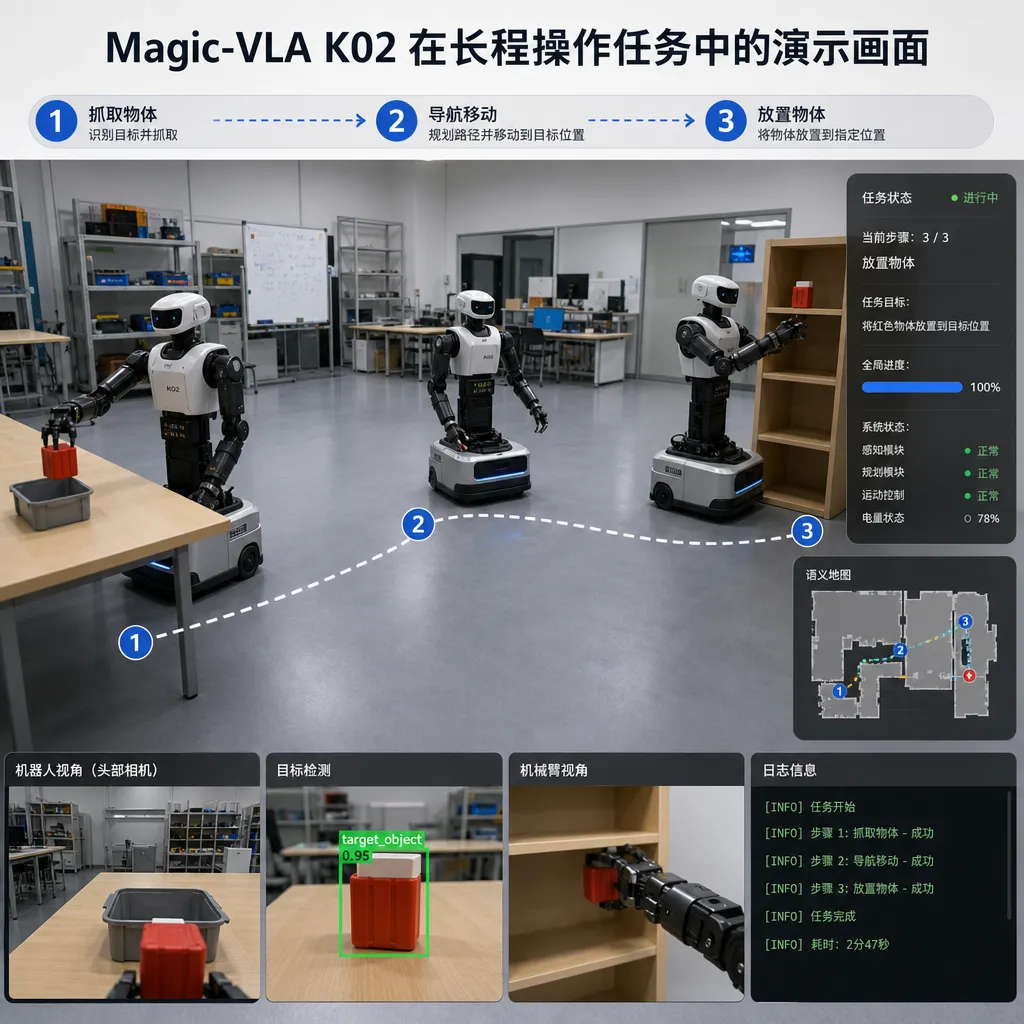
It’s worth noting that while K02 debuted domestically, Magic Atom stated clearly it will be one of the core models in their upcoming open platform—tying into their April announcement in Silicon Valley of a “$1 billion robot secondary development ecosystem” over five years. The intent is obvious: make K02 a foundation for developers, not just an internal tool.
3. Magic-Mix: How the Dual Engine Loop Runs
Compared with K02, Magic-Mix is the true star of the company’s technical narrative this year.
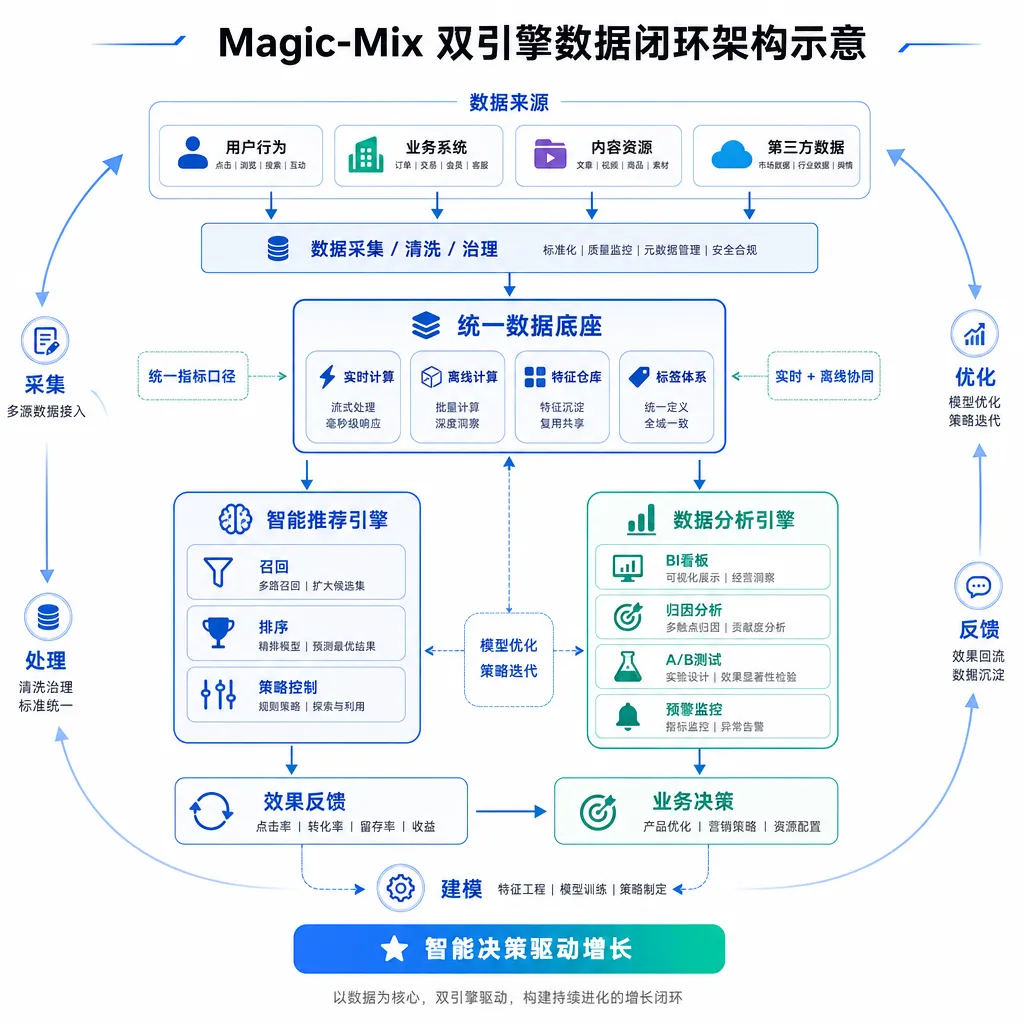
Magic-Mix consists of two engines:
- Magic-Mix WAM (World Action Model): Responsible for understanding the physical environment, performing spatial reasoning, and making action decisions.
- Magic-Mix Creator: An offline data generation engine that synthesizes training samples in bulk.
Together, they form an interesting closed loop:
Real data collection → WAM learns physical laws → Creator synthesizes new scene data
        ↑                                       ↓
        └────── Model retrains on new data ←─────────┘
The beauty of this mechanism is that it addresses embodied intelligence’s biggest cost pain point—data.
Robot real data collection is notoriously expensive. One machine, one engineer, collecting a few hundred task samples a day—at labor costs, each high-quality data point can cost tens of dollars. Magic Atom disclosed figures of ~16,000 samples collected daily, with over 1 million hours of high-quality data—already first-tier domestically.
But the real killer is Creator: using world model synthesis to increase data volume by a factor of 10,000. In other words, 1 million hours of real data translates into the model having seen 10 billion hours. This difference gets magnified mercilessly on the training curve.
Of course, synthetic data has its pitfalls—distribution shift, physical inaccuracies, insufficient long-tail coverage—these are old issues. But as long as WAM’s physical modeling is accurate, synthetic data usability can be kept high. This is why world models have recently become consensus in embodied intelligence: it’s not just a model—it’s the engine of the data flywheel.
4. Where Magic Atom Stands Among Peers
Looking horizontally, the embodied intelligence track currently looks like this:
- Physical Intelligence (PI) and Figure in North America: Deepest in end-to-end VLA, but their closed loops rely heavily on real data.
- 1X Technologies bets on humanoids + household scenarios; also working on world models but mostly internally.
- Domestic players Zhiyuan, Unitree, Galaxy General each have their focus; VLA and world models are often developed separately, rarely bundled and showcased together.
Magic Atom’s dual-line “full-stack” narrative, combined with vertical integration from dexterous hands to the body to models, is rare domestically. It’s more like Tesla’s Optimus + Dojo + FSD vertical integration, rather than a single-point breakthrough.
This strategy’s advantage is a complete narrative and easier valuation pitches; its disadvantage is having to shoulder every component yourself. Model poor? Your fault. Hardware poor? Also your fault. Data flywheel stalls? Definitely your fault. All pressure stays in-house.
5. Details Developers Should Watch
1) When will the platform ecosystem truly open?
At the April Silicon Valley conference, Magic Atom mentioned the “Thousand Scenes Co-Creation” plan: $1 billion over five years, opening hardware prototypes, development funding, core technology, and brand resources to ecosystem partners. Now, after unveiling K02 and Magic-Mix domestically, the key question for developers is: When will these two models be usable? In what form will they open? API, SDK, or direct weights?
No clear timetable yet. But given their 2036 revenue target of $14 billion, platformization must roll out quickly—selling robots alone won’t hit that scale.
2) Relationship with large model API providers
A note: developers creating embodied intelligence demos and prototypes often still need general-purpose large models for planning or multimodal understanding. In such cases, unified access is far more convenient than connecting to each provider separately—platforms like OpenAI Hub let you call GPT, Claude, Gemini, DeepSeek, etc., through one key, compatible with OpenAI format, direct domestic access—saving hassle with proxies and multiple keys. While waiting for K02 to open, front-end planning logic can be temporarily handled by general models.
3) How to evaluate world models?
This is an industry-wide challenge. Models like Magic-Mix look impressive in demos, but quantifiable evaluation lacks a standard. Prediction accuracy, long-term extrapolation stability, physical consistency, synthetic data downstream usability—each requires granular metrics. Magic Atom hasn’t yet published benchmark figures; hopefully, these appear in developer documentation later.
6. Some Judgments
An unfiltered judgment:
For Magic Atom’s two models, the technical direction is correct, the narrative cadence is right, but concrete evidence of real-world application is still missing.
- The VLA + world model combo is industry consensus, and they’re ahead domestically, but overseas PI and Figure aren’t idle.
- The data flywheel concept is smart, and the 10,000x synthesis figure is impressive, but the real contribution of synthetic data depends on improved success rates in real tasks.
- The platform ecosystem is a big promise, and so is $1 billion—the key is how many APIs are opened and how many developers signed in the next 12 months.
For frontline developers, the best move now is: Watch K02’s rollout pace, track their SDK and data format definitions. If Magic Atom indeed releases both their VLA and world models externally, this would be the first time domestic embodied intelligence developers get a complete “dual engine” toolchain—impact comparable to Stable Diffusion’s open-source release in the image generation world.
As for whether they can survive to reach $14 billion revenue by 2036—that’s for the capital markets to worry about. Technologists care about one thing only: Is the model strong enough, and can the flywheel turn?
This battle has just begun.
References
- Magic Atom’s First Showing of VLA K02 Model at CSITF - 36Kr: Debut-day report from CSITF (domestic access restricted, listed for sourcing)
- Magic Atom’s Silicon Valley conference materials: details on Magic-Mix dual engine architecture and “Thousand Scenes Co-Creation” plan
- Embodied intelligence industry studies: discussions on VLA generalization limits and world model supplementation


