
iFlytek Spark X2-VL Released: Embedding Multimodality into the "AI Brain" of Embodied Intelligence

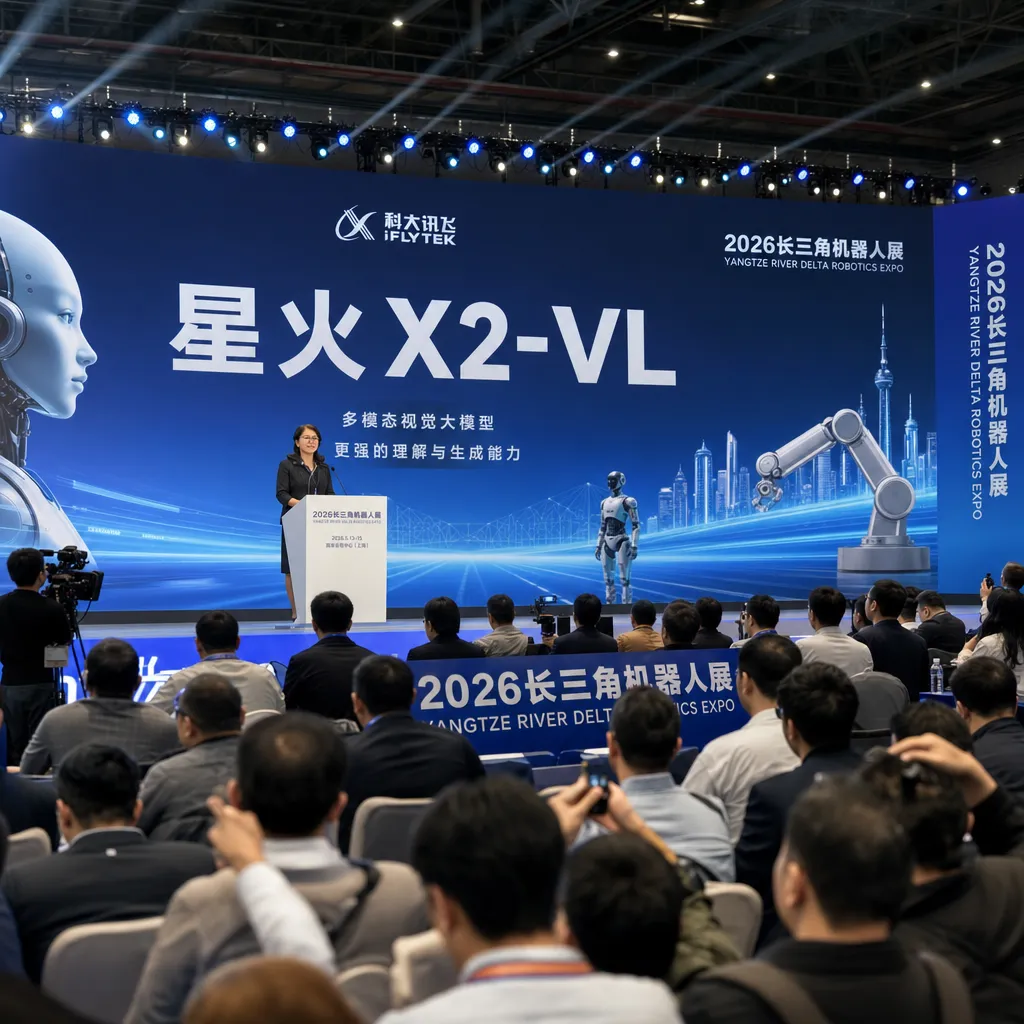
On June 11, iFlytek released the Spark Multimodal Large Model X2-VL in Wuxi. Based on MoE architecture and native multimodal training, it achieved nearly 95% accuracy across all subjects in simulated college entrance exam papers. It also spawned a new generation embodied model, GEAR-VLA, targeting real-world robotic applications such as logistics picking.
iFlytek Puts Multimodality into Robots’ “Brains”
June 11, Wuxi. On the opening day of the 2026 Yangtze River Delta Robotics and Automation Expo, iFlytek President Wu Xiaoru unveiled a new trump card on stage—Spark Multimodal Large Model X2-VL. This was not just a routine demo show; the event’s theme was “Capability Advancement, Ecosystem Fusion,” accompanied by an Embodied AI Industry Chain Partner Conference. In other words, this time iFlytek is not simply releasing a model—it aims to use the model to knock on the doors of the robotics industry chain.
Up front: X2-VL is the “1” in iFlytek’s “1+2+2” model matrix, i.e., the multimodal base model. The two supporting verticals are the Embodied Intelligence Large Model and the Hyper-Human Digital Human Large Model, plus two industry-specific versions—IoT multimodal and industrial multimodal. From its architecture diagram, this combination looks very “Wuxi”—manufacturing, IoT, robotics, all industries that the city has in reserve.
Technical Breakdown: MoE + Native Multimodality, Putting “Fast and Slow Thinking” into One Model
First, the architecture. X2-VL follows the Spark MoE route, with a training paradigm of native multimodality—this is key.
“Native multimodality” contrasts with the earlier “train a language model first, then attach a vision encoder” patchwork approach. The native method feeds images, text, tables, and scenes together from the pretraining stage, so the model learns from the ground up to treat pixels and tokens as the same kind of object to process. Gemini played this card early, GPT-4o uses the same approach. iFlytek’s explicit emphasis on “native multimodality” signals alignment with the mainstream consensus of the front-runners, at least narratively.
Key engineering details to note:
- Lightweight visual encoder: This leaves deployment paths open for edge devices and robots. Embodied AI scenarios are highly latency-sensitive; if the vision tower is too heavy, it’s unrealistic to run it directly on a robot.
- Unified fast and slow thinking model: System 1’s intuitive responses and System 2’s chain-of-thought reasoning are scheduled within the same set of weights. OpenAI’s o-series and Claude 3.7’s extended thinking use this approach; iFlytek has explicitly made “fast-slow unification” a product selling point. For developers, this means no need to maintain two sets of interfaces for “Q&A” and “reasoning.”
- MoE sparse activation: Balancing large parameter scale and inference cost. iFlytek has not disclosed the number of experts or activated parameters, but the direction is clear.
Benchmarks: Nearly 95% on Mock Gaokao Tests
iFlytek’s favorite showcase is still education scenarios. X2-VL used multimodal test questions from the 2026 nationwide mock Gaokao exams as a test set, achieving an average accuracy rate close to 95% across all subjects.
How to view this number? The difficulty of multimodal test questions lies not in reading text, but in “image-text coupling” problems—geometry diagrams, function graphs, chemical structural formulas, geography diagrams—where the text description and the image convey different aspects that must be aligned to solve the problem. Achieving ~95% across all subjects indicates visual reasoning has been solidly engineered. Compared horizontally, domestic multimodal models from major companies last year were hovering in the low 80% range for similar tasks.
Of course, mock Gaokao tests are neither MMMU nor MathVista, so this score can’t be directly compared with overseas models. But as a metric for China’s education context, its commercial value is higher than topping international charts—because iFlytek will next be selling AI blackboards and intelligent grading machines.
Education and Judiciary: Monetizing Capabilities Where They’re Familiar
iFlytek disclosed Wuxi’s deployment figures openly:
Education:
- Nearly 1,200 AI blackboards covering 75 primary and secondary schools
- Daily active rate 87%
- 128 Spark intelligent grading machines deployed, covering 80 primary and secondary schools
Judiciary:
- Handwriting recognition accuracy 97.2%
- Complex table recognition accuracy 95%
- Civil/commercial case closure rate within 60 days up 18%
- Criminal case handling efficiency up 30%
- Smart courts covering Wuxi’s two-tier courts: trial durations shortened 30–50%, manpower efficiency up 60%
The judiciary line is especially noteworthy. The difficulty in electronic dossiers has never been OCR—it’s layout. A dossier might include printed text, handwritten transcripts, stamps, signatures, tables, photocopies, traditional OCR patchwork solutions often fail in the layout parsing step. iFlytek has made “complex layout parsing” a core capability of X2-VL, essentially using the multimodal model as an end-to-end document intelligence engine, bypassing the traditional pipeline.
The Real Highlight: GEAR-VLA and Embodied Intelligence
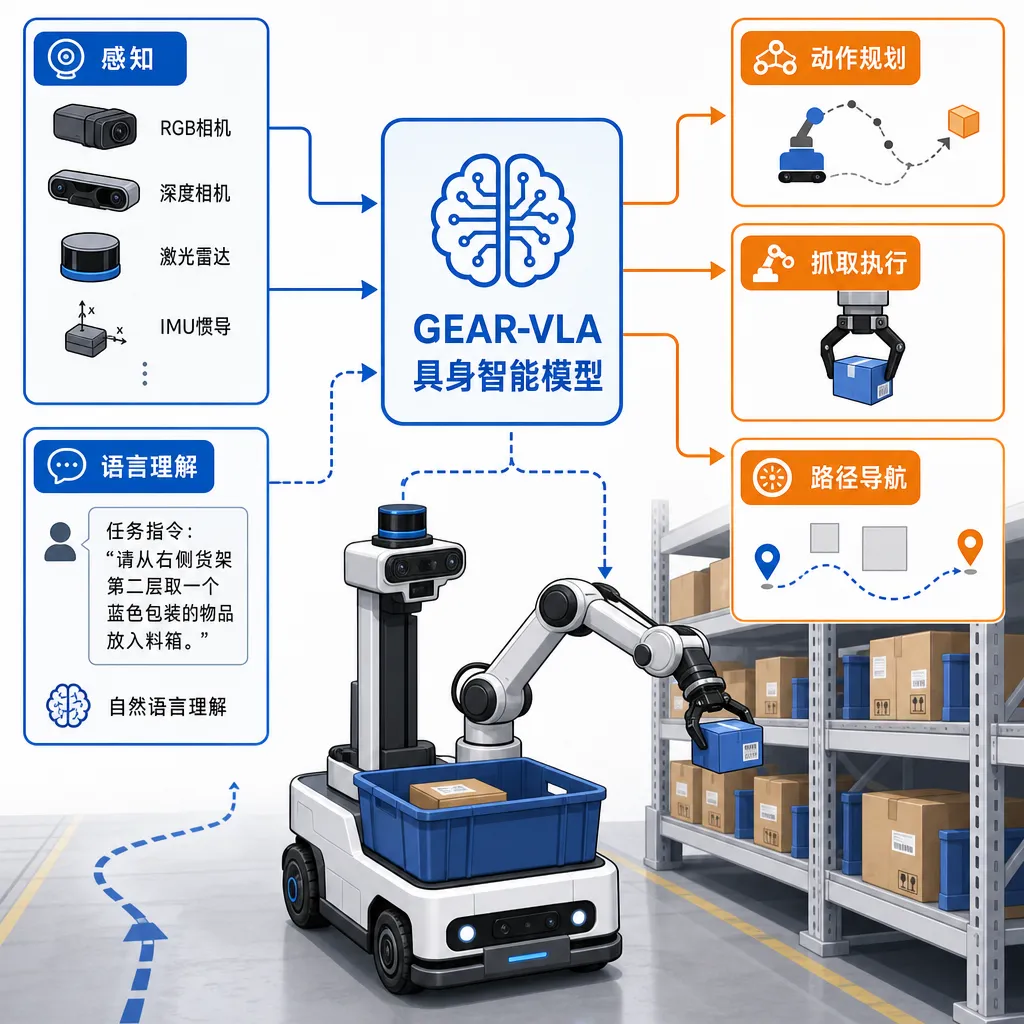
If the above was warm-up, GEAR-VLA is the real star of this launch.
The VLA (Vision-Language-Action) paradigm was popularized by Google DeepMind’s RT-2 in 2023. Its core is training vision, language, and action in the same token space, enabling robots to directly translate natural language commands like “bring me the cola” into joint angle sequences.
iFlytek’s GEAR-VLA is an embodied derivative model atop X2-VL; officially, it “further improves spatial task precision and object feature generalization ability, and leads in domain public benchmark suites.” Two keywords:
- Spatial task precision: Grasping a transparent cup, inserting parts into toleranced holes, avoiding objects on a table—these sub-centimeter precision tasks have always been tough nuts for VLA models.
- Object feature generalization: Seen a red cup during training—can it grasp a green one during testing? Plastic during training, metal during testing? If generalization fails, the robot can only operate on fixed SKUs and can’t perform general picking.
iFlytek chose a practical entry scenario—logistics picking. The reasons are straightforward:
- Logistic warehouses have many SKU categories, diverse shapes, high order mixes; traditional vision + rules approaches can’t handle all cases, making it a sweet spot for VLA.
- Warehouses are structured environments, unlike open domestic service, making technical risk controllable.
- Strong customer willingness to pay, clear ROI—a robot replacing several sorting workers is an easy calculation.
This strategy differs from Figure, 1X, Galaxy General’s home/industrial routes, resembling Covariant, Mech-Mind’s deep vertical focus in warehousing. iFlytek explicitly stated it aims to “create industry-level embodied robots, accelerating soft-hard integrated solutions and standard products.” Soft-hard integration is key—pure model sales don’t bring big profits; packaging the model, vision sensor, and robotic arm into a single SKU for warehouse integrators is the business model.
The “Fully Domestic Compute” Card
Wu Xiaoru emphasized in her speech that Spark is China’s first fully stack-independent large model trained on a fully domestic compute platform, and X2-VL was trained on the Taihu Xingyue Platform jointly built with Wuxi.
In the 2026 context, this statement carries weight. On one hand, domestic compute (Huawei Ascend series) availability has significantly improved in the past 18 months; on the other, for G/B-end customers in education, judiciary, and government—iFlytek’s main battlefields—“fully domestic” is almost a hard requirement. iFlytek has been pushing this label for three years, and X2-VL continues it into the multimodal era.
Ecosystem Numbers: Developers Up 26.4% in a Year
iFlytek Open Platform also released some figures:
- Wuxi local developer teams grew from 48,000 in June 2025 to 61,000+ in June 2026, up 26.4%
- Total platform developer teams 11.241 million+
- Total applications 4.14 million+
- Total open AI capabilities and solutions 981
The significance here: iFlytek, while doing ToB large model business, hasn’t abandoned ToD (to developers). The open platform has long been a differentiator from Alibaba Tongyi and Baidu Wenxin—those two lean toward all-in-one cloud platforms, while iFlytek is more like an “AI capability supermarket,” selling at API granularity.
A Bit of Judgment
Looking at X2-VL in the mid-2026 sequence of domestic multimodal models: it’s neither the largest in parameters nor the flashiest on leaderboards, but its industrial deployment path is among the clearest:
- Education and judiciary—iFlytek’s traditional strong scenarios—are upgraded naturally, without suspense;
- Embodied intelligence is a new front, entered via GEAR-VLA + logistics picking, a pragmatic track choice;
- The “1+2+2” model matrix is tied to Wuxi’s industrial resources, effectively creating its own customer base.
Short-term risks are also obvious:
- International competition pressure on multimodal base models: GPT-5, Gemini 3, Claude 4.5 are vying in long video understanding and real-time multimodal interaction; X2-VL’s public selling points so far focus on static image-text, with little detail on real-time integration of long video and audio.
- Actual performance of VLA model: GEAR-VLA’s “leading in public benchmark suites” is a vague claim—no specifics on which benchmark, against whom, disclosed at launch.
- Logistics picking red ocean: Many players have been deeply cultivating this track for years; as a newcomer, iFlytek’s hardware supply chain and on-site delivery capabilities remain a question mark.
But whatever the critiques, an AI company that can connect and monetize the entire chain from “multimodal base → vertical derivatives → industry products → deployment scenarios” remains rare in China’s 2026 market. X2-VL may not dazzle on scores, but it’s likely to be the core story of iFlytek’s H2 2026 financial report.
On model availability: Spark X2-VL is currently mainly provided through iFlytek Open Platform. OpenAI Hub is evaluating integration; if launched, developers could call Spark series directly alongside GPT, Claude, Gemini, and DeepSeek with the same Key, avoiding the hassle of switching SDKs. We will follow up on progress in future briefings.
References
- iFlytek Open Platform 2025 Ecosystem Summary - Zhihu Column: Review of iFlytek Open Platform’s “Super Brain Platform” soft-hard integrated solutions for robot manufacturers in 2025, serving as background for GEAR-VLA’s commercialization path this time.


