
GLM-5.2 fully open with 1M context, open source next week
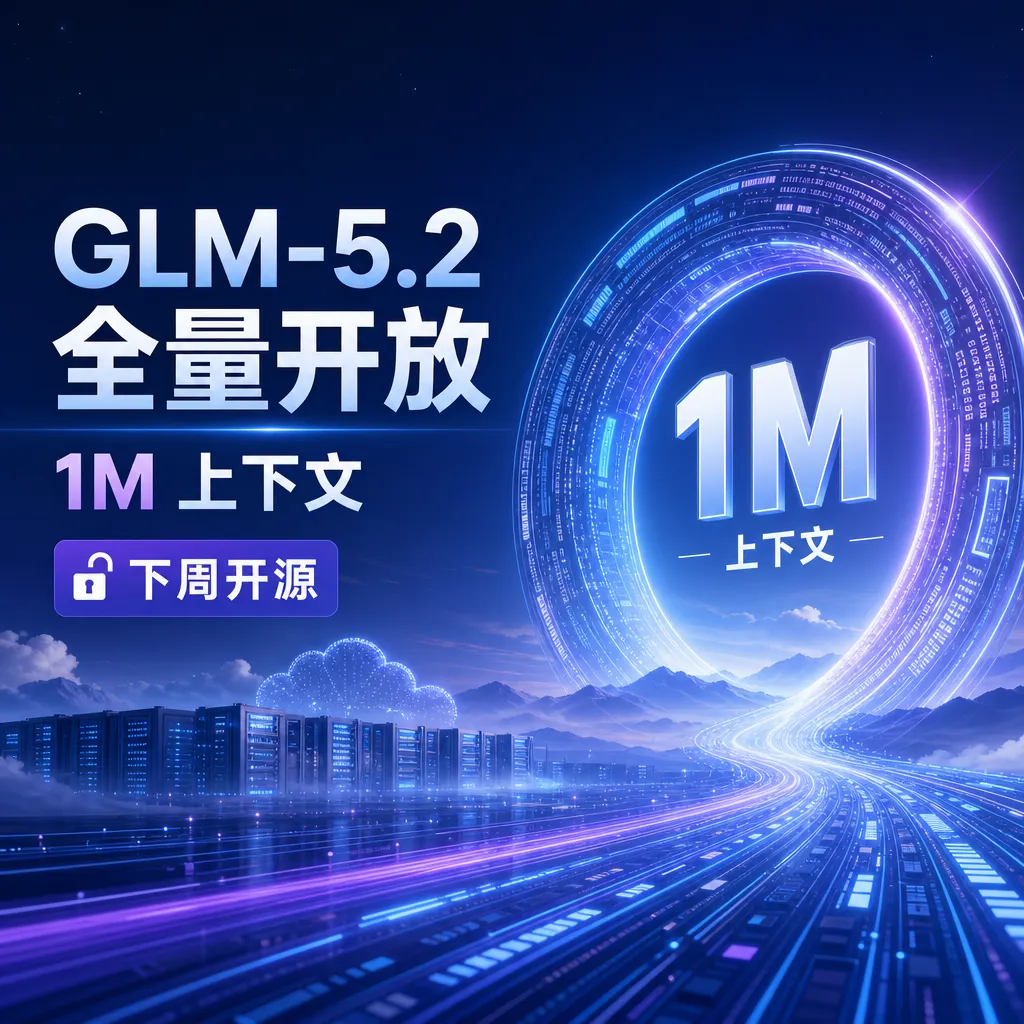
Zhipu releases GLM-5.2, offering a truly usable 1M context to all GLM Coding Plan users. Both the API and the MIT-licensed open-source version will be launched next week.
Zhipu Has Actually Achieved 1M Context
Today, Zhipu released GLM-5.2—no press conference, no pre-hype, directly fully open to all GLM Coding Plan users. Lite, Pro, Max, plus the Team Edition—all rolled out at once. Next week the API will follow, and model weights will be open-sourced under the MIT license.
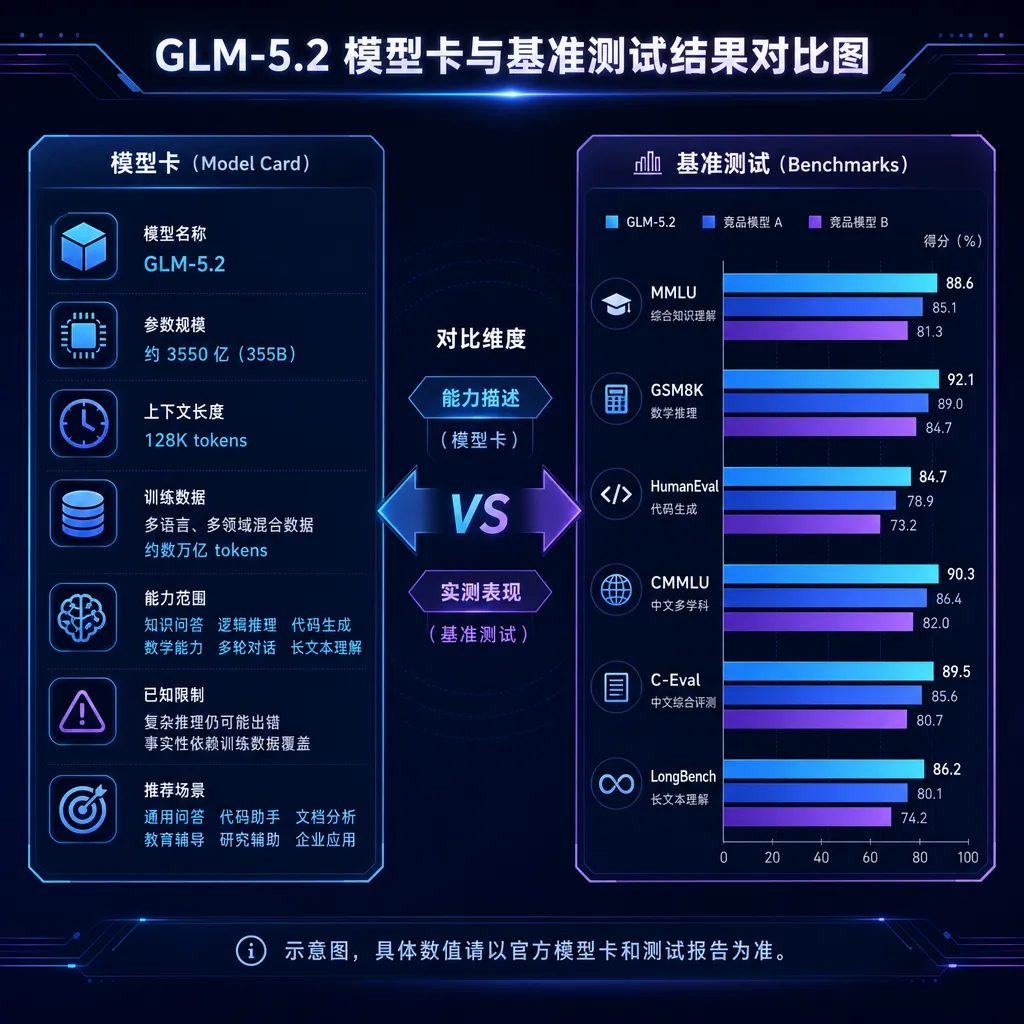
This is another transparent move in Zhipu’s line of foundational programming models, following GLM-5’s launch on Z.ai in February and the release of open-source weights at the end of Q1. Unlike last time, the selling point here is not benchmark scores, but something much more concrete for developers—1M context—and a 1M that is actually usable.
Why 1M Context is Worth Highlighting This Time
Long context has been a competitive battlefield for all vendors over the past two years. Gemini wrote 1M and even 2M into its specs early on; Claude boosted its 200K context to 1M; many domestic vendors also showcased 1M in their PPTs. But every developer knows one thing: the stated context window and the effectively usable context are two entirely different matters.
We’ve seen too many “long context fails” in real-world scenarios:
- After stuffing in 200K, the model starts forgetting earlier variable names
- Cross-file reasoning silently loses dependencies in the middle
- Token billing is charged as 1M, but recall quality crashes outside the colorful NIAH (needle in a haystack) plots
What GLM-5.2 emphasizes this time is "full open access," meaning two things: first, no throttling based on tier or phased rollout—every Coding Plan user can start using it immediately; second, the 1M number is not watered down—the model’s attention is coherent across the entire context window.
Behind this is the DeepSeek Sparse Attention (DSA) architecture introduced in GLM-5, further refined in 5.2. The core idea of DSA is to reduce the reasoning cost of long sequences from O(n²) with sparse attention, while carefully designing sparse patterns to retain long-range dependencies. In simple terms, the model doesn’t “look at every token for every token” but can “see the tokens it needs to” when necessary. This mechanism makes 1M context more than just a marketing number.
What This Means for Developers
Anyone who has built a Coding Agent knows that context length directly sets the capability ceiling.
A medium-sized monorepo project, just the core directory source code plus dependency type definitions, easily exceeds 300K tokens. If you want your agent to do end-to-end refactoring, add features, and fix cross-module bugs in such a project, 128K is nowhere near enough for a full working context. This is why Claude Code’s early product experience relied heavily on RAG-like file retrieval and trimming—not because RAG is inherently elegant, but because it had no choice.
Scenarios that genuinely open up with 1M context include:
- Feeding the entire repo: Medium-sized codebases no longer need complex file routers—just feed the directory tree and key source files, and let the model decide where to look.
- Long-range agent tasks: Tasks like Vending-Bench 2, which simulate a year-long operation, previously had to collapse history via interim summarization; with 1M, the raw trajectory can be preserved.
- Ultra-long document audits: In legal, compliance, security audit contexts, the model can see the entire document at once without slicing and merging.
- Multi-round debugging conversations: A truly long-lived coding session need not worry about the context window kicking early key decisions out.
Relationship with GLM-5
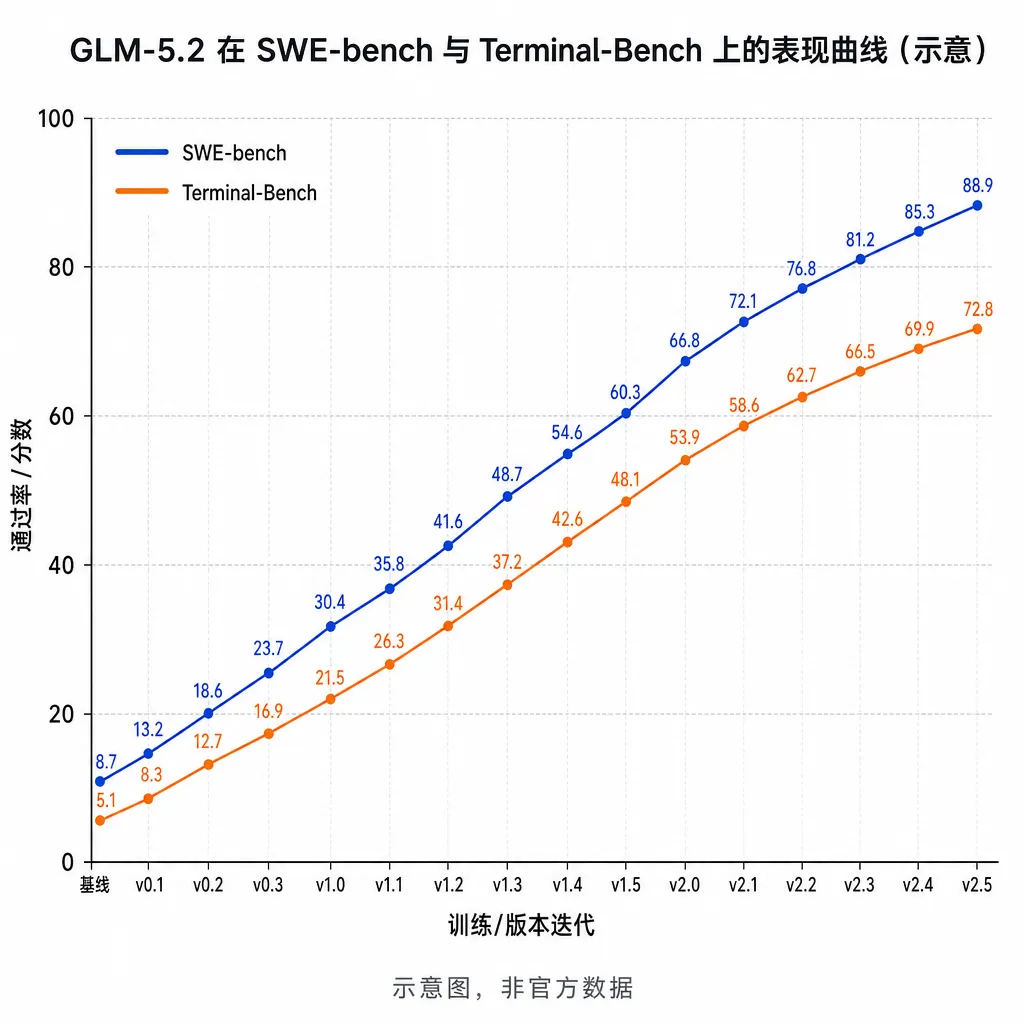
Here’s a point likely to cause confusion. GLM-5, released in February, was the flagship product emphasizing Agentic Engineering, aiming to push programming paradigms from Vibe Coding to Agentic Engineering. On benchmarks like SWE-bench Verified, SWE-bench Multilingual, Terminal-Bench 2.0, GLM-5 had already reached open-source SOTA, standing shoulder to shoulder with Claude Opus 4.5 and GPT-5.2 (xhigh), and even outperforming Gemini 3 Pro and GPT-5.2 on SWE-bench Multilingual.
GLM-5.2 is not a brand-new model trained from scratch, but an iteration of GLM-5. According to Zhipu, key updates are in three directions:
- Context upgraded from 128K/256K to fully usable 1M
- Further optimization of sparse attention reasoning paths, improving throughput and first-token latency in long-context scenarios
- Upgraded strategy alignment in asynchronous Agent RL, pushing further on self-correction ability for long-range tasks
During the GLM-5 era, Zhipu talked about their “asynchronous RL infrastructure”—decoupling generation and training so that rollout phases don’t block training steps. 5.2 doesn’t revisit this technical architecture, but it’s clear another round of reinforcement learning post-training was run extensively. From initial hours of feedback after Coding Plan users got access, long-range agent task stability has indeed gone up another notch compared to 5.
Open-Sourcing Next Week Under MIT License
Zhipu continues GLM-5’s open-source strategy, releasing GLM-5.2 weights under MIT next week. In mid-2026, MIT remains the most permissive license for cutting-edge models—allowing commercial use, redistribution, and closed-source fine-tuning for resale, without Llama-style user number caps or “no use by competitors” fine print.
The industry significance of this surpasses the model itself. With Claude Opus 4.5 and GPT-5.2 pushing closed-source frontiers to new heights, in the open-source camp only DeepSeek V3.2 and the GLM series can currently compete head-to-head with closed-source SOTA in SWE-bench. MIT licensing means any team wanting private deployment, industry fine-tuning, or compliant delivery within China can adopt it directly.
How to Use It
Several routes:
- GLM Coding Plan users: Available today—Lite / Pro / Max / Team Edition all covered. Zhipu official IDE plugins and CodeGeeX pipelines will likely switch to 5.2 default first.
- API users: Live next week, invocation method remains consistent with GLM-5 series—just change model name to
glm-5.2. OpenAI-compatible layer works as usual. - Self-deployment users: Wait for next week’s open-source weights; expected to be listed on Hugging Face and ModelScope simultaneously.
On aggregation platforms, OpenAI Hub will integrate GLM-5.2 on the day API opens. Developers already using one key to call GPT / Claude / Gemini / DeepSeek can simply add one line to routing config to switch over—direct domestic access, no need to separately integrate with Zhipu’s open platform. This is convenient for teams using A/B routing and fallback strategies—for example, running long-context tasks via GLM-5.2, short reasoning through Claude Opus 4.5, and cost-sensitive fallback through DeepSeek.
Some Unresolved Points
Open-sourcing is great, but a few aspects deserve priority verification after next week:
- True recall quality of the 1M context: NIAH stellar scores are easy, but whether cross-file reasoning and cross-chapter QA maintain quality needs third-party community evaluation.
- Deployment cost of sparse attention: DSA may be cheap to run, but inference framework support is still catching up. Official kernels for vLLM / SGLang will determine actual self-deployment barriers.
- Differentiated positioning versus GLM-5: If 5.2 fully replaces 5, what will be Zhipu’s version cadence; if they coexist, how will pricing and scenario recommendations be divided?
Closing Words
As we reach June 2026, the frontier model market has settled into a pattern led by the big three: Claude Opus series, GPT-5.2 series, and Gemini 3 Pro, while DeepSeek and GLM hold the top tier in open-source. GLM-5.2 hasn’t made aggressive moves in benchmarks this time, but has turned the oft-mentioned “1M context” into a genuine product feature—all users, available immediately, open-source next week.
This is a very “Zhipu” release cadence: low-profile, but with every step landing squarely on points developers truly care about.
References
- GLM-5.2 Full Open Access Discussion Thread - linux.do: First-hand community release info and Coding Plan user feedback


