
Intel Cuts BigDL: Open-Source AI Framework to Be Archived at the End of June

Intel has added BigDL, its open-source AI acceleration framework developed over many years, to its termination list, with official archival scheduled for June 30, 2026, leaving only a two-week migration window. Making such a decision at a time when AI demand is at its peak is rather unusual.
Intel Axes BigDL: Another Open-Source AI Framework Comes to an End
Intel’s open-source axe has swung again. This time it’s BigDL—the open-source framework once highly touted by Intel, claiming it could seamlessly scale AI workloads from laptops to the cloud.
Phoronix first noticed this week that BigDL’s GitHub repository had posted an “no longer maintained by Intel” archive notice. Shortly thereafter, on Friday (June 12), Intel officially announced that the final archival date is set for June 30, 2026. That means from today, existing users have only about half a month left to migrate.
The pace is neither lightning-fast nor leisurely—but for a project still committing code regularly and actively updating documentation, a farewell window of just two weeks feels somewhat rushed.
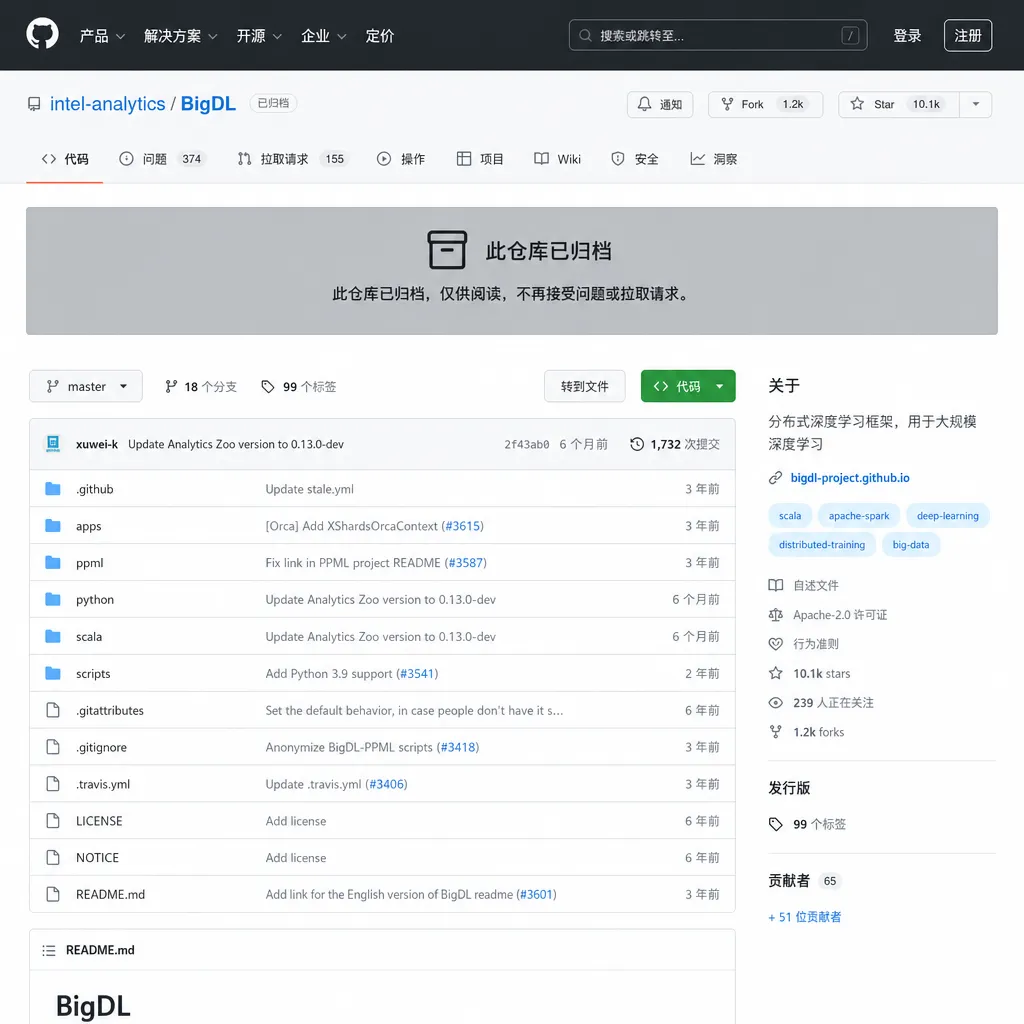
What BigDL Is and What It Was Meant to Do
Looking back at BigDL’s origins, you’ll see that this project wasn’t some throwaway filler from Intel. Its history dates back to 2016—when the deep learning framework wars weren’t over, TensorFlow and PyTorch hadn’t yet firmly taken the top spot, and Intel launched BigDL essentially as a bid to earn CPU training workloads a place in the AI world.
Intel’s logic at the time was clear: GPUs were expensive and the ecosystem was dominated by NVIDIA, while a lot of enterprise data still ran on big data clusters based on Spark/Hadoop, all powered by Xeon CPUs. If deep learning could run directly on Spark and existing CPU clusters, it could bypass the GPU barrier.
The earliest version of BigDL was a distributed deep learning framework based on Apache Spark, focusing on “natively running DL on Hadoop/Spark clusters,” positioned against Caffe and Torch. The route didn’t attract large crowds of followers, but it did have a niche—particularly in traditional industries such as finance and telecom where data resided in Spark clusters and companies were reluctant to relocate it.
When the era of large models arrived, BigDL evolved into BigDL-LLM (later repackaged for a time into components related to IPEX-LLM). Its positioning became:
- An open-source large model acceleration library based on Intel XPU (CPU, integrated GPU, discrete Arc/Max series GPU)
- Support for FP4 / INT4 / NF4 / FP8 / INT8 and other low-bit quantization formats
- Integration with TensorFlow, Keras, PyTorch, Spark, and Flink
- Confidential computing using SGX and TDX to protect data and model security
- Coverage from Core Ultra laptops to data center GPUs
In short, over the past two years, BigDL was treated as one of Intel’s key external AI technologies. In Mazhiya’s interview back then, the oft-repeated “AI democratization” was, in engineering terms, embodied in this stack.
Why This Axing Feels Abrupt
It’s not news that Intel has been cutting open-source projects over the past year—from scaling back Clear Linux to ending development on performance analysis tools—its open-source footprint is shrinking. But most projects cut were either inactive for months or already in maintenance mode.
BigDL is different. Looking at its commit history, code was being actively submitted just weeks before the archive notice. Intel engineers were still replying to community issues. Declaring its death in this state is indeed unusual.
The timing is even stranger. Right now, industry demand is surging for on-device large model inference, low-bit quantization, and heterogeneous hardware support:
- Apple’s M-series chips brought on-device LLMs into the mainstream spotlight
- Qualcomm Snapdragon X Elite is pushing NPU inference hard in Copilot+ PCs
- AMD Ryzen AI is telling similar stories to vie for the laptop market
Intel’s Core Ultra series is a main player in this battle. BigDL (or its derivative LLM acceleration stack) should have been part of its software moat. Cutting it now means selling hardware and leaving customers to figure software out themselves.
Intel Behind the Axe
To understand this decision, you have to see Intel’s own circumstances.
Lip-Bu Tan became CEO earlier this year, and the company has clearly entered a more aggressive cost-cutting cycle. Restructuring, layoffs, cutting non-core businesses—new moves almost every month. Open-source projects, as “long-term investments, short-term no direct revenue” assets, are naturally among the first to go.
But this cutting approach has an obvious paradox:
Intel emphasizes AI PCs, heterogeneous XPU architectures, and developer friendliness on the hardware side; yet on the software side, it shuts down the very open-source acceleration tools developers need most.
In the GPU market, NVIDIA’s win isn’t the chip itself—it’s the CUDA ecosystem. AMD has been scrambling to catch up with ROCm. Intel’s oneAPI plus various open-source frameworks was a decent differentiation strategy. In this ecosystem map, BigDL could cover the “LLM inference” corner of developers’ mindset.
Now merging/cutting it theoretically consolidates work into IPEX-LLM, oneAPI, and OpenVINO. But for developers, every instance of toolchain archiving, migration, or renaming is a loss of trust.
What Users Should Do
If you’re still using BigDL, especially BigDL-LLM, in production, you need to quickly examine migration paths. Options include:
- Migrate to IPEX-LLM: Intel’s own continuation plan, active community, with ongoing support for Arc GPU and Core Ultra iGPU/NPU
- Switch to OpenVINO: If your main scenario is inference optimization and model deployment, OpenVINO is Intel’s more heavily invested stack
- Move to vLLM / llama.cpp: Leave Intel’s ecosystem and adopt general community solutions—llama.cpp’s SYCL backend for Intel GPU has matured significantly in recent years
- Change hardware path entirely: If your business isn’t tightly bound to Intel’s platform, reevaluate whether it’s worth staying
The time window is indeed tight. After June 30, BigDL’s repository won’t disappear immediately, but Issues, PRs, and Releases will stop; whether CI will remain is unclear. For projects that depend on specific version numbers or official Docker images, it’s best to create local mirrors/forks before archiving.
A Bit of Judgment
Frankly, the BigDL case isn’t huge news in isolation—a single open-source project, you migrate and move on. But within the context of Intel’s list of open-source project cuts over the past year, you can see the direction:
- Retrenching to focus resources on “official” stacks like oneAPI and OpenVINO
- Reducing redundant projects to avoid internal teams each creating their own stack
- Offloading some maintenance costs to the community, or abandoning them entirely
Logically it makes sense—but the cost is further fragmentation and fatigue in the developer ecosystem. While NVIDIA adds new features to CUDA every quarter and releases new TensorRT-LLM versions, Intel is doing subtraction. Whether this is a good strategy may only be clear next year.
For now, at least, Intel’s software side in the AI battle hasn’t found its rhythm.
References
- ITHome: Intel’s open-source footprint continues to shrink, BigDL officially archived at the end of this month – The first Chinese report on this archival event
- Zhihu Column: Interview with Intel STO Mazhiya – Open-sourcing BigDL, a brilliant step toward AI democratization – Official interview on BigDL’s early positioning and strategic background


