
Zhipu ZCode 3.0 bets on self-developed Agent, kicking third-party cores out the door
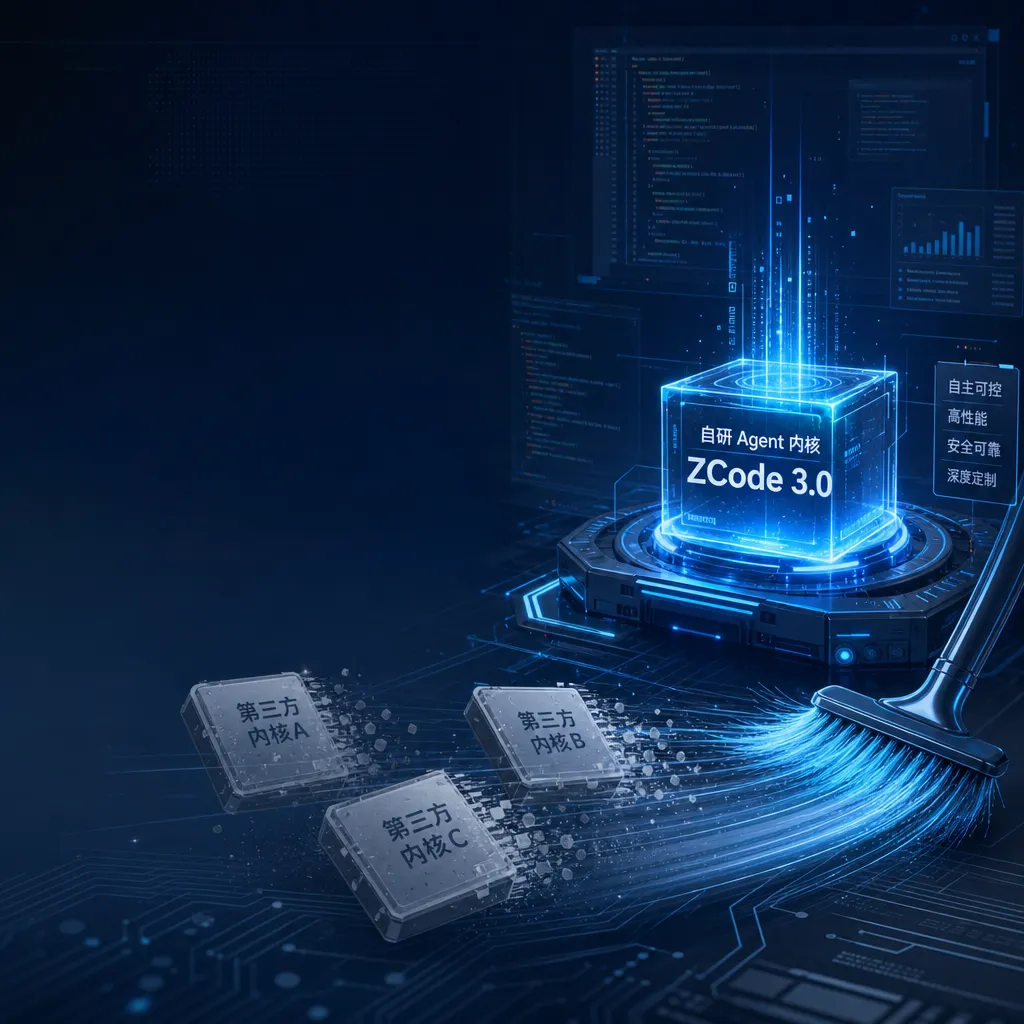
Zhipu released ZCode 3.0 today, officially switching to its self-developed ZCode Agent core, with deep integration for GLM-5.2. The official statement makes it clear that third-party Agent adaptation will no longer be maintained in the future—this is a move to reclaim control over the development experience.
Today (June 13), Zhipu threw a not-so-small stone into the domestic programming tool scene: ZCode 3.0 was officially released, fully switching to the self-developed ZCode Agent core, while being deeply adapted to GLM-5.2, which has just been made available to all users of the GLM Coding Plan.
The most noteworthy thing about this update is actually not that long string of features in the changelog, but one rather inconspicuous sentence from the official announcement — “Subsequent versions will focus on the self-developed Agent experience and will no longer bundle or maintain adaptations for other Agents.” In plain language: those compatibility layers in ZCode that interfaced with third-party Agent frameworks are all getting axed.
This is quite a hardline product consolidation.
Why Kick Out Third-Party Agents
Over the past year, domestic programming tools have mostly followed the “shell + third-party Agent + in-house model” assembly-line approach. The advantage is a fast cold start, but the downside is obvious: no matter how strong the model, if the Agent orchestration is not in-house, long-chain tasks exceeding dozens of steps cause tool invocation chains to misfire — looping on the same tool, or outright skipping key steps. When developers modify slightly more complex projects in their IDE, it’s often the case that the model itself is fine, but the Agent scheduling takes them off the rails.
Zhipu’s judgment this time is straightforward: For full-strength GLM, deeply optimizing long-range reasoning, tool invocation, and large project execution chains, overall task completion performance is already significantly better than with third-party Agents. In plain words — our own scheduler runs more stably than the open-source ones, at least when running GLM-5.2.
This logic is essentially the same as Anthropic with Claude Code, or Cursor with its in-house Agent: the model and the Agent must be co-designed. The prompt templates for tool invocation, the context truncation strategy, and the way tool results are fed back all need to align with the model’s preferences. Wrapping a specialized model in a generic framework is ultimately a lose-lose.
GLM-5.2: 1M Context That’s Actually Usable
Released alongside ZCode 3.0 is GLM-5.2, which Zhipu calls “the most capable open-source model to date” and emphasizes support for a truly usable 1M context.
The key phrase here is “truly usable.” The 1M-token context window has become standard marketing lingo since Gemini 1.5, but developers know full well: for most models, after you pump in 500k tokens, recall rates plummet, and so-called needle-in-a-haystack retrievals are just lucky hits. GLM-5.2’s main pitch this time is suppressing the “memory decay” problem in long-range tasks — for real-world projects with dozens of files and tens of thousands of lines of code, this is a far more pressing need than benchmark scores.
With ZCode Agent, GLM-5.2 can theoretically run cross-file refactoring or automated module transformations from requirements documents far more stably than before, compared to GLM-5.1 + third-party Agent. Of course, this needs to be tested hands-on by developers — launch event numbers are just for reference.
It’s worth noting that GLM-5.2 is still open-source. Zhipu has stuck firmly to this path — from GLM-4.5 to 5.2, the open-source policy hasn’t broken. For enterprise developers, this means you can use the GLM Coding Plan subscription for convenience, or download the weights for private deployment. OpenAI Hub has also integrated GLM-5.2 right away, so domestic developers can compare Claude, GPT, and GLM-5.2 code generation effects under the same key, without the hassle of opening separate accounts.
Seven Key Things in ZCode 3.0
Aside from the core switch, the 3.0 feature updates are quite dense this time, but a few genuinely address daily pain points and deserve a closer look.
Grouped Task Workspaces
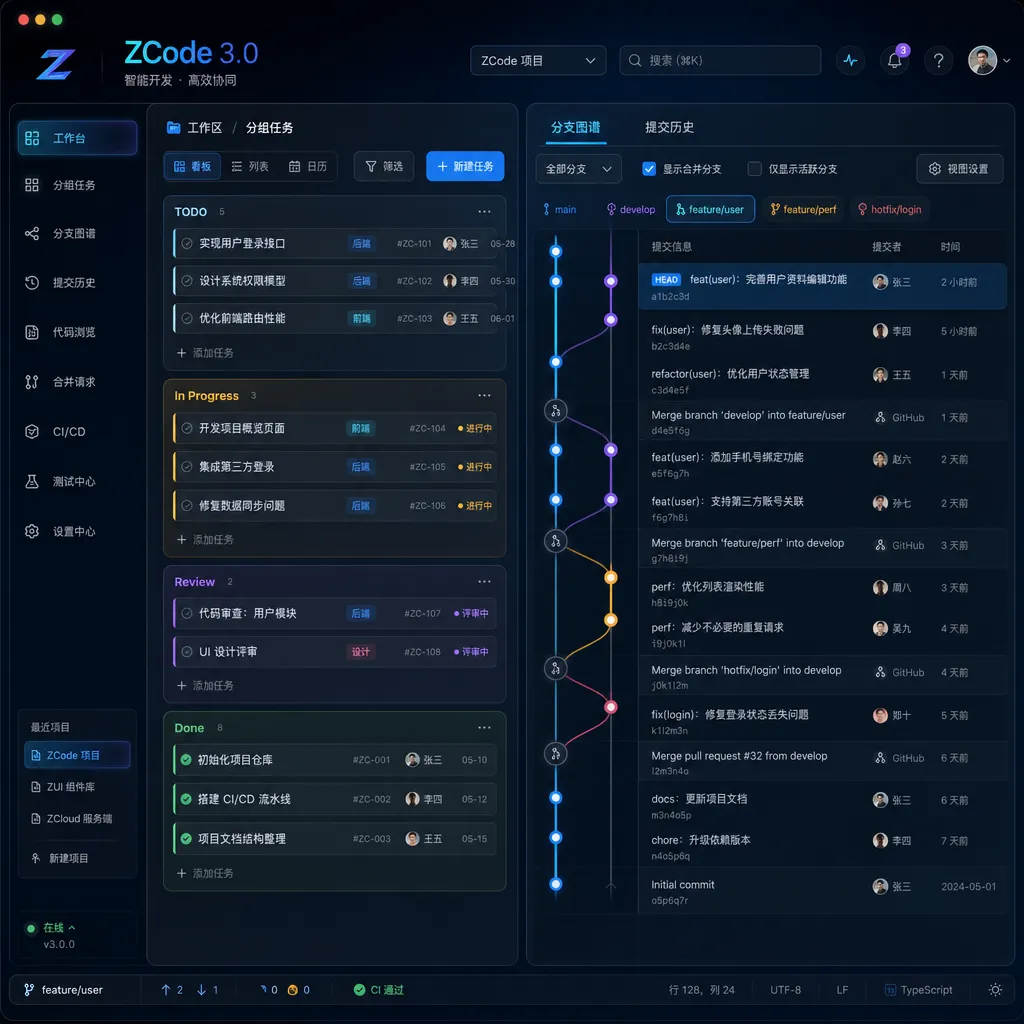
Previously, running three or four Agent tasks simultaneously in ZCode piled up tabs like a web browser. 3.0 introduces grouped workspaces that support drag-and-drop collapsing, cross-group migration, and batch management. This design is clearly aimed at “multi-Agent concurrency” — when you have Agent A running tests, Agent B writing docs, and Agent C fixing bugs, at least your screen won’t explode visually.
This detail feels very Cursor. Or put another way, domestic programming tools are finally recognizing the reality that “a developer may run multiple Agent tasks at the same time.”
Zread Intelligent Project Knowledge Base
This is an interesting feature. Zread automatically generates structured documentation for your project, supporting directory browsing, progress tracking, and one-click regeneration. Essentially, it turns the pre-processing step of “making the model understand the entire project” into a reusable knowledge base.
The biggest benefit in practice is reducing token consumption from repeated scans — previously, every new session required the Agent to grep the project structure all over again. Now this abstraction layer is fixed. For large monorepos, this is not just “a nice extra” but “the difference between usable and unusable.”
Visual Git Branch Graph
View branch topology directly in the IDE, with AI auto-generated commit notes. This may sound simple, but any tool that writes commit messages with AI is often useful — since few people enjoy manually writing neat Conventional Commits.
Other Features
- Customizable Chat Interaction: Streaming rendering, thought process display, performance modes, all toggleable, with low-spec compatibility. Friendly for users on older laptops.
- Status Monitoring Dashboard: Aggregates chat summaries, task progress, model usage, and context occupancy alerts. In short, it lets you know “how much of your plan is left” at any moment.
- Multi-type Attachments: Whiteboard snapshots, file paths, and images can be fed directly to the Agent. Especially friendly for front-end devs — drag a design mockup and it can cut and style immediately.
- New Visual System: Dual light/dark themes, reworked launch/login/welcome pages. Standard minor version polish, nothing major.
What This Update Means
Looking at the big picture, ZCode 3.0 is a landmark moment for domestic AI programming tools, signaling a move from “plugging into big models” toward “deep model–tool synergy.”
Previously, the prevalent product logic in China was: “I have an IDE plugin that can connect to various models.” The ceiling for this is low — you never know which model will suddenly surge ahead, so you scramble to build compatibility layers. But the thicker those layers, the less room for optimization for any single model.
This time Zhipu went the other way: narrow compatibility and put all engineering effort into the GLM stack. The cost is losing some users who want “Claude/GPT for coding,” but the payoff is GLM users getting an Agent truly tuned for GLM.
It’s a somewhat risky choice. But given GLM-5.2’s capability ranking and the subscription scale of the GLM Coding Plan, Zhipu can afford to bet.
For developers, the more practical issue is: if you’re used to doing side-by-side model comparisons in your coding tool, after ZCode 3.0 you might need to split by scenario — run GLM-stack tasks in ZCode, and use aggregators for other models. Platforms like OpenAI Hub that let you call all models with a single key fill this gap nicely: enjoy deeply-optimized GLM-5.2 in ZCode, and still benchmark Claude, GPT, Gemini from your scripts and tools, without conflict.
An Open Question
Zhipu’s strategic choice here also throws a question to domestic peers: in a world where model iteration speed is far from stabilizing, should you build a “Swiss Army knife” compatible with many models, or a “dedicated chainsaw” tied to one model?
ZCode 3.0 gives its answer. Cursor, Windsurf, and their Silicon Valley peers mostly give the same answer. But China’s market is more complex, with developers having an especially strong desire for “freedom to choose models,” so whether a single-model-focused tool can scale remains to be seen later this year.
In any case, with its version number “3.0” paired with the dual move of “core switch + abandoning third-party Agents,” this release carries real weight. The rest will depend on whether GLM-5.2 + ZCode Agent can hold up under real engineering workloads.
References
- ITHome: Zhipu AI Programming Tool ZCode 3.0 Released — First-hand info on the ZCode 3.0 release, including the full changelog


