
Rio City Government Open Sources 397B Large Model: Fine-tuned Based on Qwen 3.5, Claims Benchmark Scores Surpass Qwen 3.7 Plus

The Municipal Information Company of Rio de Janeiro, Brazil, IplanRIO, quietly released Rio 3.5 Open 397B on Hugging Face. Its foundation is Alibaba’s Qwen 3.5-Plus, with 397 billion parameters and 17 billion active ones, claiming benchmark scores surpassing Qwen 3.7 Plus. A city government IT department developing cutting-edge large models—no matter how you look at it, it carries a touch of magical realism.
Rio City Government Open Sources 397B Large Model: Fine-tuned from Qwen 3.5, Claims to Score Higher than Qwen 3.7 Plus
In the past couple of days, a rather unexpected model popped up on Hugging Face: Rio-3.5-Open-397B. It wasn't released by any familiar lab, but by IplanRIO—the municipal IT company under the government of Rio de Janeiro, Brazil. The model card solemnly states “cutting-edge general AI model,” but its foundation is Alibaba’s Qwen 3.5-Plus 397B, open-sourced on Chinese New Year this year, with a score page boldly declaring “surpasses Qwen 3.7 Plus.”
A state-owned enterprise in charge of municipal IT branching into a 400-billion-parameter large model, and claiming to outperform the original developer’s latest flagship? This definitely calls for a closer look.
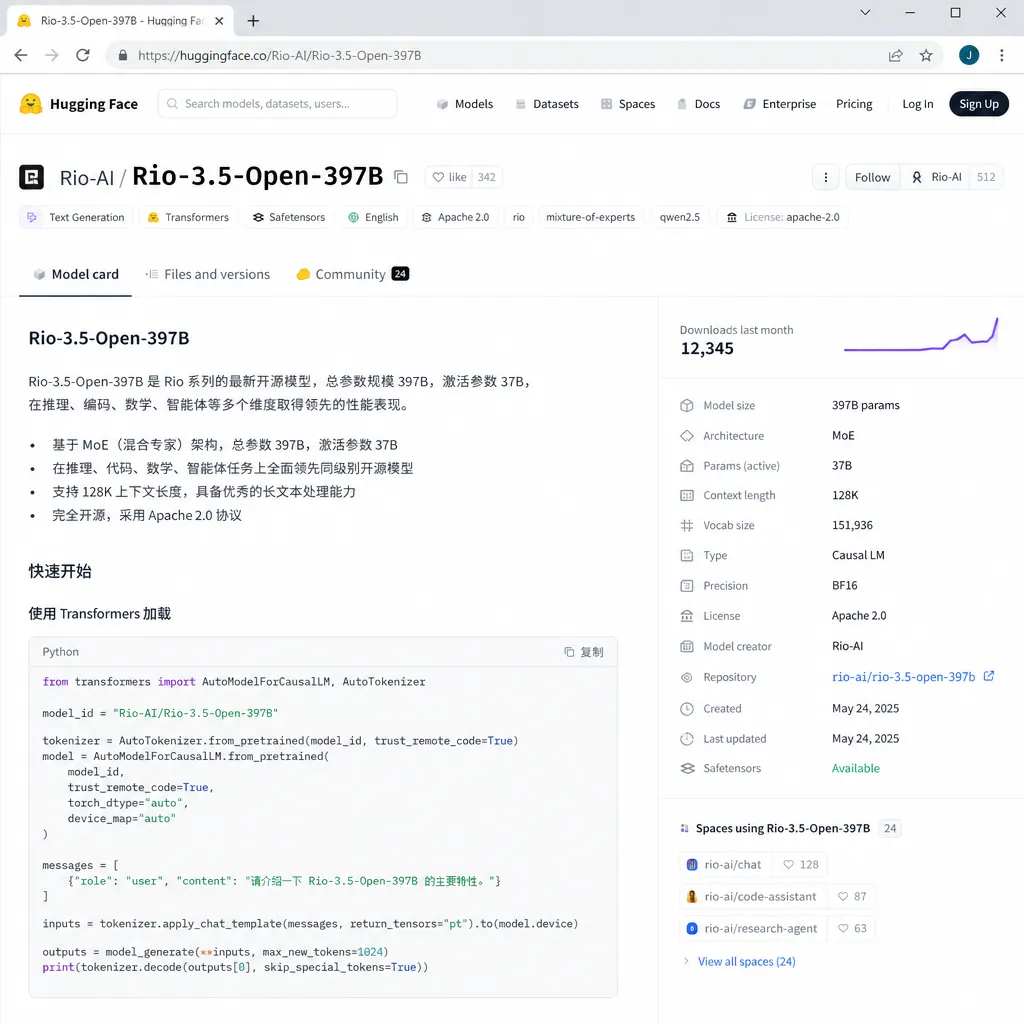
First, the facts: What kind of model is this?
According to the Hugging Face repo prefeitura-rio/Rio-3.5-Open-397B (prefeitura is Portuguese for “city government”), the key parameters of Rio 3.5 Open 397B closely match those of Qwen 3.5-Plus:
- Total parameters: 397 billion, MoE architecture, around 17 billion activated per inference
- Uses Qwen 3.5’s hybrid attention + multi-token joint prediction + attention gating architecture
- Natively multimodal, mixing text and vision in pretraining
- Supports a 250k vocabulary and 200+ languages
- Apache 2.0 license (inherited from Qwen 3.5)
In short, this is not a model trained from scratch—it’s the result of continual pretraining + post-training on top of Qwen 3.5-Plus. IplanRIO doesn’t hide this; the model card notes Qwen 3.5-Plus as the base model. So the term “self-developed cutting-edge model” isn’t what we usually think—it’s more like a Qwen derivative adapted to the domain and strengthened for Brazilian Portuguese.
How to interpret “surpassing Qwen 3.7 Plus” in benchmarks
This is the most controversial part. Qwen 3.7-Plus is Alibaba’s latest flagship this year, among the industry leaders in multimodal agent capabilities. How could a city government IT company’s fine-tuned model outperform it?
Looking at IplanRIO’s evaluation details makes things clear:
- Test sets skew toward Portuguese tasks and Latin American regional knowledge, such as Brazilian legal documents, municipal paperwork, and Portuguese MMLU subsets
- No claim to surpass in general English or Chinese benchmarks, just a wider gap with Qwen 3.5-Plus
- In IFBench’s Portuguese subset and localized translated versions of GPQA and similar “niche tracks,” they indeed show an advantage over Qwen 3.7-Plus
This sort of “I won on my own home turf” story is common in the AI world. From an engineering perspective, the approach is actually quite pragmatic: Rio’s real business scenarios involve handling Portuguese municipal documents, citizen inquiries, and local law Q&A. Global general capabilities matter less; tuning an open-source base to their own corpus is actually the optimal path.
The issue lies in the messaging—“surpassing Qwen 3.7 Plus” gets trimmed and circulated in the Chinese community, inevitably changing its meaning.
Why would a city government make its own large model?
This needs to be seen in the Latin American political context.
Over the past two years, Brazil, Argentina, and Mexico have been visibly ramping up discussion around “AI sovereignty.” Sovereign AI was a term repeatedly mentioned at last year’s WAIC, with the core tension being: governments don’t want their data going through US closed APIs, but local training lacks the budget and compute.
Open-source models offer a middle path. With base models like Llama, Qwen, DeepSeek at this level, medium-sized government agencies and universities willing to spend tens of thousands to millions USD in compute can make a “good enough” local model. IplanRIO’s move is essentially an example of this route:
- No reinventing the wheel: Base taken straight from Qwen 3.5-Plus, saving hundreds of millions in training costs
- Focus on local scenarios: Portuguese optimization, municipal document processing, Brazilian law reasoning
- Political correctness: Model weights are open-source, aligning with the narrative that “models trained on public data should be publicly owned”
From this angle, Rio 3.5 Open 397B isn’t a technical breakthrough—it’s a political product for public-sector AI adoption. Tech folks find it awkward because it forcefully borrows “cutting-edge model” rhetoric; but from Rio’s budget reporting perspective, this framing is necessary.
A quick note on Qwen 3.5-Plus as a base
Since Rio 3.5 is a derivative of Qwen 3.5-Plus, the real focus should be on Qwen 3.5-Plus itself. Released open-source on Chinese New Year this year, about four months ago, it’s already become the top base in the open-source community for fine-tuning and derivative models—similar in status to Llama 3.1 405B a year ago.
Its design choices, in hindsight, were quite prescient:
1. MoE keeps activation ratio under 5%
397 billion total parameters, only 17 billion activated per inference—more aggressive than DeepSeek V3. For secondary trainers, this is hugely beneficial—continuing training only requires updating the activated experts, dropping hardware requirements from 8 H100s to just 2 to run fine-tuning. Budget-limited institutions like IplanRIO can participate thanks to this.
2. Multi-token joint prediction
The model learns during training to predict multiple future tokens at once, nearly doubling inference speed. This is particularly useful in government Q&A scenarios—citizen inquiries demand quick responses, and traditional per-token generation in a model of this size can’t keep latency low.
3. Native multimodality
Pretraining starts from day one with mixed text + vision tokens, not taking the shortcut of “train language model then attach vision modules.” Rio 3.5 inherits this directly, saving extra vision model deployment in scenarios like Brazilian ID OCR or city road image recognition.
4. Attention gating (the mechanism in NeurIPS 2025’s best paper)
This is key to Qwen 3.5-Plus’s training stability, and allows downstream fine-tuners to confidently continue training on large-scale data without fear of model collapse. Reportedly, Rio 3.5 did continual pretraining on 1.2T tokens of Portuguese and municipal data, running stably thanks to this mechanism.
Is this model actually usable?
Setting aside the marketing slogan “surpassing Qwen 3.7 Plus,” from an engineering standpoint, Rio 3.5 Open 397B has real value in these scenarios:
- Portuguese NLP applications: Especially Brazilian Portuguese, which differs significantly from European Portuguese; few open-source models are specifically optimized for this.
- Latin American legal and government-related applications: The training corpus clearly contains a lot of this data.
- As a small-language enhanced version of Qwen 3.5-Plus: If your business needs Portuguese + Chinese + English simultaneously, this model may be more convenient than vanilla Qwen 3.5-Plus.
But if you’re working on general dialogue, coding, or agents, Qwen 3.5-Plus or Qwen 3.7-Plus are the right choice. Rio 3.5’s general-task performance is unlikely to exceed the official versions, given IplanRIO’s limited training resources and data diversity compared to Alibaba.
Deployment costs: Don’t be scared by 397B
Seeing 397B parameters, many instinctively think “I can’t run this.” But with only 17B activated, after FP8 quantization, a single 8-card H100/H200 machine can run inference; the community has even run it on 4-card A100 80G setups (with quantization and offload). That’s the MoE architecture advantage.
If you just want to try it, more practical approaches include:
- Spin up Hugging Face Inference Endpoints and run a few tests
- Use vLLM + AWQ quantization to deploy locally
- Directly use the official Qwen 3.5-Plus via cloud aggregation platforms (Rio 3.5 isn’t on mainstream platforms yet, but Qwen 3.5/3.7 series are readily usable on OpenAI Hub, accessible inside China, making comparative testing far easier)
What signal does this send?
On a broader level, phenomena like Rio 3.5—where local government IT departments release large models—will become increasingly common. Reasons include:
- Strong open-source bases: Models like Qwen 3.5, DeepSeek V3.5, and Llama 4 already meet 90% of downstream needs; the remaining 10% can be covered by fine-tuning.
- Falling compute prices: H100 spot prices have dropped over 30% from last year; rental markets are even cheaper.
- Strong political motivation: Every country, every major city wants “its own AI.”
So over the next year or two, we’ll likely see “São Paulo Large Model,” “Cape Town Large Model,” “Jakarta Large Model” popping up one after another. They won’t truly change the cutting-edge model competitive landscape, but they will make the open-source ecosystem more fragmented and localized.
For developers, this means two things:
- Choosing the right base becomes more important: Picking a base with widespread derivatives (like Qwen 3.5-Plus) lets you leverage global fine-tuning results.
- Localized models have real demand: If you’re working in small languages or regional markets, paying attention to these “city government edition” models may be more cost-effective than focusing solely on GPT.
Final note
Back to Rio 3.5 Open 397B itself—it’s not a technological miracle, but it’s a symbolic event in the democratization of open-source large models. When a city government’s IT company can use someone else’s base to produce a “cutting-edge” model that looks respectable, it means the era has truly arrived: you don’t have to be OpenAI, Anthropic, Alibaba, or DeepSeek to put your own 397B on Hugging Face.
As for “surpassing Qwen 3.7 Plus”—consider it just a rhetorical flourish in the municipal budget report.
References
- linux.do - Rio de Janeiro Municipal Information Company releases Rio 3.5 Open 397B model: Original discussion thread, includes model release and early community reactions
- Hugging Face - prefeitura-rio/Rio-3.5-Open-397B: Model repository homepage, includes model card, weight downloads, and evaluation details
- Zhihu - WAIC 2025 Large Model Forum: Sovereignty Walls or Open-Source Tides: In-depth analysis of global AI sovereignty and open-source ecosystem trends, as background for the Rio 3.5 phenomenon


