
OpenRouter Launches Fusion API: Combine Multiple Models into One
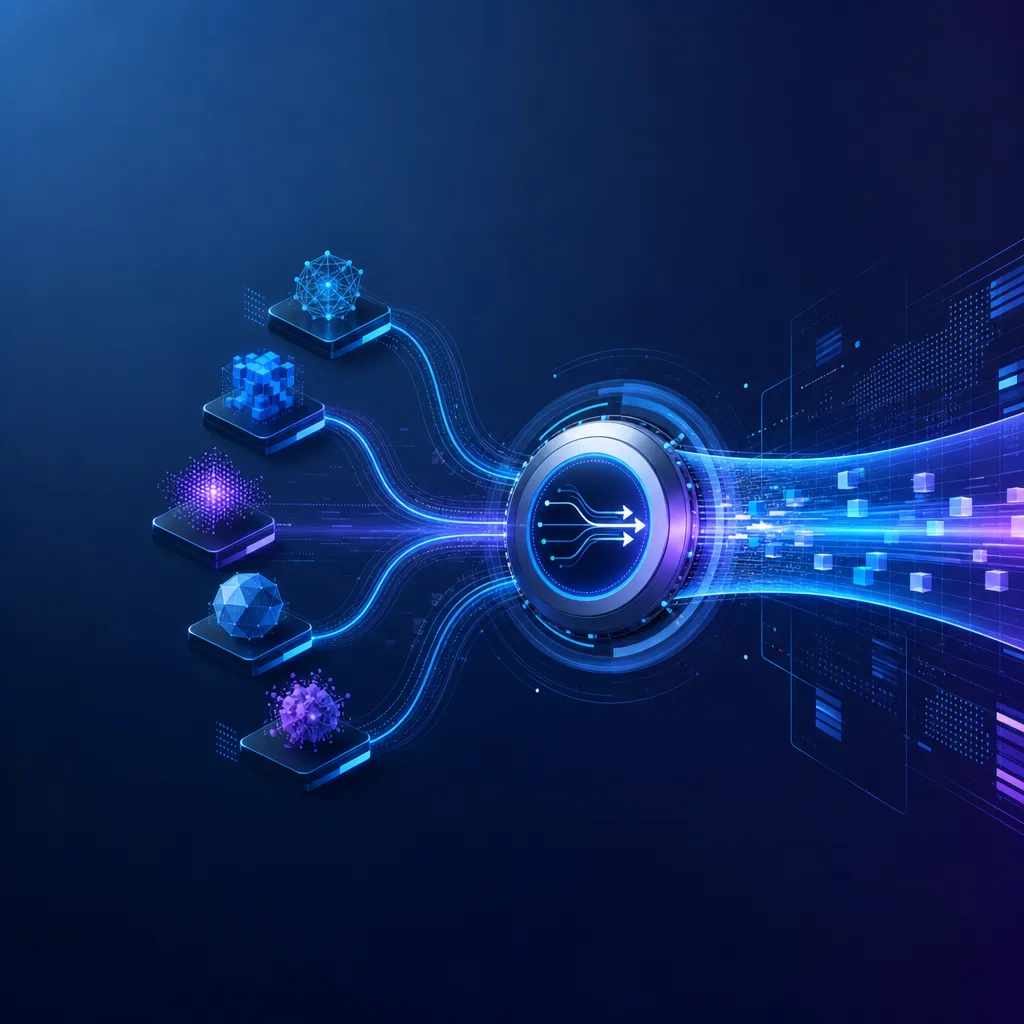
OpenRouter launches the Fusion API, which aggregates multiple models to work together, claiming to achieve Fable-level intelligence at half the price. The test task chosen is deep research rather than coding, a choice that is intriguing in itself.
OpenRouter This Time Isn’t About Routing — It’s About Fusion
On June 13, OpenRouter quietly launched something new called the Fusion API. Unlike its previous focus on routing and load balancing, Fusion takes a more aggressive approach — chaining/parallelizing multiple models to work together, then exposing the result as a single API endpoint. Their selling point is straightforward: “Achieve Fable-level intelligence at half the price.”
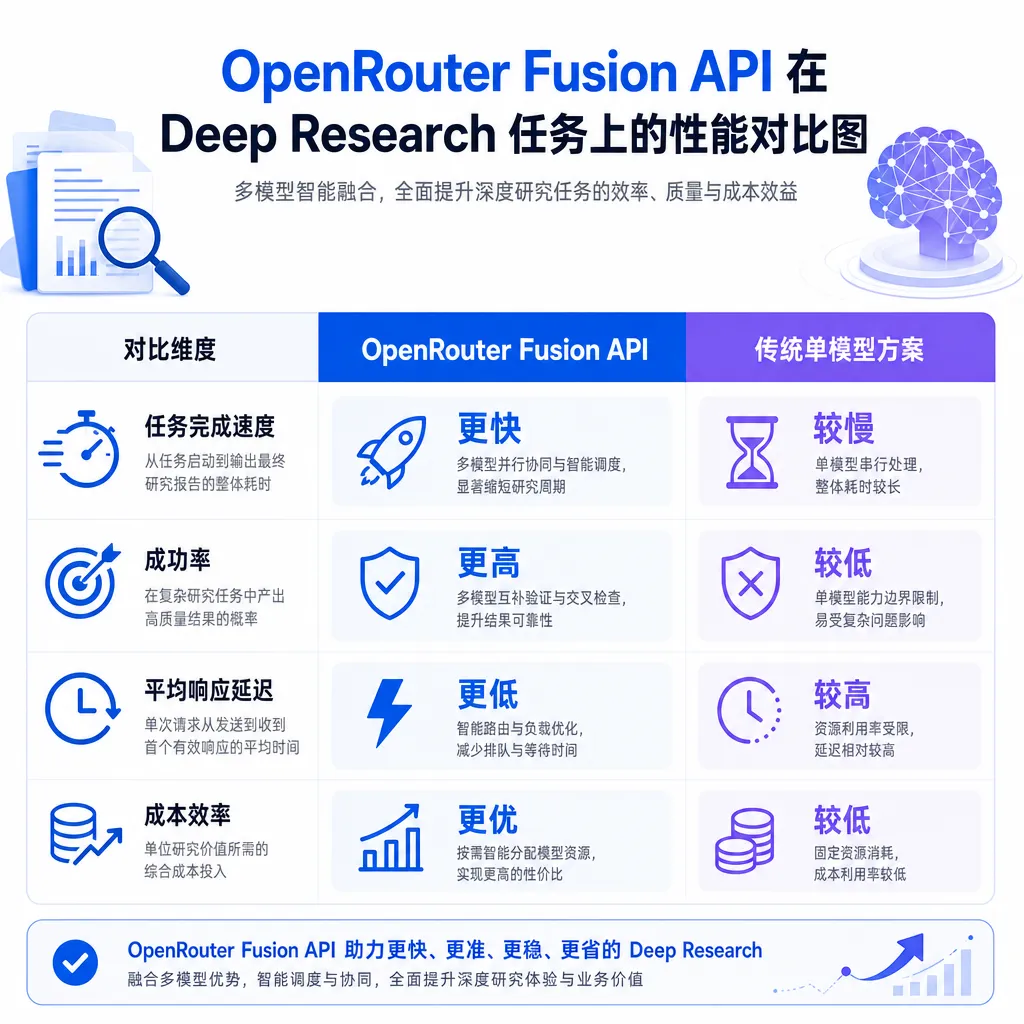
At first glance, you might think this is just another engineered packaging of MoA (Mixture-of-Agents). But looking closely at the benchmark tasks OpenRouter provided, some interesting details emerge: the evaluation metric is Deep Research, not coding. In their comparison chart, DeepSeek V4 Pro in solo mode even scores competitively with top-tier models — and this combination indicates that Fusion is targeting a market not for deterministic, standardized-answer tasks like coding, but for open-ended, long-context, multi-perspective research-oriented tasks.
Why “Fusion” Instead of “Routing”
To understand the difference between Fusion and OpenRouter's earlier Model Routing, we need to clarify concepts.
Previously, OpenRouter essentially “picked the single best model to answer”. You sent a request, and it would choose a provider based on latency, price, availability, or domain strengths, then forward it. The whole process was transparent to you, but each request still ended up being handled by only one model.
Fusion is different. It “makes several models work together, then synthesizes an answer”. Based on community information, Fusion internally runs something like a MoA-style pipeline:
- First layer: multiple models generate drafts in parallel, each bringing different perspectives from their preferences and knowledge strengths/weaknesses
- Second layer: one or more aggregator models read all drafts, cross-check facts, remove duplicates, and fill in gaps
- Third layer: a final synthesizer outputs a unified answer, standardizing style and logic
This architecture isn’t new in academia — Together AI published a MoA paper back in 2024, showing that layering six open-source models could outperform GPT-4 Omni on AlpacaEval. Fusion’s value isn’t in inventing something, but rather in turning something engineers had to cobble together into a single endpoint — you POST a prompt, and don’t have to worry about the rest.
Why Deep Research, Not Coding
This choice is no accident. MoA-style architectures are highly sensitive to diversity between models.
For coding, the space of correct answers is narrow. If you ask five models to write binary search, differences mostly lie in variable names and comment style. Aggregators have little to gain from merging these drafts — and might even end up lowering code quality by introducing output from a suboptimal model. That’s why top-tier models like Claude or GPT-5 in solo mode have yet to be consistently beaten by any MoA approach for coding tasks.
Deep Research is a completely different ecosystem. A research question — e.g., “Analyze the divergence in stablecoin regulation in the US, Europe, and Japan over the past 18 months” — demands multi-dimensional, multi-perspective, integrative content. In such a case:
- DeepSeek V4 Pro excels at Chinese context and financial regulation details
- Claude 4 Opus excels at long-document summarization and structured output
- Gemini 3 excels at cross-lingual fact retrieval
- GPT-5 excels at maintaining logical argumentation
When you fuse their outputs, coverage of information genuinely increases. That’s why Fusion uses Deep Research as an evaluation metric — it’s the scenario where MoA shines the most by playing to each model’s strengths.
In short, OpenRouter isn’t trying to go head-to-head with single-model SOTA. It’s smartly picking a track where collective intelligence > individual intelligence.
Pricing Logic: Why “Half of Fable”
“Half the price for Fable-level intelligence” sounds like marketing, but the breakdown makes sense.
Fable, as a closed-source model, has pricing that includes the full R&D chain — pretraining, alignment, safety auditing, brand premium. Fusion’s approach is to call APIs for several mid-range open-source models (DeepSeek V4 Pro, GLM-5, Qwen3-Max, etc.) and combine them to reach similar output quality — inherently lowering the per-request token cost by an order of magnitude.
However, Fusion isn’t a free lunch:
- Higher latency — multi-layer pipelines mean at least 2–3× end-to-end wait time, making them unfit for real-time use cases
- Increased token consumption — drafts and aggregation each burn tokens; “half price” assumes the task’s complexity justifies this overhead
- Uncontrollable variance — multi-model output stability is harder to tune than in solo mode
So Fusion’s ideal use cases are clear: asynchronous, deep, quality-sensitive-over-latency tasks. Research report generation, long-document analysis, complex decision support — in such scenarios, waiting 30 more seconds for a more comprehensive answer is totally worth it.
What This Means for Developers
If you’ve ever built an MoA pipeline yourself, you know the pitfalls:
- Maintaining separate rate limits and retry logic for different providers
- Deciding fallback strategies (what if the aggregator fails? What if a draft model times out?)
- Designing prompts separately for drafter, aggregator, and synthesizer roles
- Splitting cost accounting by layer
Fusion takes care of all of this. API-wise, it’s still the standard OpenAI-compatible format — just change the model name to openrouter/fusion, and you don’t need to know how many models it runs behind the scenes. For small and medium teams, the real value is saving engineer salaries, not just API costs.
But there’s also a concern: it’s more of a black box. You don’t know which models contributed to the answer, which aggregator did the merging, or whether fallback was triggered. For enterprise scenarios requiring auditability and traceability (law, healthcare, finance), this “end-to-end fusion” format may not be directly usable for now. OpenRouter will likely need to add full trace outputs, exposing intermediates for compliance review.
Lateral Comparisons
OpenRouter isn’t alone on this track:
- Together AI has long had an official MoA implementation, but more as a research demo than a stable commercial product
- Anyscale and Fireworks offer Agent Orchestration frameworks for DIY assembly, but not as a ready-to-use API
- China’s SiliconFlow and SiliconCloud have recently promoted the concept of “multi-model collaboration,” but are still at the self-routing stage
OpenRouter’s biggest differentiator is turning multi-model collaboration from a “framework” into a “service” — one API endpoint, unified billing, standard compatible format. This kind of engineering polish is exactly what an aggregation-layer platform like OpenRouter should be doing.
As a side note, OpenAI Hub has already unified mainstream models (GPT, Claude, Gemini, DeepSeek, etc.) into an OpenAI-compatible format. If you want to assemble a Fusion-like MoA flow within China’s direct-connect environment — scheduling multiple models with one key — the technical barrier is much lower than overseas. Once OpenRouter’s Fusion architecture stabilizes, it’s worth watching whether domestic aggregators will follow with similar “service-style fusion.”
A Few Points to Keep Watching
In the short term, Fusion still hasn’t answered a few questions:
- Is the model combination fixed or dynamic? Fixed combos risk underperforming on tasks outside their strengths; if dynamic, the routing strategy itself is core IP.
- Custom fusion support? Letting users specify “I want Claude + DeepSeek + Qwen” would be a strong enterprise demand.
- Relation to Agent frameworks — If Fusion integrates with Tool Calling and MCP, it could become not just a Q&A endpoint but the seed of a “multi-model collaborative Agent.”
OpenRouter’s timing is interesting — single-model capability curves are flattening, while model differentiation is growing, opening a window for “compositional arbitrage.” Whether Fusion is the ultimate answer doesn’t matter; what matters is that it drags “multi-model collaboration” out of research papers and into production API calls.
Once this step is taken, there’s no going back.
References
- linux.do — OpenRouter Fusion API discussion thread: The earliest community discussion of Fusion API performance data and pricing, including Deep Research benchmark comparisons
- Zhihu — The universal entry point in the era of large models: OpenRouter: In-depth analysis of OpenRouter’s overall positioning and the value of the aggregation layer


