
Google has turned search into a "backstage night watchman": AI agents monitoring the entire internet 24/7

Google has officially launched a search agent in AI mode, capable of running 24/7 in the background, actively monitoring information across the entire web and pushing updates instantly. This marks a key step for search engines from "waiting for you to ask" to "proactively telling you." Currently, it is only available to AI Ultra subscription users.
Today (June 14), Google officially launched the search agent feature that was previewed at last month’s I/O. Simply put, the search box — a “passive entry point” that’s been around for over twenty years — can now watch the things you care about in reverse. You don’t open a tab, and it still runs.
The first batch online is the Information Agents, which monitor the whole web and push updates instantly, currently only available to Google AI Ultra subscribers. Two monthly tiers: $99.99 and $199.99, covering all languages and regions currently supported in AI mode. The AI Pro tier will be available later in the summer.
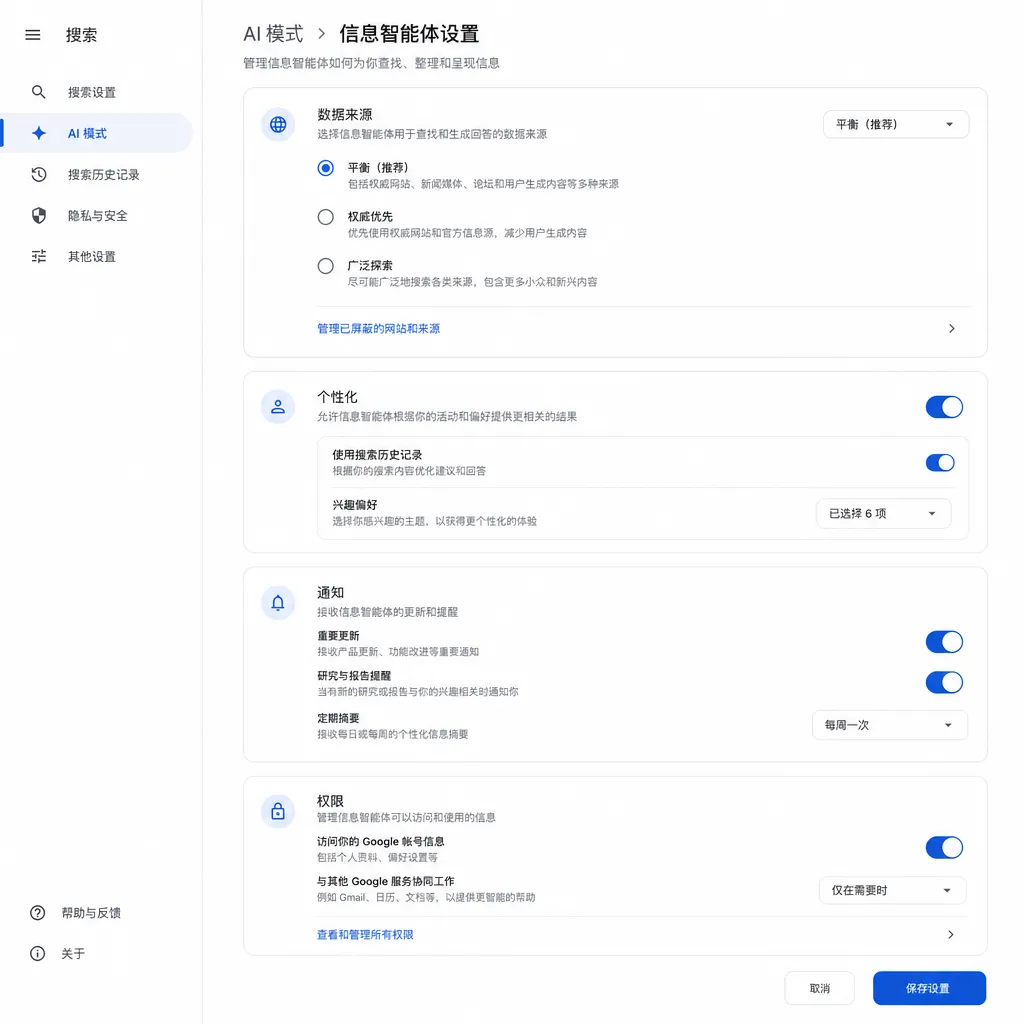
This isn’t a scheduled task — it’s a resident process
Let’s break it down. In AI mode, a user inputs something like — “Keep monitoring…” or “Alert me when…” — then adds specific conditions, such as local second-hand homes under $5 million and above 90m², or stock updates for a limited-edition collaboration sneaker. The agent is then created. Once triggered, it consolidates the content it captures into an update and pushes it to you, with shortcuts (e.g., directly jump to purchase, or property details).
Sounds like an upgraded version of Google Alerts? In a sense, yes — but the operating mechanisms are completely different.
Google Alerts is keyword matching + scheduled push, which gives you a “list of new links containing this word.” Google’s other automation products — scheduled tasks in standard Gemini, periodic retrieval in Gemini Spark — are also periodic, ranging from every 15 minutes to daily.
The search agent changes the logic. It no longer polls on a schedule — instead, it continuously performs semantic-level analysis on global data streams: blogs, news platforms, social media, financial quotes, product inventory, sports live data — as soon as new content arrives, it runs a match against your agent’s rules. If matched, it pushes immediately.
This difference is crucial for scenarios like breaking news, limited releases, and inventory fluctuations. A restock window for a pair of collaboration sneakers might only last 3 minutes — tools running every 15 minutes simply can’t keep up.
Built on Gemini 3, with emphasis on “proactive reasoning”
As disclosed at I/O, the system runs on Gemini 3. Besides text, it can handle multimodal inputs — charts, data visualizations, and video clips.
But what really justifies the “agent” name is proactive reasoning. For example, say you create an agent to monitor a tech company’s stock price — traditional tools give you numbers and news links. The new agent will do this:
- Monitoring price fluctuations as a baseline;
- Integrating current financial reports, industry reports, and social sentiment to explain the change;
- Comparing different analysts’ views, telling you market sentiment;
- Based on data, offering actionable suggestions — whether to increase or reduce holdings, and where to set a stop-loss.
This is key: it doesn’t just revolve around your keywords — it will automatically identify potentially related items. Monitoring a tech company, it will also pull in updates from upstream suppliers and major competitors. You can add rules like “only alert when fluctuations exceed 5%” or “only push authoritative sources.”
Essentially, it compresses what would require an analyst assistant into a resident agent. Moving from "information retrieval" to "information + judgment + suggestion" shifts the tool’s role upward.

Search engine “role reversal”
From a distance, the significance isn’t just “Google launched another feature.”
Traditional search is a passive entry point: you enter keywords → it returns a list of links → you click → you digest the content yourself. This paradigm hasn’t changed much since Google launched in 1998, aside from ranking algorithms and ad formats.
Search agents flip the direction of interaction — entry point shifts from user-initiated querying to system-initiated notification. This aligns with a bigger trend: users no longer “go online to search,” but instead hand over intents to a resident agent to run the process for them. Gemini Spark is also moving in this direction — Spark leans toward “execution on behalf” (e.g., handling emails, placing orders), whereas search agents focus on “perception on behalf.” Together, they form Google’s envisioned AI-era search: perception + decision + execution in a closed loop.
This paradigm shift has side effects developers should note. When distribution moves from “user clicks a page” to “agent decision pushes,” traditional SEO, attribution pathways, and ad slot logic will all be impacted. One immediate issue: if 80% of user information consumption happens through agent summaries, where does source site traffic come from? That’s a tricky question for Google itself — it’s both a search engine and a traffic middleman, and now its agents are, in some ways, intercepting its own outbound traffic.
Competitive landscape: Bing and Baidu are doing it too, with different paths
By 2026, the search agent track is already crowded.
- Microsoft Bing launched its ChatGPT-5-based agent function in Q1, with a differentiator being integration with the Office 365 ecosystem — you can directly call an agent from within a Word doc to grab the latest data, avoiding window-switching when writing reports. Its advantage is penetration in B2B office scenarios.
- Baidu’s “Wenxin Agent” targets Chinese-language contexts, integrating Baidu’s own data assets like Baidu Baike and academic resources, providing localized information services.
- OpenAI’s ChatGPT Tasks and Agent modes launched last year, but strictly speaking are “periodically run assistants” — their ability for global real-time monitoring + instant push hasn’t yet caught up.
Google’s differentiator is index scale. Its two-decade accumulation of web crawling and real-time indexing infrastructure is a natural barrier in “continuous monitoring” — other companies attempting the same face massive infrastructure costs just to stream all global blogs, social media, and inventory data in real time.
The trade-off is cost. AI Ultra at $199.99/month is obviously not aimed at ordinary users — it’s for financial analysts, procurement managers, and information arbitrage professionals. These groups will pay to “know 10 minutes earlier than others.” When AI Pro launches this summer, the price threshold will enter the realm of ordinary consumer consideration.
What it means for developers
If you’re building products or writing code, here are a few points worth thinking about:
- Passive search logic is becoming outdated. If your product depends on users actively searching, clicking, and consuming content, consider whether users will outsource that to agents. If so, how will your content be cited by agents?
- The value of structured data is rising. Agents clearly prefer sources with schema, APIs, and clear metadata. Adding friendlier structured markup to your product’s content may be the simplest “AI SEO” in the coming years.
- Real-time capability becomes a competitive dimension. Tools polling every 15 minutes aren’t enough in breaking scenarios — monitoring, alerting, and subscription products need a tech stack reevaluation: push or pull, acceptable latency levels.
- Multi-model composition is becoming normal. Gemini 3 excels here, but not all tasks suit it. For developers, combining calls to different models and routing by scenario is more realistic than locking into one. Platforms like OpenAI Hub that connect GPT, Claude, Gemini, DeepSeek etc., with domestic direct access and OpenAI-format compatibility, make multi-model orchestration easier.
Unresolved issues
Stepping back, this feature still faces several obvious hurdles:
- False positives and noise. Global real-time monitoring brings high recall rates with potentially lower precision. If an agent pushes 50 updates and 40 aren’t what the user wants, the experience breaks. Fine-grained rule customization is key.
- Privacy and data scope. “Global monitoring” sounds great, but how deep can it go? Social media platforms have tightened anti-scraping, rate limits, and API policies in recent years — data acquisition costs for X, Reddit, Instagram are rising. The actual scope of “global” depends on experience.
- Over-reliance on a single source. When users consume information entirely via an agent, filter bubble issues worsen — you won’t see what the agent didn’t push. This is an ethical design question, and Google hasn’t given a clear response.
- Price. $99.99/month is too high for consumers — until AI Pro launches, this is essentially a tool for enterprises and high-net-worth users.
Summary
The search agent isn’t a revolutionary tech breakthrough — proactive reasoning, multi-source integration, instant push are not new concepts individually. But turning the search engine itself into a resident Agent is significant in product form. It marks a shift from search as a tool to search as a service, and signals that the information distribution landscape will be reshuffled in the coming years.
For developers, instead of worrying “will people use this,” it’s better to consider: “If users really start outsourcing search to agents, how will my product survive?” That’s a question worth more time than the feature itself.
References
- ITHome: Google launches search agent feature to proactively monitor global information for you — First report on the launch, including pricing and feature details


