
Alipay is going to embed an Agent called "Abao," and this time Ant Group wants to take a shortcut to being AI-native.

Ant is carrying out an AI Agent transformation for Alipay. The new assistant "Abao" can directly place orders for ride-hailing, food delivery, and coffee via voice or text. With authorization, it can also purchase funds and manage investment accounts. This is an attempt to migrate from a super app to an agent-based entry point.
Bloomberg dropped a scoop today: Ant Group is undertaking a rare major overhaul of Alipay — the first since 2008 — with the core move being to replace the entire app’s interaction layer with an AI Agent. The new assistant has a down-to-earth Chinese name: "Ah Bao" (阿宝).
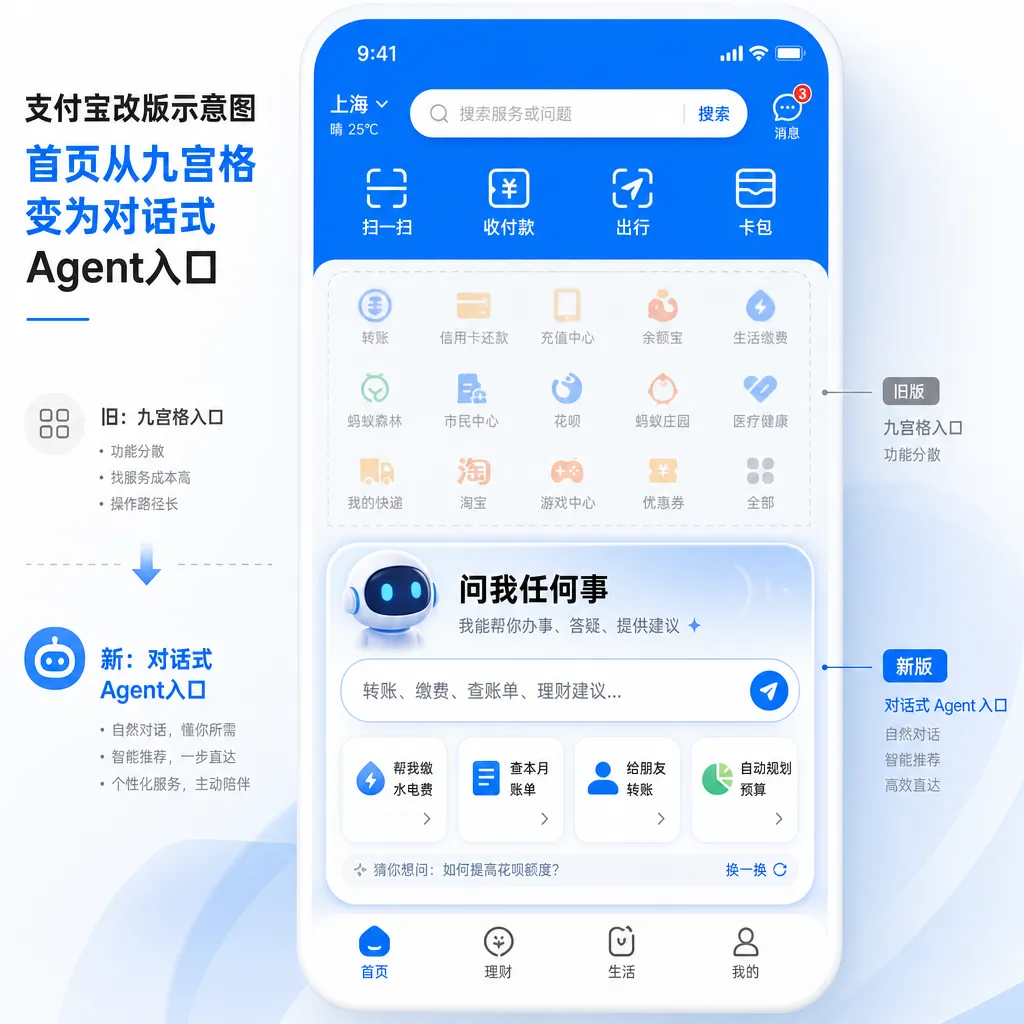
According to internal demo videos seen by Bloomberg reporters, the revamped Alipay works like this: When users open the app, instead of a grid of mini‑program icons, they directly speak or type to “Ah Bao” — “Get me a ride to Hongqiao,” “Order a Luckin Coconut Latte to my office,” “Order any light meal for dinner.” With additional user authorization, Ah Bao can even directly execute financial commands: buy a certain mutual fund, adjust recurring investments, or manage positions in an investment account.
The launch date hasn’t been set, and Ant hasn’t officially confirmed it. But the signal value of this move is more important than its timetable.
Why Alipay Has to Change
First, a largely overlooked fact: Alipay hasn’t fundamentally changed in a long time.
Since 2013, this app has followed the “super app” path, cramming everything possible into its homepage — transportation, food delivery, healthcare, government services, wealth management, insurance, utility payments. The grid kept expanding, secondary pages got buried deeper. As a result, most users scan to pay, open their health code, occasionally repay credit cards — and can’t find or use 90% of the other functions.
This is the curse of all super apps: once features stack to a certain extent, the entry point itself becomes the ceiling of user experience. WeChat, Meituan, Alipay — all are at this critical point.
The emergence of AI Agents presents a way to bypass “entry design” — users no longer have to look for a button, the button comes to them. Under this logic, an app can shift from being a “function shelf” to “a person who gets things done.”
Ant clearly wants to act before WeChat and Meituan, and make this cut first.
What Exactly Is “Ah Bao”
From the demo details, Ah Bao is not just a Chatbot with a wrapper, but an Agent with execution permissions. Two key points stand out:
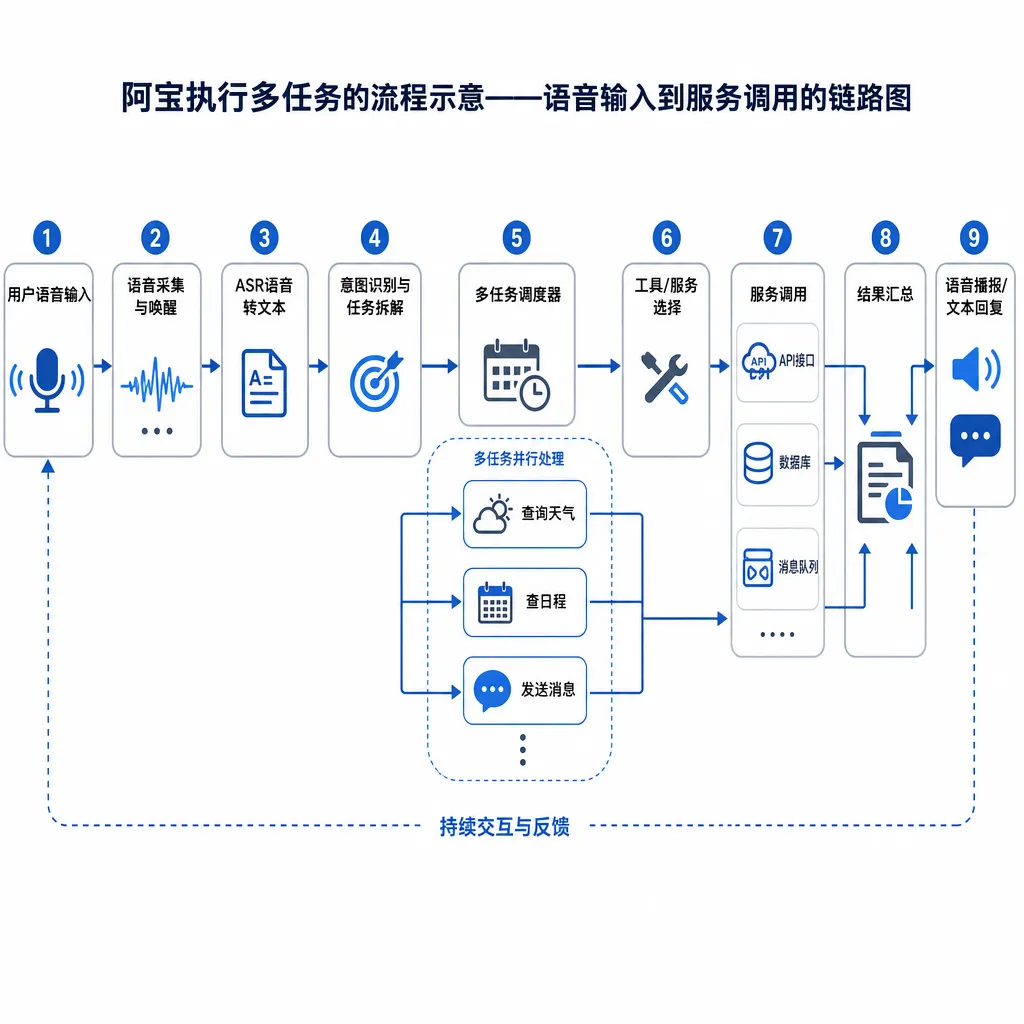
First, cross‑service task orchestration capability. When a user says “Get a ride,” Ah Bao must know which ride‑hailing service to call (Gaode? Didi? Alipay’s own?), the user’s frequent addresses, payment method, whether to share rides. For “Order coffee,” it must handle brand selection, store location, menu matching, delivery address, order confirmation. This is built on service call chains accumulated over more than a decade, connecting third‑party mini programs, lifestyle accounts, and merchant APIs into the Agent’s tool layer.
The difficulty here lies not in model reasoning, but in re‑engineering an ecosystem with thousands of mini programs into an “Agent‑ready” integration standard.
Second, Agent-ization of wealth management scenarios. This is a bold step. Errors in ordering rides or meals may cost only tens of yuan, but letting an Agent buy funds or manage accounts involves compliance and financial security at every step. Ant’s approach is “additional authorization” — graded permissions, where ordinary life commands are executed by default, while actions involving money require separate secondary confirmation.
This design isn’t aggressive, but in China’s tightly regulated financial environment, getting to “AI executes fund purchase” is already walking a fine line. Likely, Ah Bao’s initial wealth management capabilities will be conservative — more “recommend + assist confirmation” than full autonomous decision‑making.
Ant’s Trump Cards: The Bailing Model and Service Ecosystem
Ah Bao is almost certainly powered by Ant’s self‑developed Bailing model, not external APIs. This is unsurprising — at Alipay’s scale, daily invocation volume can easily reach the tens of billions, making reliance on third‑party inference impractical.
But the model itself is not Ah Bao’s moat. The true moat is the two assets Alipay has amassed over more than a decade:
- Verified identity and payment ability: The hardest part of an Agent placing orders is not understanding what you say, but legally and compliantly paying on your behalf. Alipay has already cleared this hurdle.
- Service call network: From food delivery to government services, Alipay runs on a plug‑and‑play service graph. Adding a new coffee brand could be 10× faster than a new Agent platform negotiating from scratch.
These give Ah Bao a unique advantage in China — making it far closer to “getting things done” than generic Agents (such as some startup “super intelligent assistants”).
A Few Pressing Questions
Don’t cheer too soon — this is a highly complex execution challenge, with some unanswered questions:
How does Agent economics work? Alipay’s mini program ecosystem has long relied on traffic distribution — merchants buy homepage slots, recommendation spots, ads. If users stop “browsing” the homepage and let the Agent execute directly, the traffic distribution model collapses. Why should a merchant be first in Ah Bao’s recommendations? How does the ranking algorithm decide? This may require an entire rewrite of the business model.
What about multi‑Agent competition? Today a user might use Ah Bao in Alipay to order takeout; tomorrow they open Meituan and use its Agent; the next day WeChat launches one. Will Agents become the new battleground for super app entry points? Quite possibly. Ant must not just launch an Agent but build the habit of “ask Ah Bao to handle it” — harder than cultivating QR code payments.
How to handle hallucinations and mis‑operations? The biggest risk with Agents is “misheard commands.” “Buy ¥1,000 worth of a fund” could be heard as “buy ¥10,000”; “cancel order” could be heard as “place another order.” In finance and payment scenarios, such mistakes are costly. Ant will need extensive “secondary confirmation” and “undo windows” in interaction design — which in turn erode the Agent’s “smooth” experience.
A Domestic Sample of Agent Deployment
Looking at the bigger picture: Over the past year, "AI Agent" has become an overused buzzword, yet few products have truly completed a commercial cycle. Overseas, OpenAI’s Operator and Anthropic’s Computer Use are still in beta; domestically, ByteDance’s “Kouzi” and Zhipu’s AutoGLM are iterating in small steps.
Ant’s move is among the few attempts to put an Agent directly into a “hundreds‑of‑millions‑DAU national app.” This means:
- Scenario density is high enough: One app running travel, dining, finance, and government services — the best testbed for validating Agent generality.
- Data feedback is fast enough: How users use it, which commands succeed, which scenarios fail — feedback loops measured in hours.
- Risks are large enough: Problems affect wallets and experiences of hundreds of millions.
If Ah Bao succeeds, China’s mobile internet may truly enter a new form — apps organized not by pages but by “intent‑execution” units. This is not a gradual upgrade, but a paradigm shift.
If it fails, it likely means Agent tech is not mature enough for the consumer side, at least not to replace traditional GUIs — a landmark judgment.
Final Note
A sidenote — for developers, the biggest pain point in making Agent‑type apps in China is model invocation. Overseas models from OpenAI, Anthropic, Google are hard to connect directly; domestic model APIs vary in style. OpenAI Hub (openai-hub.com)’s approach is to use one key to connect GPT, Claude, Gemini, DeepSeek and other mainstream models, all compatible with OpenAI’s format, and available for domestic direct connection. For Agent projects needing cross‑model comparison and A/B testing of different inference engines, this can save a lot of integration cost.
Back to Ah Bao — Ant’s boldness in this move is more noteworthy than its technology. Turning a payment app with 1.4 billion users directly into an Agent leaves no room for half‑measures — once pushed to users, they either use it or delete it. No middle ground.
The only certainty now: the Alipay team has already produced the demo video. The rest depends on whether, on launch day, Ah Bao truly gets things done — or turns out to be an AI‑skinned customer service bot.
We shouldn’t have to wait long for the answer.
References
- ITHome: Ant Group plans to add AI assistant to Alipay, can order coffee, buy funds — detailed scoop and feature description of Alipay’s AI Agent “Ah Bao”


