
SILX AI Releases Quasar-Preview: 18B MoE Architecture Challenges Long Context Limits
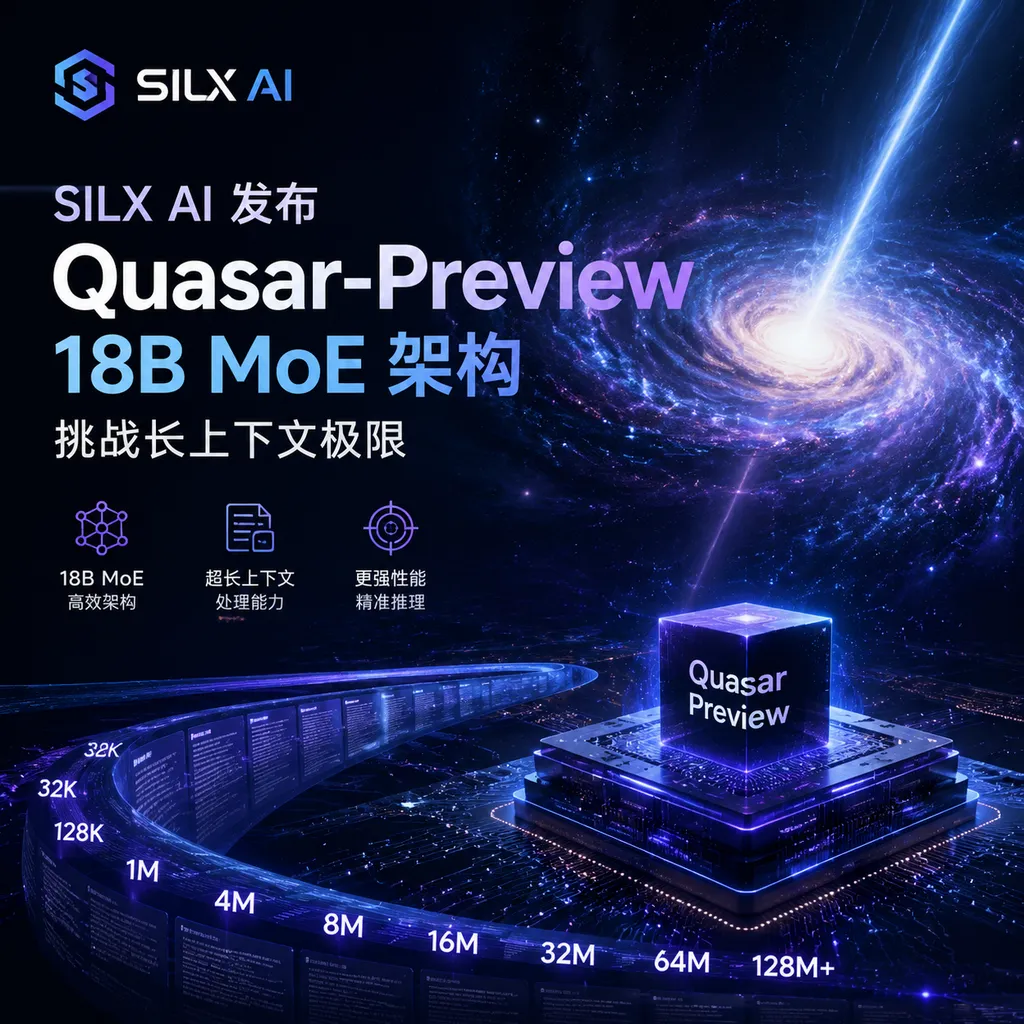
SILX AI has launched an experimental model, Quasar-Preview, featuring an 18B MoE architecture and claiming to support a 5 million token long context. The specs sound impressive, but how does it actually perform? We’ll examine the model from three perspectives—technical architecture, application scenarios, and competitor comparisons—to see whether it’s truly a breakthrough or just impressive numbers on paper.
SILX AI Releases Quasar-Preview: 18B MoE Architecture Challenges Long-Context Limits
Today, SILX AI dropped a bombshell—the experimental Quasar-Preview model has been officially released. With 18 billion parameters in an MoE architecture, it claims to support a 5 million token long context. What does that mean? Essentially, you could feed the model over 3,000 pages of technical documentation, or transcripts of dozens of hours of meetings.
But the industry has seen too many cases of “parameters look fierce on paper, but real performance is disappointing.” Can a 5 million token context window actually be usable? Or is it just a marketing gimmick? We dissect this model from three perspectives: architecture, performance, and practical use cases.
MoE Architecture: The Right Way for Small Models to Do Big Things
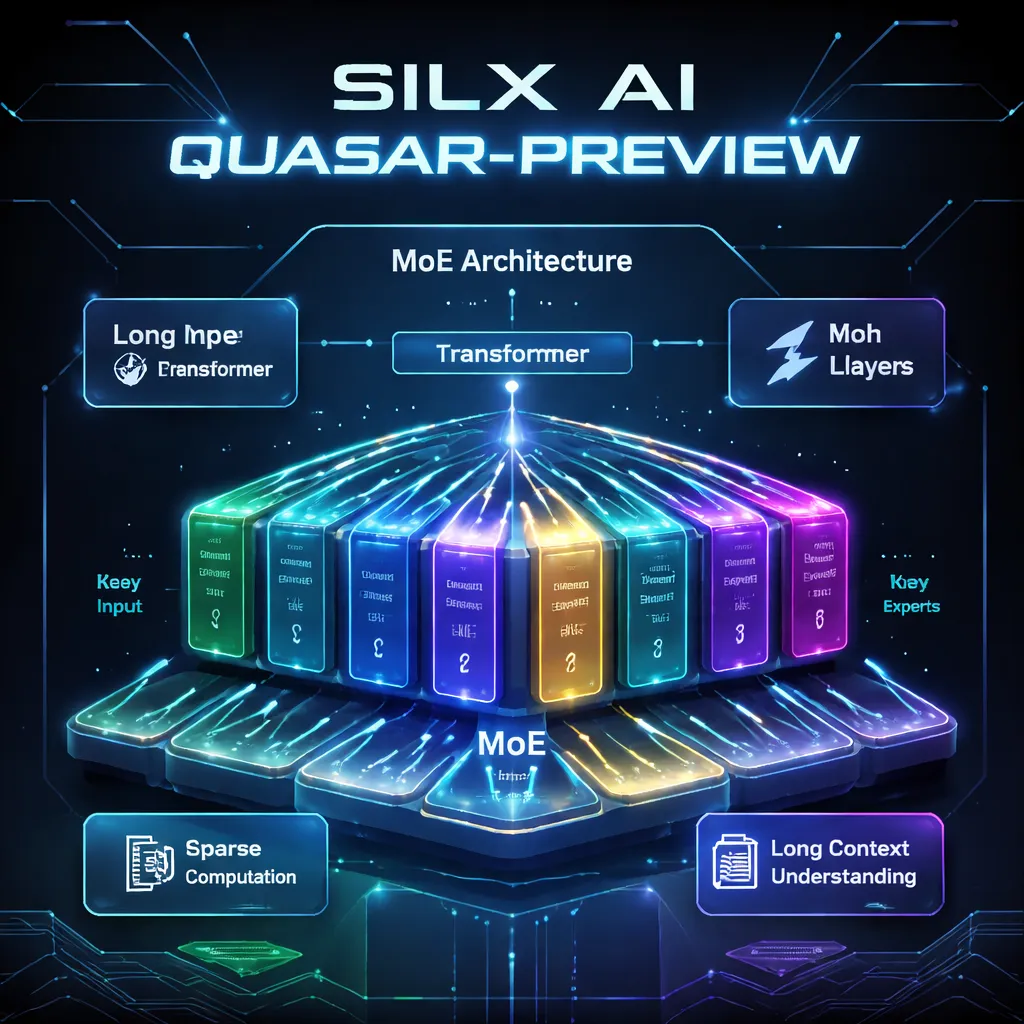
Let’s start with the architecture. Quasar-Preview uses a Mixture of Experts (MoE) architecture with 18 billion total parameters, but only activates a portion of the expert networks during each inference. This design is similar to Alibaba's Qwen3 series and Google’s Gemini 1.5 Flash-8B—trading sparse activation for inference efficiency.
The advantages of MoE are obvious: lower inference cost, faster speed, while maintaining the overall model capacity. 18B parameters may not sound huge, but with an activation rate of 20–30%, the actual computation is equivalent to a dense model of 4–6B parameters, which is quite practical in production environments.
Comparing with competitors:
-
Qwen3-30B-A3B: 30.5 billion total parameters, 3.3 billion active parameters, native support for 256K context expandable to 1M tokens. Alibaba optimized heavily for instruction following, multilingual support, and tool use—positioning it as a general-purpose workhorse.
-
Gemini 1.5 Flash-8B: 8 billion parameters, focused on multimodal input and long text summarization with a 2 million token window. Google’s strengths lie in visual comprehension and cross-modal reasoning, though its pure text processing still trails Qwen.
-
DeepSeek-V3.1: Trillion-parameter scale MoE, topping multiple leaderboards in programming and reasoning. But it's a true large model and doesn't compare with an 18B model in inference cost and deployment threshold.
Quasar-Preview’s positioning is clear: it doesn’t aim to compete with trillion-parameter models for raw intelligence, but to excel in the niche of ultra-long context. Its 5 million token window is 5 times larger than Qwen3’s extended version (1M) and 2.5 times bigger than Gemini 1.5 Flash’s 2M tokens. If this number is truly achievable, it’s a genuine differentiator.
5 Million Tokens: Technical Breakthrough or Inflated Spec?
Long context isn’t new, but a 5 million token spec is rare. Currently, in open-source models, Qwen3-VL and Qwen3-Omni support 256K native context, extendable to 1M. In closed-source models, Claude 3.5 Sonnet supports 200K, Gemini 1.5 Pro supports 2M. How did SILX AI reach 5M tokens?
The key lies in two technical points:
1. Position Encoding Optimization
Traditional RoPE (Rotary Position Embedding) suffers interpolation distortion with ultra-long sequences. Qwen3 uses an improved RoPE, with NTK-aware interpolation and YaRN methods extending effective context from 32K to 256K, then sliding window attention to push it to 1M.
Quasar-Preview probably uses similar tech, but 5M tokens require much higher positional encoding interpolation precision. Poor handling would cause severe attention decay in the tail of ultra-long sequences—basically “remembering the start, forgetting the end.”
2. Attention Mechanism Modification
Full attention at 5M tokens has O(n²) complexity, overwhelming memory and compute. The industry’s mainstream approach is a hybrid of segmented attention (sliding window) and sparse attention.
For example, Gemini 1.5 Pro uses Ring Attention—splitting long sequences into chunks, with full attention inside each chunk and ring-shaped communication between chunks to share KV cache. This has the advantage of linear memory growth but requires multi-GPU parallelism.
If Quasar-Preview aims to run 5M tokens on a single GPU or small cluster, its attention optimization must be even more aggressive. This may sacrifice some global dependency modeling for a longer effective window.
But here’s the issue: long context ≠ effective context. Claude 3.5 Sonnet’s 200K window sees retrieval accuracy drop significantly above 100K; Gemini 1.5 Pro’s 2M token window is recommended for use cases of only hundreds of thousands of tokens. If Quasar-Preview’s effective window is only 1–2M tokens, the 5M figure might be inflated.
SILX AI hasn’t published benchmark data like RULER (long-context retrieval test) or LongBench (long text comprehension benchmark). Until we see those, the 5M token spec remains questionable.
Real-World Scenarios: Who Needs 5 Million Tokens?
Let’s assume for a moment that Quasar-Preview’s 5M tokens are genuinely usable—what scenarios would require this?
Scenario 1: Understanding and Refactoring Entire Codebases
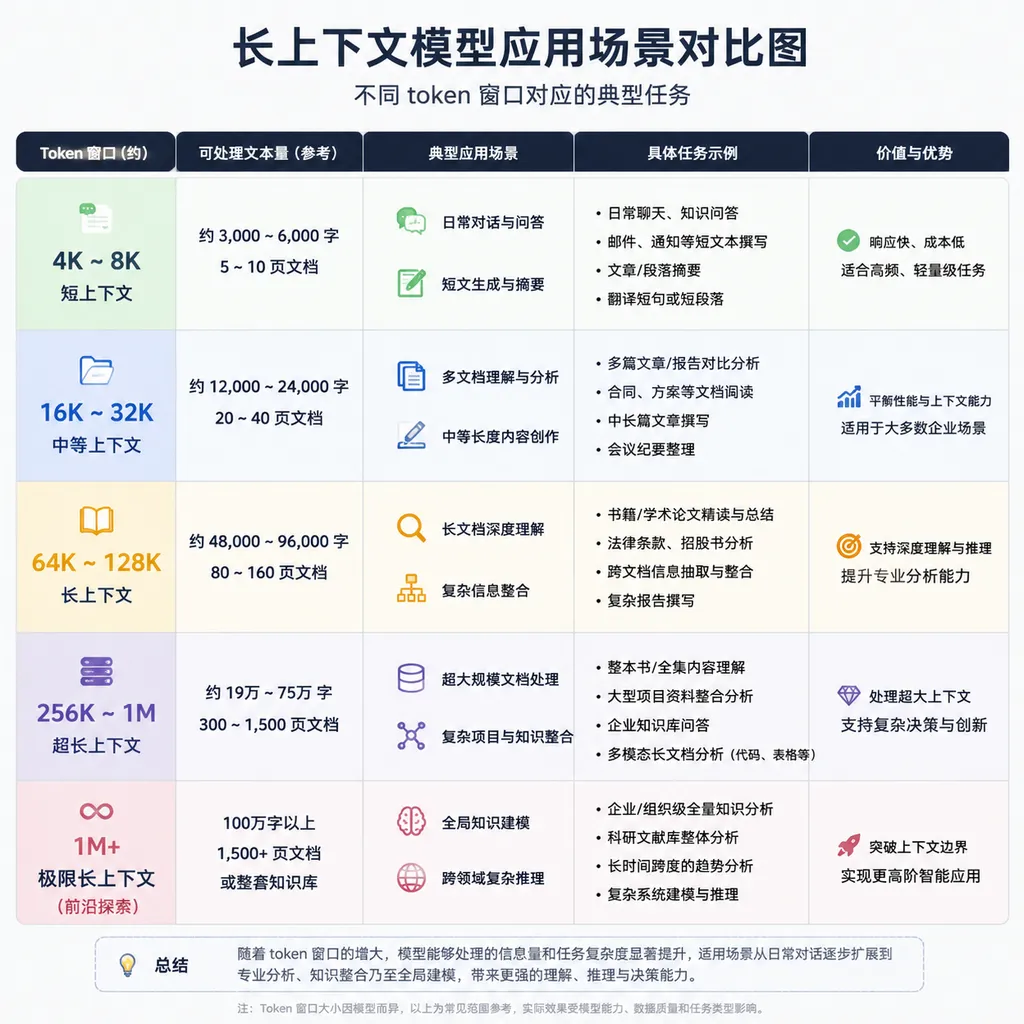
A medium project’s full codebase plus docs and commit history can easily exceed 1M tokens. Cross-file dependency analysis, architecture refactoring recommendations, and technical debt detection could benefit from long-context models.
But here, the Qwen3-Coder-30B-A3B already supports 256K context and can combine with RAG (Retrieval-Augmented Generation) for larger codebases. 5M tokens’ advantage is minimal—unless you’re processing the entire Linux kernel source (~3M lines, ~15M tokens) at once.
Scenario 2: Full Analysis of Extended Meetings or Podcasts
Qwen3-Omni can handle 30-minute meetings; Quasar-Preview could theoretically process dozens of hours. This is useful for corporate meeting minutes, legal transcripts, academic lecture consolidation.
But in practice, does anyone need to process 10 hours’ worth of meeting recordings in one go? Most cases can be handled with segmented processing plus merged summaries, at lower cost—unless you need cross-timeline causal reasoning (e.g., “the decision at hour 3 was based on which point discussed in hour 1”).
Scenario 3: Joint Reasoning Across Multimodal Data
If Quasar-Preview supports multimodal input (no official info yet), 5M tokens could process hundreds of images plus long text and audio together—for example, medical imaging (CT scan sequences + medical records + reports), or industrial inspections (production line videos + sensor data + logs).
This has potential, but multimodal long-context tech is still immature. Qwen3-VL supports 2-hour video + 256K text—already the ceiling in open source. Without multimodal ability, Quasar-Preview’s applicability narrows.
Competitive Comparison: Where is Quasar-Preview Different?
Placing Quasar-Preview in the current model ecosystem, what’s its position?
| Model | Parameter Size | Context Window | Core Advantage | Applicable Scenarios | |-------|----------------|----------------|----------------|----------------------| | Quasar-Preview | 18B MoE | 5M tokens | Ultra-long context | Large-scale document analysis, cross-timeline reasoning | | Qwen3-30B-A3B | 305B/33B active | 256K (extended to 1M) | Balanced general capability, strong tool use | Enterprise apps, agent development | | Gemini 1.5 Flash-8B | 8B | 2M tokens | Multimodal, low cost | Multimodal summarization, long video understanding | | DeepSeek-V3.1 | Trillion params | 256K | Top-tier programming and reasoning | Complex reasoning, code generation | | Claude 3.5 Sonnet | Unannounced | 200K | Instruction adherence, safety alignment | Conversation, writing, analysis |
From this, Quasar-Preview’s differentiation is clear: smaller parameter size (18B) + aggressive architectural optimization, targeting the ultra-long context niche.
Two advantages:
- Lower deployment threshold: 18B MoE can run on a single A100/H100, no need for multi-GPU parallelism—friendly to small teams and edge deployments.
- Controlled inference cost: Sparse activation means faster inference and lower energy use. If SILX AI can price inference at half of Qwen3-30B, the cost advantage is obvious.
But also two disadvantages:
- Unknown general ability: No public benchmarks, so performance in math reasoning, code generation, multilingual comprehension is unknown. If it excels only in long context but lags elsewhere, its use cases are limited.
- Lack of ecosystem support: Qwen3 has Alibaba Cloud Bailian platform, ModelScope community, and Hugging Face integration; DeepSeek has broad open-source community backing. As a new player, Quasar-Preview needs time to build developer ecosystems.
Open-Source or Closed? Pricing Matters
SILX AI hasn’t disclosed Quasar-Preview’s open-source plan or pricing—critical points.
If open-source, the 5M token context could attract tech enthusiasts and researchers. But commercialization of open source is unclear unless SILX AI offers accompanying cloud services or enterprise editions.
If closed API, pricing must compete with Qwen3, Gemini, Claude. For example, Alibaba Cloud Bailian pricing for Qwen3-30B is:
- Input: ¥0.4 / million tokens
- Output: ¥1.2 / million tokens
Processing 5M tokens input + 10K tokens output (a detailed report) costs about ¥2. If Quasar-Preview is 2–3× this, its appeal drops.
A more practical strategy might be tiered pricing: offer a free/low-cost 256K version to attract developers; make 5M context a premium feature with on-demand charges. This balances rapid user acquisition with monetizing high-end demand.
Technology Choice: Long Context vs. RAG
Finally, the fundamental question: are long-context models inherently better than RAG (Retrieval-Augmented Generation)?
RAG logic: don’t feed all data into context—retrieve only relevant fragments via vector search, then hand to the model. Advantage: low cost, scalable; drawback: retrieval accuracy limits, weak cross-fragment reasoning.
Long-context logic: feed all data at once for global understanding and reasoning. Advantage: no information loss, strong reasoning; drawback: high cost, requires capable models.
In practice, they’re used together:
- RAG for coarse filtering, shrinking TB-scale datasets to a few million token candidates;
- Long-context models for in-depth reading and reasoning within candidates.
Qwen3 embodies this: Alibaba Cloud Bailian offers vector DB + long-context model as a complete solution, letting developers mix per scenario.
Quasar-Preview’s 5M token window would be more valuable integrated with RAG workflows, e.g.:
- Step 1: RAG retrieves 10M tokens from a 10TB enterprise knowledge base;
- Step 2: Quasar-Preview processes this 10M tokens into structured analysis;
- Step 3: A smaller model formats the final output.
This ensures coverage while controlling costs. If SILX AI provides supporting tools (vector DB, retrieval optimization, model orchestration), Quasar-Preview gains competitiveness.
Conclusion: Wait for Real Data Before Deciding
Quasar-Preview’s launch is interesting. On paper, 18B MoE + 5M tokens is eye-catching. But AI has seen too many “launch-ceiling” cases—real value shows only after production use.
Currently, SILX AI hasn’t disclosed:
- Benchmark scores: RULER, LongBench, MMLU, HumanEval, etc.
- Effective context: retrieval accuracy and reasoning capacity within the 5M window.
- Pricing: open or closed? API cost?
- Case studies: real-world deployment examples.
It’s wise to wait for these before concluding. If Quasar-Preview can differentiate in long context, with reasonable pricing and ecosystem support, it has market potential. If not, it’s another story.
For developers, a practical choice now is still Qwen3 or Gemini 1.5. These have complete docs, stable APIs, rich case studies, and low risk. Quasar-Preview is worth watching, but don’t go all-in yet.
References
- SiliconFlow - Model List – SILX AI official platform for model specs and API usage
- Machine Heart Industry News – AI industry news aggregation covering releases, breakthroughs, and use cases
- Generative AI Large Model Weekly Report – Tracks model updates from OpenAI, Google, Alibaba, including Qwen3, Gemini, DeepSeek competitor comparisons


