
NeuroVLA by Zhipingfang: Disassembling the robot’s “brain, cerebellum, and spinal cord”

At the 2026 Zhiyuan Conference, Zhifang released the world’s first brain-like embodied intelligence system, NeuroVLA, which uses a cortex–cerebellum–spinal cord three-tier architecture to break down the traditional single large VLA model. The collision reflex is reduced to 20 milliseconds, and the spinal cord layer’s power consumption is only 0.4 watts.
At the Beijing Zhiyuan Conference on June 13, Zhipingfang founder Guo Yandong unveiled NeuroVLA — an embodied intelligence system that integrates the human brain’s three-layer structure of “cortex–cerebellum–spinal cord” into a robotic large model. They define it themselves as “the world’s first brain-like architecture VLA.”
If you’ve been following the VLA (Vision–Language–Action) line recently, you might have noticed a subtle shift: over the past two years, everyone has been busy cramming vision, language, and action into one end-to-end large model to prove that “one network solves everything” is feasible; but starting in 2026, more and more players have realized that this “monolithic brain” hits a wall in the real physical world. NeuroVLA is one of the most radical examples in this wave of change.
Where exactly the ceiling of monolithic VLA is stuck
First, let’s clarify why we need a brain-like architecture. Traditional VLA takes a straightforward approach: vision encoder + language model + action decoder, trained end-to-end, inputting an image and instructions, outputting an action sequence. The OpenVLA, RT-2, π0 series are typical examples.
This paradigm looks amazing in demo videos, but when deployed in factory or home scenarios, three long-standing issues remain unsolved:
- Response delay: An action has to go through the full “perception–reasoning–generation” chain, taking as little as over 100 milliseconds and as much as 300–500 milliseconds. If a robot starts thinking “What should I do?” only after bumping into someone, it’s already too late.
- Motion jitter: Large models are inherently weak in high-frequency motion control, leading to noticeable tremors and overshoot during fine operations, with post-processing filters only able to alleviate it.
- Runaway power consumption: Running a 7B VLA model requires onboard GPU power starting from dozens of watts, which heavily eats into the endurance of mobile robots.
Zhipingfang’s solution — the human brain doesn’t work this way, so why should robots?
Three-layer architecture, each doing its own job
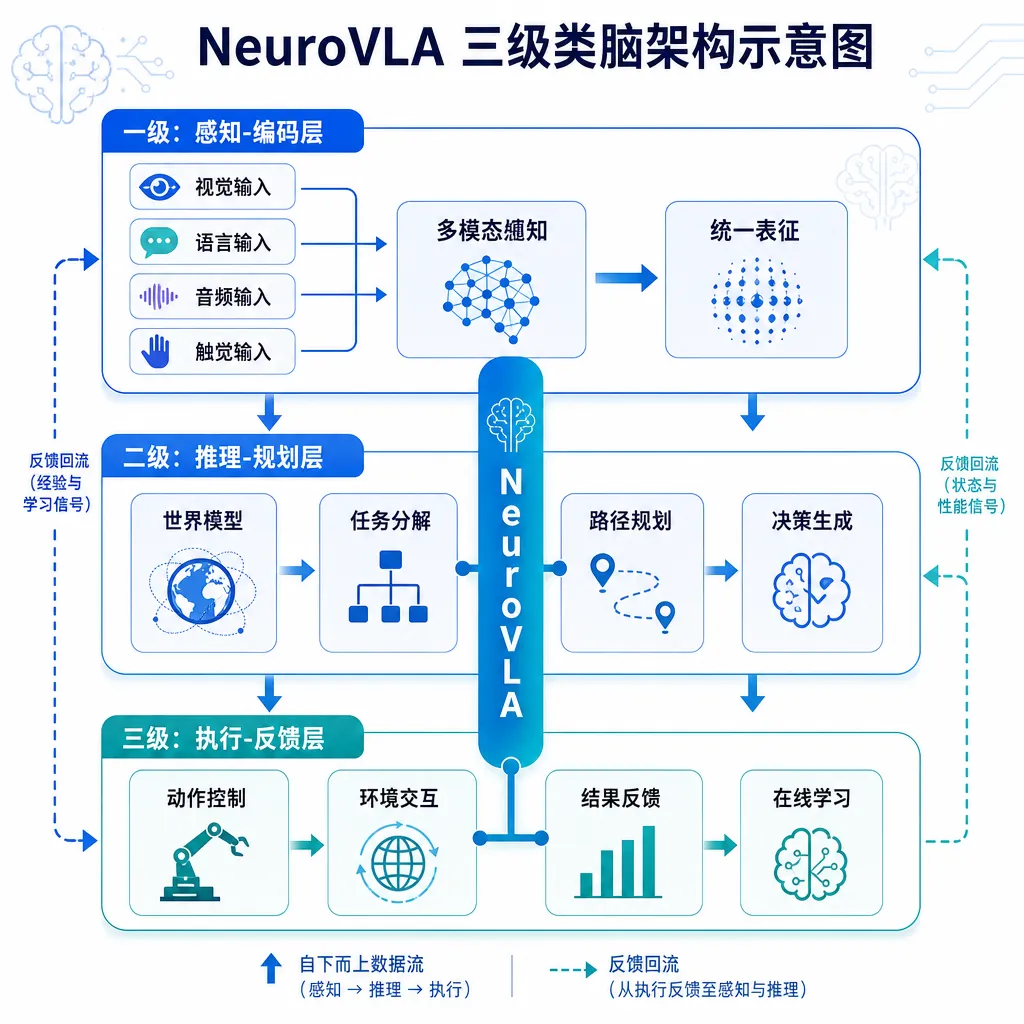
NeuroVLA divides the entire system into three parts based on biological hierarchy, with each layer having its own frequency and responsibilities:
Cortex: slow thinking
Responsible for semantic understanding, task planning, and long-range reasoning. This layer essentially corresponds to the multimodal large model part in traditional VLA, runs on the main controller computing power, with low frequency (a few Hz to tens of Hz), but broad scope — understanding instructions like “Hand the coffee cup on the table to the person wearing blue.”
Cerebellum: high-frequency motion coordination
This is the most critical layer of NeuroVLA. The cerebellum layer receives the action intent issued by the cortex and refines it into smooth, stable, and coherent motion trajectories, performing dynamic adjustments based on real-time feedback. Official data shows this layer reduces motion jitter by over 75% — if this figure can be replicated in real tests, it would be highly significant for fine operation scenarios.
The cerebellum layer’s design draws on the biological cerebellum’s “feedforward + feedback” control concept, no longer letting the large model directly output joint angles, but having a dedicated motion coordination module perform interpolation, smoothing, and disturbance compensation.
Spinal Cord: reflex arc
This is the most interesting layer. The spinal cord layer has one job: respond reflexively to danger signals within a millisecond-level time window. Collision, falling, pinching — in these scenarios, there’s no time to let the cortex “think”; it must be handled directly, like humans instantly withdrawing their hand when touching something hot.
NeuroVLA’s spinal cord layer achieves collision–reflex response in 20 milliseconds. By comparison, traditional VLA systems take over 200 milliseconds — an order of magnitude difference. More importantly, the task recovery success rate after collision increased from 0% (traditional VLA basically freezes on the spot) to 54.8% — meaning the robot can not only dodge but also adjust its path and continue working.
Spiking neural networks with online learning
The spinal cord layer employs a spiking neural network (SNN) as the action head, with the training algorithm being R-STDP (reward-modulated STDP). These two concepts aren’t new in academic circles, but being seriously applied in mass-produced robots makes NeuroVLA an early adopter.
The benefits of SNN: first, low power consumption — official data shows average power consumption during spinal cord layer task execution is only 0.4 watts, lower than a phone playing video; second, it’s naturally suited for processing temporal signals and event-driven tasks, which fits “reflex” use cases perfectly.
R-STDP brings an interesting capability: online adaptive learning during deployment. In plain terms, as the robot works in a factory, it can fine-tune the spinal cord layer’s response for the current scenario on its own, similar to how humans form “muscle memory” after repeated practice of a movement. This is particularly crucial for handling long-tail issues in industrial scenarios — each production line in a factory has unique details, so letting the robot adapt itself rather than retraining every time is of great value.
What exactly this architecture solves
Comparing NeuroVLA to traditional VLA, the differences are clear:
| Dimension | Traditional VLA | NeuroVLA | | --- | --- | --- | | Architecture | Monolithic end-to-end large model | Cortex–cerebellum–spinal cord three-layer division | | Collision reflex delay | >200ms | 20ms | | Motion jitter | Baseline | Reduced by 75%+ | | Post-reflex task recovery rate | 0% | 54.8% | | Spinal cord layer power consumption | N/A | 0.4W | | Online learning | Typically unsupported | Supported via R-STDP |
Notably, the three layers don’t simply call each other in series, but run in parallel without blocking each other. While the cortex is engaged in slow thinking, the cerebellum keeps running, and the spinal cord’s reflex arc is always online. This is actually the most essential advantage of brain-like design — to delegate tasks with different time scales to different subsystems, rather than having a single large model handle both semantics and millisecond-level reactions.
Simply put, this is bringing the software architecture concept of “separation of concerns” to the model architecture level of embodied intelligence.
Already commercialized
Zhipingfang didn’t just release a paper-level demo. They also disclosed several commercialization milestones at the conference:
- NeuroVLA has been open-sourced on AlphaBrain Platform — great news for developers, enabling research and secondary development
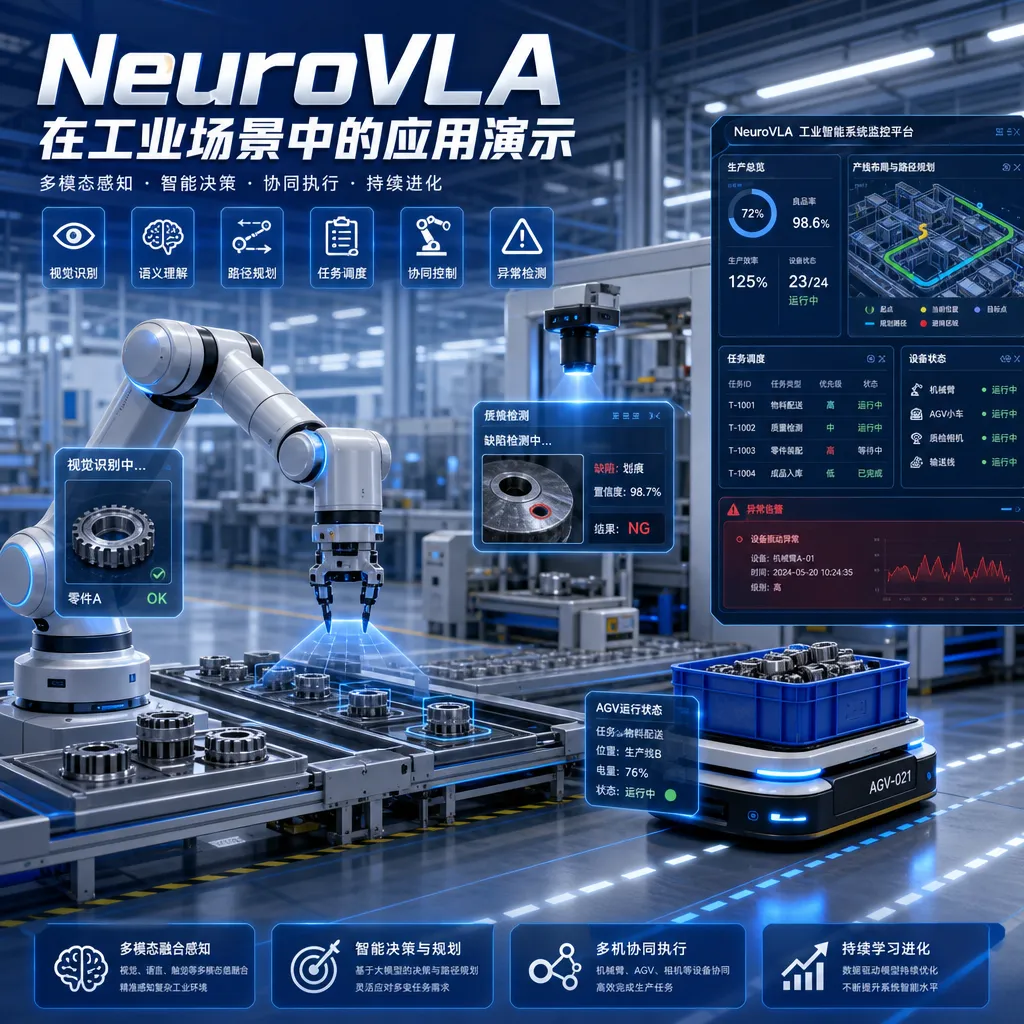
- Commercial scenarios already cover industrial production lines for automotive, semiconductors, etc.
- Their own product “ZhiCube” robotic store assistant has been deployed in over ten provinces nationwide
Guo Yandong made an intriguing remark: general intelligent robots are the “fourth-generation intelligent terminal” after PCs, mobile phones, and cars, and the industry should return to technological innovation and avoid wasteful competition. Coming from the CEO of a company actively mass-producing robots, this statement has a bit of an industry call-to-action feel — in the past year, many star companies have emerged in the embodied intelligence track, with impressive financing figures, but few have delivered real engineering deployment data.
Is brain-like VLA the next stop?
Back to the bigger question: monolithic end-to-end VLA or layered brain-like architecture — which is the right path?
From NeuroVLA’s data, the brain-like route shows clear advantages in safety, stability, and power consumption — the three most critical dimensions for engineering. But the costs are real: architectural complexity increases, collaborative training between layers, communication delays, failure handling — all new challenges; designing the interface between cortex and cerebellum to be both flexible and efficient is itself an open problem.
End-to-end proponents will likely counter: “You’re going backwards; scaling laws can solve problems without prior structure.” This debate isn’t new in the large model space, it’s just now moved into embodied intelligence.
Personally, I lean toward the view that the real-time constraints of the physical world are hard constraints that scaling can’t solve. You can scale a VLA model from 7B to 70B to 700B, but the speed of light and circuit delays are fixed — the time it takes for a monolithic large model to complete one forward pass won’t disappear as parameters increase. In this respect, layered brain-like architectures have structural advantages.
As for NeuroVLA itself — if its 20ms reflex, 0.4W power consumption, and 75% jitter suppression can be stably replicated in third-party evaluations and more scenarios, this architectural concept will likely become a direction other players follow in the next year or two. AlphaBrain Platform’s open-source release also lowers the barrier for others to validate it.
Incidentally, OpenAI Hub has connected to a series of mainstream multimodal models, so developers working on the cortex layer in a three-layer VLA architecture can directly switch between GPT, Claude, Gemini, DeepSeek, and others with a single key to run comparisons — choosing which large model to use for the cortex layer is actually an engineering trade-off worth testing.
References
- Who’s leading in brain-like embodied large model technology? 2026 cortex–cerebellum–spinal cord collaboration capability evaluation - IT Home — an in-depth overview of NeuroVLA’s technical details, performance data, and the three-stage evolution of VLA


