
Songyan Power N2 debuts at HDC 2026: Open-source HarmonyOS embedded in humanoid robot
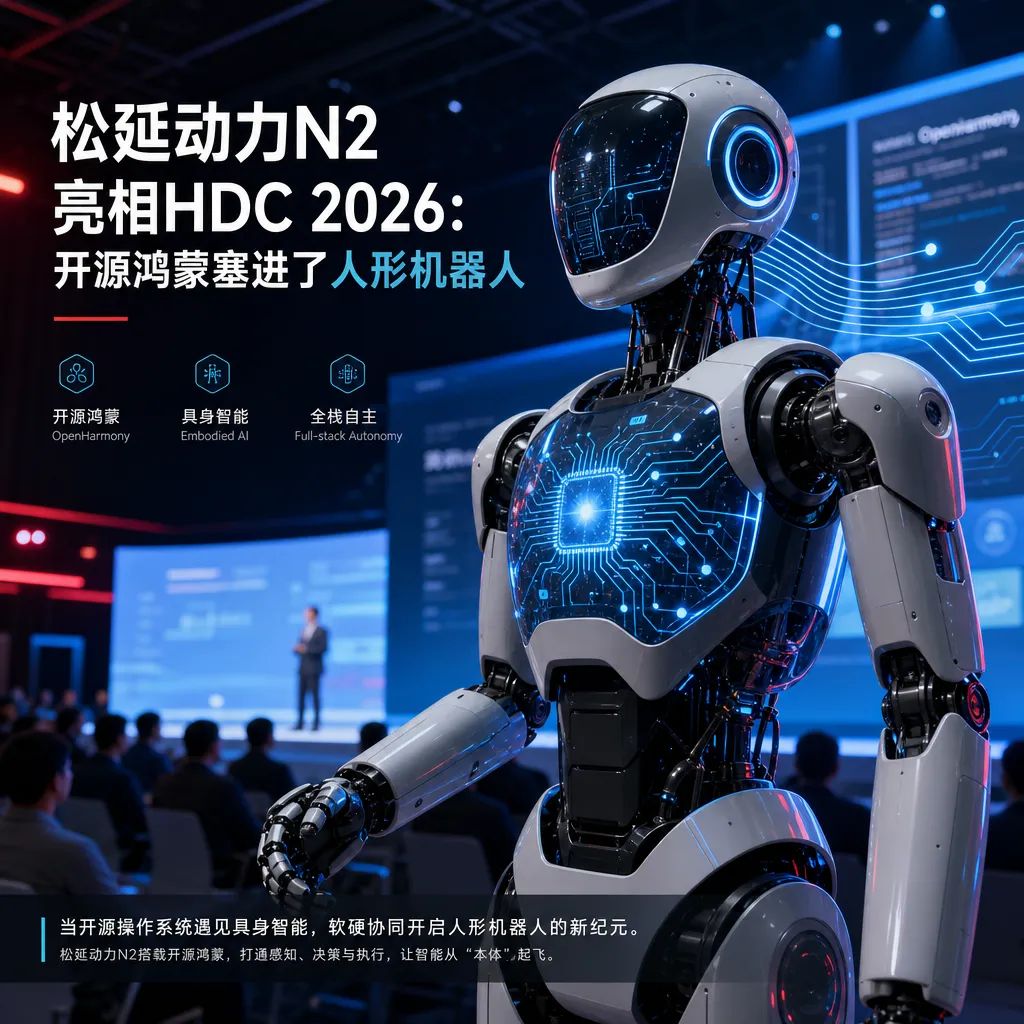
Songyan Power launched the industry’s first open-source HarmonyOS consumer-grade humanoid robot N2 at HDC 2026, and initiated the "Hundred People, Hundred Machines" co-creation program for developers, aiming to use a microkernel + agent ecosystem to solve the ecological isolation problem of consumer-grade humanoid robots.
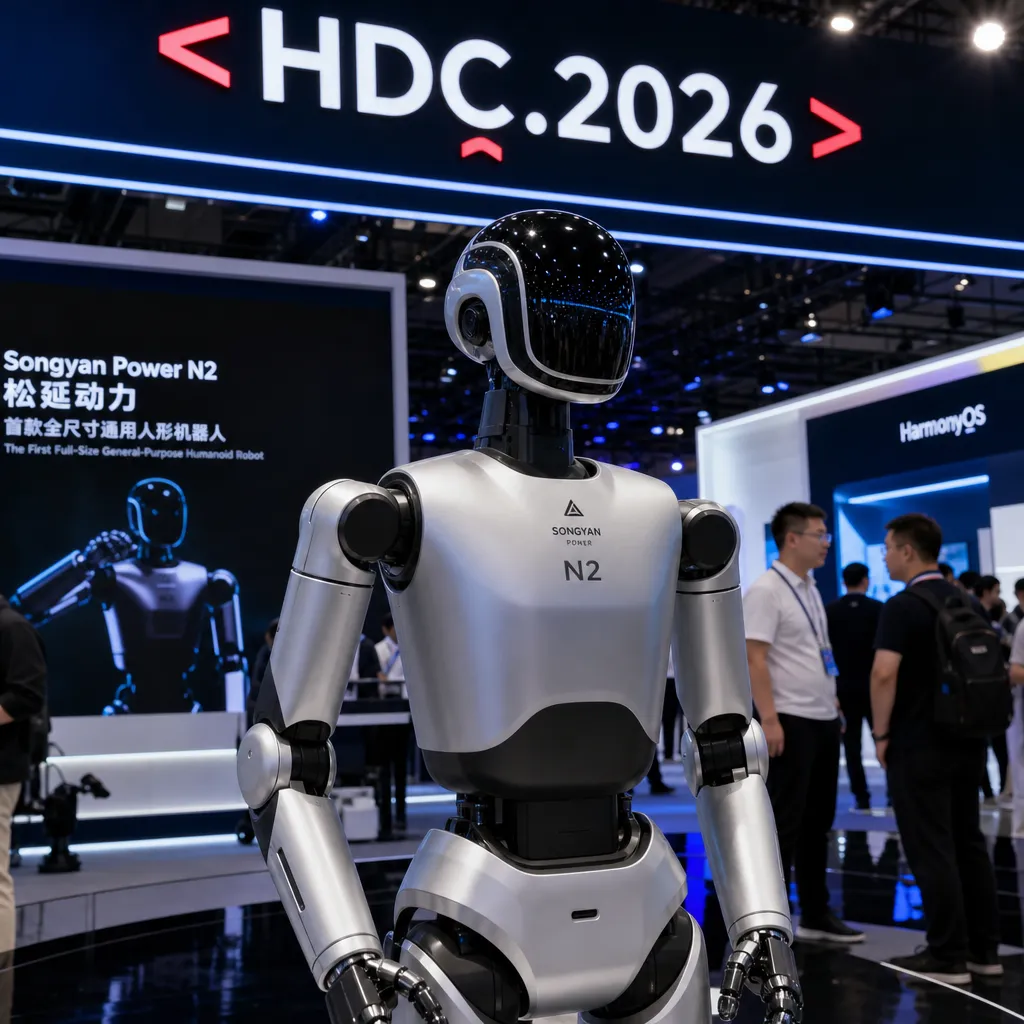
At last weekend’s Huawei Developer Conference HDC 2026, Songyan Dynamics showcased an N2 running OpenHarmony. This is the industry’s first truly consumer-grade humanoid robot running open-source HarmonyOS—note, consumer-grade, not those lab prototypes that can only take two steps in a demo video.
Two years ago, this wouldn’t have been much news. At the 2024 HDC, Leju’s “Kuafu” made an appearance as “China’s first open-source HarmonyOS humanoid robot for home scenarios,” right when Huawei Cloud’s Pangu large model had just released version 5.0. But Kuafu leaned more toward scientific research, education, and corporate services. This time, Songyan Dynamics literally put “consumer-grade” on its forehead—its intention is clear: aiming to step through the front door.
Why insist on putting HarmonyOS in a robot
To understand the significance of this N2, you first need to see where consumer-grade humanoid robots are stuck.
Tang Ziyang, Songyan Dynamics’ VP of Product, put the pain points bluntly at the conference: Right now, most consumer humanoids are essentially “isolated islands that can move.” They can run and jump, maybe even chat with you briefly, but they’re totally disconnected from your smart screen, air conditioner, robot vacuum, or smart door lock. Each manufacturer builds their own protocol stack, none line up with phone or smart home ecosystems, so when users buy them, they end up as expensive toys.
A more realistic issue is on the development side. Under traditional architectures, doing cross-device linkage is a nightmare—anyone who’s worked in IoT knows: network protocol adaptation, heterogeneous data conversion, device discovery, permission models—you have to rewrite the glue code for every device type. Developers shy away, and robot manufacturers can’t afford the huge adaptation teams needed.
The third pitfall is resources. Robots have to carry motor drivers, perception algorithms, control code, plus a full Linux stack and ROS middleware—the onboard compute and power consumption get eaten up. This runs counter to product goals like lightweight design and long battery life.
The microkernel architecture of open-source HarmonyOS targets these three pain points. Microkernel inherently has an advantage in memory footprint and boot speed over traditional monolithic kernels; the distributed soft bus essentially handles cross-device communication, discovery, and data flow at the system level, so developers don’t need to write masses of adaptation code; in terms of security, microkernel’s small Trusted Computing Base (TCB) is a plus for home-use robots involving camera, microphone, and home appliance control permissions.
What exactly is the N2 positioned as
Songyan Dynamics’ original N2 isn’t unfamiliar—small-size biped humanoid, weight well controlled, focused on high-dynamic actions like jumping and running, priced for consumer acceptance. This OpenHarmony version likely retains the same hardware; the software stack is the key difference.
According to official descriptions, the robot’s capability stack is broken into several layers:
- Bottom layer: Open-source HarmonyOS microkernel + distributed soft bus, handling cross-device discovery and collaboration
- Middle layer: AI system agent, responsible for voice interaction and long-term task planning
- Application layer: Specific service capabilities for home scenarios, e.g., appliance linkage, security responses, educational companionship
Here’s a detail worth elaborating: “Long-term autonomous task planning.” This is exactly what Huawei Cloud emphasized when releasing its embodied Pangu large model in 2024—“complete complex task planning of 10 steps or more.” In other words, N2 likely uses Pangu or a similar multimodal large model as the “brain,” open-source HarmonyOS as the “nervous system,” and the physical body as the “torso,” integrating all three.
This layered approach isn’t unique to Songyan, but putting the full package into a consumer product and opening it to developers—few have done that so far.
Intelligent agent ecosystem: robots ≠ isolated devices
The most noteworthy point in this release is not the N2 itself, but its positioning as “the execution endpoint of whole-home intelligence.”
Recall March this year at AWE, GIIC together with Haier, Midea, Hisense, TCL, Huawei, and others announced the Unified Smart Home Interconnection Standard—clearly aimed at bringing different manufacturers’ smart appliances to one protocol table, making the large model truly have hands and feet to command. At AWE, you could already see interactions like a HarmonyOS phone touching a TCL HarmonyOS air conditioner to automatically pop up for pairing.
What role does a humanoid robot play in this system? Simply, it’s the most human-like “embodied intelligent extension.” Robot vacuums, air conditioners, and fridges handle single-point tasks; robots handle composite tasks spanning rooms, devices, and times—e.g., “Remind me on my way home from work to set the air conditioner to 26°C, hand me a glass of water at the door, and check if the elderly have taken their medicine”—only a mobile, perceptive, cross-device scheduling embodiment can handle that.
An N2 running open-source HarmonyOS inherently sits inside the HarmonyOS Smart Home protocol system—no extra translation needed to control air conditioners, lights, door locks, security cameras. This is its biggest difference from pure ROS/Ubuntu products.
“One hundred people, one hundred machines”: bringing developers in
More notable than the N2 itself is Songyan’s simultaneous announcement of a “One hundred people, one hundred machines” co-creation plan—selecting 100 developers or teams, giving each a real machine for local development.
This is smart. Right now, the biggest issue for consumer-grade humanoids is not hardware, but not knowing what users will do with it. Early PCs, early smartphones, early VR all faced this: hardware in place, killer apps still needed from developers. Songyan is directly spreading the trial-and-error cost to the community.
Supporting development is also well-prepared:
- Supports both Ubuntu and open-source HarmonyOS, without forcing developers to choose sides
- Provides native SDK and full development environment
- Compatible with mainstream development frameworks (ROS is likely included)
This dual ecosystem is key. Academia and embodied intelligence researchers mostly work on Ubuntu + ROS 2 + Isaac Sim, which HarmonyOS can’t replace in the short term; but for consumer landing and home scenario integration, HarmonyOS ecosystem is unavoidable. Supporting both means research can continue algorithm iteration, and products can achieve scenario closure.
Comparing with competitors: Is this a good move?
Looking horizontally at the consumer humanoid track now:
- 1X NEO: Targeting home scenarios, OpenAI ecosystem, overseas route, small-batch production in 2026
- Unitree R1: JD.com exclusive version integrated with JoyAI, going the e-commerce launch route
- Leju Kuafu: Pangu + HarmonyOS pioneer, but leaning toward education, commercial display, and enterprise/government
- Songyan N2 OpenHarmony version: Consumer-grade + deep HarmonyOS ecosystem integration + dual-ecosystem SDK
Songyan’s differentiator is “consumer-grade pricing + deep HarmonyOS integration + developer program.” Short-term sales won’t spike—100 developer machines are not a sales-driven move—but it’s capturing an ecological niche: when HarmonyOS Smart Home protocol standards are fully deployed and consumers are ready to pay for a “running household butler,” it can harvest the ecosystem dividends.
This is a typical strategy of “trading developer quantity for time window.”
Some unanswered questions
After the positives, let’s pour some cold water.
First, compute allocation. For Pangu or similar large models’ “long-term task planning,” the mainstream solution is still cloud inference, with local running only for perception and control. How much model load can N2’s onboard compute handle? Can the latency of end-cloud collaboration stabilize to an acceptable experience level under home Wi-Fi? No details disclosed.
Second, real machine reliability. For consumer-grade humanoids, the biggest reputation killer isn’t insufficient AI intelligence, but robot reliability—motor overheating, joint wear, battery overstating, inability to stand up after falls. Songyan’s N2 has good reviews for dynamic performance, but 24/7 home use is a whole different test.
Third, cold-start for application ecosystem. HarmonyOS watches already have 40+ apps, HarmonyOS Smart Home has aligned major appliances, but the “HarmonyOS robot app market” is currently zero. After developers get the robot, can what they build run through a commercial loop? Songyan can’t decide that alone.
A bigger judgment
By mid-2026, domestic humanoid routes have clearly diverged:
- Industrial (Ubtech, Fourier, Zhiyuan, etc.): Targeting factories, inspections, special operations, delivering to orders
- Research (Unitree, ZQ, etc.): Perfecting hardware and control, leaving application layer to community
- Consumer (Songyan, 1X, etc.): Betting on home scenarios, ecosystem linkage, developer community
With open-source HarmonyOS, Songyan N2 is firmly in the consumer + ecosystem camp. This route is the hardest, but the ceiling is highest—if successful, it could be the next billion-unit terminal category after smartphones.
Huawei’s strategy is also clearer—the “selling shovels” model: Pangu large model as the brain, open-source HarmonyOS as the system, Ascend as the compute, packaged for body manufacturers. From Leju to Songyan, humanoid body makers joining this system are rapidly growing. This is essentially the same as Nvidia’s strategy in autonomous driving and robotics.
As for when consumers will see a truly working humanoid at home—given current iteration pace, optimistic estimate is 2027–2028 for entry into the early adopter market. Before that, whether the developer community can make scenarios run through will be the key to success.
N2’s debut this time is essentially hitting a clear acceleration key for the whole story.
References
- Industry’s first open-source HarmonyOS consumer humanoid robot: Songyan Dynamics N2 debuts at Huawei Developer Conference HDC 2026 - IT Home: Main news source for this article, includes Songyan Dynamics N2 release details and “One hundred people, one hundred machines” plan description


