
WeChat Pay AI Toolbox 2.0: 9 Languages + Token Halved
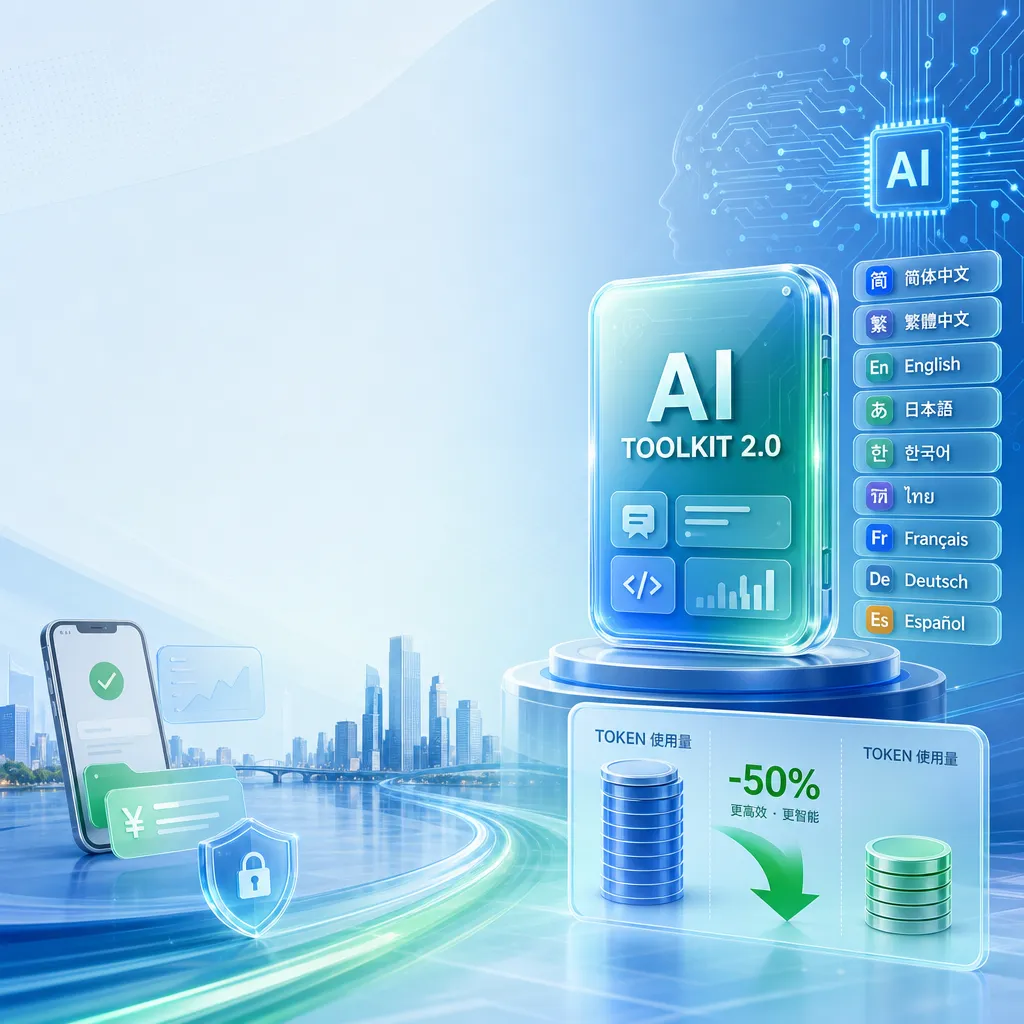
WeChat Pay AI Integration Toolbox welcomes version 2.0, adding support for 9 new languages, CLI dynamic troubleshooting, financial-grade code review, and restructuring charts using the Mermaid format, cutting token consumption during the integration process by half.
WeChat Pay AI Integration Toolbox 2.0 is here: Full coverage in 9 languages, Token consumption cut in half
Today (June 15), WeChat Pay released version 2.0 of its AI Integration Toolbox. Only two months have passed since the 1.0 launch in April, and the iteration pace is faster than expected—showing that this Skill system for AI coding scenarios is indeed producing data feedback from real developers.
The core of this upgrade can be summed up in one sentence: Making AI write WeChat Pay integration code go from "usable" to "smooth". Focusing on three aspects—"secure, efficient, native fluency"—the official team updated five major areas in one go.
First, the background: What is the “AI Integration Toolbox”
If you’re not familiar with 1.0, here’s a quick recap. In April this year, WeChat Pay released a set of tools specifically for AI coding assistants, consisting of three parts:
- Skill package: Think of it as feeding “WeChat Pay expert knowledge” to AI programming tools like Cursor, Claude Code, and Cline;
- AI-friendly documentation: Rewriting official documentation into a format more suitable for large models to understand;
- AI-friendly APIs: Modifying APIs to be more compatible with LLM calls.
At its core, as more developers use AI assistants to write code, the traditional “humans read documentation” model is being replaced by “models read documentation.” But official docs are usually made for humans—HTML formatting, embedded sequence diagrams, and navigation links are all noise and token costs for models. What WeChat Pay did in April was essentially rewriting the manual specifically for AI as a new reader.
The problem was that 1.0 had limited coverage—it only supported “Payments” and “Coupons”; the troubleshooting manual was static, requiring manual reference; and language support was only for Chinese developers—all of which have been addressed in 2.0.
The Five Major Upgrades—Breaking Down One by One
1. Native support for 9 languages, overseas developers can dive right in
2.0 fully supports Chinese, English, Japanese, Korean, French, Russian, Portuguese, Spanish, and Arabic—covering major markets' native developers.
The signal behind this move is more noteworthy than the technology itself. In recent years, WeChat Pay has been active in cross-border acquiring and overseas merchant integration, but overseas developers have been deterred by “Chinese-only documentation.” For small developers in Southeast Asia, integrating WeChat Pay in their local language previously meant going through agents; now, an AI assistant can discuss integrating JSAPI payments with you in Portuguese—opening up this pipeline.
This is more than just translation. Terminologies, error messages, and troubleshooting paths in Skills have to be localized—requiring substantial effort.
2. Expanding from “Payments + Coupons” to the entire product line, plus two AI expert roles
1.0’s Skills only understood payments and coupons—lost when it came to profit sharing, refunds, marketing tools, or cross-border settlements. 2.0 now feeds in knowledge for the entire WeChat Pay product line, and adds two role-based AI capabilities:
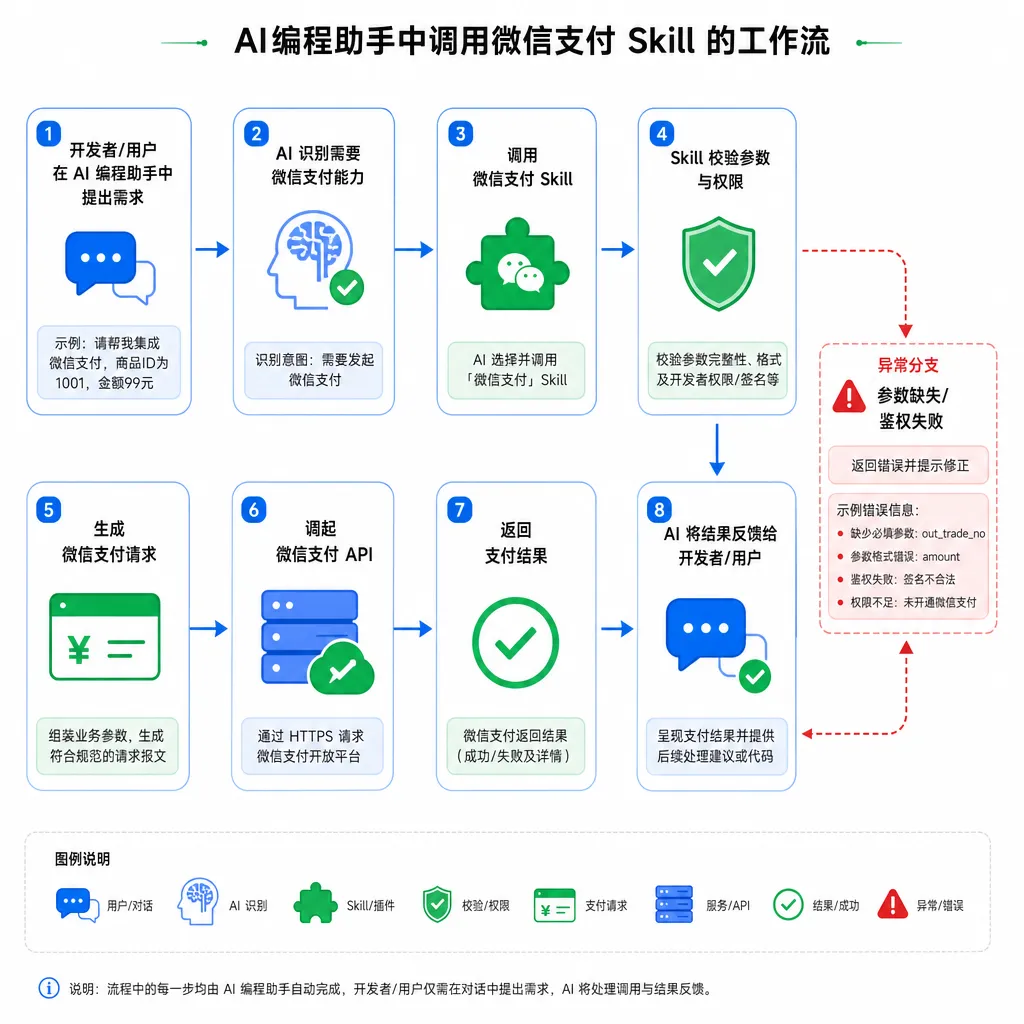
- Technical Expert: Handles everything—from scenario selection (e.g., “I’m building a SaaS subscription—what payment product should I use?”), understanding integration flows, to dynamic troubleshooting—entirely within the conversation. The key is supporting a complete loop of “error → locate → fix,” without leaving the IDE.
- Financial-grade R&D Expert: This role is interesting—it has a built-in code quality review mechanism, assessing your code from financial-grade security standards and best practices. WeChat Pay scenarios have many easy-to-miss pitfalls—like signature validation sequence, callback idempotency, currency unit handling, log de-identification of sensitive fields—which ordinary AI code review often misses.
Developers integrating payments know that the gap between “working” and “production-ready” often lies in these details. AI speeds up coding, but mistakes cost more—so this financial-grade review role is essentially a crucial patch.
3. CLI dynamic troubleshooting: Debugging without switching to merchant backend
This is personally my favorite upgrade in 2.0.
In the 1.0 era, troubleshooting was static—AI gave you a manual, and you matched error codes yourself. 2.0 adds CLI dynamic troubleshooting: in the IDE, you can ask AI in natural language, “Check the status of the refund order from last night,” and AI runs the CLI, returning results directly.
Developer: Why didn’t we receive the callback for out_trade_no=20260615xxx just now?
AI Assistant: (CLI query) The order status is SUCCESS, callback was sent at 14:23:01,
              merchant-side HTTP response was 504. Suggest checking timeout settings for the callback interface.
Previously, the standard process for debugging a payment issue was: write code → encounter error → switch to merchant backend → find order → compare status → return to IDE and modify code. Now, this workflow is streamlined—the debugging flow isn’t interrupted, greatly benefiting the flow state.
4. All documentation converted to Mermaid format, Token consumption reduced by 50%
This is the most hardcore engineering change in 2.0.
WeChat Pay documentation contains many sequence diagrams and state diagrams, which used to be in image or HTML-rendered formats. Models reading these would either invoke multimodal capabilities (expensive and slow), or fail to parse and skip them (losing information).
2.0 rewrote all sequence and state diagrams into Mermaid format. This is a bold move:
- Models without multimodal capabilities (e.g., text-only DeepSeek-V3 or early Qwen series) can now directly understand diagram semantics via Mermaid source code;
- Models with multimodal capabilities no longer need to go through image recognition—saving one inference step;
- Combined with existing Markdown documents and site index files, the overall Token consumption is reduced by 50% compared to original HTML docs.
Half price isn’t trivial. In pay-per-token development scenarios, this means twice the context for the same budget—allowing richer background info for complex integration scenarios.
This approach is worth copying for other cloud service providers—restructuring documentation for AI is a seriously underestimated infrastructure task.
5. Skill auto-syncs with official website version
A small but practical detail: when Skills start up, they automatically compare the local knowledge base to the official one, and update if there are differences.
Anyone who’s built Skills / MCP / Agent toolsets knows that “users running outdated knowledge” is a nightmare—when official interfaces change but AI still codes from three-month-old docs, strange errors inevitably occur. With this auto-sync built into Skills, WeChat Pay blocks the “user forgot to update” issue at the root.
Some takeaways: This is an underestimated developer infrastructure move
A few observations:
First, WeChat Pay is moving faster down the “AI-friendly” path compared to peers. Domestic mainstream payment/cloud service providers are aware that AI coding will change developer integration methods, but few have fully reworked documentation structure, Skill systems, and CLI toolchains from an AI perspective. Two-month major iterations show high internal priority.
Second, the real meaning of halving Token consumption. On the surface, it’s about saving money—actually, it lowers the barrier for “AI fully understanding WeChat Pay.” Token budgets are finite—the more budget saved on docs, the more context remains for business, increasing AI integration success rates. This is leverage, not gimmick.
Third, CLI dynamic troubleshooting is a paradigm signal. Letting AI directly query production data in the IDE (even if read-only and sanitized) is a key gap in current Agent-based development. WeChat Pay is an early mover here—but strict permission boundaries are a must—financial scenarios require careful design on what AI can and cannot access.
Fourth, a note for developers themselves. Developers integrating payments are shifting from “reading docs and writing code” to “describing needs to AI, AI writes code, AI troubleshoots.” WeChat Pay 2.0 is essentially making your AI assistant smarter—not directly helping you. This distinction is central to next-generation developer tools.
Practical tips for developers
If you’re working on or planning to integrate WeChat Pay:
- Install the 2.0 Skill into your AI editor right away (Cursor, Claude Code, Cline, etc., are supported)—especially for complex scenarios like profit sharing, cross-border, or subscriptions;
- Use the financial-grade R&D Expert as the final Code Review step, especially for callbacks, signature validation, and currency calculations—these are high-risk areas;
- Enable CLI dynamic troubleshooting—the debugging efficiency improvement is obvious;
- If you run overseas business, have overseas teams integrate directly in their local language—minimizing translation loss.
By the way, for model selection in AI coding assistants, mainstream options like Claude, GPT, Gemini, and DeepSeek can handle the 2.0 Markdown + Mermaid format. Domestic developers wanting simpler official API configuration can use aggregation services like OpenAI Hub (openai-hub.com), switching models with one key to test integration—especially useful for scenarios requiring frequent debugging.
WeChat Pay 2.0 isn’t a flashy release—but it’s a solid engineering upgrade. In the current era where AI is rewriting developer workflows, this kind of “rebuilding infrastructure for AI” move is far more valuable than simply launching a new feature.
References
- IT Home: WeChat Pay releases AI Integration Toolbox 2.0, Token consumption cut in half — Original report with full details on the five major updates


