
MiniMax open-sources VoxCPM 2: 2B parameters powering speech synthesis in 30 languages

VWall Intelligent’s open-source multilingual speech model **VoxCPM 2**, built on the **MiniCPM-4** architecture with only **2B parameters**, supports **30+ languages** and **9 dialects**, features **voice cloning** and **creative timbre design** capabilities, and delivers **48 kHz studio-quality audio output**.
Wall-Facing Intelligence just dropped something big these past few days — VoxCPM 2 is officially open source.
A 2B-parameter speech synthesis model, supporting 30 languages and 9 dialects, capable of voice cloning and creative timbre design, outputting 48kHz studio-grade audio quality. The parameter count isn’t huge, but the ambition certainly is.
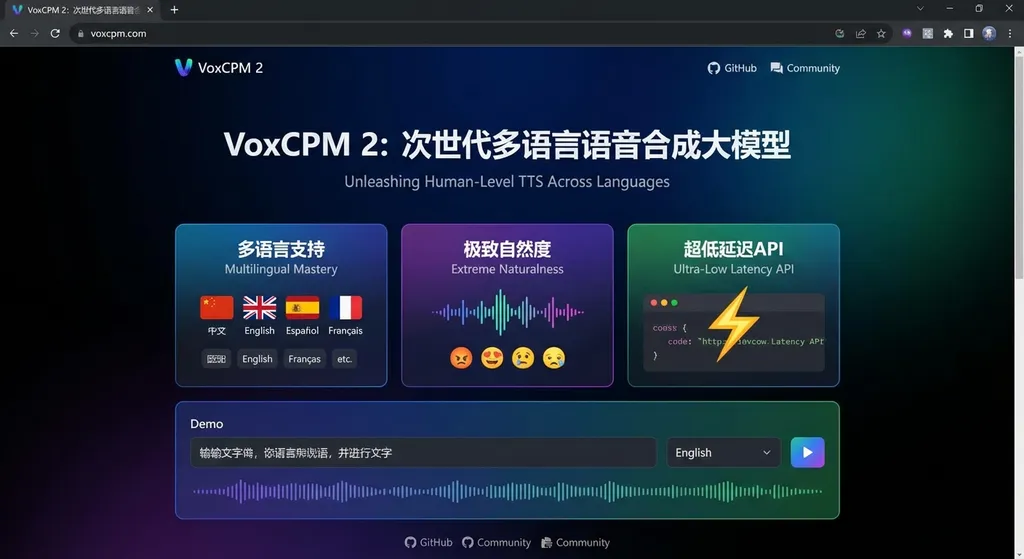
First off, what exactly is this
VoxCPM 2 is the second-generation model in Wall-Facing Intelligence’s VoxCPM series.
The previous generation, released last September, was a 0.5B version. It gained over 1,000 likes and 5,500+ downloads on Hugging Face and achieved SOTA performance in synthesis naturalness and timbre similarity among models of similar size.
This time, it jumps directly from 0.5B to 2B, with a base upgraded from the original MiniCPM to MiniCPM‑4.
Training data is massive — over 2 million hours of multilingual speech. For comparison: Meta’s Voicebox used 60,000 hours of English data, and Microsoft’s VALL‑E 2 also used tens of thousands. 2 million hours puts VoxCPM 2 at an extremely aggressive scale among open-source TTS models.
Technically, VoxCPM 2 adopts a Tokenizer-Free continuous representation approach.
Most speech models first discretize audio into tokens and then model it as a language sequence. VoxCPM 2 skips this step entirely, generating directly in a continuous space.
The benefit is simple: no info loss due to discretization, allowing higher audio fidelity — which supports its 48kHz output, while many open-source TTS models are still stuck at 16kHz–24kHz.
Three core abilities, explained
Multilingual synthesis in 30 languages
It supports 30 languages, covering major ones such as Chinese, English, Japanese, Korean, French, German, Spanish, Portuguese, Russian, and Arabic — plus 9 dialects (very likely including Cantonese, Sichuanese, and Shanghainese).
Importantly, it doesn’t require language labels.
You just feed in the text, and the model auto-detects and synthesizes in the right language. This saves developers a lot of effort — no need to maintain separate language detection logic for multilingual apps.
It also supports cross-language timbre transfer.
Using a Chinese reference voice, you can synthesize French or Japanese speech with the same timbre. From demo results, cross-language consistency is impressive, with no noticeable accent drift.
Creative timbre design
This feature is quite fascinating.
You can describe a voice using natural language — for example: “male around 30, deep and warm voice, slow speaking rate, slightly magnetic tone” — and the model generates that timbre out of thin air, without any reference audio.
For content creators, this is super practical — audiobooks, podcasts, game voice-overs. You imagine a character’s voice but can’t find the right sample? Now you can just “design” it with words.
Of course, results depend on your description and the model's interpretation capability. Feedback so far suggests that simple, clear descriptions work best, while abstract ones (“sounds like autumn wind”) are still a challenge.
High-fidelity voice cloning
Give it a short clip, and it clones the speaker's timbre.
Not new — GPT‑SoVITS, CosyVoice, Fish Speech all do this.
VoxCPM 2’s twist is “controllable cloning” — you can modify emotion, speed, expressiveness through text instructions, while keeping timbre intact.
Someone in the community reportedly used it to replicate Guo Degang’s fast-talking performance of The Reckless Man — a brutal test for rhythm and breath control. The fact it handled that well suggests strong prosody modeling skills.
Compared with competitors — where does VoxCPM 2 stand
The open-source TTS space is getting crowded. Here’s a side-by-side:
| Model | Parameters | #Languages | Sampling Rate | Voice Cloning | Timbre Design | Tech Path | |--------|-------------|-------------|---------------|----------------|----------------|------------| | VoxCPM 2 | 2B | 30 | 48kHz | ✅ | ✅ | Continuous Representation | | CosyVoice 2 | ~1B | Chinese, English, Japanese, Cantonese, Korean | 24kHz | ✅ | ❌ | Discrete tokens | | Fish Speech 1.5 | ~1B | 10+ | 44.1kHz | ✅ | ❌ | VQGAN+LM | | GPT‑SoVITS v2 | <1B | Chinese, English, Japanese, Korean, Cantonese | 32kHz | ✅ | ❌ | SoVITS | | IndexTTS 2.0 | ~1B | Chinese, English | 24kHz | ✅ | ❌ | Discrete tokens |
Key advantages:
- Widest language coverage. 30 languages — unmatched among open-source models. Great for global product development.
- Unique timbre design. Other models need reference audio; VoxCPM 2 generates timbre from text — a qualitative leap for creative use.
- 48kHz studio-grade audio. Most competitors still output 24kHz or 32kHz — the difference is audible.
Points to watch:
- Inference cost. 2B parameters = higher latency vs ~1B peers. Real-time use cases (like voice assistants) need testing.
- Ecosystem maturity. GPT‑SoVITS and Fish Speech already have community tools and GUIs. VoxCPM 2’s ecosystem is still early.
Technical architecture — why continuous representation
Let’s unpack the design choice.
Most TTS models follow the pipeline:
Audio → discrete tokens → LLM-style generation → decode back to audio.
That’s convenient — it reuses mature next-token prediction infrastructure from LLMs.
But discretization introduces an information bottleneck.
Quantizing continuous audio into a limited codebook inevitably loses detail — especially fine timbre and emotional nuances, which are high-frequency information easily erased.
VoxCPM 2 instead models directly in continuous space, using MiniCPM‑4 as backbone; both input and output are continuous representations.
This increases training complexity and engineering overhead — but also raises the performance ceiling.
Results speak: 48kHz high-quality output and high-fidelity cloning = proof that this approach works.
The 2M-hour dataset is also noteworthy.
Multilingual audio is hard and costly to collect and clean. For Wall-Facing Intelligence to assemble such scale implies massive data engineering investment.
So even though the model is open-sourced, retraining it isn’t easy — data remains a major barrier.
How developers can use it
VoxCPM 2 is now open-sourced on GitHub, Hugging Face, and ModelScope, with an online demo available.
For local deployment, the README shows a standard workflow:
# Clone the repo
git clone https://github.com/OpenBMB/VoxCPM.git
cd VoxCPM

# Install dependencies
pip install -r requirements.txt

# Download model weights (from Hugging Face or ModelScope)
# huggingface-cli download openbmb/VoxCPM2 --local-dir ./models/VoxCPM2
For inference, memory requirement is estimated around 6–8GB VRAM (FP16) — runnable on a consumer GPU.
With INT4 quantization, ~4GB should suffice. This continues MiniCPM’s “edge-device-friendly” philosophy.
Those needing API-based TTS access should note: major TTS API aggregators (like OpenAI Hub) may soon include VoxCPM 2.
An OpenAI-compatible API makes model testing and comparison far easier.
Example API call in OpenAI format:
from openai import OpenAI

client = OpenAI(
    api_key="your-api-key",
    base_url="https://api.openai-hub.net/v1"
)

# Text-to-Speech (OpenAI-compatible format)
response = client.audio.speech.create(
    model="tts-1-hd",  # check supported model names on platform
    voice="alloy",
    input="Hello, this is a speech synthesis test.",
)

response.stream_to_file("output.mp3")
The MiniCPM ecosystem — where VoxCPM 2 fits
Viewed within Wall-Facing Intelligence’s broader ecosystem, VoxCPM 2 makes perfect sense.
The MiniCPM series focuses on “small models, big capabilities.”
- Text: MiniCPM
- Multimodal: MiniCPM‑V (now at version 4.5, supports real-time video understanding)
- Speech: VoxCPM 2
Plus MiniCPM‑o 4.5 for instant free conversation — together they form a complete multimodal capability matrix around 2B-size models.
Strategically, it’s clever.
Large models are hitting saturation, but lightweight, deployable models are in huge demand.
2B can run on mobile or edge devices — essential for IoT, automotive, and smart hardware.
VoxCPM 2 covers speech synthesis — meaning developers can theoretically build full multimodal applications using only Wall-Facing’s model stack.
Why this matters
Frankly, the open-source TTS space is already crowded.
But VoxCPM 2 distinguishes itself in several ways:
-
30-language coverage raises the bar for multilingual TTS.
Previously, global speech synthesis required expensive commercial APIs or hybrid setups.
Now you get full coverage with one open 2B model — a massive win for developers. -
Continuous representation may influence future technical directions.
If VoxCPM 2 consistently outperforms discrete-token models, more teams could shift to this paradigm. -
2B parameters + edge deployment = commercial potential.
A phone-runnable TTS model supporting 30 languages and voice cloning? The possibilities are endless.
Of course, it’s new — real-world validation is needed: latency, long-text stability, cross-language quality consistency, cloning robustness in extreme cases.
These will take time to test.
But given the current info, VoxCPM 2 is among the most noteworthy open-source TTS releases recently.
Developers interested can check out the demo page first — then decide whether to deploy locally.
References:
- VoxCPM 2 GitHub Repository — source code, model weights, docs
- VoxCPM 2 Community Discussion — forum thread about the open-source release
- Introduction to VoxCPM voice cloning & generation — detailed Zhihu article on the VoxCPM series


