
Ideal Mach Mind-Pro onboard L9, the vehicle-side large model is finally no longer just a gimmick

On Livis Day, Li Auto unveiled the multimodal large model Mach Mind-Pro, fully implementing L9 Livis in-car intelligence. Core evaluations such as IFEval and AIME26 entered the industry’s top tier, with all reasoning performed locally on the vehicle.
Ideal Mach Mind-Pro Boards the L9—Onboard Large Model Finally Not Just a Gimmick
On the afternoon of June 15, during the Livis Day automotive software and AI launch event, Ideal played a key card—its multimodal large model Mach Mind-Pro has been fully deployed into the L9 Livis onboard intelligence. This is the most significant update in Ideal’s self-developed large model matrix since Mind GPT in 2023 and Mach VLA in 2025, and it marks the first time a domestic automaker has truly put a multimodal model comparable to top-tier general-purpose large models into a mass-produced car.
Saying “put it in and run it” is because this time, Ideal presented not a PPT, but a set of evaluation results and engineering parameters.
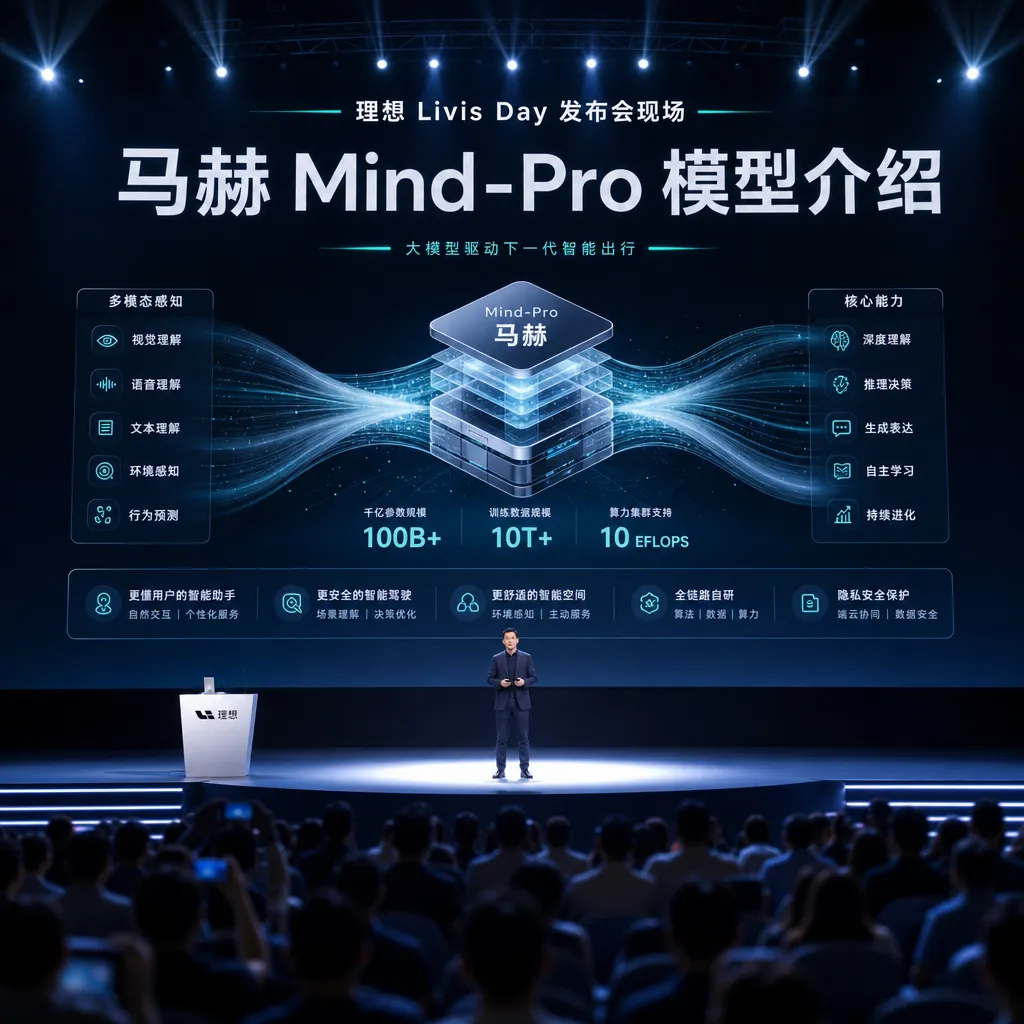
1. Not a car assistant—this is a true general-purpose large model mounted on a vehicle
Over the past two years, whenever an automaker said “large model onboard,” it usually meant connecting to a cloud API or embedding a small 10+ B model for intent recognition—basically, a smarter voice assistant. Mach Mind-Pro’s scorecard this time looks different:
- IFEval instruction following: First-tier
- LongBench-v2 long-text understanding: First-tier
- AIME26 advanced mathematical reasoning: First-tier
- BFCL-v4 tool usage: First-tier
These four cover the core capability profile of a general-purpose large model—understanding complex instructions, processing long contexts, hardcore reasoning, and calling external tools. Being in the first tier on AIME26, the 2026 updated collection of math competition problems, is rare domestically; Ideal put it into a car.
More importantly, another set of data: Token generation speed, task completion quality, token cost, end-to-end response latency all meet mass production requirements. These are not technical metrics—they are commercial metrics. Once a model runs on the car side, it must contend with compute limits, range anxiety, and latency tolerance. Mind-Pro being production-ready means this model + inference engine + automotive-grade SoC combination has been refined to run smoothly.
2. Multimodal streaming temporal modeling: letting the model continuously watch the world
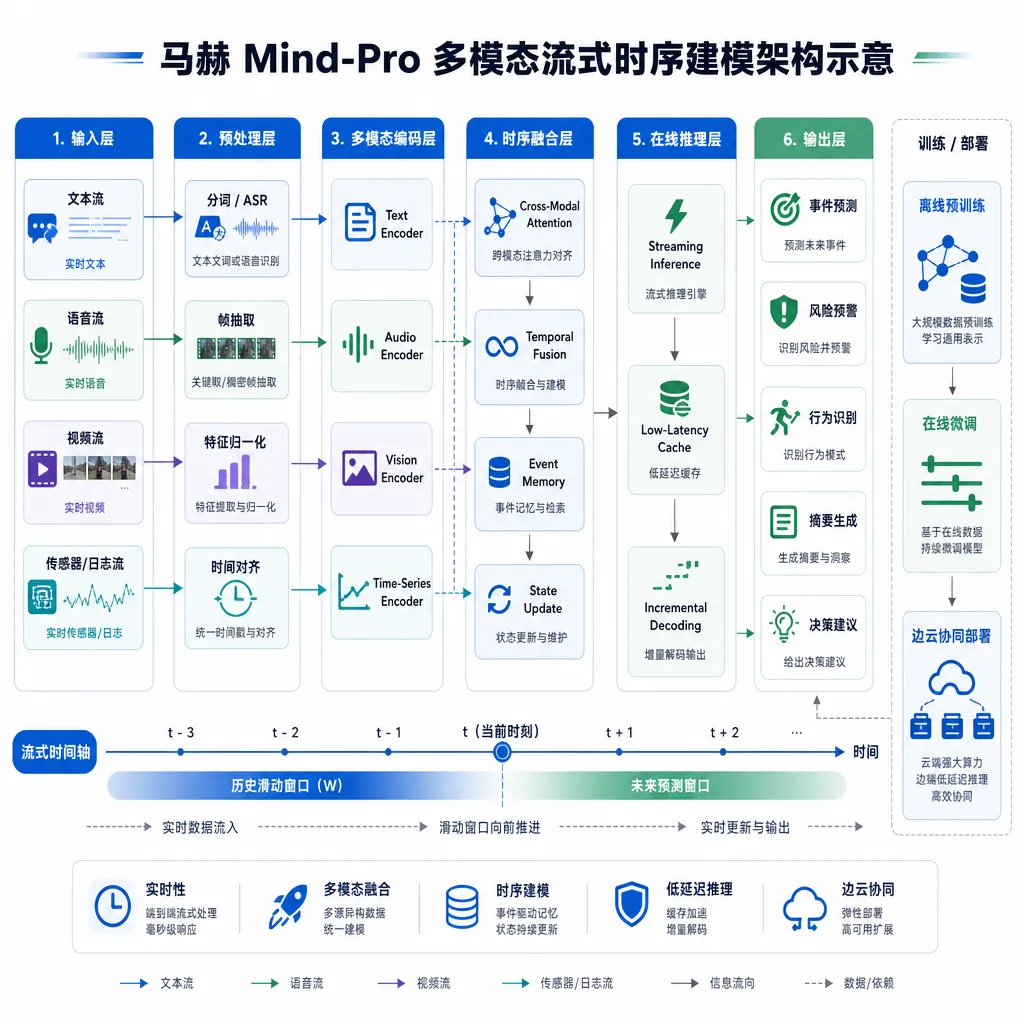
Even more notable than the capability score is Mach Mind-Pro’s architecture choice—Multimodal Streaming Temporal Modeling.
Traditional multimodal models handling video or dynamic scenes typically sample frames, feeding one image every few hundred milliseconds into the model, which processes each frame independently. This is fine for short video understanding, but unsuitable for onboard scenarios—you can’t have the model “look” at road conditions every 500 ms, nor can you risk skipping a child darting into the street between frames.
Streaming temporal modeling treats signals from cameras, microphones, the vehicle CAN bus, etc., as continuous temporal signals, letting the model perceive continuously over time rather than slicing frame by frame. It's akin to upgrading the model from “looking at a photo album” to “watching a livestream,” and during that livestream, it can perform causal reasoning based on historical context at any time.
Once this is achieved, the capabilities described by Ideal—Always-on active sensing, continuous dynamic physical world understanding, causal reasoning, autonomous decision-making—become possible. Otherwise, your onboard assistant will only react passively, never being able to proactively alert “Look, the car behind is about to change lanes.”
3. Behavior-specific training: model directly outputs actions
Another engineering-heavy but important design of Mind-Pro is extensive onboard-specific behavior specialization training, enabling direct action output and real-time hardware calls.
Here’s some elaboration. The two mainstream paradigms for large model tool usage today are:
- Function Calling: Model outputs JSON, middleware parses, routes, executes
- Agent Framework: Model outputs natural language, framework layer performs intent recognition before triggering action
Both work in web services, but onboard they have a fatal flaw—latency. A command like “turn on driver’s seat heating and set to level 3,” if requiring JSON parsing and then hardware RPC, can easily exceed one second end-to-end. Mind-Pro incorporates vehicle control actions as a “native output modality” trained into the model; during inference, it can directly send hardware instructions, cutting an entire layer.
The downside is high coupling—changing hardware means retraining. But Ideal’s fully self-developed stack, from chips (Mach M100) to OS to model, makes coupling a feature, not a limitation.
4. Local inference + no data upload: strong privacy guarantee
Another repeatedly emphasized point at the event: All capabilities—Always-on active sensing, human–vehicle interaction, autonomous control, multimodal Q&A—completed locally on the vehicle, with zero data upload.
For consumers, this is a privacy and security perk; for engineering, it’s serious prowess. Running a model that achieves first-tier AIME26 results entirely on a vehicle SoC demands either extreme distillation and sparsification of the model, or extraordinary optimization of the underlying inference engine. Ideal previously self-developed the LisaRT-LLM inference engine; Mind-Pro likely reuses this infrastructure, with dedicated kernel optimization for the Mach M100.
Local inference advantages are clear:
- Privacy: Conversations and visuals in the cabin never leave the car
- Availability: Works in signal-deprived tunnels and underground garages
- Latency: Eliminates network round trips, enabling end-to-end responses in hundreds of milliseconds
- Cost: No cloud token consumption—saves Ideal money
But the trade-offs are real—model size, context length, and concurrent requests are limited by onboard hardware ceilings. Mind-Pro achieving first-tier performance in these constraints is solid engineering capability.
5. Comparing competitors: where Ideal wins
A horizontal comparison of domestic automakers’ large model deployments:
| Player | Model Strategy | Deployment Method | Multimodal Capability | |--------|----------------|-------------------|-----------------------| | Ideal Mind-Pro | Self-developed multimodal | Local on vehicle | Streaming temporal, continuous perception | | NIO NOMI GPT | Self-developed + cloud | Primarily cloud | Voice-focused | | Xpeng XGPT | Self-developed base | Cloud | Vision + voice | | Huawei Pangu in-car | Pangu sub-models | Cloud + edge | Multimodal | | BYD Xuange | Multiple partnerships | Cloud | Voice-focused |
Ideal’s sharpest differentiators this time are: Fully local inference, streaming multimodal, native vehicle control output. The first two are technical route choices; the third is the product of vertical integration. This combo puts Ideal in front, at least regarding “large model as cabin OS.”
Mind-Pro remains just the cabin brain; Ideal’s autonomous driving line uses another model—Mach VLA (Vision-Language-Action), upgrading system-level 3D spatial understanding and closed-loop reinforcement learning. Together, cabin and intelligent driving form Ideal’s two-legged AI strategy.
6. What it means for developers
Straight to a few conclusions:
-
Vehicle-side inference engines will be the next red ocean. Mind-Pro proving feasibility of fully local inference means multimodal models at the 7B~14B scale are now mass-production viable on automotive-grade chips. By next year there will be new players in vehicle LLM runtime.
-
Vehicle app ecosystem interfaces will be restructured. Once models can “directly output actions,” traditional app invocation methods (Intent, SDK, deep linking) may be replaced by native large model protocols. Ideal hasn’t said if it will open the interface, but if it does, it’s a new opportunity.
-
Multimodal evaluation benchmarks will shift. Metrics like IFEval, BFCL previously used mainly for cloud models are now applied to vehicle-side performance, showing vehicle model evaluation is absorbing general NLP benchmarking systems.
-
Privacy + local inference will become default compliance. Once top automakers adopt “data stays in car,” regulators may follow suit. Later, cloud-reliant automakers will face higher compliance costs.
7. Summary
Mach Mind-Pro is not a new vehicle assistant—it’s the capability curve of a general-purpose large model pressed against the ceiling of onboard hardware, carving out a new path. Among domestic automakers, Ideal is the first to achieve the trifecta of “multimodal large model with capability benchmarks online, commercial metrics viable for mass production, inference completed locally.”
L9 Livis owners will likely be the first to enjoy the benefit, but the significance of this launch extends beyond one car—it sets a new baseline for the industry: From today, onboard large models should be evaluated by the standards of general-purpose large models.
References
- Ideal: Mach Mind-Pro Model Fully Deployed to Empower L9 Livis Onboard Intelligence - IT Home: Livis Day event report, including model evaluation data and commercialization metrics


