
Antigravity 2.0 Real Test: Can It Beat Cursor and Codex?
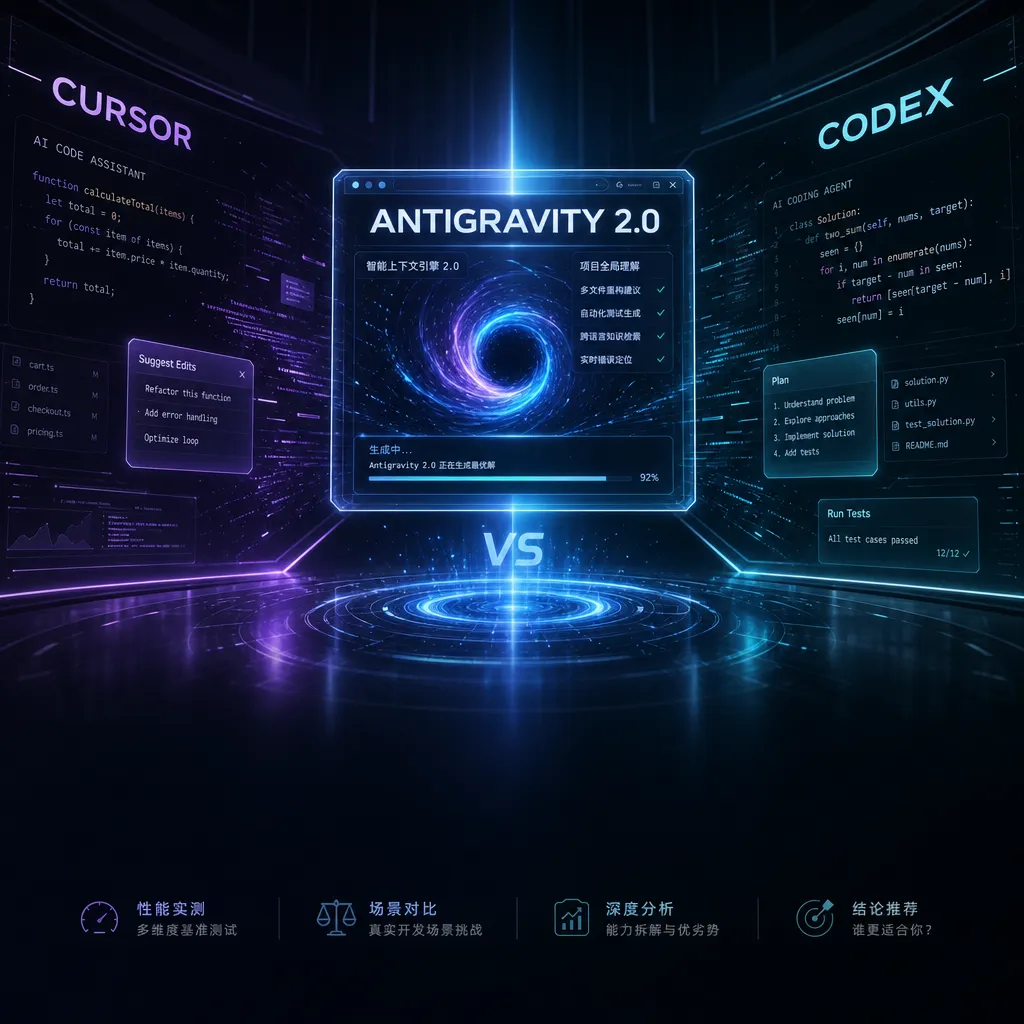
Six months after the release of Google Antigravity 2.0, the developer community has begun seriously discussing its real differences compared to Cursor, Claude Code, and Codex. The Agent Manager is a highlight, but weaknesses in the ecosystem still remain.
On linux.do, someone posted asking: “Has anyone been using Antigravity 2.0 in depth? Compared to Cursor, Claude Code, and Codex, what exactly are its unique advantages?” The post wasn’t long, but the discussion below was lively — this is actually a question that’s been repeatedly chewed over in the AI programming community during the first half of 2026.
It’s been more than half a year since Google repackaged the Windsurf team it acquired into Antigravity. Version 2.0 was released in late spring, with a major overhaul to Agent Manager and Gemini 3.1 Pro set as the default model. Half a year was enough for the initial “Gemini 3 launched and instantly became legendary” hype to fade, leaving developers with a calmer assessment: Antigravity is not a Cursor killer, but in certain scenarios it has indeed, for the first time, put real pressure on Cursor.
First, let’s clarify the positioning of the four tools
By 2026, AI programming tools can no longer be divided simply by “completion / no completion.” Today’s four mainstream options each have a very clear persona:
- Cursor: Deep fork of VS Code, the de facto standard for AI-native IDEs, top citizen in the ecosystem, monthly fee starting at $20, heavy users on Ultra at $200
- Claude Code: Anthropic’s terminal Agent, powered by Sonnet 4.6 / Opus 4.6, quality ceiling but also price ceiling
- Codex (CLI + Web): OpenAI’s gpt-5.3-codex-driven, most consistent sandbox execution, friendlier UI experience than Claude Code
- Antigravity 2.0: Google’s Agent-first IDE, bundled Gemini 3.1 Pro + Flash + Claude Sonnet + GPT-OSS, marketed as “cheap and generous”
If you just look at the price list, Antigravity seems like a dimensionality-reduction attack: for the same $20/month, it gives you more than double Cursor’s token allotments and throws in 2TB of Google One storage. But price is only half the story.
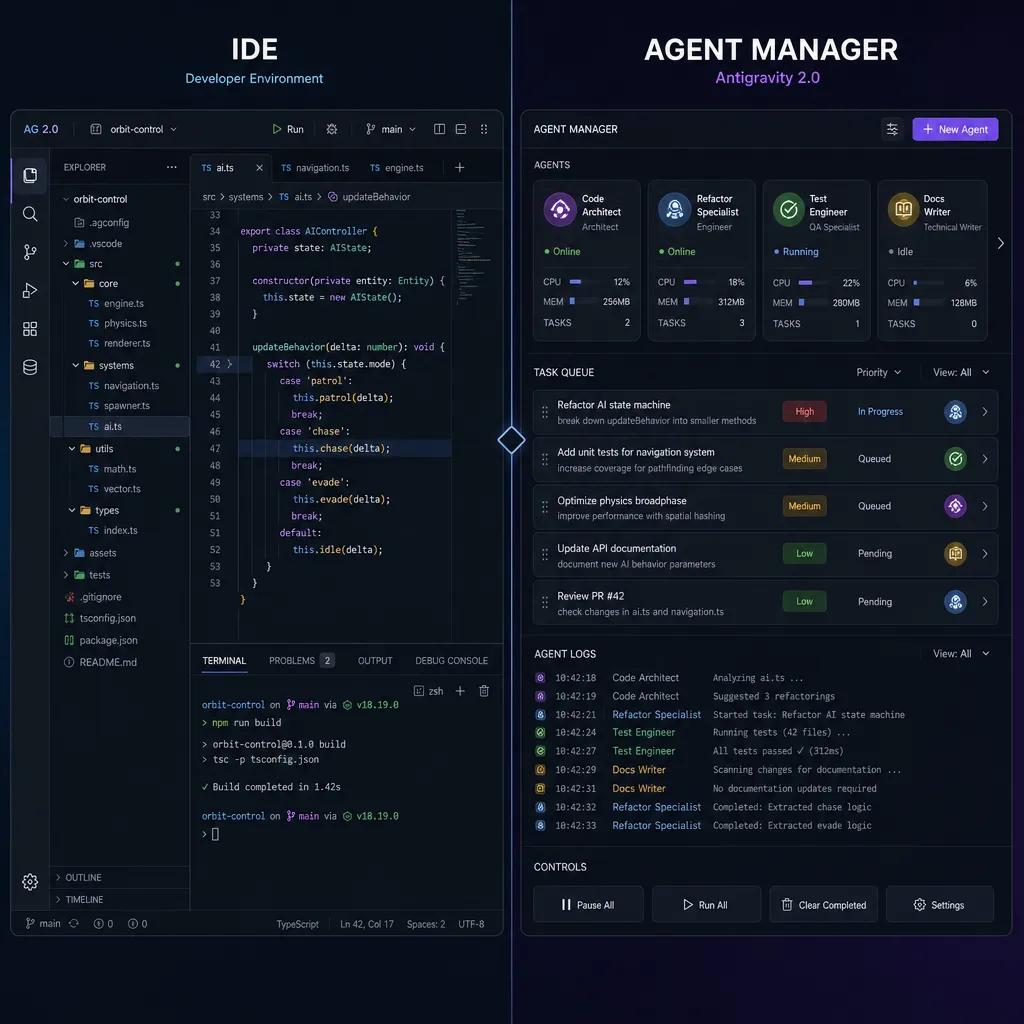
The true differentiator of Antigravity 2.0: Agent Manager
After six months of use, developers generally admit that Antigravity has something that the other three haven’t fully matched yet — the Agent Manager panel.
The logic is this: you are no longer “talking to one AI to change code” but instead running 4 to 8 Agents in parallel, each in its own independent Git Worktree doing its own task. One edits the front-end, one writes tests, one fixes bugs, one does refactoring — in the Manager panel you monitor their progress like viewing a K8s Dashboard; if one gets stuck, you click in to check; if one finishes, you review and merge.
This is the biggest change from version 1.x. In 1.0, Agent Manager was more like a task queue; after 2.0 it truly became a “visualized parallel workflow” — each Agent has its own browser sub-agent, its own terminal, its own file tree view, all without interfering with one another.
Cursor’s Composer mode also supports multiple files, but is essentially single-threaded; Claude Code can achieve similar effects with Git Worktree, but requires you to manually orchestrate with tools like tmux; Codex has similar parallel capability on the web, but IDE integration isn’t as seamless as Antigravity.
This is Antigravity’s most solid differentiator in 2026: it has turned “multi-Agent parallelism” from an advanced trick into the product’s default shape.
Is it actually more useful in practice? Depends
After half a year, community feedback is actually split. Here are some high-frequency scenarios:
Scenario 1: Building an MVP from scratch
Antigravity shines here. As one Reddit user put it, "shockingly good at one-shot" — Gemini 3.1 Pro’s long context + parallel Agents make it particularly suitable for “I have an idea, help me build it” tasks — you can have one Agent write the backend, one the frontend, and one set up CI/CD, progressing in parallel.
Cursor isn’t bad here either, but you have to manually switch contexts; Claude Code is more stable quality-wise but slower; Codex has the best sandbox security but a weaker IDE experience.
Scenario 2: Bug fixing in a million-line legacy codebase
This is Claude Code’s turf. Sonnet 4.6 / Opus 4.6’s holistic codebase understanding is still ahead of Gemini 3.1 Pro. Antigravity can call Claude Sonnet too, but IDE-level integration isn’t as deeply optimized for Claude as it is for Gemini — many complain: "Using Claude inside Antigravity isn’t as good as using Claude inside Claude Code."
Scenario 3: The daily 90% of work
Writing business logic, tweaking styles, fixing minor bugs, adding endpoints — Cursor’s advantages here still dominate: the responsiveness of Tab completion, precision of Cmd+K, plugin ecosystem, and quick searchability of solutions — these “boring but crucial” experiences have been refined by Cursor for over three years, and Antigravity can’t catch up quickly.
Scenario 4: Terminal users / CI integration / automation scripts
Claude Code and Codex CLI both have their fans. Claude Code’s native terminal experience is more lightweight, Codex CLI’s sandbox execution is safer for production integration. Antigravity also has a CLI, but its completeness is clearly behind the IDE’s, looking more like a “bonus feature.”
Several key improvements in version 2.0
Compared to 1.x, the most noticeable changes in Antigravity 2.0 over the half-year are:
- Smarter Agent scheduling: in 1.0, Agents often fought over locks and overwrote files; 2.0 adds file-level coordination
- Browser Subagent is now usable: can open webpages, read DOMs, return screenshots — useful for front-end debugging and scraping tasks
- Aligned with MCP ecosystem: supports Anthropic’s MCP protocol thoroughly, making third-party tool integration much smoother than in 1.0
- Throttling mitigated but not eliminated: the early complaint of “suddenly throttled mid-use” still exists, especially during Gemini 3.1 Pro peak hours
An uncomfortable truth: stability
Here’s something less pleasant: Antigravity 2.0 currently leans more toward “usable” than “excellent.” Frequent issues after half a year include:
- Reliability fluctuations: during peak, Gemini 3.1 Pro’s response latency can spike from 2 seconds to 20 seconds
- Agents occasionally lose contact: long-running tasks can leave Agents in “unknown” state, requiring manual restart
- Opaque quota calculation: users often don’t know how much remains, with no clear warning when throttling kicks in
In comparison, Cursor is the most reliable of the four; Claude Code is expensive but stable; Codex is average.
My verdict: how to choose
If I were to recommend to a friend right now:
- No budget limits, serious projects: Claude Code as main + Cursor as IDE backup — painful monthly fee but maximum efficiency
- Budget $20/month, heavy daily use: Cursor still the first choice — ecosystem maturity wins over everything
- Budget $20/month, heavy Gemini user / likes parallel Agent workflows: Antigravity 2.0 offers the best value
- Terminal users / old school developers: choose between Codex CLI or Claude Code CLI depending on your model loyalties
- Want it all: the CSDN “four-in-one” combo (Claude Code + Codex + Gemini CLI + Antigravity) isn’t a joke — some do use it, switching per scenario
By the way, if you don’t want to manage keys and billing for four subscriptions, an aggregation platform like OpenAI Hub is a lazy option — one key for GPT-5.3, Claude Opus 4.6, Gemini 3.1 Pro, DeepSeek, all OpenAI-format compatible, directly usable with tools like Cursor / Cline / Continue that support custom endpoints — no proxy hassle in China. For developers wanting to “try out Gemini 3.1 Pro used in Antigravity without opening a Google account,” this is a pretty convenient entry point.
Conclusion
The half-year story of Antigravity 2.0 actually confirms a basic fact about the 2026 AI programming tool market: there’s no silver bullet, only trade-offs. Google has carved out its territory with “cheap + parallel Agents,” but it hasn’t come close to overthrowing Cursor; Cursor’s ecological moat remains deep; Claude Code holds the quality ceiling; Codex holds the OpenAI ecosystem.
This quadripod structure is actually the best state for developers — prices stay in check, features keep advancing, and choices abound. Whether Antigravity can take another step forward in the second half depends on whether Google can fix the stability issues. Otherwise, cheap alone won’t retain serious coders.
References
- linux.do original thread discussion: Anyone using Antigravity 2.0 in depth? – Original post source, community developer hands-on experience share
- Reddit r/vibecoding: Antigravity vs Claude Code vs Codex vs Cursor — which is best? – Overseas developer paid-tier comparison discussion
- Zhihu: Comparison of three mainstream AI programming tools (Claude Code, Antigravity) – Chinese community horizontal review


