
HarmonyOS SDK 26 is here: 80,000 APIs as the foundation, device-side Skills are the real deal
At HDC2026, Huawei rolled out HarmonyOS SDK 26 with over 100 Kits and more than 80,000 APIs fully open. But what’s truly worth developers taking apart and examining is the device-side Skill integration and the Ark Agent Framework — this means HarmonyOS is beginning to feed application capabilities directly to the system’s intelligent agents.
On June 15, Huawei’s official smartphone account announced the formal release of HarmonyOS SDK 26. This comes right after the June 12 HDC2026 keynote speech and the HarmonyOS 7 Developer Beta 1 — the former aimed at users, the latter meant for developers.
According to official statements, SDK 26 opens over 100 Kits and more than 80,000 API interfaces, pushing HarmonyOS’s strength from “running apps” to “running agents.” If you just look at the nine innovation directions listed in the PPT — media, multi-window, intelligence, communications, performance, spatialization, low power consumption, security, full-scenario — you might mistake this for another routine upgrade. But if you break it down, you’ll find the focus in this release is really only two things: making device-side agents truly able to use apps, and handing over the dirty and tiring work of multi-form adaptation to AI.
Not Just Another “API Giveaway”
Let’s start with some numbers: HarmonyOS device count has surpassed 66 million, developers number over 11 million, unique apps exceed 400,000. These figures were given on-site at HDC2026 by Gong Ti, President of the Software Department at Huawei’s Terminal BG. HarmonyOS 6’s upgrade rate is over 98%, and top apps have seen user satisfaction improve by more than 50% over the past year.
These stats define the tone of SDK 26: it no longer needs to prove desperately, as during the HarmonyOS NEXT era, that it “can do what Android can do,” but is now moving upward, building differentiated capabilities.
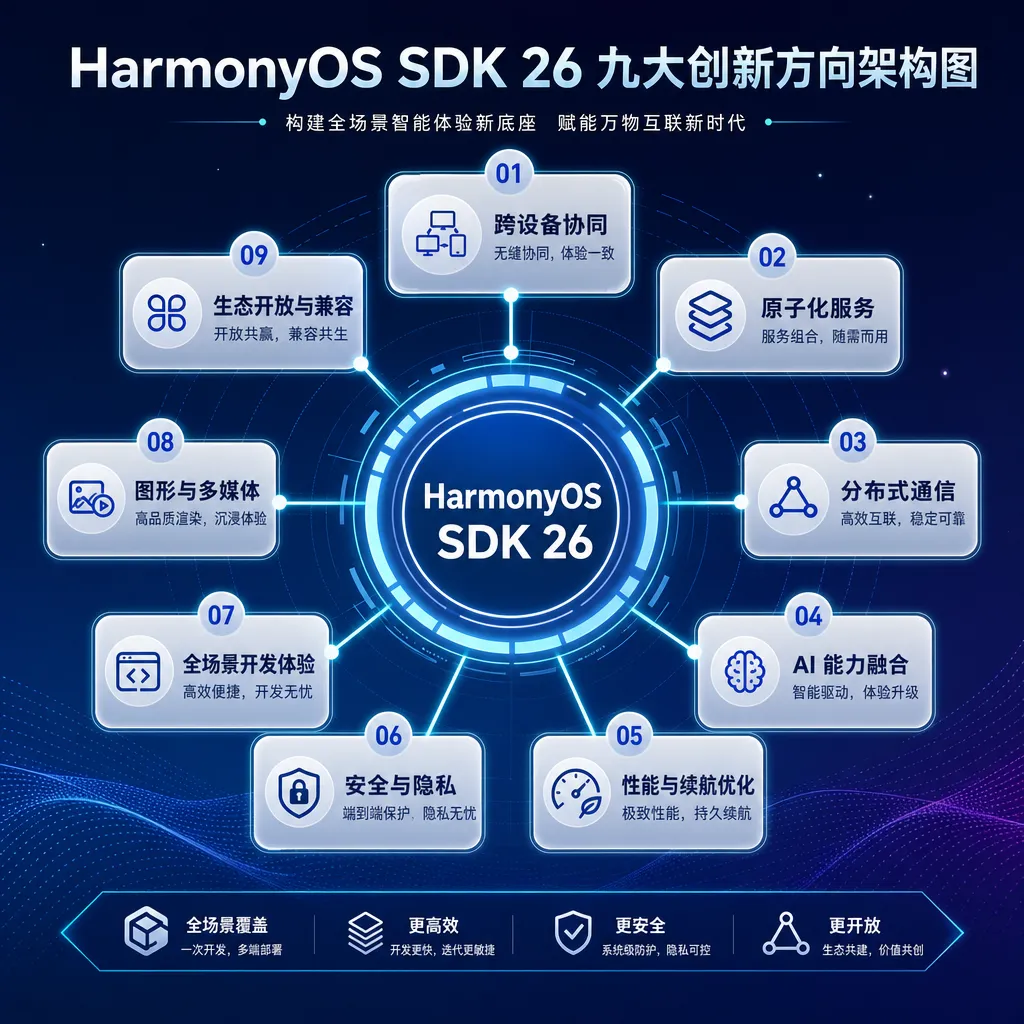
Out of the nine directions, truly “new” are:
- Intelligence: Device-side ecosystem Skill integration — app capabilities can be called in a closed loop by system-level agents like Celia
- Spatialization: Immersive light-sensing components, immersive 3D spatial imaging — paving the way for foldable and large-screen form factors
- Communications: System-level QUIC protocol openness, device-cloud network pre-built links — capabilities previously hidden inside the system
- Performance: FAST acceleration service, games “instant launch and open” — Graphics Accelerate Kit adds pre-launch features
- Security: Device-side confidential computing space — data “usable but invisible”
The rest — floating windows & quick control ball, live windows, LTPO dynamic refresh rate — are more about gathering previously scattered capabilities into standard APIs that third-party developers can use.
Skills Are the Real Star of This Release
If we could only highlight one thing, it would be Ark Agent Framework supporting device-side Skills.
This means your app is no longer just an “icon,” but can break its functions into individual Skills, ship them with the app, and have them directly called by system agents — like Celia, or other future agents. Skills come in both device-side and cloud-side forms; the benefit of device-side is no network dependency, no link loss, and controllable privacy.
A live example: The Time Travelogue app’s developer integrated with Celia via the Agent Framework Kit, and in just 10 minutes created “automatic historical story recall for travel photo locations”. The entire app went from development to launch in 20 days with over 10,000 users; the team completed development in only 14 days.
This paradigm matters because it follows the same path as iOS’s App Intents and Android’s App Actions, but HarmonyOS is more aggressive — it treats Skills as first-class citizens in the SDK and integrates them with the DevEco Code AI programming pipeline. Developers are not “incidentally” making a Skill, but must consider from project inception: which functions of my app are worth opening up to system agents?
It’s a mental shift. In the past, app development focused on “acquisition-retention-monetization.” In the future, HarmonyOS apps must also ask: Can it be triggered by an agent?
Generative UI: Making Models Output Images, Not Just Text
Another easily overlooked update is HarmonyOS’s generative UI capability. Simply put, large model output is no longer limited to pure text — it can be directly displayed as mixed text-image cards or components.
For developers, this means that tasks like writing your own markdown renderer, handling streaming output, and manually assembling cards are now taken care of by the system. For users, it means that when Celia pushes content to you, it’s no longer just a cold block of text, but an interactive card.
With immersive light-sensing components — the official claim is “one line of code can give interface components layered light and shadow effects” — HarmonyOS’s visual layer starts to have its own flavor. Apple has been leveraging Vision Pro’s Material for light experiences, while the Android camp has largely missed that train. This time HarmonyOS has built it directly into system components.
DevEco Code: Distilling HarmonyOS Experts for You
Along with SDK 26, Huawei also launched two AI-assisted development tools: DevEco Code and DevEco CLI.
DevEco Code is based on Huawei’s Pangu large model and OpenCode, and is an “AI agent that understands HarmonyOS.” Its killer feature is a set of open Skills:
- Multi-device development Skill: Say “help me adapt,” and it adap a bar phone’s code project to foldables and other form factors — handling avoidance, rotation, hardware calls automatically, boosting adaptation efficiency by 50%
- Problem diagnosis Skill: Say “help me locate,” and it handles memory leaks, app crashes, sudden exits — supporting root cause location, self-repair, self-verification
DevEco CLI is even more interesting — it’s a command-line tool for programming agents, supporting mainstream programming agents. In other words, you can call HarmonyOS’s full toolchain from Cursor, Claude Code, etc. Huawei has also converted over 20 million words of official HarmonyOS documentation into knowledge resources callable by agents.
This is key. HarmonyOS was often criticized for “hard-to-find documentation, closed ecosystem.” DevEco CLI acknowledges that developers will not switch IDEs for HarmonyOS, so HarmonyOS capabilities must follow developers instead.
On-site presentations from Douyin and Kuaishou showed solid data:
- Douyin’s HarmonyOS main feature points: AI test coverage 100%, success rate in high-frequency scenarios 70%
- Kuaishou: during development stage, AI code generation rate 80%, direct acceptance of auto-generated test cases 84%, acceptance of ops fault rectification suggestions 73%
- Kuaishou + HarmonyOS’s Ark Refiner-Sendable Skill: shortened performance optimization from two people in one week to half a day, cold start improved by 16%
Such numbers were unimaginable two years ago — back then, HarmonyOS developers’ biggest pain point was “can’t find the right API.”
Several Hard Changes in SDK 26.0.0 Beta1
Back to the SDK itself, 26.0.0 Beta1 is an iteration based on 6.1.1 (24), with several changes worth reviewing:
- Core File Kit: supports sharing sandbox directories as system-level visible — liberating scenarios needing cross-app collaboration (like file managers, IDEs)
- Device Security Kit: StarShield engine strengthened along with super privacy controls
- Graphics Accelerate Kit: adds a pre-launch feature — significantly improving perceived cold start in games
- Notification Kit: notifications support pulling up the app’s notification settings page in a semi-modal way
- ArkWeb: Chromium kernel upgraded from 132 to 144
A note on ArkWeb’s upgrade to Chromium 144 — this brings HarmonyOS browser kernel versions very close to mainstream Chrome. It’s a positive for all hybrid apps using WebView.
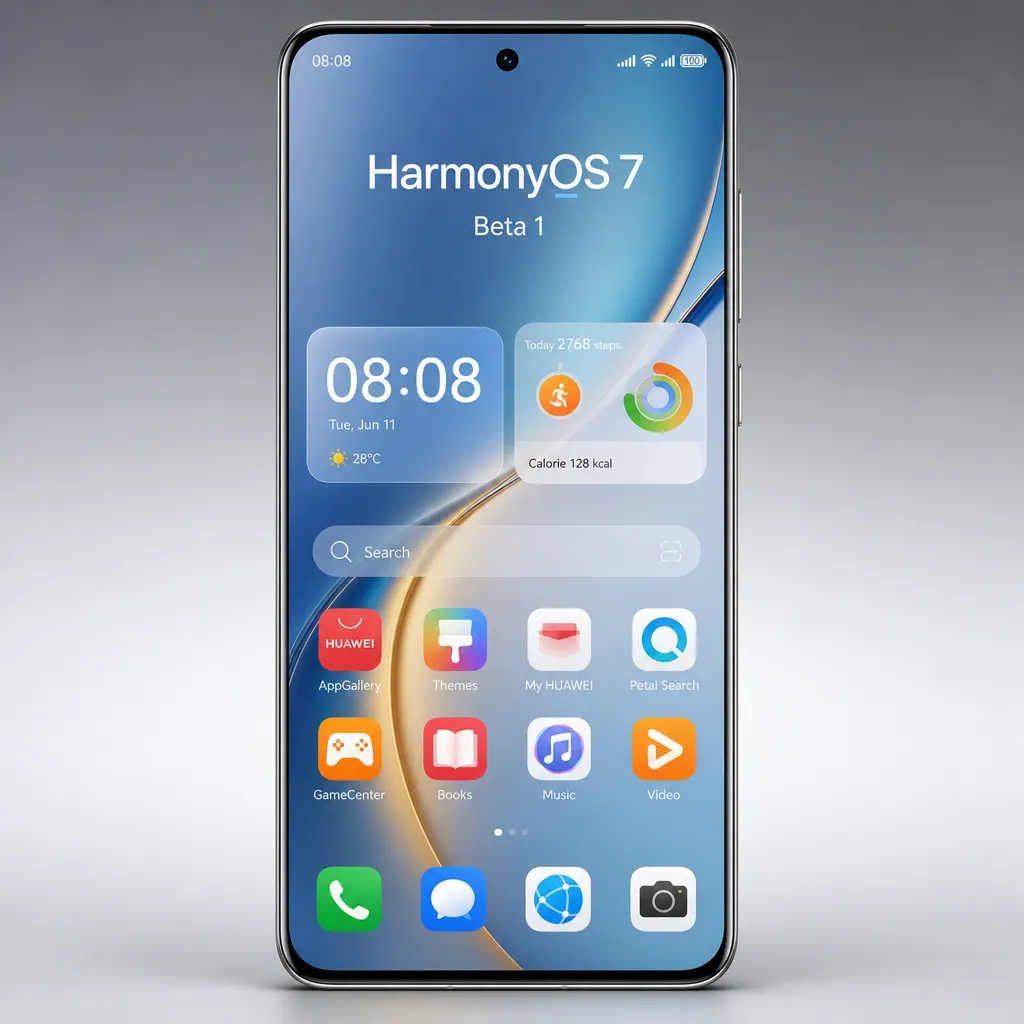
First devices supporting HarmonyOS 7 (API 26) Developer Beta 1:
- HUAWEI Mate 80 Pro
- HUAWEI Mate X7
- HUAWEI Mate XTs Extraordinary Master
- HUAWEI Pura 90 Pro Max
- HUAWEI Pura X / Pura X Collector’s Edition
- HUAWEI nova 15 Pro
Cross-End Framework: Tencent Video’s 90% Reuse Rate
The KMP & CMP framework first Beta version also launched at HDC2026. Tencent Video was a showcase: using the cross-end solution to run one codebase on three ends — HarmonyOS end completion 95%, three-end code reuse rate 90%.
Performance data was more straightforward:
- DMA memory down 95%
- Lag rate down 90%
- Cold start “instant launch and open”
- Full compilation time shortened from 4 hours to 50 minutes, efficiency improved over 4×
In the past, HarmonyOS suffered in cross-end — forcing big companies to maintain separate code for it was too costly. If KMP/CMP truly works, it could accelerate filling the HarmonyOS gap for long-tail apps. This year Huawei worked with the open-source community, major enterprises, and universities to support 18 mainstream cross-platform frameworks, helping 13,000+ apps achieve HarmonyOS compatibility — not a bad number.
Key Time Points for Open-Source HarmonyOS
Gong Ti also revealed timelines worth noting:
- July 15, 2026: StarFlash protocol stack fully open-sourced to the OpenHarmony community
- Cangjie language to further open-source AI tech stack
- OpenHarmony community currently has 30,000+ Stars, 800,000+ PRs, and 1,200+ devices passing compatibility certification
StarFlash open-sourcing is a signal — previously a relatively closed near-field wireless technology from Huawei, now fully open-sourced, clearly aiming to make it an industry standard — competing for ecosystem space with Bluetooth and Wi-Fi.
Some Personal Judgments
If SDK 26 had to be summed up in one sentence: HarmonyOS is now being designed as an OS for the Agent era.
The 80,000 API figure is no longer important — iOS and Android both have tens of thousands. What matters is that Huawei has clarified several points:
- Skills are the next form of app capability. Apps must be callable by agents, or they are isolated.
- AI must be deeply involved in development. DevEco Code/CLI aren’t “nice-to-have,” they are core to reducing the HarmonyOS learning curve.
- Cross-end must avoid forcing developers to rewrite code. KMP/CMP and “help me adapt” Skills are two legs.
Of course, whether it works will be seen over the next year. The story of Agent Framework integrating with Celia will only be truly alive if half of the 400,000 apps are willing to support it — otherwise it’s “opened, but unused.”
But one thing is certain: with 66 million devices, 11 million developers, and 98% HarmonyOS 6 upgrade rate, HarmonyOS already has its entry ticket. After SDK 26, HarmonyOS developers’ question shifts from “Can I migrate my app?” to “How can I use these capabilities to create something others can’t?”
That’s a good question.
References
- Huawei HarmonyOS SDK 26 Official Release: Floating Windows & Quick Control Ball, Instant Game Launch, etc. - IT Home: SDK 26 release details and nine innovation directions
- HarmonyOS News Center - IT Home: HDC2026 full news and first device list


