
GitHub open-source multilingual dataset fills a gap in non-English AI training

GitHub has released a CC0-1.0 licensed repository-level multilingual dataset covering README, Issue, and PR, targeting the current training blind spots of large models on content from non-English developers.
GitHub Open-Source Multilingual Dataset — Filling a Gap for Non-English AI Training
On June 14, GitHub dropped a new open-source dataset on its official blog, under the most permissive CC0-1.0 license (public domain, no attribution required). The goal is crystal clear — to make it easier for researchers and developers to access multilingual developer content from GitHub, for training and evaluating code LLMs.
It might not look like a big deal, but in the context of 2026, it’s quite interesting. Over the past two years, code models have been competing fiercely — from GPT-5-Codex to Claude Opus 4.5 to DeepSeek-V4 — all boasting their SWE-bench scores. But if you’re not an English-speaking developer, the experience is very different: asking a model to read a Chinese README, parse a Japanese Issue, respond to a PR with Russian comments — the effectiveness drops instantly. GitHub now wants to patch this weakness itself.
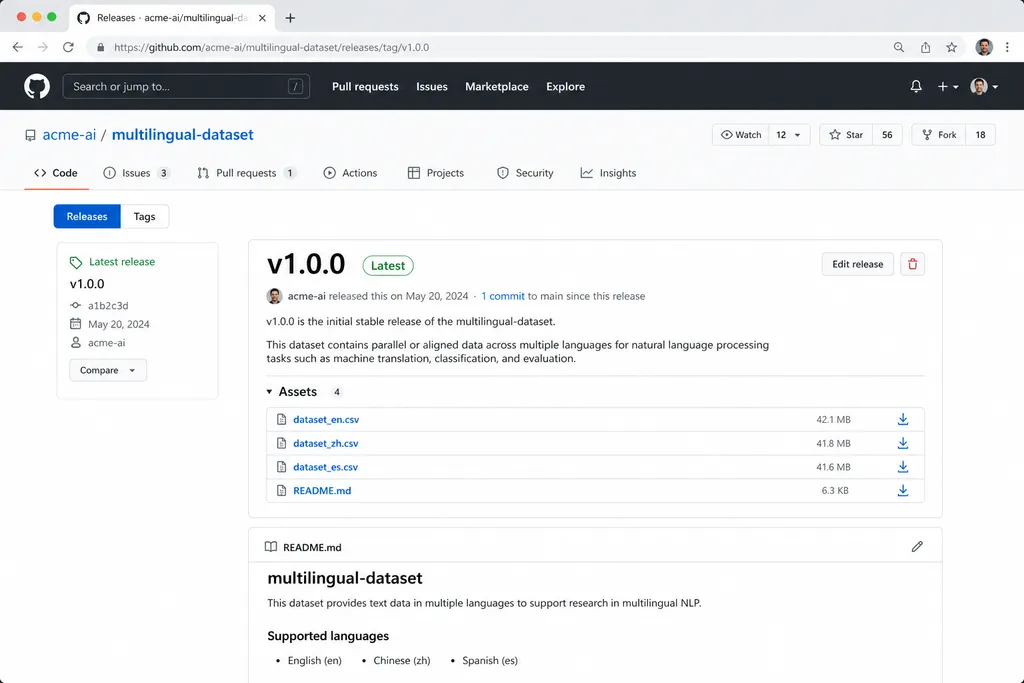
What Exactly Is This Dataset
Unlike past "code-centered" datasets such as CodeSearchNet or The Stack, GitHub’s focus this time is on repository-level natural language content, specifically in three categories:
- README: The project’s front page, containing introductions, installation steps, usage examples
- Issues: Bug reports, feature requests, discussion threads
- Pull Requests: Code review discussions, change descriptions
These share a common trait: high proportion of natural language, tightly bound to code context. For example, an Issue written in Portuguese might contain a Python error stack trace and a snippet of fix code — this "natural language + code + collaboration context" hybrid sample is exactly the rare material needed for training SWE Agents or code assistant models.
Previous code corpora either stuck to function-level snippets (like CodeSearchNet) or scraped README as generic documentation (like The Stack), without truly addressing "what language developers use when collaborating." As the source of the data, GitHub is now organizing it at the repository level with language tags and metadata — the intent is clear: pave the way for RAG, Agents, and long-context downstream tasks.
Why Now
A quick industry assessment: The evolution path of open-source code models this year is already clear:
- From function completion to repository understanding: IDEs like Cursor and Windsurf are no longer satisfied with single-file completion — whole-repo retrieval and planning are must-haves.
- From English-centric to global: Developer growth in India, Brazil, and Southeast Asia far outpaces North America, but their Chinese, Portuguese, Hindi content on GitHub is severely underrepresented in mainstream training sets.
- From pure code to collaboration process: Issue discussions contain the causal chain of "why change this" — far more informative than commit diffs alone.
This dataset hits right at the intersection of these three trends. In plain terms, GitHub holds the largest trove of relevant data; in the past, legal and privacy concerns kept them from releasing it broadly. Now, with the CC0 license, they’re basically telling the industry: I won’t compete over training data ownership — use it if you want, just focus on building great models.
This approach aligns with Microsoft and OpenAI’s current strategies — de-emphasizing data ownership disputes and refocusing competition on model architecture and training methods.
What This Means for Developers
If you’re working on any of the following, this dataset is worth checking out immediately:
1. Training or fine-tuning multilingual code models
The biggest pain point for domestic teams is inconsistent quality in Chinese code corpora. This dataset has been cleaned at the repository level and language-tagged, making it theoretically ready for direct integration into pretraining pipelines. Teams like Qwen, DeepSeek, and Zhipu working on code models will likely start experiments this week.
2. Building evaluation benchmarks
Current code model evaluation is locked into SWE-bench and LiveCodeBench, both English-centric. To create a true “multilingual SWE-bench,” this dataset is an excellent seed corpus. You can sample Issue + PR pairs in different languages to construct end-to-end tasks like “understand non-English description → write a fixing PR.”
3. RAG/Agent retrieval corpora
If you’re building enterprise code assistants for non-English teams (e.g., Japanese or German companies), you can use this dataset as pretraining retrieval augmentation corpora, giving models prior knowledge of "non-English developer scenarios."
Details Worth Attention
From GitHub’s release notes, several points are worth elaborating:
CC0-1.0 license choice: Even more permissive than MIT or Apache — essentially relinquishing all rights. Huge advantage for commercial model training, meaning no legal costs for data compliance. In contrast, Common Crawl-derived datasets have danced on the edge of copyright lawsuits for the past two years.
Repository-level organization: Not file-level, not function-level. This granularity is especially friendly for long-context models — you can join a whole repo’s README + several Issues + related PRs into one context window for in-context learning experiments.
Multilingual ≠ multi-programming-language: GitHub emphasizes diversity of natural languages (Chinese, Japanese, Arabic, etc.), not Go/Rust/Python in the programming sense. Many might confuse this.
Predicted Dataset Structure
Based on GitHub’s blog description, the dataset is likely organized like this (fields subject to repo README):
repo_id: string
primary_language: string  // Natural language, e.g. "zh", "ja", "pt"
readme: {
  content: string,
  detected_languages: [...]
}
issues: [
  {
    title: string,
    body: string,
    comments: [...]
  }
]
pull_requests: [
  {
    title: string,
    description: string,
    review_comments: [...]
  }
]
metadata: {
  stars: int,
  created_at: timestamp,
  ...
}
This structure is perfect for teams doing Agent training, saving tons of ETL work.
Horizontal Comparison: Open-Source Code Dataset Landscape
Placing this dataset on the current map:
| Dataset | Granularity | Content Type | Multilingual Support | License | |---------|-------------|--------------|----------------------|---------| | CodeSearchNet | Function-level | Code + docstring | Average | MIT | | The Stack v2 | File-level | Pure code | Weak | Various | | GitHub New Dataset | Repository-level | README + Issue + PR | Strong | CC0 | | StarCoder Training Set | File-level | Code-focused | Average | Custom |
The position is clear: GitHub is filling the “collaboration context + multilingual” gap. It’s not here to replace The Stack, but to complement it — use The Stack to learn syntax, use this dataset to learn "how developers communicate engineering issues in their native language."
A Potential Risk
Not without issues. The biggest concern is privacy and sensitive information. Issues sometimes contain internal URLs, tokens, emails; PR descriptions may include undisclosed security vulnerability details. GitHub likely filtered these, but under CC0, liability in case of problems is an open question.
Another issue is language detection noise. Many GitHub repos mix languages — Chinese README + English Issues + Japanese comments. How is this tagged? If they crudely classify by main language, multilingual switch scenarios could be lost. The community might have to fix this later.
Final Thoughts
GitHub’s move is quite smart. They’re not (at least outwardly) training models themselves, but by opening data, they define “what constitutes good code model training data,” indirectly shaping the development path of open-source code LLMs.
For domestic code model teams, this is a window not to miss. Whoever integrates this dataset into their pretraining pipeline first will gain an edge in multilingual code capabilities. Given Chinese developers’ activity on GitHub, the proportion of Chinese samples in this dataset will not be small — especially friendly for local models.
Worth watching: whether the next versions of Qwen3-Coder or DeepSeek-Coder will explicitly mention using this dataset; and whether any team will build a true “Chinese SWE-bench” based on it.
References
- createmomo/Open-Source-Language-Model-Pocket — Collection of open-source language model resources, useful for comparing related code model ecosystems
- AI-Compass LLM Collection — Technical ecosystem diagram of mainstream language models
- 30 Large Language Model Training Datasets Shared (Zhihu) — Includes a horizontal review of code datasets such as CodeSearchNet


