
ByteDance Seedance 2.0 Mini Launch: Halved Per-Second Cost, Targeting Mass Production
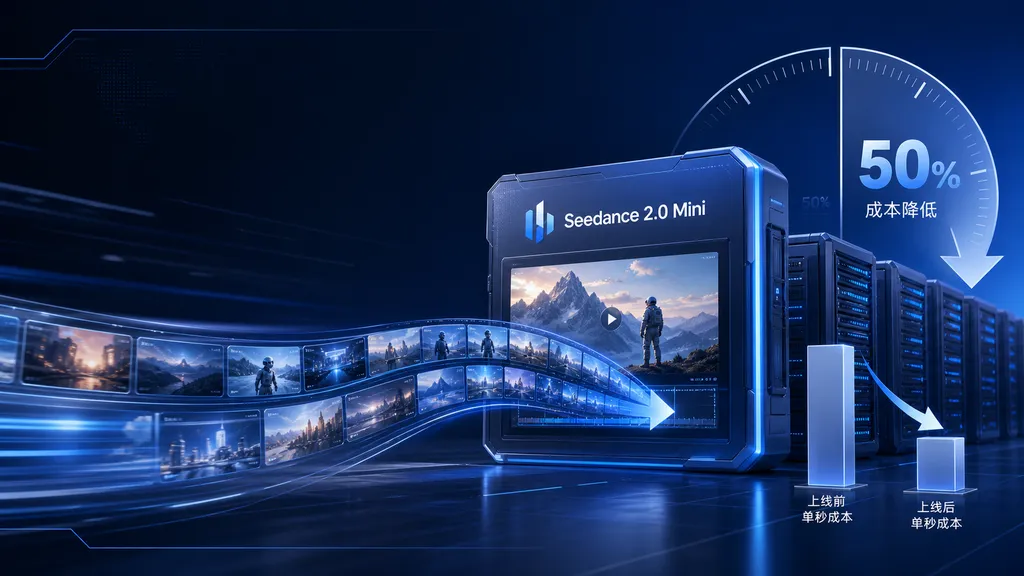
On June 15, Byte Volcengine Ark Experience Center launched the Seedance 2.0 Mini video generation model, which is twice as fast as the Fast version, with the cost of a 720P second reduced to about 0.5 RMB. The API will be available soon. This is another move by Byte in the video model price war.
ByteDance Lowers Video Generation Prices Again
On June 15, Volcano Engine’s Volcano Ark Experience Center quietly launched Seedance 2.0 Mini. The official wording was restrained—"high cost-performance positioning, aimed at large-scale production"—but translated into developer-friendly language, it means: the cost of the Seedance 2.0 Standard Edition has been cut in half, and it's twice as fast as the Fast version. The API is also on the way, and judging by Volcano Engine’s usual pace, it’s highly likely to be fully open within this week.
Looking at this in the context of June 2026, it’s not an isolated move. Just last week, Volcano Engine made the full Seedance 2.0 API suite available—text-to-video, image-to-video, video generation, reference generation—all rolled out, along with compliance features like portrait authorization and a library of over 10,000 virtual avatars. Releasing a Mini version right after is clearly intended to bring down the marginal cost of video generation to a level where e-commerce and UGC scenarios become economically viable.
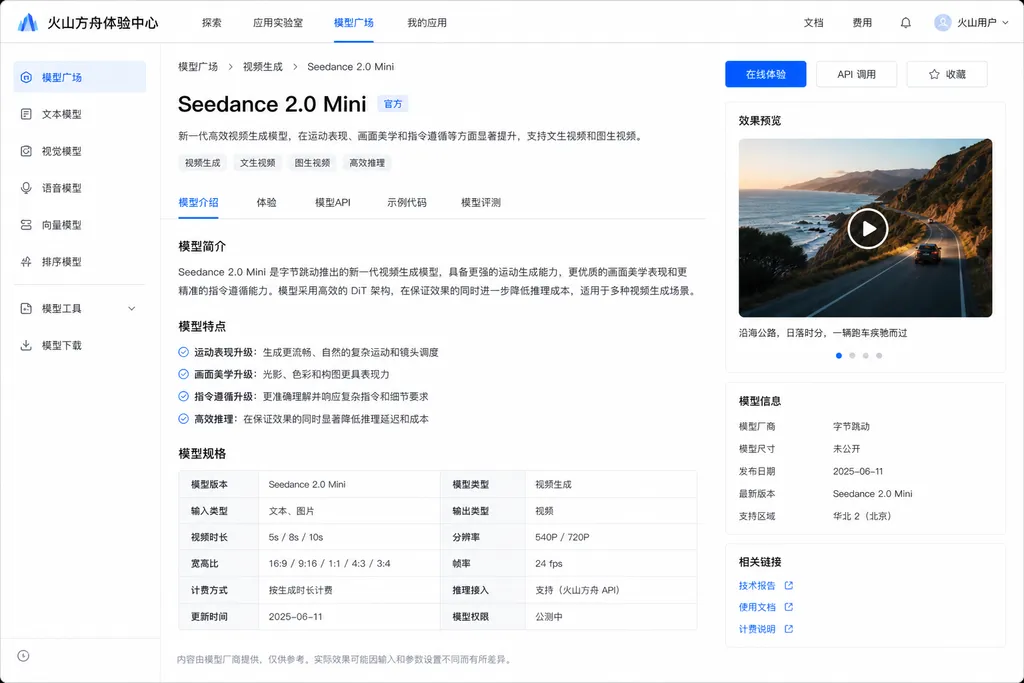
Let’s Look at the Numbers First
Here’s the official pricing table Volcano Engine provided for the Mini version:
- Image-to-video: ¥0.023 / 1,000 tokens
- Video-to-video: ¥0.014 / 1,000 tokens
- 720P specification conversion: cost per second of video generation is about ¥0.5
- Drop compared to Standard Edition: ~50%
- Speed compared to Fast Edition: 2× faster, but output quality "comparable to Fast"
A few details are worth breaking down.
First, charging by token rather than by second is a pricing logic carried over from the LLM era. The benefit of token-based billing for video is that resolution, frame rate, and duration can be decoupled from pricing—you can generate short clips in 480P or full productions in 720P without a flat fee. The drawback is it’s unfriendly to developers, who have to manually calculate how many tokens one second of video consumes. Volcano Ark’s guideline is about ¥0.5 for one second at 720P, which means a second of Mini version video corresponds to just over 20,000 tokens.
Second, the statement "2× faster than Fast, quality comparable to Fast" is essentially product-manager speak, but in engineering terms it means: Mini uses more aggressive distillation or fewer diffusion steps, maintaining usable visual quality while cutting inference computation to half of Fast’s. Considering that Fast’s price via channels like Atlas Cloud overseas is $0.022/sec, with domestic equivalents at around ¥0.16, this cost performance is not just ByteDance being cheaper—it effectively drags the baseline price for domestic video generation APIs down another notch.
Who Mini Is Meant For
The official target use cases are four: e-commerce content production, bulk marketing material generation, UGC creation, and special effects gameplay. Note what’s missing—"film-grade creation"—that’s reserved for the Seedance 2.0 Standard Edition, which aims for "industrial-grade, photorealistic, director-level control."
This tiered approach resembles OpenAI’s strategy when they split GPT-4 into Turbo and then Mini. Video generation today faces problems similar to LLMs a year ago:
- Top-tier model quality is sufficient, but too expensive for high-frequency business use. For example, producing 5 short test videos per e-commerce SKU to gauge ROI is prohibitively costly at Standard Edition prices.
- Fast is indeed fast, but its quality is still overkill for UGC scenarios. A 3-second TikTok special effects clip doesn’t need frame-by-frame motion blur perfection.
- The killer applications need "good enough + cheap + sufficient concurrency capacity".
Mini is designed for that third point. At ¥0.5/sec for 720P, a mid-sized e-commerce seller could run 10,000 five-second short videos per day at a cost of ¥25,000—well within the reasonable "marketing budget" range for stores with tens of millions in GMV.
How It Fits into the Seedance 2.0 Family
Using the Mini launch to sort out the Seedance 2.0 product lineup:
| Version | Positioning | Speed | Price Range | Suitable Scenarios | | --- | --- | --- | --- | --- | | Seedance 2.0 (Standard Edition) | Film-grade, photorealistic | Slow | High | Final rendering, industrial-grade content | | Seedance 2.0 Fast | High throughput, low cost | Medium | Medium | Rapid iteration, bulk materials | | Seedance 2.0 Mini | Large-scale production | 2× faster than Fast | ~½ of Standard | E-commerce, UGC, special effects gameplay |
In terms of input modalities, Seedance 2.0 supports text, images, audio, and video—up to 9 images + 3 clips of video/audio (each under 15 seconds) for reference. Whether Mini fully inherits all multimodal input capabilities is still unclear; full details are expected only once the API documentation is released.
Assessing ByteDance’s Move
From an editorial standpoint, observing the past few months makes ByteDance’s video generation strategy clear.
First, their product launch timing is spot-on. Seedance 1.0 focused on "smooth motion + multi-shot storytelling," 2.0 added audio and photorealism, the full Seedance 2.0 API suite was opened, and right when the market started saying "too expensive," they added Mini—each step tuned to the moment demand shifted. This pace is more aggressive than overseas players like Sora or Runway, who might go months without new moves.
Second, they treat compliance as a product feature. Seedance 2.0 emphasizes portrait and copyright safety standards, with over 10,000 pre-made virtual avatars ready for commercial use—designed as a defensive measure against the portrait rights lawsuits plaguing overseas AI video companies. For B2B clients, "won’t get sued" outweighs "picture quality 5% higher".
Third, they’re bold with pricing. ¥0.5/sec isn’t the absolute lowest in China (some startups using open-source models can go lower), but Seedance 2.0 Mini is "the first mainstream big-company product to hit 720P at ¥0.5"—a psychological threshold-breaker for small and medium developers.
If we’re nitpicking, Mini still has two issues to watch:
- Volcano Ark Experience Center allows demos, but the API isn’t officially open yet, only "coming soon". If "soon" drags by a couple weeks, overseas players like Pika or Luma could release new features first.
- "Quality comparable to Fast" is self-assessment—we’ll need third-party results from benchmarks like SeedVideoBench-2.0. Fast shows noticeable flaws in some complex motion scenes; if Mini is "2× faster but with copied flaws," it won’t appeal to industrial-grade users.
Tips for Developers
If you’re currently working on video generation-related business:
- First do subjective testing at Volcano Ark Experience Center. Stress-test the prompts most likely to fail in your business scenarios (multi-person interaction, rapid camera moves, physical collisions) to see if Mini meets your needs.
- Calculate the token-to-seconds conversion precisely. ByteDance’s token-based billing means the same "1-second video" varies greatly in price depending on resolution and frame rate—don’t just rely on the official ¥0.5/sec figure for budgeting.
- Watch for API concurrency & rate-limiting policies. Large-scale production bottlenecks often stem from concurrency rather than unit price; how Volcano allocates QPS quotas after Mini goes API-live will determine true batch viability.
- Budget for multi-model comparisons. Seedance 2.0 Mini, Keling, Vidu Q1, MiniMax video-01 now form China’s first-tier video-generation models. Price and quality trade-offs vary across cases. Platforms like OpenAI Hub, if they integrate Seedance, will make cross-model testing easier—one key to load-test several models beats registering multiple accounts.
In the video generation race, 2025 was about "can it generate," while 2026 is about "can it generate cheaply at scale." Seedance 2.0 Mini’s arrival effectively declares ByteDance’s intent to set the price floor themselves. The next move will likely be lifting API rate limits and pushing SDKs across the entire Volcano platform. When the official API comes out, we’ll do another round of comparison testing.
References
- Costs Halved, ByteDance Launches Seedance 2.0 Mini Video Generation Model - IT Home: IT Home’s first report on Seedance 2.0 Mini’s launch at Volcano Ark Experience Center, pricing scheme, and application scenarios.


