
Alibaba open-sources HappyHorse: 8 steps to generate audio-visual synchronized videos

Alibaba’s new team led by P11 Zhang Di has open-sourced the multimodal video generation model **HappyHorse**, which adopts a **single-Transformer Transfusion architecture**. It can generate 720p videos with sound effects and narration in just **eight inference steps**, and previously anonymously topped both leaderboards on the **Artificial Analysis Video Arena**.
Ali quietly did something big.
A video generation model called HappyHorse appeared anonymously in early April on the blind test leaderboard of Artificial Analysis Video Arena. Both versions, V1 and V2, simultaneously broke the Elo scores for text-to-video and image-to-video generation, leaving top players like Seedance 2.0, Kling 3.0, and PixVerse V6 behind. A few days later, HappyHorse 1.0 disappeared from the list, leaving only screenshots and speculation.
Now the mystery is solved — this dark horse comes from Alibaba, built by a new team led by P11 Zhang Di, and it’s been announced as fully open source.
First, the most important part: what exactly is open-sourced
Not the kind of "demo-only open source." This is the full package, for real:
- Base model weights
- Distilled model weights
- Super-resolution module
- Complete inference code
This means you can run it right away, no need to wait for an official API or guess inference details. For a model that just topped the Arena leaderboard, the degree of openness is exceptionally rare. Competing models like Seedance 2.0 and Kling 3.0 remain fully closed and API-only.
Architectural ambition: one Transformer to rule them all
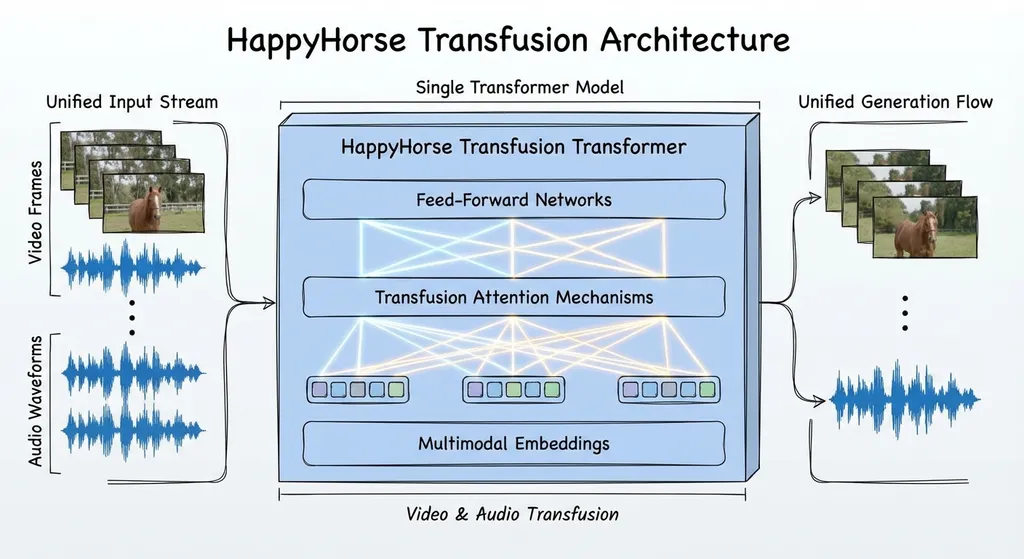
The most interesting thing about HappyHorse isn’t its score—it’s its architectural choice.
In mainstream video generation, audio and video are handled by separate pipelines: first generate the video, then dub it with another model for voices and sound effects—or in reverse. The problem with this “assembly” approach is clear: mismatched audio and visuals, unsynced lip movement, background sounds disconnected from scenes. Anyone who has seen an AI-generated video where clapping lags half a beat behind knows that mismatch feels worse than silence.
HappyHorse’s approach is to merge video and audio into a single Transformer using the Transfusion paradigm for unified processing. In simple terms: while the model generates each frame, it simultaneously “thinks” about the corresponding sound. It’s not post-production dubbing—it’s native, synchronous generation.
This idea isn’t entirely new. Alibaba’s own Wan 2.5 (Tongyi Wanxiang) has already been exploring native multimodal models capable of generating voice, sound effects, and background music to match visuals. But HappyHorse takes it further—it doesn’t even use CFG (Classifier-Free Guidance).
Developers familiar with image generation will know CFG, which boosts generation quality but requires two forward passes, doubling inference time. HappyHorse cuts that entirely, producing videos in just 8 inference steps. For comparison, many diffusion models need 25–50 steps even with optimization tricks, rarely dropping below 10 without quality loss.
Eight steps, no CFG, single Transformer—these three keywords together point to one practical benefit: drastically lower inference costs. For teams aiming to use video generation in production, this may be more attractive than any Elo score.
What can it generate specifically
Parameter overview:
| Parameter | Specification | |------------|---------------| | Resolution | 1280×720 (720p) | | Frame rate | 24fps | | Duration | 5 seconds | | Inference steps | 8 | | Audio capability | Sound effects / Ambient noise / Narration | | Supported languages | Chinese / English / Japanese / Korean / German / French |
720p, 5 seconds, 24fps—these specs alone aren’t particularly stunning. Wan 2.5 already handles 1080p, 10 seconds, while Kling 3.0 and Seedance 2.0 push even further.
But HappyHorse’s differentiation isn’t in hard specs. It lies in two aspects:
First, audio is natively generated, not added later. It supports narration in six languages plus sound effects and ambient noise, meaning you can provide a prompt and get a ready-to-share video, no need for a separate dubbing tool. For short-form content creators and marketing teams, this removes one of the most tedious workflow steps.
Second, it’s open-source. 720p for 5 seconds might not sound large, but you can run it locally, fine-tune it, and modify it. Closed-source models may give you 1080p—but you can’t change a single line of code, and pricing power isn’t in your hands.
Arena ascent and disappearance: a staged debut?
Looking back, HappyHorse’s Arena performance was interesting.
In early April, it anonymously appeared at the top—text-to-video Elo of 1333, image-to-video Elo of 1392, taking both top spots. A few days later, version 1.0 vanished. Then the team revealed its identity and announced open-sourcing.
This rhythm looks like a well-crafted "prove first, unveil later" strategy. Anonymous blind testing eliminates brand bias—evaluators didn’t know this was Alibaba’s model and scored purely on output quality. Once the scores stabilized, revealing the identity added credibility more powerfully than just publishing a paper.
Some raised valid questions: do blind-test results truly represent production quality? Is the Arena’s sample size large enough? Those concerns are fair. Still, methodologically, blind testing is more credible than self-published benchmarks.
Comparing HappyHorse to competitors
Line up the video generation landscape in Q1 2026:
In the closed-source camp, Seedance 2.0, Kling 3.0, and Veo 3.1 lead—with high resolution, long duration, and mature commercialization—but all remain closed and API-priced.
In open-source territory, strong contenders were nearly nonexistent. Wan models from Alibaba have contributed much but mostly focus on image generation or basic video capabilities. HappyHorse is the first video generation model proven in blind tests and fully open-source.
This defines its true significance: not that it can instantly replace Kling 3.0 for enterprise use, but that it raises the ceiling for open-source video generation considerably.
Think of it like this: HappyHorse for video is to some extent what Stable Diffusion was for images. Not the strongest on parameters, but open-sourcing itself changes the game.
What this means for developers
If you’re developing video-related products or features, HappyHorse’s open-sourcing brings several direct opportunities:
- Local deployment and fine-tuning. No reliance on third-party APIs, no data leaving your domain—ideal for privacy-sensitive use. The distilled model also enables inference on consumer GPUs, not necessarily A100 clusters.
- Unified pipeline for audio-visual sync. Previously, “generate video + add voice + add sound effects” required chaining 3–4 models. Now one model, one inference does it all—drastically reducing engineering complexity.
- Baseline for secondary development. Eight-step, no-CFG design makes a great starting point for research teams or startups to innovate.
For now, model weights and code release dates haven’t been fully confirmed. Official GitHub and Model Hub pages still list “Coming Soon.” Keep an eye on updates and be ready to pull code when available.
If you want to use video generation APIs right now
Before HappyHorse weights are officially published, projects that can’t wait may use commercial APIs. Platforms like OpenAI Hub let you call multiple models through a unified OpenAI-compatible interface—once HappyHorse is live, you can switch models easily without rewriting code.
Here’s a typical example:
import requests

# Call a video generation model via OpenAI Hub (OpenAI-compatible format)
response = requests.post(
    "https://api.openai-hub.net/v1/videos/generations",
    headers={
        "Authorization": "Bearer YOUR_OPENAI_HUB_KEY",
        "Content-Type": "application/json"
    },
    json={
        "model": "kling-3.0",  # Can switch to happyhorse-1.0 later
        "prompt": "a golden horse running across a prairie in sunlight, camera following, ambient sounds of wind and hoofbeats",
        "size": "1280x720",
        "duration": 5,
        "fps": 24,
        "audio": True
    }
)

print(response.json())
Keeping your toolchain model-agnostic is good practice—get your prompt templates, review flow, and post-processing pipeline running independently; model swapping can then happen seamlessly.
The bigger picture: four trends shaping video generation in 2026
HappyHorse’s debut reflects broader structural shifts in the video generation field:
Single-stream Transformers replacing multi-stream complexity. Previously, video models chained multiple sub-networks; now, more teams are validating “one Transformer for all.” Both HappyHorse and Wan 2.5 pursue this path—simpler architecture means easier engineering and ecosystem growth.
Ultra-few-step inference replacing dozens of denoising steps. The reduction from 50 to 25 to 8 steps directly impacts deployment cost and user experience. If 8-step inference truly holds quality, real-time video generation may soon be reality.
Blind-test leaderboard first, papers later. Increasingly, teams use public results to prove capability before revealing tech details. This “show results, then explain” approach outperforms lengthy reports and resists manipulation.
Open-source commitments replacing closed APIs. Perhaps most critical—when leading video models open up, innovation accelerates exponentially. Remember the LLaMA effect: within months, the community produced full pipelines for quantization and fine-tuning. Video generation may be reaching the same inflection point.
Each of these shifts alone is striking; together, they signal video generation transforming from a “big-company-only game” into an open competition anyone can join.
A moment of calm
That said, let’s stay grounded.
720p and 5 seconds are modest specs for commercial use. The Arena’s sample size and evaluation scope need more verification. History has seen open-source promises delayed between announcement and weight release.
And the “top-then-disappear” move, while clever marketing, makes continuous independent evaluation impossible for now. The real verdict will come when code and weights are public and reproducible Arena results emerge.
One thing is certain: Alibaba’s investment in video generation is accelerating—from Wan 2.5’s native multimodality, to Wan 2.6’s multi-shot storytelling, and now HappyHorse’s minimalist inference route. Different teams are pursuing different goals, a competitive internal ecosystem proven effective in the large-model era.
For developers, the pragmatic approach is: watch the official repo, benchmark once weights are released, and keep current pipelines flexible—ready to switch at any moment.
This Happy Horse deserves a chance to run.
References:
- Behind-the-scenes team revealed for HappyHorse - Linux.do — community discussion post with key model and team details
- Source: WeChat official release — official information announcement on HappyHorse


