
Alipay has completely revamped itself, and "Abao" begins invite-only testing today.

On June 16, Alipay officially launched the AI version “Abao,” claiming to be the world’s first fully AI-enabled super app. Swiping right takes you to a conversational interface, with over ten thousand services already adapted. The first batch of 100 invitation codes has been released.
Alipay Rebuilt Itself — “Abao” Opens Beta Invitations Today
On the morning of June 16, Alipay dropped a not-so-small bombshell: the AI-powered version of Alipay was officially launched under the name “Abao.” The official statement calls it the “world’s first fully AI-powered super app” — which sounds like PR talk, but once you try it, you’ll find they’re not bluffing. The entire interaction logic of the app has been completely redesigned.
On today’s Alipay main screen, you can swipe right to enter the new version. Instead of the crammed home page full of grids, lifestyle accounts, Sesame Credit, transit cards, and health codes, you’re greeted with an almost minimalist chat interface alongside an assets page. The whole app has shifted from a shelf-like SKU display on the homepage to a conversational entry point.
This is an even more fundamental overhaul than the launch of Ant Forest or Lifestyle Accounts back in the day.
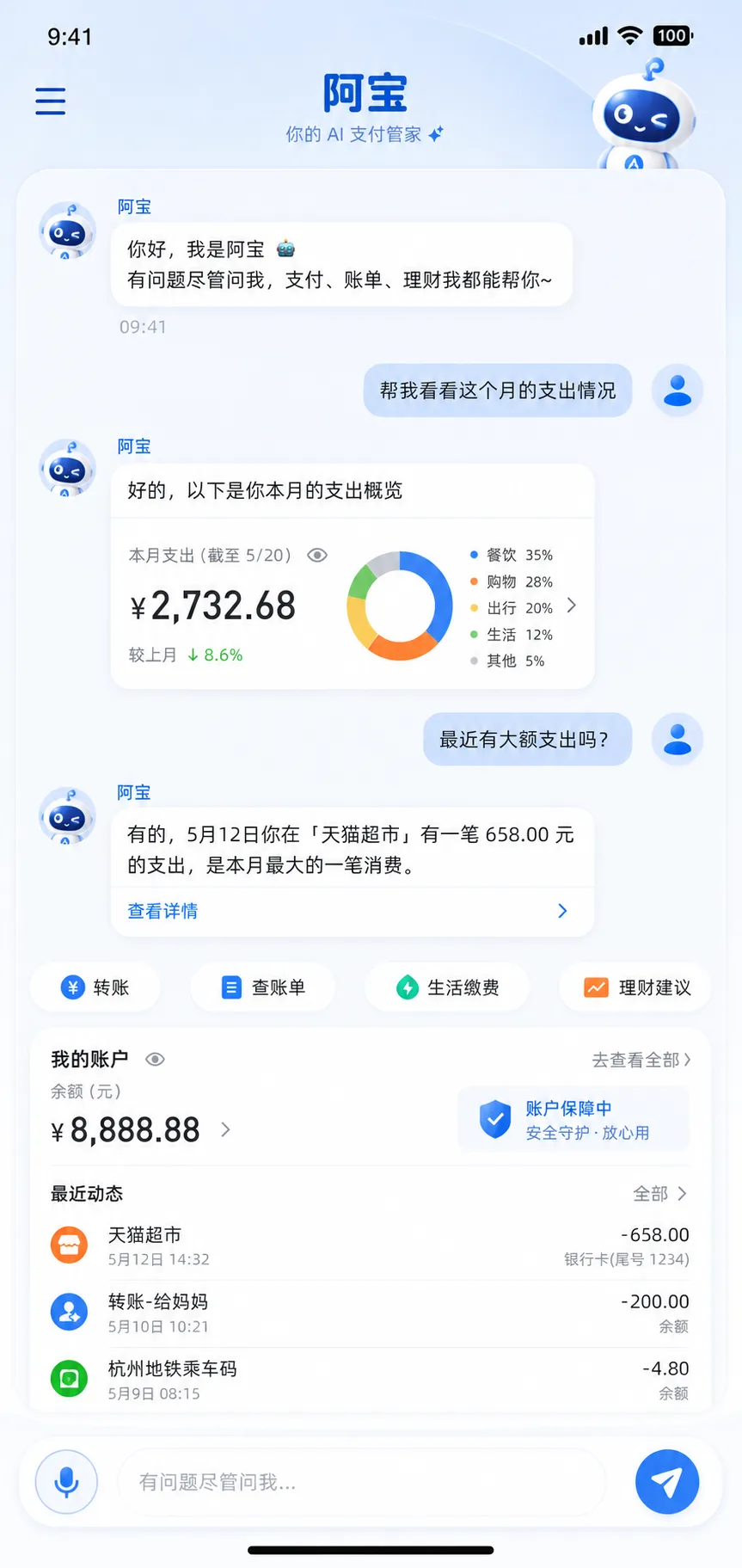
From “Display-Oriented” to “Conversational” — What’s Actually Changed
Alipay’s biggest problem over the past decade has been obvious to everyone: too many features, too hard to find.
If you wanted to check your housing provident fund in the old app, you’d have to type in the search box, go to the services page, tap “city services,” then “provident fund inquiry,” jump to the city housing provident fund mini program, log in, select the service, and then find the inquiry option. The whole process took six to seven steps on average, involving at least two page jumps and one login.
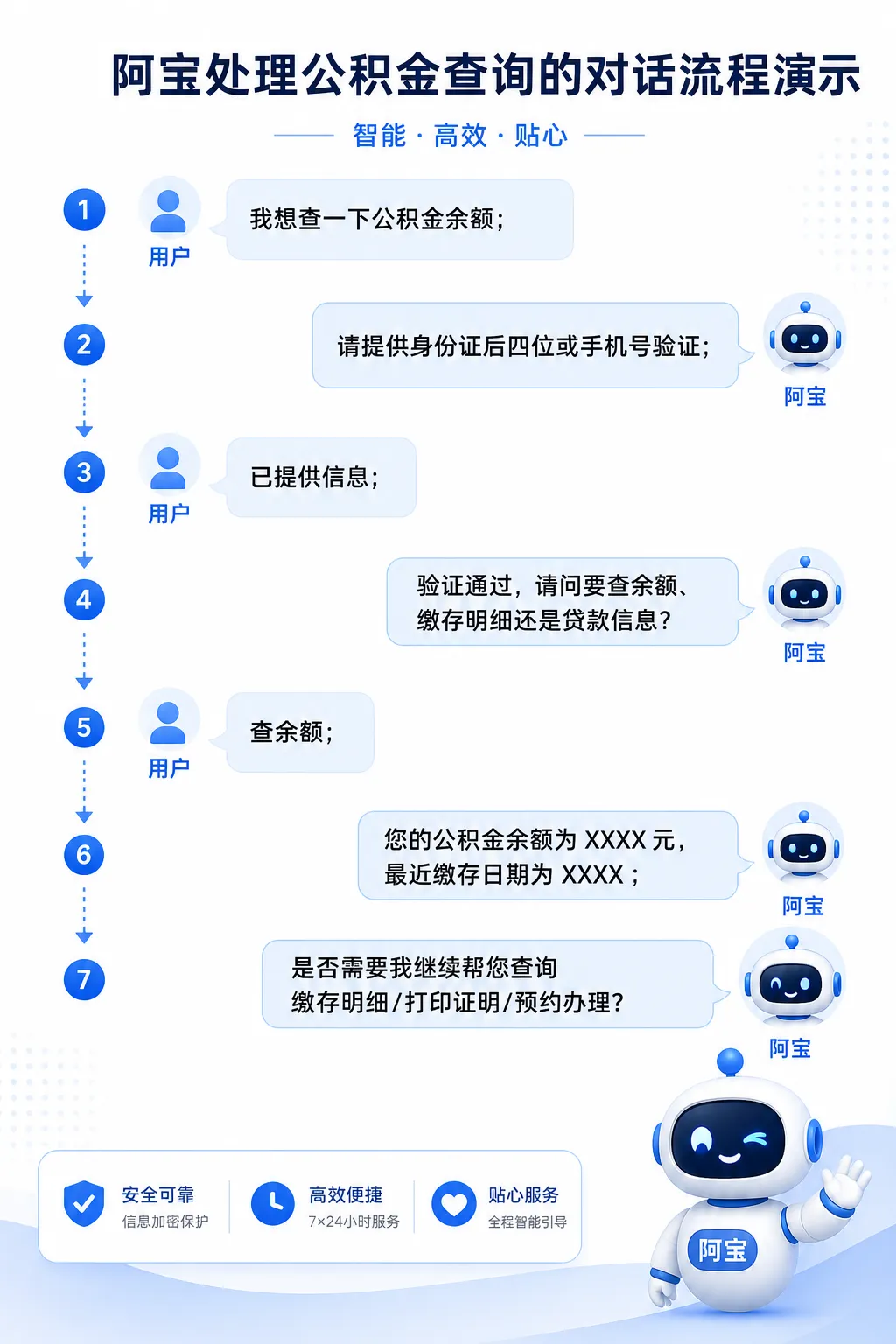
Abao folds this entire process into a single sentence.
In the official demo, a user simply says: “I want to check my housing provident fund.” Abao automatically recognizes the intent, matches the corresponding city service mini program, and directly presents the provident fund inquiry interface — all that’s left is for the user to tap “login confirmation.” Multi-step navigation collapses into a single conversation — the most straightforward value of integrating LLMs into a super app.
Put simply, in the past Alipay was like a supermarket where you wandered the aisles; now Abao is like a clerk who fetches exactly what you requested and puts it in front of you.
Adapting Tens of Thousands of Services — The Real Hard Part
If you think this is just ChatGPT wearing a new skin, you’re underestimating the engineering workload.
Alipay’s public data shows that over ten thousand services have been AI-adapted, covering government services, transportation, daily life, healthcare, finance, and almost all high-frequency scenarios. Behind this number is the fact that every third-party mini program, every city service window, every utility payment entry point had to provide a structured schema for Abao to understand and call.
This isn’t a model problem — it’s a supply-side engineering problem.
Compared across the industry:
- WeChat has a larger mini program ecosystem, but has yet to offer an end-to-end conversational entry point, instead embedding AI into search and input methods.
- Douyin/ByteDance’s “Doubao” product is well-made, but it’s an independent app without Alipay’s “services as infrastructure” foundation.
- OpenAI’s Operator and Anthropic’s Computer Use take the Agent UI-manipulation route, which looks flashy but is shaky in stability and less efficient.
Alipay has chosen a third path — requiring all service providers to actively adapt to AI interfaces. This is painful engineering work at the start, but once it’s running, the speed and stability will far surpass brute-force UI tapping by Agents. Based on today’s demos, at least in standardized scenarios like provident fund inquiries, medical appointments, and bill payments, Abao’s execution chain is impressively clean.
A Firm Line on Financial Security
Anyone who’s built an AI Agent knows — the biggest risk isn’t wrong answers, it’s wrong payments.
Alipay has given Abao a very clear boundary: all actions involving monetary transactions must be confirmed by the user themselves.
In their own words: “Abao will handle the process and present the interface, but the final step — ‘pay’ or ‘don’t pay’ — will always be decided by the user.”
This is a smart product decision. AI can search, fill in details, and navigate for you, but can’t press the final “pay” button. This preserves user trust and sidesteps future liability disputes — because if AI accidentally transfers millions, no one can take the fall.
As a side note, the two most frequent actions — scanning QR codes and transferring money — still have quick-access buttons instead of being forced into a conversation flow. This shows the product team understands that not all interactions should be conversational — a QR scan that takes 0.5 seconds shouldn’t require you to say “open scanner” first.
The Classic Version Remains — A Smart Strategy
Notably, Abao doesn’t forcibly replace the old version. Users can switch between the AI version and the classic version at will.
This is crucial. Alipay has nearly a billion users, many of whom are older and may not be as receptive to conversational interaction. Forced redesigns carry huge risks — as seen in the backlash when Alipay changed its home page in the past.
Running both versions in parallel gives the product team an A/B testing window. The AI version can collect data and iterate among early adopters, and only when it’s mature will they consider a full rollout. This is the restraint a mature product team should have.
The first batch of 100 invitation codes has been released, with IT Home also distributing them. Based on the rollout pace, large-scale access is expected between late June and July.
What This Means for the Industry
By early 2026, China already had too many AI assistant products to count. But most still only operated as Q&A tools — you ask, they answer.
Abao’s significance is that it’s the first time a real, usable service ecosystem has been connected to a conversational AI. This means:
- AI is no longer just a chatbot — it’s an assistant that can actually get things done. Checking provident funds, booking medical appointments, paying electric bills, checking social security — all tasks Alipay users already do, now completed with a single sentence.
- The concept of a “super app” is being redefined. It’s no longer about how many features you’ve packed in, but about how many features your AI can coordinate.
- The mini program ecosystem could see a revival. Long-tail mini programs buried deep in search results might regain traffic through AI-initiated calls.
Of course, challenges remain:
- The ceiling of intent recognition. “I want to pay my electricity bill” is straightforward. But what about “Why did I use so much electricity this month?” Can Abao jump from usage analysis to payment to energy-saving suggestions? This is where model capabilities are really tested.
- Cross-service orchestration. For example: “Check my bill for this month and also pay my credit card” — such multi-service, compound instructions, if handled well, can deliver a breakthrough user experience; if not, they can be a PR disaster.
- Balancing personalization and privacy. For AI to really know you, it has to remember you, but in financial contexts, data sensitivity is extremely high. Drawing this line has likely kept Ant Group’s compliance team up many nights.
Final Thoughts
Alipay’s courage this time deserves recognition. For a national app with hundreds of millions of daily active users to throw out its home page interaction logic and start over — that’s rare. Most big-company products at this scale only dare to add features, not subtract them, let alone multiply their impact.
Is Abao a perfect product? It’s too early to tell. But at the very least, it opens a new path for AI Agent deployment in China — not relying on model Agents to brute-force UIs, nor on stacking parameters for more capability, but on thickening the ecosystem and standardizing interfaces so AI can stand atop ten thousand services.
It’s a slow road, but a steady one.
In the coming months, developers should keep an eye on how this AI transformation race between Alipay, WeChat, and Douyin plays out.
References
- AI-powered Alipay announces beta invitations: swipe right to open “Abao,” 100 invitation codes released — IT Home — Full IT Home report on Abao’s beta details and feature demos.


