
Ali unveils the Qwen-Robot trio: equipping robots with hands, feet, and brains
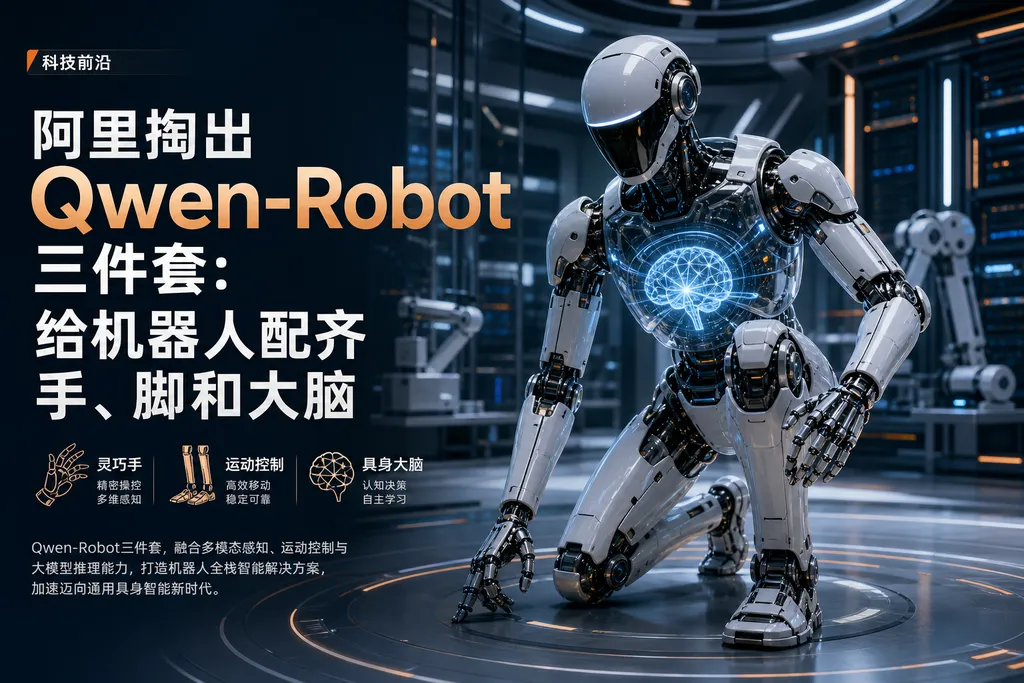
Ali today released its first complete embodied intelligence large model series, Qwen-Robot, which includes the operation model RobotManip, the navigation model RobotNav, and the world model RobotWorld, officially bringing Qwen’s multimodal capabilities into the physical world.
Alibaba Unveils Qwen-Robot Trilogy: Equipping Robots with Hands, Feet, and Brains
On June 16, Alibaba officially extended the Qwen family’s territory into the physical world. The newly released Qwen-Robot series debuted three models at once: the VLA model Qwen-RobotManip for manipulation, the VLN model Qwen-RobotNav for navigation, and the world model Qwen-RobotWorld serving as an “imagination engine.” In the official—though not novel but very intuitive—analogy, these correspond respectively to a robot’s hands, feet, and brain.
This marks the first time the Qwen family has presented a fully structured matrix of embodied AI models. Previously, Alibaba approached this field with a “investment + partial exploration” attitude: at the group level it invested in Unitree, Stardust Epoch, Xinghai Map, and Juji Power; DAMO Academy released the RynnVLA series late last year; and in October, Qwen announced via Lin Junyang’s Twitter that an internal embodied AI team had been established. Half a year later, the team has delivered results.
1. What problems do the three models solve?
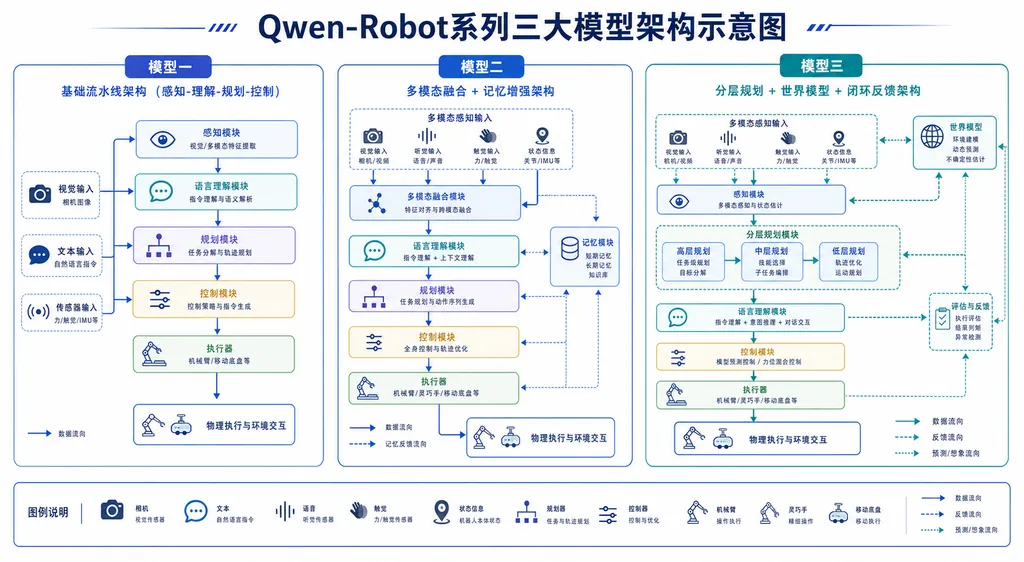
Anyone experienced in embodied AI knows there’s no “one-size-fits-all” architecture in this domain. Manipulation focuses on sub-millimeter-level end-effector control, navigation concerns large-scale spatial memory and path planning, while a world model is a different track—predicting future frames and planning inversely. Trying to cram these three tasks into one big model is basically a disaster. Alibaba’s approach this time is divide and conquer, but the base layer shares Qwen’s VLM capabilities.
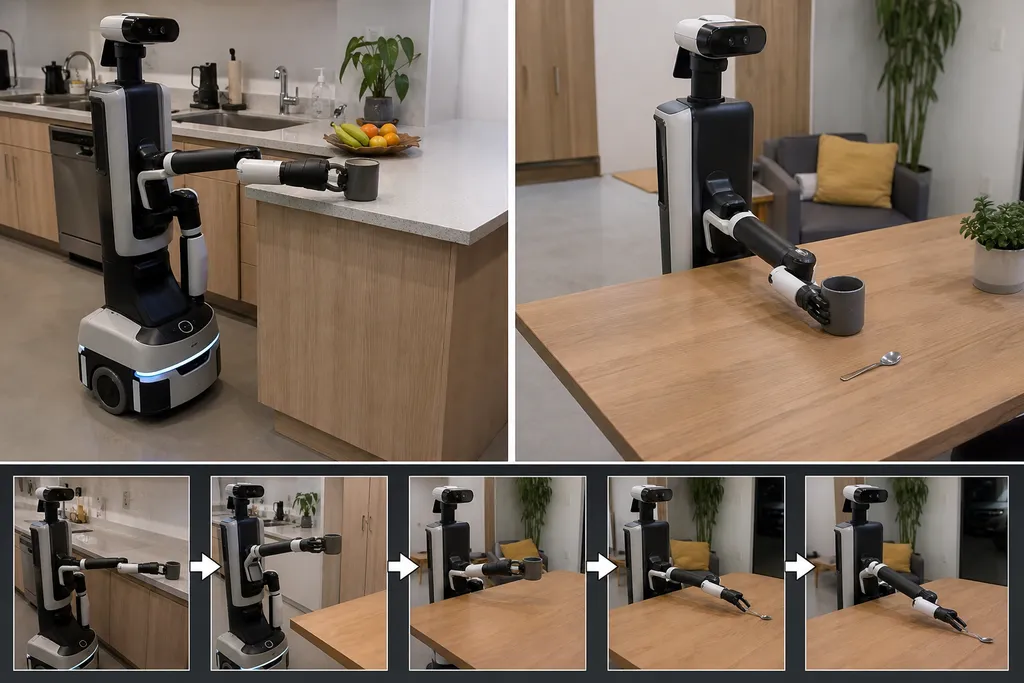
Qwen-RobotManip: Scaling VLA training data to 38,100 hours
VLA (Vision-Language-Action) has been the hottest paradigm in the embodied world in recent years, converging from RT-2, OpenVLA to Pi-0. The technical highlights of Qwen-RobotManip are:
- Standardized state-action space: Unifies joint definitions and coordinate systems across different robot models—a prerequisite for large-scale multi-model training. Historically, the embodied domain faced the issue of “data non-transferability”—even for the same task like grasping a cup, strategies learned by UR5 and Franka were almost unusable across each other.
- End-effector incremental pose (delta EE pose) under the camera coordinate system: Uses relative pose instead of absolute joint angles as action representation, a path taken by Pi-0 and RDT. The advantage: greatly reduces dependence on camera calibration and the robot’s physical body.
Training data is entirely sourced from open datasets, exceeding 38,100 hours—an aggressive figure. For comparison, OpenVLA used the Open X-Embodiment dataset with about 1 million episodes, roughly in the tens of thousands of hours scale. Alibaba’s “exhaustive use” of open data is evident, indirectly signaling Qwen’s belief that the current bottleneck in VLA is not the algorithm, but data scale and cleaning quality.
Qwen-RobotNav: Integrating navigation, tracking, and autonomous driving into one model
The Nav model is designed more like “an agent with VLM at its core” — via controllable observation encoding and tool interfaces, the model can invoke low-level motion control. Officially, it unifies four types of tasks:
- Instruction following
- PointGoal / ObjectGoal navigation
- Object tracking
- Autonomous driving
Putting autonomous driving and indoor navigation into the same model is bold. Structurally, both are indeed “observation → decision → low-level control” pipelines, but differ greatly in scale, dynamics constraints, and safety boundaries. Whether Qwen-RobotNav can actually perform in L2+ autonomous driving will require further benchmark verification. However, the unified interface itself is developer-friendly—you don’t need separate prompt templates for a household robot and an outdoor delivery robot.
Qwen-RobotWorld: Natural language-driven world model
This is the most intriguing. World models, from Sora, Genie, V-JEPA to 1X’s 1X-World Model, have in recent years become hotly contested territory in embodied and autonomous driving circles. Qwen-RobotWorld’s selling point is its natural language action interface—you describe an action intent in language, it predicts a physically plausible future video, and this capability spans manipulation, driving, and navigation scenarios.
This suggests two uses:
- It can serve as a data generator, producing synthetic training data for the VLA model;
- It can serve as a planner, “rolling out” candidate trajectories in its “mind” and selecting the optimal for execution.
This thinking mirrors Yann LeCun’s advocated paradigm of “world model-based planning,” though LeCun bets on JEPA’s non-generative route, while Alibaba pursues the generative route. Which will prevail is still undetermined. From an engineering perspective, generative world models at least make it straightforward to “see what the robot is thinking,” greatly improving debugging experience.
2. Why now?
This development in June 2026 is not unexpected. Look back at key moments:
- October 2025: Lin Junyang announces on X the formation of Qwen’s internal embodied AI team, explicitly stating “I set up,” implying a personal lead.
- September 2025: At the Yunqi Conference, Alibaba Cloud and NVIDIA jointly propose the “Physical AI” plan, bringing AI into robotic arms and industrial automation.
- August 2025: DAMO Academy open sources RynnRCP, RynnVLA-001, and other key components at the World Robot Conference, paving the way.
- May 2026: Qwen3.7-Max ranks first among domestic models in Arena blind tests, providing a strong VLM foundation.
Six months from “team formation” to “complete trilogy” is not slow. More importantly, Alibaba has complemented all three core embodied capabilities (manipulation, navigation, world modeling) in one go, a much broader scope compared to DAMO Academy’s earlier single-point breakthroughs like RynnVLA.
3. Positioning Qwen-Robot among competitors
Looking broadly, players in embodied foundation models fall into three camps:
First camp: startups, represented by Physical Intelligence (Pi-0, Pi-0.5), Skild AI, Figure (Helix), focusing on pure VLA and manipulation.
Second camp: big tech’s embodied initiatives, such as Google DeepMind’s Gemini Robotics, NVIDIA’s GR00T N1/N2, ByteDance’s GR-2/GR-3—often extensions of their large model teams.
Third camp: domestic “full-stack players”, such as Huawei Pangu Embodied, Zhiyuan Qiyuan’s large model, and Galaxy General GraspVLA.
Qwen-Robot clearly belongs to the second camp leaning toward the third. Its differentiation lies in:
- Clear division of labor: Separate Manip / Nav / World models, unlike Gemini Robotics’ one VLA end-to-end approach. This is more engineering-oriented; single-point capabilities are easier to refine but require higher coordination from integrators.
- Independently deployable yet capable of cooperation: Meaning you can use only Nav for a mobile chassis, or only Manip for tabletop tasks. This “Lego-like” flexibility benefits small and medium robot manufacturers—they don’t need to purchase a full set for one capability.
- Backed by Qwen3.7’s VLM base: Alibaba’s biggest asset. Gemini Robotics’ base is Gemini; Helix’s base is Figure’s in-house; Qwen-Robot benefits from Qwen3.7-VL.
As for actual performance, Alibaba has yet to release full technical reports and benchmarks, so papers and demos in coming weeks will clarify. Based on past Qwen team reputation, some of the bold claims will likely materialize, but “cross-scenario generality” should be viewed with tempered expectations.
4. Key points for developers
If you’re developing robots or embodied applications, this release has several points worth noting:
- Training data strategy: 38,100 hours of purely open-source data suggests Qwen will likely publish recipes for data cleaning and blending. This is a big win for the open-source community, arguably more valuable than just releasing model weights.
- Engineering details of action representation: Delta EE pose in camera coordinate systems combined with standardized state-action spaces—if these interfaces are opened, they may become de facto standards in the domestic embodied AI field.
- Generation quality of the world model: Can it truly predict physically plausible futures, or just outputs that look plausible? This is critical to assessing whether Qwen-RobotWorld is genuinely capable. A world model that can’t simulate rigid body collisions accurately is useless for planning.
- Actual autonomous driving capabilities: Integrating ADAS into a general Nav model is aggressive. Short term, its practical value is limited, but long term it’s a direction worth pursuing.
5. In closing
In the lively embodied AI field of 2026, few players can actually integrate “foundation model + data + hardware.” Alibaba’s unveiling of the Qwen-Robot series is more of a declaration—Tongyi Qianwen is no longer just “the brain in the cloud,” but intends to step into the physical world.
Frankly, as a tech editor, I’ve always been cautious about domestic big tech’s embodied AI projects. In recent years, there have been too many “PPT embodiments,” with virtually no models running effectively in factories or homes. At least this time, Alibaba has put up the framework; now the next few months—technical reports, open-source progress, real deployment cases from partners—will tell the rest.
Worth anticipating, but also keep calm. Whether Qwen-Robot can become the “universal foundation” in embodied AI will be clear in half a year.
References
- IT Home: Alibaba releases its first embodied AI foundation model — the Qwen-Robot series — Official Qwen-Robot series announcement with details of three models
- Zhihu Column: Qwen goes into robotics — Lin Junyang announces formation of embodied AI team — Background on the October 2025 formation of Qwen’s embodied team, personally led by Tongyi Qianwen’s technical director Lin Junyang


