
QoderWork gave the AI assistant a "consciousness": it can remember, reflect, and develop skills on its own.

Alibaba Desktop AI Assistant QoderWork has launched the "Consciousness" feature today, integrating three modules: memory, reflection, and skill evolution, so that AI is no longer a goldfish starting from scratch in every conversation. Behind it is an engineered solution that includes layered memory, snapshot rollback, and Fork Session.
QoderWork Gives AI Assistant a “Consciousness”: It Can Remember, Reflect, and Grow Its Own Skills
On June 16, Alibaba’s desktop AI agent QoderWork launched a functional module called “Consciousness.” Sounds mystical, but when unpacked it’s actually three things: memory, reflection, and skill evolution. In short—this is meant to make the AI assistant running on your computer stop being a “goldfish” that starts every conversation from scratch.
This is one of the more significant updates since QoderWork’s release in January. In earlier months, it mostly focused on completing the “can do things” layer—being able to operate local apps, read files, open design and slide workspaces. This time the “Consciousness” module targets the “can remember how to do things” layer. From a product roadmap perspective, Alibaba’s trajectory is edging toward the competitive paradigm shared by Anthropic Cowork, Moonshot’s Kimi Work, Tencent Workbody, and other desktop agents.
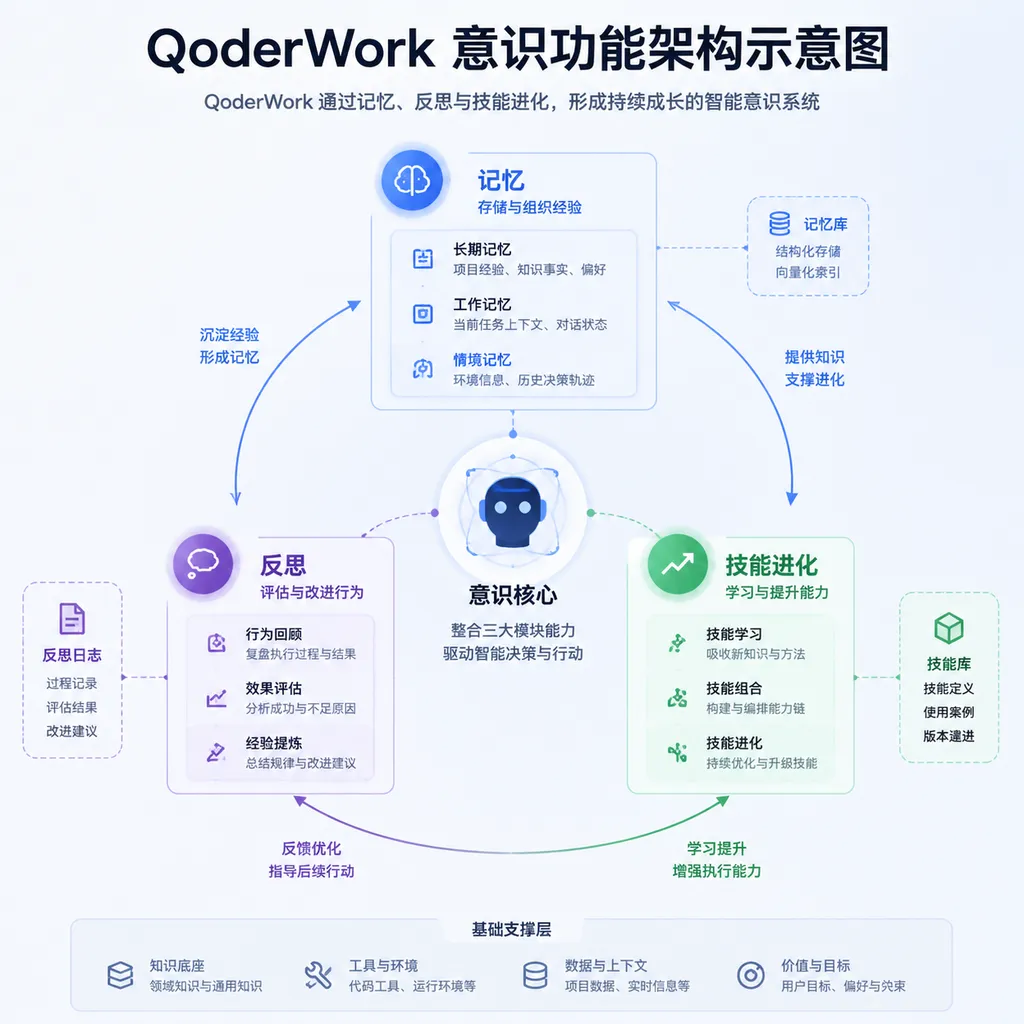
Not Just “Saving Conversations” — Layered Memory + Active Pruning
If “memory” simply means “saving past conversations,” ChatGPT was already doing that two years ago—hardly novel. QoderWork’s difference this time lies in two points: layering and active organization.
According to official descriptions, the memory system is divided into short-term and long-term layers: daily conversations first sink into short-term memory, while content that has cross-session reuse value gets promoted to long-term memory. This structure itself isn’t new—the 2023 “Generative Agents” paper mentioned similar layered architectures, and open-source solutions like MemGPT and Letta have proven them. But QoderWork grounds it in the desktop agent scenario—things like the invoice format you had it organize yesterday, the working directory habits you instructed last week, or the project background you discussed with it should theoretically be deposited here.
The key is how to “prune.” If an agent’s memory only grows without deletion, within six months its context will be flooded with noise, collapsing retrieval accuracy and reasoning quality. QoderWork’s solution is inspired by the human brain’s “selective forgetting”: before each reflection, it makes a snapshot backup; after reflection, it performs hard-rule post-checking, and if key information is found to have been mistakenly deleted, it automatically rolls back.
This “rollback” step is important. LLMs are very unreliable at organizing their own memories—they might delete your most important client name as noise, or conversely keep a temporary debug log as a long-term preference. Engineering safeguards like hard rules + snapshots are more industrial-grade than relying purely on the model’s self-judgment.
Another commendable design: all memories are stored locally in plain-text Markdown, which users can directly view, edit, or delete. This is fundamentally different from designs that feed everything into a black-box vector database where users have no idea what’s stored. For developers, this means two things: first, privacy and auditability are robust; second, these Markdown files themselves can be used as corpus for other tools—you can grep them and feed them to other agents.
Reflection Mechanism: Score Threshold Triggered, Token Use Kept Under Control
“Reflection” is the easiest part of this feature to talk abstractly about. What does AI reflect on? How does it reflect? How much does each reflection cost?
QoderWork’s answer is a multi-factor weighted scoring model: it considers user intent depth, conversation length, task complexity, and other dimensions to score each conversation in real-time, and only when the score exceeds a threshold will it trigger the evolution process. In other words, it’s not secretly running a review meeting after every chat—that kind of setup could blow up an API bill in a week.
Once triggered? Here’s a smart engineering trick: evolution tasks use a Fork Session mechanism to branch a lightweight sub-session from the main session, reusing the original context. The official data says cache hit rates are above 99%, with additional costs kept within 5% of the main conversation’s total cost.
How to interpret this? Nowadays most mainstream long-context models support prompt caching (Anthropic, OpenAI, Gemini, etc.), and tokens hitting the cache are usually 1/10 the price—or less—of uncached tokens. The forked sub-session doesn’t resend the original context, so you’re almost only paying for the added “reflection instructions” and model output. A 5% cost cap is reasonable in engineering practice.
The significance of this combo: it compresses “letting the AI reflect on itself” from a demo-level concept into a cost structure that can scale in consumer products. Otherwise, imagine—if every reflection required resending the entire context, a heavy user would burn more money daily than their subscription fee, killing the business model instantly.
Skill Evolution: From “Repetitive Tasks” to “Reusable Scripts”
Of the three modules, “Skill Evolution” is the most relatable to developers’ daily experience.
When the system detects you repeatedly perform a certain type of task—such as batch-renaming screenshots in a specific folder every Monday, or fetching data from a certain dashboard before writing each weekly report—the “Consciousness” module will automatically generate a skill suggestion. Note: it’s a suggestion, not an immediate write into your skill library. Users can accept, ignore, or reject; rejected suggestions enter a cooldown period so they won’t keep popping up.
This interaction rhythm shows restraint: it’s easy for agent auto-learning to become “acting on its own,” leading to users spending half their day reviewing weird things the AI secretly added. Explicitly keeping decision power with the user, plus adding cooldown, makes the product a “suggestion provider” rather than an “executor”—at least at the skill level.
From a technical abstraction standpoint, this essentially combines Anthropic’s Skill system (agents expanding capabilities through coding) with adaptive learning. Claude Code and Qoder rely on Programmatic Tool Calling mechanisms so models can write and call tools themselves. QoderWork adds a layer of “self-observation”: it can not only call skills, but also deduce new skills from historical calls.
Comparing QoderWork to Manus, Kimi Work, Cowork
We can’t avoid seeing this in the context of the desktop agent race. By 2026 this track is quite crowded:
- Anthropic Cowork: pioneered the desktop agent concept, backed by Claude 4.6+’s long context and skill system; deepest technical foundation.
- Manus: breakout hit earlier this year, blending agent + browser + file operations into a cloud workspace form.
- Moonshot Kimi Work: recently out in beta, positioned as a general-purpose local agent.
- Tencent Workbody / MiniMax Desktop Agent: same-era products in similar form to QoderWork.
- Cognition Devin Desktop: upgraded from Windsurf, emphasizes agent command center.
Horizontally compared, QoderWork’s “Consciousness” feature clearly stakes its claim on long-term memory and self-evolution. Cowork’s skill system shines in tool-dimension expansion, Manus excels in workspace form, and QoderWork has chosen a cognitive architecture route—closer to the academic concept of “Memory-Augmented Agent.”
Is it truly stronger than competitors? Hard to say—it depends on actual user experience and long-term effects. But at least from the architecture, layered memory + snapshot rollback + fork session + threshold triggers is engineeringly sound, unlike some demo products that only look good in PPT.
Details Worth Developers’ Attention
After reviewing the official description, here are some practical points for developers:
- Memory storage in plain-text Markdown: means you can script-process the memory repository—migrate, export, analyze, debug.
- Fork Session + high cache hit rate: critical for keeping “self-reflection” agent features cost-sustainable. Any team building similar systems must push prompt caching hit rates above 95%.
- Hard-rule post-check rollback: never trust the LLM’s “I organized it fine.” In production, any model operation on memory/state must have roll-backable snapshots and external rule safeguards.
- Skill suggestions rather than auto-write: draw clear boundaries for automation. Agents acting autonomously is the fastest way to lose user trust.
Final Thoughts
By 2026, agent products can no longer differentiate solely on “can call tools.” Tool use, long context, local operation permissions—these are infrastructure, everyone has them. What’s next in determining winners?
My judgment: state management.
How an agent remembers you, learns from history, avoids noisy data polluting its reasoning, and deposits repetitive tasks into reusable assets—these matter more to users than adding another MCP server. QoderWork’s “Consciousness” feature chooses the right angle, and its engineering implementation appears to be seriously done. Whether it shines in product experience depends on user feedback over the coming months.
A side note: QoderWork’s workspace architecture (Chat / Design / Slides / Writing + industry expert kits) is decoupled from the model layer. For teams wanting to build similar desktop agents, using an aggregation platform like OpenAI Hub for model calls saves effort—switch between GPT, Claude, Gemini, DeepSeek, etc. with one key, connect directly within China, maintain OpenAI format compatibility, and facilitate A/B testing and cost optimization.
As for whether “Consciousness” is an appropriate term for an AI product—that’s subjective. But at least here it doesn’t mean marketing fluff; it refers to a real set of engineering mechanisms. That matters more than the name.
References
- IT Home: Alibaba Cloud QoderWork launches “Consciousness” feature, enabling AI to learn memory, reflection, and growth — Full official description containing layered memory, reflection mechanism, fork session, and other technical details


