
OpenRouter launches Fusion API: Combine models to rival Claude Fable 5
OpenRouter launches the Fusion composite model API, which sends a single question in parallel to multiple models and then has a judge model merge the answers. The budget team, using DeepSeek+Kimi+Gemini Flash, achieved 64.7%, matching Fable 5, at only half the cost.
The Multi-Model Teaming Thing Has Finally Been Made into a Product by OpenRouter
On June 14, OpenRouter dropped something called Fusion on its blog — a composite model API. The logic is simple: you send over a prompt, and behind the scenes it simultaneously distributes it to up to 8 LLMs to answer in parallel, then uses a judge model to merge all the responses into a final result. Two days later, today, discussions in the community have almost overshadowed last week's uproar over Anthropic Fable 5’s global outage.
The timing of these two events is actually quite subtle. Last week, Fable 5 was ordered by the U.S. government to be removed globally for national security reasons, instantly knocking out the strongest card in developers’ hands. OpenRouter then launched Fusion on the 14th, and its first publicized performance report was: using DeepSeek V4 Pro + Kimi K2.6 + Gemini 3 Flash — three budget models — to team up and achieve 64.7% on Perplexity’s DRACO deep research benchmark, only 0.6 percentage points shy of Fable 5’s solo run at 65.3%, but at half the cost.
When you put this timing and these numbers together, the significance changes.
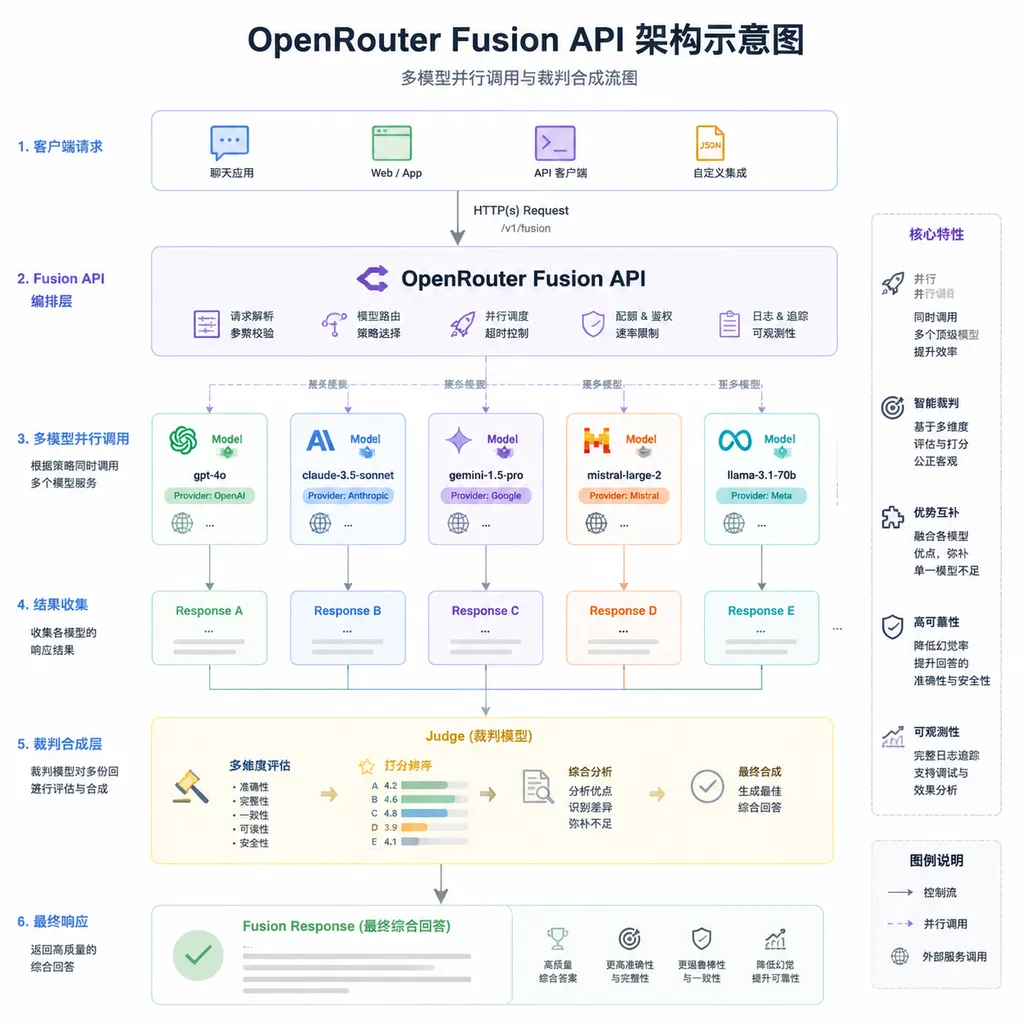
How Fusion Actually Works
The official documentation breaks the pipeline into three steps, with clean logic:
- Parallel distribution: The user’s prompt is sent simultaneously to all models in the panel. Each model has its own web search capability and completes full reasoning and retrieval independently.
- Structured judging: A fixed judge model (currently Claude Opus 4.8 by default) reads all responses and outputs a structured analysis — which points are consensus, which conflict, who has unique insights, and where the common blind spots are.
- Final synthesis: The calling model uses this analysis to write the final answer.
The interesting part lies in the second step. This is not simple majority voting, nor just concatenating answers for the model to “summarize.” Instead, it explicitly asks the judge to identify disagreements and blind spots. In the agent community, this is called self-consistency or ensemble reasoning, which previously appeared mainly in academic papers or hand-crafted pipelines. OpenRouter has turned it into an API-level product.
Integration is also very light: just replace the model name in the API call with openrouter/fusion, and parallel distribution plus synthesis runs entirely server-side — one call gets the result. If you want the model to decide whether to team up, you can add Fusion to the tools list so the upper-layer agent can call it. For a completely no-code approach, simply open the openrouter.ai/fusion web page, select a preset package, and try it out.
Looking at the Scores: Teaming Really Can Surpass the Strongest Solo
This benchmark uses Perplexity’s DRACO, which specifically tests deep research capabilities across 10 domains (academic, finance, law, medicine, etc.), with about 39 weighted scoring criteria per question. Wrong answers deduct points, and simply outputting more text won’t boost scores. Here’s the 100-question scoreboard:
| Combination | Score | | --- | --- | | Fusion: Fable 5 + GPT-5.5 (Opus 4.8 synthesis) | 69.0% | | Fusion: Opus 4.8 + GPT-5.5 + Gemini 3.1 Pro | 68.3% | | Fusion: Opus 4.8 + GPT-5.5 | 67.6% | | Fusion: Opus 4.8 × 2 (same model run twice) | 65.5% | | Solo: Claude Fable 5 | 65.3% | | Fusion: Gemini 3 Flash + Kimi K2.6 + DeepSeek V4 Pro (budget group) | 64.7% | | Solo: DeepSeek V4 Pro | 60.3% | | Solo: GPT-5.5 | 60.0% | | Solo: Claude Opus 4.8 | 58.8% | | Solo: Kimi K2.6 | 53.7% | | Solo: Gemini 3.1 Pro | 45.4% | | Solo: Gemini 3 Flash | 43.1% |
Three points in this table are worth a close look for developers.
First, top-tier teams can break through the frontier ceiling. Fable 5 + GPT-5.5’s 69.0% beats Fable 5’s solo score by 3.7 points, showing that even if you already have the strongest model, adding a partner with a different “bloodline” still adds value. The gain comes from diversity — the two companies used different training data, alignment methods, and tool-calling styles. Their mistakes differ, and their correct answers complement each other.
Second, same-model self-teaming can also improve scores. The Opus 4.8 × 2 setup is particularly noteworthy — running the same model twice and merging results boosts scores from 58.8% to 65.5%, a gain of 6.7 points. This means a large part of Fusion’s benefit doesn’t come from “multiple vendors” but from the “fusion” action itself. The same model under different sampling may follow different reasoning paths, call different tools, and select different reference materials. Reconciling these differences produces a significant improvement. For agent developers, this is a practical signal — you don’t necessarily need to pay for multiple APIs; running the same model several times and merging may suffice.
Third, the budget group is the real product breakthrough. The Gemini 3 Flash + Kimi K2.6 + DeepSeek V4 Pro trio scored 64.7%, beating solo GPT-5.5 (60.0%) and Opus 4.8 (58.8%), and came within 0.6 points of Fable 5. The cost is about half that of Fable 5. This line means “achieving frontier-level performance without the most expensive model” is no longer just a slogan on a slide — it’s an API endpoint ready for direct use.
About That 65.3% Little Detail
Fable 5’s 65.3% was actually for only 93 questions — the remaining 7 were blocked by its own content filter. OpenRouter didn’t use Opus 4.8 to fill in these 7, so this reflects Fable’s true ability. But compared to competitors who ran all 100 questions, it did get a small advantage. Fusion makes this irrelevant — if one model in the team drops the ball, others can pick up the slack. This fault tolerance is effectively a hidden KPI for production use.
What This Means for Developers
Over the past few years, the industry’s default path has been pushing a single model to be as strong as possible: more parameters, longer training, more cutting-edge capabilities — as if AGI is a straight line of single-model growth. Fusion’s counter-proposition is: organizing multiple diverse models to collaborate can produce results surpassing any one model alone — just like a diverse human team can solve problems no single genius can.
For frontline developers, this means rethinking several engineering aspects:
- Model selection is no longer a single-choice question. In the past, building an application meant choosing between “all expensive” or “all cheap.” Now you can dynamically form teams at the task level. Simple tasks use a single model, complex tasks use Fusion — routing strategy itself becomes an engineering challenge.
- Latency and cost need recalculating. Fusion’s latency is max(models) + judge time, not sum, but token cost is additive. For deep research, compliance checks, or medical/legal scenarios where mistakes are costly, spending extra for accuracy is worth it. For casual chatbots, skip Fusion.
- Prompt engineering must adapt to multi-models. Your prompt must be understandable to all models in the panel, regardless of their varied backgrounds. Styles relying heavily on one vendor’s unique system prompt tricks may fail under Fusion.
- Evaluation systems must upgrade. In the single-model era, eval sets were “question–answer” pairs. In the Fusion era, you must evaluate the panel’s collaboration quality, including whether the judge model is biased or mistakenly treats wrong consensus as a correct answer.
New Position for Domestic Models
In the budget group’s 64.7%, Kimi K2.6 and DeepSeek V4 Pro represent domestic open-source routes. The subtext is: domestic model companies pursuing open source and cost-effectiveness need not compete head-on in “single-model leaderboards” with closed-source giants — combination mechanisms can yield near-frontier results.
This is a direct boon for domestic AI application teams. Moonshot AI and DeepSeek previously lagged behind Anthropic and OpenAI in solo benchmarks, but in Fusion’s ensemble framework, their “cheapness” translates directly into “higher ROI.” The current gap left by Fable 5’s global outage may be a prime window for domestic combination solutions to grab market share.
Some Unresolved Issues
Fusion is not a silver bullet, and some questions remain unanswered:
- Bias in the judge model. Using Opus 4.8 as judge — does it systematically favor Claude-style answers? OpenRouter hasn’t released cross-judge comparison experiments.
- Task boundaries. DRACO tests deep research. For coding, agent tool calls, and similar tasks, whether Fusion’s gains are equally significant is unknown.
- Streaming output experience. The first two steps in the pipeline must finish before generation starts, meaning first token latency is much higher than with a single model. For conversational products, whether to use Fusion needs consideration.
- Failure modes. When all panel models answer incorrectly or poorly, the judge’s synthesis could be a “self-consistent but all wrong” answer, making errors harder to detect than with a single model.
Situation at OpenAI Hub
All underlying models used by Fusion — Claude Opus 4.8, GPT-5.5, Gemini 3.1 Pro/Flash, Kimi K2.6, DeepSeek V4 Pro — are already available on OpenAI Hub (openai-hub.com), accessible directly in China with a single key switch, compatible with the OpenAI format. If you want to replicate Fusion’s multi-model collaboration pipeline in a domestic environment, you can parallel-call several models server-side with the same key and write a simple synthesis logic. The experience will be almost identical to OpenRouter Fusion, with greater control over panel composition and judge prompts. For teams wanting to avoid being locked into OpenRouter’s encapsulation layer, this is a more flexible option.
Final Thoughts
Fusion’s true value isn’t the 69% score line — it’s that it turns “multi-model collaboration” from a trick tucked away by engineers into a productizable, priceable, routable infrastructure.
The competitive focus is quietly shifting: the ability to orchestrate and merge a group of uneven models may become as important as training the strongest single model. This time, OpenRouter has taken the lead in securing the Harness layer. Next, we’ll see whether other aggregation platforms and Anthropic/OpenAI themselves follow suit with similar capabilities.
At least for today, AI application developers have gained a new tool — and a new way of thinking.
References
- ITHome: The World’s Largest AI Aggregation Platform Rolls Out “Model Mash-Up” — Fusion API release details and benchmark data summary


