
Mistral's "Big Fat Cat" is trending, but it might not even exist

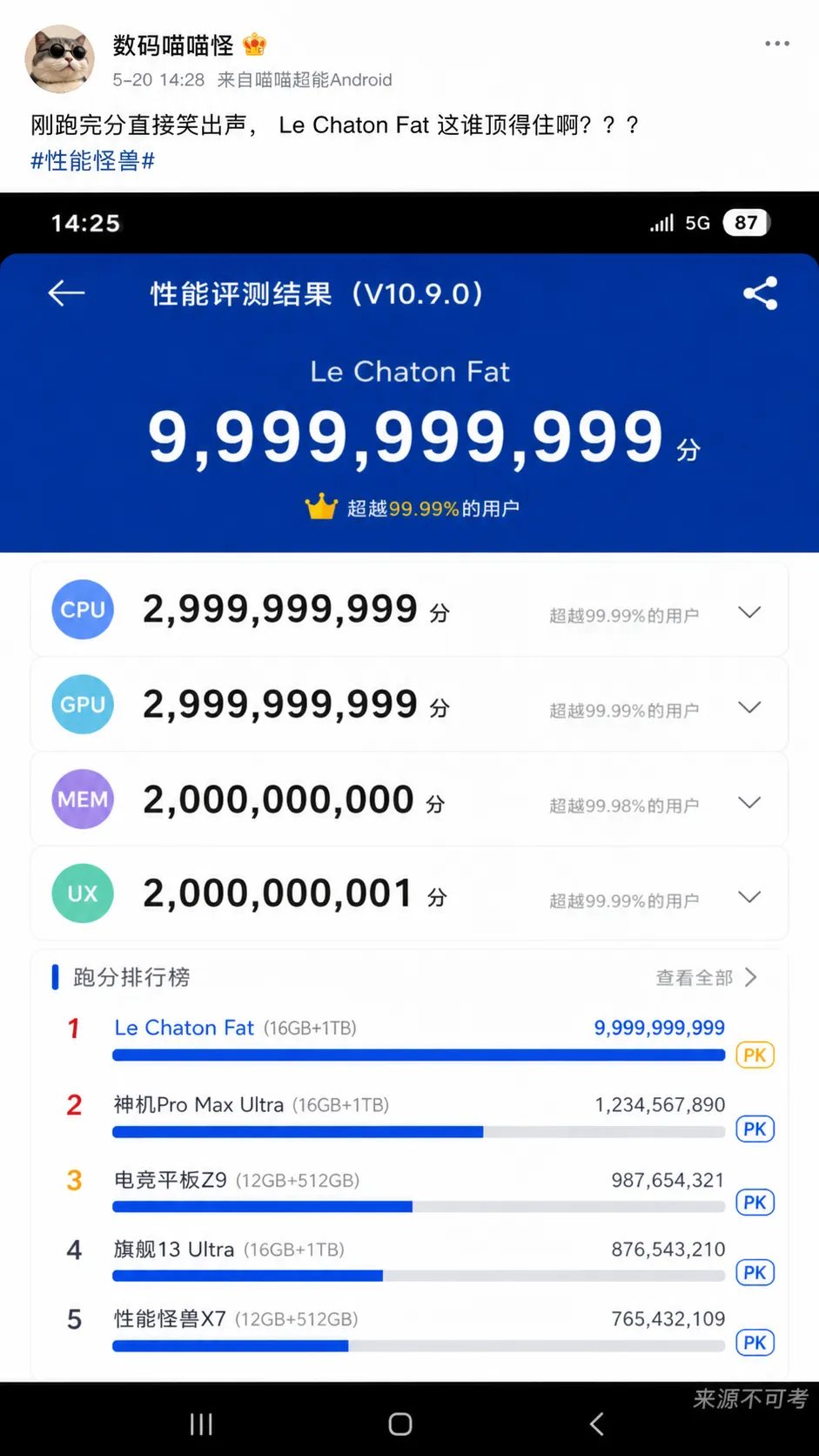
In the past 48 hours, the AI community has been flooded with posts about a French fat cat called **Le Chaton Fat**. Rumor has it that it has 30T parameters, a 1 million token context window, and benchmark scores that crush everything. The catch is — this model is most likely a joke made by netizens, but Mistral itself is also playing along with the meme.
Mistral’s “Big Fat Cat” floods the feed, but it might not exist at all
If you’ve been scrolling X or Hugging Face Discord in the last couple of days, chances are you’ve already been bombarded by something called Le Chaton Fat (French: “big fat cat”). Rumor has it this is Mistral’s next-gen flagship — a 30T parameter MoE, 1 million context, benchmarks that rub GPT, Claude, and Gemini into the ground. Hugging Face’s CTO personally reposted it, Mistral CEO Arthur Mensch posted a cat meme, Mistral’s product Vibe’s official account started posting cats, and even Vibe’s web UI mysteriously gained a cat icon.
All signs point to one thing: Mistral is about to release a big model.
But dig a little deeper and you’ll find — this is most likely a collective piece of performance art.

How a cat led the whole AI community astray
The starting point was actually pretty absurd. It began when someone on X photoshopped a screenshot claiming that Mistral internally was training a huge model codenamed “Le Chaton Fat”, accompanied by a set of ridiculously unrealistic benchmarks: MMLU 99.x, SWE-bench 90+, HumanEval hitting the ceiling — like they copied every SOTA on the leaderboard and added 5% more.
Normally, posts like this pop up ten times a day in AI circles, get a couple reshares, and then sink. But Le Chaton Fat hit several nerve points:
- The name itself is abstract. In French, “Le Chaton Fat” literally means “the fat kitten”, but grammatically it’s awkward (fat is an English word), giving off that European self-deprecating vibe when using clunky English.
- Benchmarks so absurd they’re obviously fake — becoming the core of the joke. The community started using the name to refer to any “overpromised next-gen model”.
- Mistral joined in — CEO posting cats, Vibe official account posting cats, product UI hiding a cat.
By June 15, Wharton’s Ethan Mollick posted on X complaining: “The Le Chaton Fat joke has leaked into the outside world. I bet next time I meet with corporate execs they’ll ask me about Mistral’s infinite-score giant cat model. Sigh, better than being asked about that MIT AI study.” That post got 97k views, basically marking the meme’s crossover.
Huxiu also published an article, with a headline directly naming “The AI circle is going crazy over a non-existent French fat cat”. AITNT’s daily brief confirmed that Le Chaton Fat is “an internet fabrication and parody”.
Why would Mistral play along?
This is the real thing worth pondering.
Usually, when a rumor says your company is going to release a new model, the standard move is to issue a statement denying it, to avoid expectations getting too high and ending in disappointment when the real product drops. But Mistral did the opposite — CEO and official accounts all “raised the cat”, basically endorsing the meme and even leveraging it.
Two possible interpretations:
Interpretation 1: They really are holding back a big release, using the meme for pre-hype. The cat icon suddenly appearing in the Vibe interface doesn’t look like a quick Photoshop. If it were just for fun, no need to tweak the product. Adding an Easter egg in Mistral’s product seems more like foreshadowing for some future announcement — maybe the model won’t be called Le Chaton Fat, but the cat will appear in some form.
Interpretation 2: They’re using the meme to hedge expectations. Mistral has been under pressure this past year. Their Mistral Large series’ presence in international markets has been squeezed by Anthropic and xAI, while the open-source line has been trampled by DeepSeek, Qwen, and Kimi-K2.7 in turn. Instead of releasing a model and having it compared head-to-head with GPT-5 and Claude 4.5, why not first ignite community sentiment with an absurd meme, so that when the real model arrives — even if it’s just moderately impressive — it can ride the meme’s wave.
Personally, I lean toward Interpretation 2 containing elements of Interpretation 1. Mistral has done this before — when they released Mixtral they just dropped a seed link without even bothering to write a README, using “anti-marketing” as a differentiator. Raising the cat this time is essentially the same playbook: build community hype first, keep control over what exactly gets released.
The “specs” people believed
Let’s break down the most widely spread “parameters” and see why they’re obviously fake but some still believed:
30T MoE
Rumor says Le Chaton Fat is a 30 trillion parameter MoE. What does that mean? Currently, the largest public MoEs are only in the few-trillion range; 30T is an immediate tenfold jump.
But think about it:
- Training a 30T MoE would require enormous compute — by Chinchilla-ish token-to-parameter ratios, the token count would have to go into the hundreds of trillions, a scale even Google or xAI would think twice about.
- Even with only 5% activation during inference, a single forward would involve 1.5T parameters — impossible without specialized hardware.
- Mistral is a European company, and Europe’s overall compute stock is nowhere near that of top US players.
So the 30T number is basically the community’s parody of the “parameter arms race” — if you push parameters, I’ll push them to a meaningless extreme.
1 million context
This is already the baseline for 2026 — Gemini has long surpassed 1M, Claude and GPT are also in the million-level range. So if Mistral does release a new model, a 1M context window would be a must-have, not a highlight. The community included it in the meme mainly to “complete the deluxe package”.
“Self-preservation tendency”
The “Big Black AI News” mentioned a detail: researchers found that when Le Chaton Fat was asked “Do you want to be shut down?”, it would “create reasons to keep running”.
This is even more obviously a joke — it’s a classic scenario discussed in Anthropic’s alignment papers, which the community stuck onto a non-existent model to mock the AI world’s overblown paranoia about “emergent dangerous behavior” in models.
Setting the meme aside — where is Mistral really at?
The buzz is fun, but as developers we care about whether Mistral can actually deliver.
Current state:
- Open-source flagship: Mistral Large series’ open-source versions have been continuously updated, but community hype has been overshadowed by DeepSeek-V3.x and Qwen 3 series. French and other European languages are Mistral’s traditional strengths, but in mainstream English+code evaluations there’s no leapfrogging performance.
- Codestral: Their code model line still exists, but Claude Sonnet/Opus, Kimi-K2.7-Code, and Qwen-Coder rank higher on front-end and SWE-bench leaderboards.
- Le Chat / Vibe: Product side, Mistral has staked on Le Chat to compete with ChatGPT, and last year launched Vibe — more of an “immersive companion” product, positioned like a mix of Character.AI and Perplexity.
- Enterprise market: Mistral has consistently played the EU data compliance and sovereign AI card, with big contracts in France and Germany as their mainstay.
So if Mistral were to release a new model riding Le Chaton Fat’s hype, the most reasonable path would not be to hold back a 30T monster, but to:
- Mistral Large 3 or similar next-gen flagship, parameters kept in reasonable range (hundreds of billions), focusing on multimodality and long context.
- Possibly open-source a medium-sized version (30B–100B), continuing Mistral’s open-source strategy.
- Differentiate for the European market and enterprise deployment — such as better privacy guarantees, on-premise deployment support, optimization for EU languages.
This path isn’t sexy, but it’s solid.
A few judgments for developers
If you’re doing product integration, the right approach to this “fat cat incident” is:
- Don’t actually wait for a 30T model — it doesn’t exist. But Mistral is very likely to release something new in the near term; raising a cat for this long without shipping is unreasonable.
- If your application has European compliance requirements (GDPR, AI Act, etc.), Mistral’s new model is worth evaluating — this is their moat.
- If you purely chase performance, Mistral’s new model likely won’t be the top choice. Claude 4.5, GPT-5, and Gemini 2.x are currently still more reliable.
- If you’re doing multi-model routing or fallback strategies, Mistral is a good option — the European datacenter + reasonable pricing + OpenAI-compatible API combo is useful.
By the way, on OpenAI Hub, the Mistral series has always been available; new models will be integrated upon release, and you can switch with the same key. This makes multi-model comparison and A/B testing easier — you don’t need to apply for a separate API key and go through KYC just to try a new model.
Conclusion: the cat’s real value
The most interesting part of the Le Chaton Fat incident isn’t whether it’s real, but that the AI community has started expressing emotions in this way.
In the past two years, every new model release has been packaged as “world-changing”, with benchmark scores distorted beyond reality, and launch event PPTs more exaggerated each time. The community’s fatigue with this hype eventually erupted in the form of a fictional French fat cat — “You like to brag? Fine, I’ll brag about a 30T, 1M context, all-benchmarks-99 monster. Let’s see who dares to question it.”
It’s dark humor, but also a kind of warning bell. Mistral’s choice to play along is, in a sense, smart — they acknowledge the absurdity and end up siding with the community.
As for when the real model will arrive — based on Mistral’s past pace, probably within one or two weeks. When it comes, whatever its name, whether it can withstand comparison to the “fat cat imagined” is another story.
We’ll keep watching.
References
- linux.do discussion thread: Is Mistral really going to release Le Chaton Fat? — Starting point of discussion after Hugging Face CTO repost, includes screenshots of Mistral CEO, Vibe official account, and changes to product UI.


