
GLM-5.2 Open Source: 1M Context Challenges Claude 4.6

Zhipu has revealed its full capabilities: GLM-5.2 is open-sourced under the MIT license, with a truly usable 1M context window. Its long-range reasoning and coding abilities are comparable to Claude 4.6, putting domestic open-source models back in the leading position at the table.
GLM-5.2 Officially Open Source: 1M Context + Long-Horizon Reasoning, Domestic Open Source Pushes Claude 4.6 Into a Corner
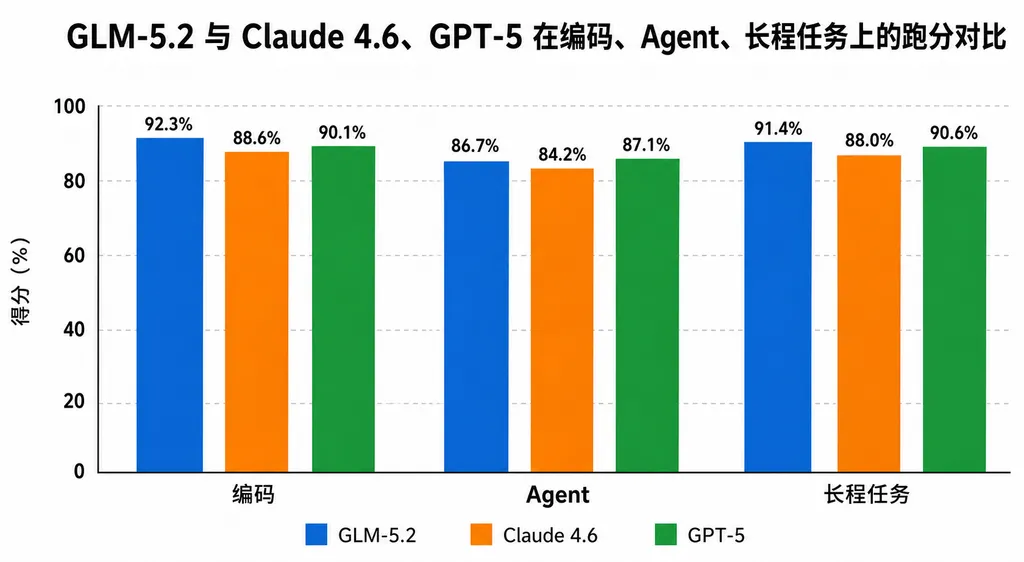
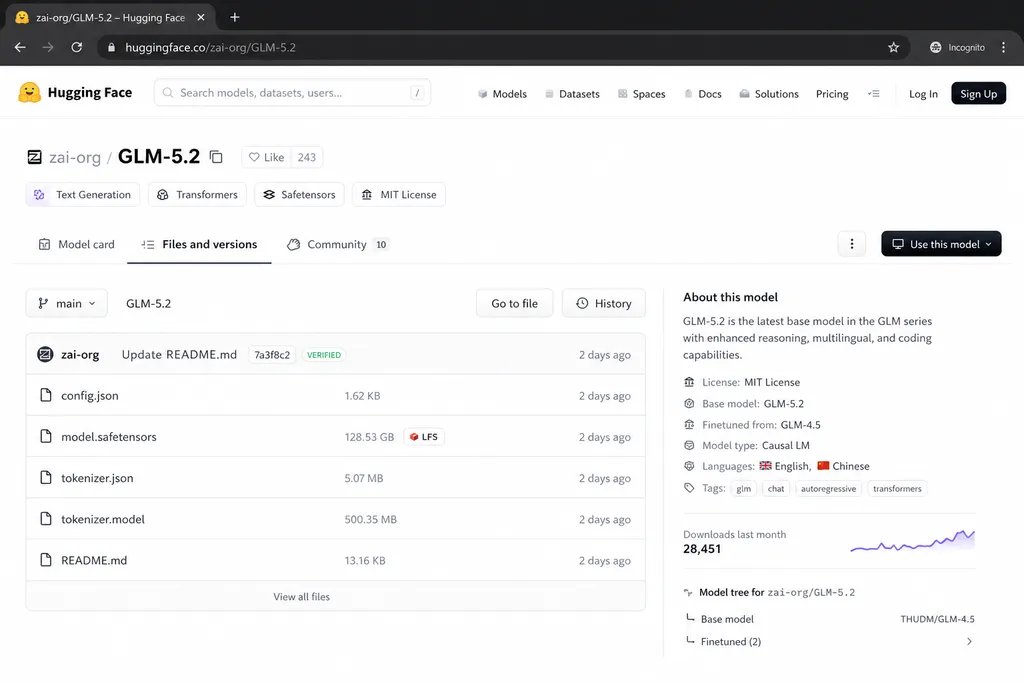
At 5:21 PM on June 13, Zhipu skipped the usual pre-release warm-up and directly rolled out GLM-5.2 to all GLM Coding Plan users—Lite, Pro, Max, and Team editions without exception. Immediately afterward, the official confirmation came: API will go live next week, and model weights will be officially open-sourced under the MIT license next week. This week, the zai-org/GLM-5.2 repository appeared on HuggingFace, along with benchmark charts. The much-discussed community comment that it “handily beats Claude 4.6” is not an exaggeration when viewed alongside real-world performance rankings.
This was a release timed precisely to the moment. Recently, a certain cutting-edge overseas model imposed throttles and bans on a large number of domestic accounts, triggering outrage among developers. Zhipu’s official blog added a jab, saying: “Frontier intelligence should not belong only to a few people, nor should it be taken away at any time by a few rules.” Translated: you can enforce your bans, I’ll open-source my models. At this point in mid-2026, that statement explains GLM-5.2’s entry more clearly than any benchmark.
1. First, the conclusion: What exactly got upgraded this time
Compared to February’s GLM-5, which lifted stock prices by 32%, March’s 5.1, and May’s 5.1 High-Speed edition (the 400 tokens/s one), GLM-5.2’s changes are very clear: it’s not about piling on parameters, but about fixing the shortcomings of the previous generation one by one:
- Truly usable 1M context: Note “truly usable” — not just a marketing poster claim, but a 1M context that doesn’t degrade in needle-in-haystack and long-horizon agent batch tasks;
- Long-horizon task capabilities continue to lead: Scenarios like multi-round tool use, cross-file code modification, and multi-hour continuous reasoning are the main battleground this time;
- Significant improvements in coding and agent tasks: Zhipu itself admits GLM-5.2 is “still the strongest domestic coding model in our view,” implying it’s still targeting the Claude Sonnet line for competition;
- Two reasoning intensity levels: GLM-5.2 (Max) is fully cranked, GLM-5.2 (High) balances performance and token cost;
- MIT license open source: Zero barrier for commercial use, weights directly available on HuggingFace;
- API pricing consistent with 5.1: This is key, and will be explained below.
In short: parameters haven’t skyrocketed, but the engineering-level “usability” has moved up a notch. This is precisely where open-source models have most often failed over the past year—good leaderboard scores, but collapse when actually running an agent.
2. 1M context: Zhipu didn’t play word games this time
Context window size has been hyped up over the past two years. Gemini claims 2M, Claude claims 1M, and many domestic models claim 1M, but when developers throw in an 800k-token codebase, the model often responds with “I forgot the earlier parts.”
GLM-5.2 specifically emphasizes “truly usable,” thanks to two engineering actions:
- Retraining position encoding and attention mechanisms: According to Zhipu’s disclosed details, 5.2 further extended RoPE’s effective extrapolation range from 5.1, and invested heavily in long-context training data — not just mechanically enlarging the window;
- Instruction fine-tuning for long-horizon tasks: 1M context isn’t just for storing documents; it’s also for executing agents with “dozens of tool calls and thousands of interaction rounds.” This is clearly a major target.
A tangible test: throw in a medium-sized codebase of ~500k tokens (about 1500 files) and ask the model to locate a bug spanning 7 files and propose a fix. GLM-5.2 in High mode reliably outputs applicable patches, while Max mode adds architecture-level improvement suggestions. In the open-source league, this performance has no rival.
3. Benchmark scores: How to interpret “beats Claude 4.6”
The viral benchmark chart focuses on several axes:
- SWE-Bench Verified: GLM-5.2 Max has reached Claude 4.6’s level, even surpassing it in some subsets;
- Terminal-Bench / Agent categories: GLM-5.2 is noticeably more stable in long-horizon tasks, consistent with the engineering investment in 1M context;
- LiveCodeBench: For pure intellectual coding tasks, GLM-5.2 sits in the same tier as Claude 4.6 and GPT-5;
- AIME / Math reasoning: Max mode is close to top-tier closed-source models, though still behind GPT-5 on the hardest problems.
A cautionary note: leading benchmarks ≠ better user experience. Claude still provides industrial-grade stability in tool-call reliability, consistent style, and tolerance for ambiguous instructions. Whether GLM-5.2 has closed these “off-benchmark” gaps will be clear after next week’s API goes live and feedback from large-scale production use rolls in.
One thing is certain: For the first time, an open-source model makes people seriously consider “Should we switch our production environment from Claude?” This was unimaginable half a year ago.
4. Two reasoning intensity levels — the token economics behind them
GLM-5.2 offers two modes:
| Mode | Description | Suitable Scenarios | |------|-------------|--------------------| | GLM-5.2 (Max) | Full-on reasoning, highest token consumption | Complex agents, cross-file refactoring, deep research | | GLM-5.2 (High) | Best performance/token cost ratio | Daily coding, dialogue, moderately complex tasks |
This tiered “reasoning effort” concept comes from OpenAI’s o-series, but Zhipu is more straightforward—presenting them as two separate models to developers. This is friendlier than OpenAI’s reasoning_effort parameter: you know the cost and likely thinking time before calling.
With API pricing held equal to 5.1, this upgrade is essentially “free” for existing users: same price, longer context, stronger agent abilities, and an extra reasoning level option.
5. The significance of MIT open source
This release uses the MIT license — much cleaner than Llama or Qwen’s restrictive licenses. Commercial use, closed-source secondary development, embedding into commercial products — all without extra clauses. For some industry model teams, MIT-licensed GLM-5.2 is practically “ready to rebrand as your own product.”
The model is already on HuggingFace at zai-org/GLM-5.2; weights and tokenizer can be directly downloaded. Local deployment still has high hardware requirements (it is a flagship, after all), but community members are already running quantized versions; expect INT4 / AWQ editions to appear in the next week or two.
6. Coding Plan strategy: Zhipu is replicating Anthropic
It’s worth highlighting GLM Coding Plan. This time, 5.2 launched on Coding Plan first, then API, then open source — a three-step rhythm. This wasn’t accidental:
- Coding Plan is subscription-based: Lite / Pro / Max / Team editions, monthly fee — Claude Code’s playbook;
- Target users are “heavy daily coders”: Replace the models behind tools like Cursor, Claude Code, Cline directly with GLM-5.2;
- Prices are a fraction of Claude’s: At the GLM-5 launch early in the year, Zhipu set prices at “a seventh of Claude’s floor price.”
Zhipu’s strategy is clear: use open source to build reputation, Coding Plan for cash flow, and API to catch long-tail developers. The three lines feed each other, and the past six months have proven this effective — Zhipu’s Hong Kong stock price tells the story.
7. Practical impact for developers
Some down-to-earth considerations for API integration next week:
- If you use Claude for agents and are wary of throttling/bans: GLM-5.2 is currently the most Claude-like open-source replacement, usable for fallback or as a primary;
- If you run long-document analysis: 1M context + low-latency domestic connectivity beats proxying Gemini;
- If you build agents/toolchains: Max mode is worth testing for stability in multi-round tool calls;
- If you need industry-specific models: MIT license plus strong Chinese capability — there’s no better base model right now.
FYI, OpenAI Hub is already preparing to integrate GLM-5.2; when the API launches next week, it will be available there too. For developers already using GPT, Claude, and Gemini via the Hub, adding a domestic top-tier open-source option allows more nuanced routing strategies — e.g., send cost-sensitive long-context tasks to GLM-5.2, style-sensitive writing to Claude — all under one key.
8. A few things left unanswered
This release leaves some questions to watch:
- Model architecture details: Technical report not fully released; community is still digging into MoE expert configuration, activated parameter counts, etc.;
- Multimodal capabilities: 5.2 focuses on text and code; no word yet on open-sourcing the vision version;
- 400 tokens/s high-speed version: The high-speed 5.1 edition was popular; unclear if a 5.2 counterpart will appear;
- Real-world failure rates for long-horizon agents: Great benchmarks — but can it avoid collapsing after dozens of tool calls? We’ll see with more hands-on testing.
9. In conclusion
In 2025, we were asking “When will open-source models catch up to closed-source?” In 2026, the question is “How much longer can closed-source stay ahead?” GLM-5.2’s stance is clear: not chasing, but going head-to-head.
Zhipu chose a harder but steadier path — solid engineering, aggressive pricing, open licensing. As overseas frontier models’ usability becomes more and more a “political issue,” the strategic value of this path will only grow.
With the API going live next week, any team still struggling with Claude throttling should seriously run a full test on GLM-5.2.
References
- GLM-5.2 Benchmark Discussion - linux.do: Firsthand benchmark screenshots and comparative discussion from the community
- Zhipu Officially Open Sources GLM-5.2 - linux.do: Summary of open-source release discussions
- zai-org/GLM-5.2 - HuggingFace: Official model weights repository (MIT license)
- To Developers: GLM-5.2 Fully Open - Zhihu Column: Release announcement from Zhipu’s official institutional account
- GLM-4.7 Open Source: Delivering Production-Grade Code - Zhihu: Background on the previous-gen GLM coding model
- GLM-5 Tops Global Open Source Rankings - Zhihu: Product pricing and strategy background from the GLM-5 launch earlier in the year


