
NVIDIA XR AI Public Beta Launch: Embedding Agents into AR Glasses
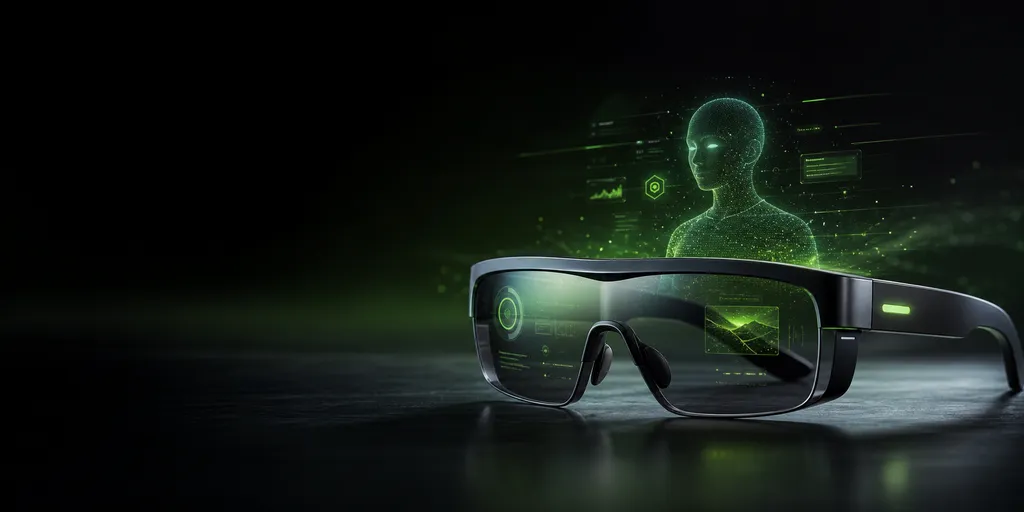
NVIDIA today launched the XR AI beta version, providing a multimodal agent development framework for AR glasses and XR devices, integrating computing power from the cloud, data centers, and the edge, enabling even lightweight glasses to run true spatial agents.
Old Huang Has His Eyes on the Glasses on Your Face
On June 17, NVIDIA officially pushed XR AI into the public beta stage. This is a framework aimed at developers, with a straightforward goal: to let lightweight devices like AR glasses and XR headsets—weak in computing power and with poor battery life—run truly multimodal intelligent agents.
This move isn’t exactly a surprise. From last year's launch of the Samsung Galaxy XR, to Google pushing the Android XR SDK to Developer Preview 3, to the unveiling of products like the XREAL Project Aura and the fashionable AI glasses collaborations from Gentle Monster and Warby Parker, the theme of the first half of 2026 has been: “In the glasses track, everyone is fighting for a piece.” But there’s an unspoken truth—glasses on their own simply don’t have the computing power to support heavy models like LLMs and VLMs. To make spatially aware Agents possible, someone has to lay down that back-end pipeline.
This time, NVIDIA is doing exactly that.

What Exactly Is XR AI
The official page defines it as “a platform that connects XR devices to all of an organization’s computing power.” That sounds like marketing lingo, but broken down, it’s actually very engineering-driven—XR AI is essentially a distributed Agent runtime + multimodal perception middleware, covering everything from sensor input on the glasses side to model inference scheduling across the cloud, data centers, workstations, and edge nodes.
Put more plainly: your glasses capture camera images, microphone audio, IMU data, gaze-tracking signals. XR AI packages, compresses, and routes these signals to appropriate compute nodes—running VLM for scene understanding, LLM for intent reasoning, ASR/TTS for voice interaction—and finally sends results back to the glasses as visual or audio overlays.
Three key points:
- Hands-free is the first principle. This framework assumes you won’t be using a controller and may not even have a touchpad. Voice + vision + spatial anchors are the default inputs, and all Agent design revolves around this.
- Computing power is elastic. Lightweight tasks (like simple object recognition or keyword wake-up) can be handled on edge nodes or even the phone paired with the glasses; heavy tasks (like detecting anomalies along an entire production line) go to the data center. Developers write code once, and at runtime it’s automatically scheduled based on latency budget and bandwidth.
- Spatial awareness is a first-class citizen. XR AI integrates SLAM, spatial anchors, and geometric understanding directly into the Agent’s context. Meaning, when the model answers “Where is this device’s emergency stop button?”, it knows the button’s physical coordinates and can directly draw an arrow in your field of view.
Why Now, and Why NVIDIA
You might ask: Apple has the Vision Pro ecosystem, Google has Android XR, Meta has the Quest and Ray-Ban Meta—why is NVIDIA jumping in?
The answer lies in the compute stack.
These players all focus on device-side OS and ecosystems, but the real bottleneck for XR Agents has never been the device—it’s latency, cost, and scheduling of cloud inference. An Agent worn on your face and constantly understanding your surroundings needs sub-second end-to-end latency—this is a whole different engineering challenge compared to a one-off ChatGPT Q&A.
NVIDIA’s advantage is that it controls GPUs, inference frameworks (TensorRT, Triton), vision models (the Nemotron Nano VL series, Cosmos), and the Omniverse spatial computing stack. Combining these into a runtime for XR is low marginal cost for them.
More practically: Glasses makers need a neutral AI back end. Brands like Samsung, XREAL, VITURE, and Thunderbird—none of them want to be completely tied to Google or Apple. NVIDIA offering a cross-platform, cross-cloud framework is win-win—hardware stays with them, intelligence stays with NVIDIA, nobody loses.
Use Cases Seen in the Public Beta
According to reference cases on NVIDIA’s developer site, the XR AI public beta focuses on four main areas:
- Manufacturing assembly guidance: Assembly line workers wear glasses, the system identifies parts in real time and checks if the assembly order is correct; mistakes are highlighted directly in the field of view. This is a story the AR industry has been telling for over a decade, but couldn’t make work—the challenge has never been display, but combining recognizing the parts + understanding human speech at the same time.
- Medical and emergency assistance: CT/MRI image retrieval, procedural prompts, remote expert collaboration. This scenario actually tolerates higher latency than industrial ones but has near-zero tolerance for model hallucinations. In demos, NVIDIA emphasized “human-in-the-loop” Agent design—every key judgment requires operator confirmation.
- Visually guided process training: New employees wear glasses, and an Agent teaches them to operate equipment step by step. If successful, this could slash factory training costs.
- Warehouse management and spatial navigation: Using glasses with spatial anchors to plan picking routes and locate storage slots. This directly competes with handheld scanners in Amazon warehouses.
The most viral official image shows a researcher using VITURE AR glasses for gene editing—XR AI provides hands-free procedural guidance in real time. It looks sci-fi, but under the hood it’s the same logic as industrial assembly: draw something in your vision that knows what you’re looking at, where your hands are, and what you should do next.
From a Developer’s Perspective: Is It Easy to Get Started?
Honestly, NVIDIA has been much more developer-friendly in recent years than in the past. The XR AI public beta workflow looks roughly like this:
- Apply for the public beta via NVIDIA’s developer portal to get the SDK;
- Choose a compatible device (beta supports certain VITURE and XREAL models, as well as standard HMDs via OpenXR);
- Spin up an XR AI Runtime on a workstation or in the cloud, attach the models you want to use (NVIDIA’s own VLMs or your fine-tuned open-source VLMs);
- Use the framework’s Agent orchestration API to write business logic; the framework automatically handles sensor streams, spatial anchors, and model routing.
Some points to note:
- It’s OpenXR-friendly. This means developers don’t need to rewrite their business logic for each type of glasses—write once, run on multiple devices.
- Models aren’t locked in. You can use NVIDIA’s own vision models or any VLM. This is especially nice for Chinese developers—you can hook in domestic models like Qwen-VL or InternVL with no problem.
- It’s integrated with Omniverse. If you already built a digital twin of a factory in Omniverse, XR AI can directly reuse that spatial data. This is NVIDIA’s killer feature, and competitors can’t easily replicate it.
Of course, a beta is still a beta, and there are pitfalls:
- Documentation is still “demo project”-oriented; complex multi-Agent orchestration scenarios require exploration;
- End-to-end latency when accessing NVIDIA’s own cloud from within China isn’t ideal—it’s better to set up your own inference nodes;
- The glasses’ power consumption models are still rough. Long-term use causes heating—half of that is a hardware issue.
A Bigger Picture
In the 2026 AI glasses track, the discussion has shifted from “Can you wear them outside?” to “If you wear them, what’s the actual use?” Ray-Ban Meta made the hardware’s look acceptable, Samsung Galaxy XR put high-end headset experience on par with Vision Pro, but the killer app that makes users wear them 8 hours a day still hasn’t emerged.
NVIDIA’s XR AI public beta is, at its core, offering a reference answer to “What should a killer app look like?”—it’s not a specific app, but a spatially oriented Agent framework. Whoever first uses this framework to make the first truly high-frequency XR Agent will get to define the syntax of next-generation human-computer interaction.
As for whether this framework can become a de facto standard, I’m cautiously optimistic. NVIDIA’s engineering prowess is unquestionable, but an Agent framework is an ecosystem play, not just a tech one. Google’s Android XR, Apple’s visionOS Agent, Meta’s multimodal Llama stack—they’re all doing the same thing in their own walled gardens. NVIDIA wants to be the cross-platform neutral layer, which sounds great, but cross-platform neutral layers are never easy to build.
This track will likely see at least another 18 months of free-for-all. Every XR, Agent, and multimodal developer should run the public beta themselves to see whether it can land in their own scenarios.
As a side note, if you want to call closed-source models like GPT, Claude, or Gemini in your XR Agent chain for high-level reasoning, OpenAI Hub currently supports this. Direct connections from within China are compatible with the OpenAI format, and switching between models with a single key during Agent orchestration experiments is quite convenient.
References
(This article is based mainly on NVIDIA’s official blog, the NVIDIA Developer site’s XR AI page, and the Android Developers Blog announcement for Android XR SDK Developer Preview 3. All are overseas sources—developers in China should obtain original information via official channels.)


