
TerraMaster F4-425 Pro Launches TOS 7: NAS Starts Embracing Native AI
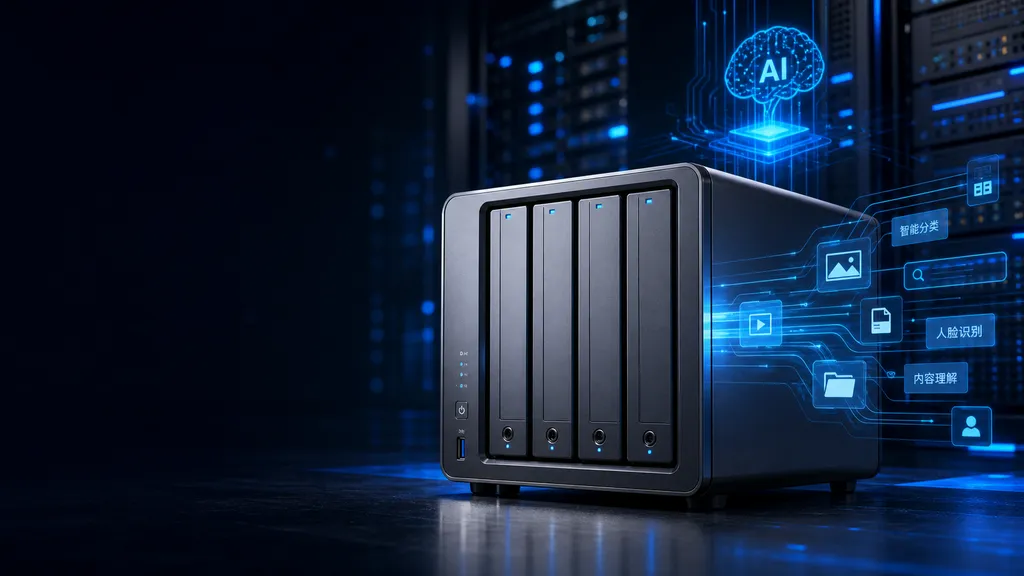
TerraMaster launches the F4-425 Pro equipped with the world’s first AI-native NAS operating system TOS 7, available with optional i3-N305/N350 processors, featuring a 4+3 hybrid drive bay configuration with a maximum capacity of 152TB, starting at 3,799 yuan.
TerraMaster F4-425 Pro Debuts TOS 7: NAS Starts Going All-In on AI-Native
On June 17, TerraMaster officially launched sales of the F4-425 Pro aluminum NAS, starting at 3,799 RMB. Judging from the hardware specs, this is a regular iteration of the F4-425 Plus, but the real highlight isn't the i3-N305—it’s the debut of TOS 7, which TerraMaster claims to be the “world’s first AI-native NAS operating system.”
In the context of the 2026 NAS market, this is significant. Over the past year, Synology, QNAP, Ugreen, and JieSpace have all added AI features to their systems, but most of these are local capabilities like “AI photo album” or “semantic search.” TerraMaster’s approach this time is to completely overhaul the interaction logic of the OS, aiming for users to complete more than 90% of NAS operations using natural language. Whether this is hype remains to be seen, but the concept is undeniably different from its peers.
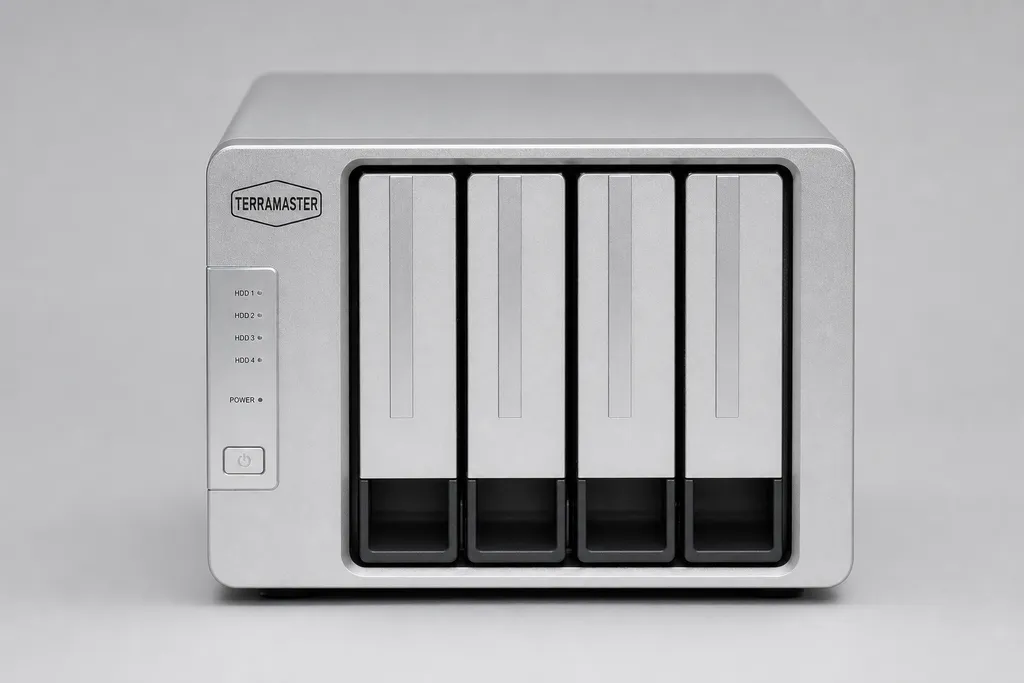
Hardware: N305 as the Anchor, Maxed-Out 4+3 Hybrid Drive Bays
Let’s get the hardware straight. The F4-425 Pro comes in two SKUs:
- i3-N305 + 8GB DDR5: 3,799 RMB
- i3-N350 + 16GB DDR5: 4,799 RMB
The N305 is the flagship of Intel’s Alder Lake-N family, with 8 E-cores and a 15W TDP. Multi-core performance is significantly higher than the previous-gen N150, with no pressure running VMs, performing 4K transcoding, or hosting Docker containers. The N350 is a newly released model this year, similar in specs but with higher clock frequencies. The 16GB RAM variant is more suitable for running small local models or memory-hungry services like Immich.
Storage expandability is solid:
- 4× 3.5" SATA bays
- 3× PCIe 3.0 ×1 M.2 NVMe slots
- Max capacity 152TB (4× 32TB SATA + 3× 8TB NVMe)
This “4+3” layout is in line with the design philosophy of the F4-425 Plus—SATA for cold data archival, NVMe for hot data caching or dedicated high-speed pools—ideal for editors and photographers.
TerraMaster was generous with ports this time:
- 2× 5GbE RJ45 (supports link aggregation, theoretical >1100MB/s)
- 3× USB-A 10Gbps
- 1× USB-C 10Gbps
- 1× HDMI
Dual 5GbE at this price point (~4k RMB) is a standout feature. Many mid-tier NAS priced above 6k RMB still use 2.5GbE. For small studios working collaboratively, aggregated links for bi-directional syncing of media can offer near-local SSD-like experience.
TOS 7: Transforming NAS from a “Data Warehouse” into a “Smart Assistant”
The hardware is an incremental upgrade; the real star here is TOS 7.
According to TerraMaster, “100 engineers worked for two years”—perhaps a claim to take with a grain of salt, but from the publicly available Beta, TOS 7 indeed feels like a complete overhaul compared to TOS 6: 90% of icons redesigned, over 50 new features, more than 1,000 detail optimizations. The underlying kernel is upgraded to Linux 6.12, improving scheduling and real-time performance.
The real highlight is its “AI-native” strategy.
More than Just Adding an AI Plugin
Most domestic NAS vendors’ so-called “AI features” work like this: bolt on a smart photo module, add semantic search, throw in a chat box. The functions exist, but they’re disconnected from the rest of the system—you can’t use natural language to change network settings, or have AI deploy a Docker container.
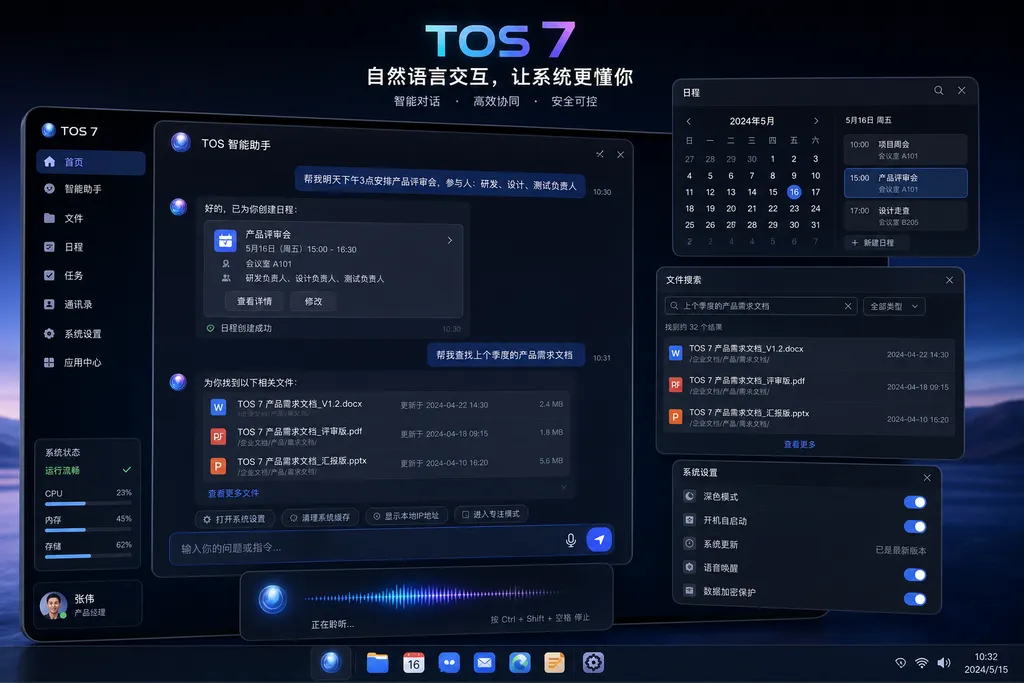
TOS 7 flips this: first standardize and AI-enable all system interfaces, enabling “intelligent agents” to directly call full system functions. In theory, storage management, network configuration, app deployment, backup and restore—tasks that used to take multiple mouse clicks—can be done with a single sentence.
One example from TerraMaster: a user says, “Automatically sync last week’s wedding photos to my iCloud, run at midnight daily,” and the system will break down the task, configure scheduling, and invoke CloudSync—no manual intervention needed.
The key is not how powerful the AI model itself is, but whether the system is designed from the ground up to be callable by intelligent agents. From public info, TerraMaster appears to have pursued this path.
Natural Language Interaction as the Main Entry Point
TOS 7 natively integrates the intelligent agent core component—no extra deployment needed. Users can give commands via text or voice, in scenarios such as:
- Natural language-based scheduling and conditional triggers
- Seamless multi-device collaboration
- Automatic breakdown of complex commands, coordinating multiple modules
- Batch operations
If this works as intended, it would be a big leap for NAS—historically known for its high learning curve. Even consumer-focused brands like Ugreen and JieSpace still lower barriers mainly through wizards and GUIs. If TerraMaster pulls this off, it effectively skips the “GUI usability improvement” stage.
Developer Platform as a Long-Term Play
TOS 7 also launches a developer platform, offering full-service coverage: documentation center, dev tools, test environments, and release management. Third-party intelligent agents can integrate and publish skills, forming a “develop-test-distribute” loop.
This is a forward-looking move. NAS vendors lack an App Store-like distribution ecosystem; TOS 7 aims to use the AI agent trend to establish one. Whether it succeeds remains to be seen, but the thinking is sound.
Practical Features Not Forgotten
Returning to more conventional functionality, TOS 7 bolsters traditional features:
- Office online editing: Word/Excel/PPT editing directly in browser, no local download needed—essential for small team collaboration
- Multimedia service: 4K hardware decoding, native support for Plex, Emby, Jellyfin
- Cloud integration: CloudSync supports uni-/bi-directional auto-backup for mainstream cloud storage
- Virtualization & containers: Supports Docker, VirtualBox
- Data protection: TRAID elastic array + HyperLock-WORM FS + AES hardware encryption
- Mobile: Deep integration with TNAS Mobile app
This combo essentially covers all mainstream use cases from home entertainment to SMB office.
Comparing with Competitors: Weak Points and Strengths
Horizontal comparison of the current ~4k RMB NAS market:
| Item | TerraMaster F4-425 Pro | Ugreen at same price | JieSpace at same price | |------|------------------------|----------------------|------------------------| | CPU | i3-N305/N350 | N100/N150 | N100-class | | RAM | DDR5 8/16GB | DDR4/5 8GB | DDR4 8GB | | Network | 2× 5GbE | 2× 2.5GbE | 2× 2.5GbE | | M.2 | 3× PCIe 3.0 | 2× | 2× | | AI capability | System-level native | Partial functions | Partial functions |
Hardware-wise, F4-425 Pro’s dual 5GbE and triple M.2 slots are clear advantages, with CPU also outclassing competitors. The downside is TerraMaster’s ecosystem and mobile experience—not as strong as consumer-focused brands like Ugreen and JieSpace, a common issue for established professional vendors.
TOS 7 is the wildcard. If the AI-native experience works well, TerraMaster gains a competitive moat; if it’s merely marketing with limited practical impact, it’s back to spec competition. From current Beta feedback, the AI portion is usable but still far from “replacing the GUI.”
Who Should Buy?
Suitable scenarios:
- Small video/design studios: 4+3 hybrid bays + dual 5GbE, combined with N305’s transcoding power, handle collaborative 4K editing easily
- Advanced home users: Run Plex/Emby + Docker + whole-home archiving, 152TB capacity is future-proof for years
- SOHO / Developers: Eager to explore TOS 7’s AI features and dev platform—lots of room for experimentation
- SMB entry-level: As local data hub + backup server, paired with TOS 7’s BBS full-scenario backup solution
Not recommended for: complete novice home users or those intending to use it purely as cloud storage—at this price, Ugreen or JieSpace offer a more idiot-proof experience.
Final Thoughts
The NAS market has been highly competitive in recent years, with hardware specs reaching diminishing returns—CPU upgrades, faster ports, more bays—everyone can do it. The real differentiator is software and ecosystem.
TerraMaster’s bet on an AI-native OS is a solid direction. The challenge is that for hardware vendors, going AI-native is costly: you need AI agent training capability, well-standardized system interfaces, and a developer community. None of these can be solved by just releasing a new product.
The F4-425 Pro feels more like the first vehicle for TOS 7. The real test lies ahead—can TOS 7’s official release deliver on time, can AI features be stable and usable, will developers join? If all these work, TerraMaster could carve out its niche in the professional NAS segment; if not, it’s another case of “marketing outweighs reality.”
A starting price of 3,799 RMB is fairly reasonable. For users with clear hardware needs who also enjoy tinkering with new system features, this machine is worth a look.
References
- TerraMaster launches F4-425 Pro aluminum NAS: available with Intel Core i3-N305/N350, debuting TOS 7 OS with AI features, from 3,799 RMB – IT之家 – Official product release with full specs and pricing information


