
IBM Releases ALTK-Evolve: The Era of AI Agents Learning While Working Has Arrived
IBM Research has open-sourced the ALTK-Evolve framework, enabling AI Agents to learn and evolve in real time while performing tasks, eliminating the need for offline fine-tuning. This could be a key step for Agents to transition from "tools" to "colleagues."
IBM Research officially open-sourced ALTK-Evolve last week — a framework that enables AI Agents to continuously learn while performing tasks. Simply put, it turns an Agent from a “use once and discard” reasoning pipeline into a system that accumulates experience and improves the more it’s used.
This is something worth discussing seriously.
Where the Problem Lies
Current mainstream Agent frameworks — whether LangChain, AutoGen, or CrewAI — are essentially stateless. Each time you call them, the Agent starts reasoning from scratch, even if it performed the same task just yesterday.
It’s like having a new intern at your company who wakes up every morning with their memory wiped. You have to teach them the same things over and over again.
Of course, you can attach an external knowledge base via RAG, or insert historical examples into prompts with few-shot learning. But those are passive memories — you have to manually organize and feed them in. The Agent doesn’t learn from failure or consolidate successful experience on its own.
Fine-tuning is another approach, but it’s costly, time-consuming, and once the task scenario changes, previous fine-tuning might even become a burden.
ALTK-Evolve aims to solve exactly this: letting the Agent learn while working.
What Exactly Does ALTK-Evolve Do
ALTK stands for Agent Long-Term Knowledge, and Evolve emphasizes that this knowledge dynamically develops over time. The framework’s core concept can be broken down into three layers:
1. Long-Term Memory Layer
This isn’t simply vector database retrieval. ALTK-Evolve maintains a structured experience store where each memory contains:
- Task context (what was done)
- Execution trace (how it was done)
- Result feedback (how well it performed)
- Abstract strategy (generalized rule distilled from the experience)
The key lies in the last item. The framework doesn’t just remember “which prompt was used last time,” but abstractly converts experiences into transferable strategies.
For example, when cleaning CSV data, if the Agent finds that “checking encoding before handling missing values” works more efficiently, that rule is extracted and can be reused in similar but not identical tasks next time.
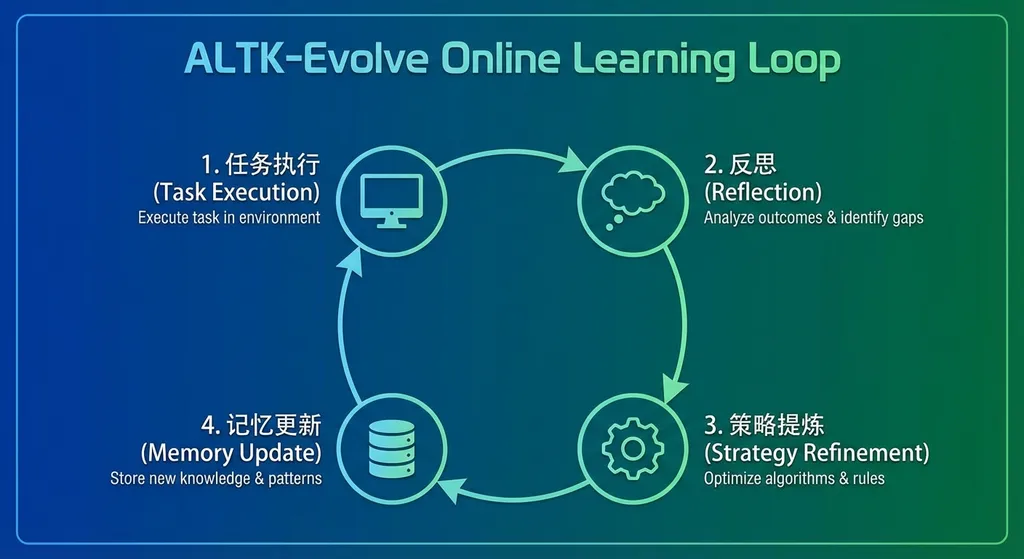
2. On-the-Job Learning Loop
Whenever an Agent completes (or fails) a task, a learning loop is triggered:
- Review its execution process
- Compare expected vs. actual results
- Identify key decision points
- Update strategy weights in long-term memory
This doesn’t require human intervention or offline training — it happens during inference, leveraging the LLM’s own capabilities.
You can think of it as an automated Reflect–Summarize–Remember process. After each task, the Agent spends a few seconds reviewing and then stores its insights.
3. Strategy Evolution Mechanism
Here’s the interesting part. As task volume increases, the Agent’s strategies accumulate — some may conflict with each other. ALTK-Evolve introduces a strategy evolution mechanism:
- Strategies that perform well and are frequently used get higher weights
- Those leading to repeated failures lose weight or get eliminated
- Similar strategies are merged and refined
- New strategies compete with old ones
It’s somewhat reminiscent of genetic algorithms, but applied at the knowledge level rather than the parameter level. The Agent improves not by adjusting model weights, but by optimizing its working methodology.
How It Compares with Existing Approaches
To be fair, IBM isn’t the first pursuing the “memory-enabled Agent” direction. MemGPT (now called Letta) did similar work early on, and the Reflexion framework also explored self-reflective Agents.
However, ALTK-Evolve stands out in several ways:
- Model-agnostic design. It doesn’t tie to a specific model — it works with GPT-4o, Claude, Gemini, Llama, or DeepSeek. This is practical — you wouldn’t want your Agent to lose all accumulated experience just because you switched models.
- Interpretable strategies. Unlike fine-tuned models, where you can’t know what was actually “learned,” ALTK-Evolve’s strategy store is human-readable. You can audit what the Agent learned, remove unreasonable rules, or even add new ones manually — critical for enterprise use.
- Integration with IBM’s watsonx ecosystem. From demo videos, ALTK-Evolve is already running on IBM Bob (IBM’s Agent development platform) and, together with watsonx Orchestrate, can be deployed directly to production. That said, the framework itself is open source and can be used independently.
That said, it’s still early-stage. According to the Hugging Face blog, it significantly improves performance in complex multi-step tasks, but introduces extra overhead in simple single-round Q&A scenarios. So its best fit is repeated iterative workflows that benefit from refinement over time.
What It Looks Like in Practice
From IBM’s demo:
Imagine you ask an Agent to perform data analysis. The first time, it might choose an inefficient path — say, visualizing before cleaning. After completion, the learning loop kicks in, and the Agent realizes it should “clean before visualizing.” That strategy gets stored.
The second time it faces a similar task, it immediately applies the optimized process. By the third and fourth iterations, the strategy is further refined. By the tenth, the Agent’s speed and accuracy are much higher than on the first.
This kind of “the more you use it, the smoother it gets” experience is what makes Agents genuinely valuable.
Installation and usage seem straightforward — it’s released as a Python package with minimal dependencies.
If you already have an LLM-based Agent system, integrating ALTK-Evolve mainly involves adding memory read/write and learning triggers to the Agent’s execution loop.
What It Means for Developers
If you’re working on Agent development, ALTK-Evolve offers an interesting perspective: instead of spending massive effort on prompt engineering or fine-tuning datasets, let the Agent learn directly from real-world interaction.
The framework still uses large-model APIs underneath. Since it’s model-agnostic, you can flexibly switch based on task complexity — use cheaper models for reflection/summarization and stronger ones for key decisions.
If you need to call multiple models from one endpoint, API aggregator services like OpenAI Hub can help — one key lets you switch among GPT, Claude, Gemini, DeepSeek, and others, all in OpenAI-compatible format.
Here’s a simplified integration example showing how to connect ALTK-Evolve’s memory module into an Agent loop:
from openai import OpenAI

# Aggregate model calls via OpenAI Hub, switchable at any time
client = OpenAI(
    base_url="https://api.openai-hub.net/v1",
    api_key="your-openai-hub-key"
)

# Simulate ALTK-Evolve’s memory retrieval + task execution + learning loop
def agent_with_learning(task: str, memory_store: list):
    # Step 1: Retrieve relevant strategies from long-term memory
    relevant_strategies = retrieve_strategies(memory_store, task)

    # Step 2: Inject strategies into the system prompt
    system_prompt = "You are a continuously learning AI Agent.\n"
    if relevant_strategies:
        system_prompt += "Here are strategies distilled from your past experience. Please apply them:\n"
        for s in relevant_strategies:
            system_prompt += f"- {s}\n"

    # Step 3: Execute task (model can be flexibly switched)
    response = client.chat.completions.create(
        model="gpt-4o",  # or claude-sonnet-4-20250514, gemini-2.5-pro, deepseek-chat
        messages=[
            {"role": "system", "content": system_prompt},
            {"role": "user", "content": task}
        ]
    )
    result = response.choices[0].message.content

    # Step 4: Trigger learning loop – reflection and strategy extraction
    reflection = client.chat.completions.create(
        model="gpt-4o-mini",  # use a lighter model for reflection
        messages=[
            {"role": "system", "content": "Review the following task and result, then extract one reusable strategy."},
            {"role": "user", "content": f"Task: {task}\nResult: {result}"}
        ]
    )
    new_strategy = reflection.choices[0].message.content

    # Step 5: Update long-term memory
    memory_store.append(new_strategy)

    return result
This is just a minimal demonstration. The real ALTK-Evolve includes extensive optimizations for strategy storage, retrieval, and evolution — but the core loop remains: execute → reflect → remember → improve next time.
A Few Realistic Caveats
No new framework should be hyped without caution. ALTK-Evolve raises several issues worth watching:
- Memory contamination. If an Agent extracts a wrong strategy from a failed task, can that “bad experience” negatively influence future tasks? The framework includes a strategy pruning mechanism, but in early stages with little data, a single bad strategy’s impact might be amplified.
- Cost. Each reflection stage entails an extra LLM call. If your Agent executes thousands of tasks daily, that overhead matters. You can use cheaper models for reflection or trigger learning conditionally (e.g., only on failed tasks), but these need careful tuning per scenario.
- Knowledge sharing among multiple Agents. Currently, ALTK-Evolve’s memory appears single-Agent scoped. In a multi-Agent system, can Agent A’s insights automatically sync to Agent B? The blog doesn’t elaborate.
- Reliability of self-reflection. How trustworthy are LLM-derived “strategies”? Sometimes models hallucinate causal explanations — thinking a step was key when it wasn’t. This concern has been raised in frameworks like Reflexion; whether ALTK-Evolve improves upon this remains to be seen from more experiments.
On a Bigger Picture
The clearest trend for the Agent space by 2026 is moving from “usable” to “useful.”
Last year’s question was whether Agents could accomplish complex tasks; this year’s focus is on making them more reliable, efficient, and cost-effective.
The direction ALTK-Evolve represents — online learning, experience accumulation, strategy evolution — will likely become a standard capability in next-generation Agent frameworks. IBM’s implementation might not be the final winner, but the concept is sound.
An Agent that doesn’t learn is basically a fancy API wrapper.
An Agent that can evolve from experience, however, might truly become your AI coworker.
IBM has open-sourced the framework; the code is available directly on GitHub.
If you’re building Agent-related projects, it’s worth spending half a day running the demo to experience what “an Agent that gets smarter the more you use it” feels like.
References:
- ALTK-Evolve GitHub Repository — Source code and documentation for IBM Research’s open-source ALTK-Evolve framework


