
OPG Open Source: Building the Backend Foundation for an “AI Corporation” as a Solo Developer
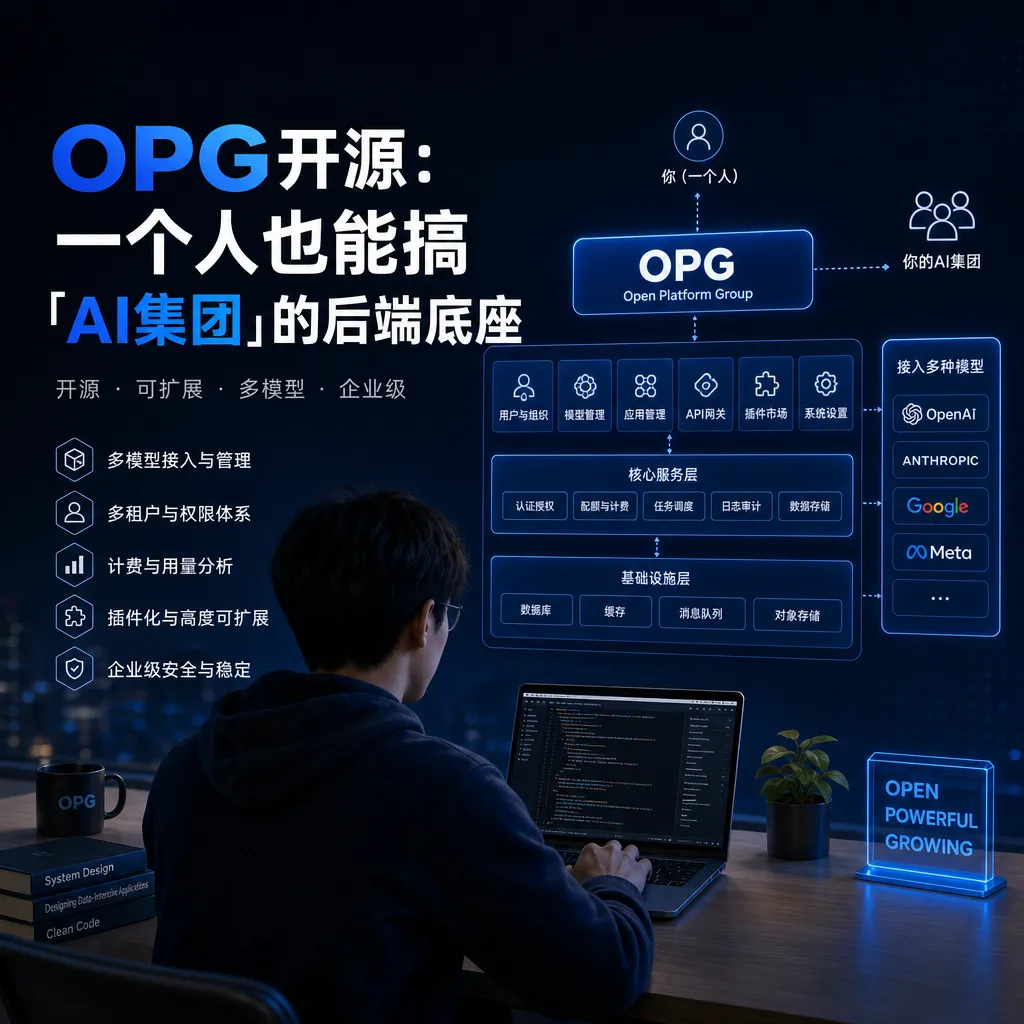
An independent developer has open-sourced the multi-tenant AI application server they’ve been using for half a year. It integrates model provider management, points-based payments, and a CLI tool for direct connection to Codex/Claude Code, with the goal of enabling a single person to easily operate multiple AI applications.
OPG Open Source: A One-Man "AI Group" Backend Foundation Is Here
On June 18, a project called OPG (One Person Group) was released as open source on linux.do. The author is an independent developer who has been using it for half a year, running four or five AI apps on this foundation, and finally uploaded all the code to GitHub today.
This is neither another Dify-style LLMOps platform nor aimed at enterprise-level SaaS. It solves a different, very specific problem that almost every indie hacker has faced: When building AI applications, the frontend can be iterated quickly, but you have to rebuild the backend every time — it's frustrating.
Origin: The “Repeated Labor Tax” for Independent Developers
If you've built more than two AI products, you probably know the feeling. Every time you start a new project, the backend work you have to redo is almost identical:
- Connecting to OpenAI / Claude / Gemini / DeepSeek, wrapping with a unified chat completions layer
- Setting up object storage for file uploads
- User system and third-party login (WeChat/Google/Apple)
- Points, subscriptions, payment (WeChat Pay/Stripe)
- Email and SMS notifications
- Admin panel
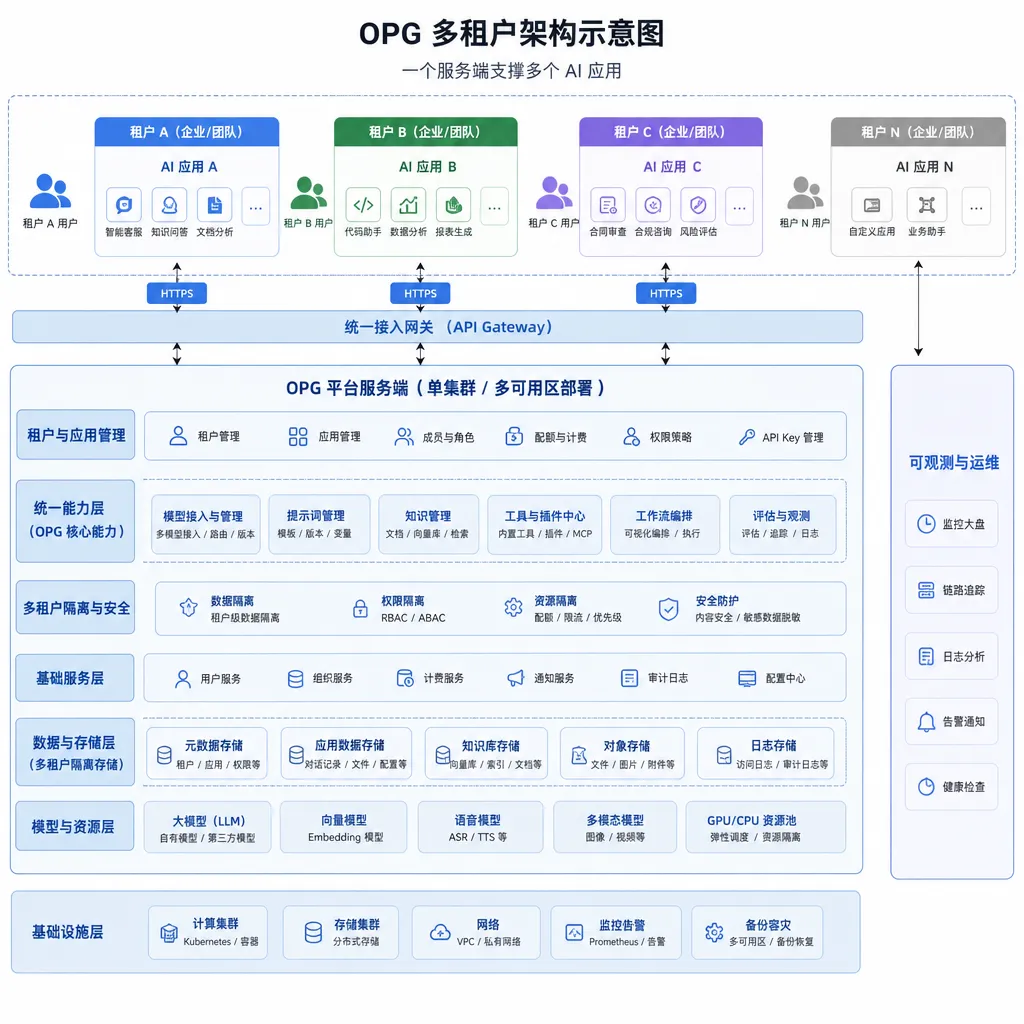
These tasks take two days the first time, and still two days the tenth time. No technical gain, but without them, your product can't go online. The OPG author's thinking is straightforward — since it's always the same, make it a multi-tenant platform where all apps share one API URL with data isolation. Creating a new app is just like creating a new database.
This idea is common in the B2B SaaS world, but for “one person building multiple consumer-facing AI apps”, it’s a form rarely seen before. On the market, you have Supabase / Pocketbase as generic BaaS (missing the AI layer) or Dify focusing on Agent orchestration (not handling payments/memberships/points). OPG wants to fill the gap in the middle.
What’s Actually Integrated
According to the author’s description and the GitHub repository, OPG turns the following capabilities into "public infrastructure":
| Module | Capability | |---|---| | AI vendor management | Multi-model key pool, routing, billing statistics | | Object storage | S3-compatible file management | | Points system | Deduct by token or by usage | | Payment | Membership subscription, one-time payment | | User system | Email, SMS, third-party login | | Multi-tenancy | App-level data isolation | | CLI tools | Install via npm for Codex/Claude Code direct operation |
The most interesting is the last item.
CLI + AI Coding Tools: The Key to the Loop
The author is clearly a heavy user of Codex and Claude Code. He wrote plainly in his post: "Most development is now done in Codex and Claude Code, so it must allow Codex to operate directly."
So OPG provides an npm-installable CLI. After logging in, an AI Coding Agent can call the CLI to configure the backend, modify the database, and view user feedback. This is quite impactful — it’s 2026, and an indie developer’s workflow is no longer “human writes code + human updates backend” but “human requests + AI writes code + AI updates backend”. If the backend cannot be operated directly by an Agent, it becomes a bottleneck in the workflow.
In other words, OPG is not just a backend for humans, it's a backend for AI Agents. This aligns with the MCP/Agent-friendly infrastructure ideas discussed in the past six months, but OPG applies it to a very down-to-earth scenario: indie hacker customer feedback and iteration loop.
You can imagine this workflow:
# Install CLI
npm install -g opg-cli

# Log in
opg login

# Let Claude Code directly read user feedback and adjust backend settings
claude "Check the user feedback for app-xxx from yesterday and adjust the points deduction rules."
Claude Code pulls data, changes settings, commits back — the entire chain doesn’t require human intervention in the database.
How Does It Relate to Dify, Hermes, Enterprise AIOS?
Let’s be clear: OPG is not trying to compete with these heavyweight platforms.
Look at Tencent Cloud’s enterprise AI Agent SaaS design — they talk about Temporal workflow orchestration, Skill Marketplace, MCP governance gateway, full-chain auditing — these are AIOS for large enterprises, and even a team of dozens might struggle to fully grasp them.
OPG’s positioning is exactly the opposite: One person, one server, multiple AI applications, AI manages for you. It doesn’t solve enterprise governance or compliance auditing; it solves the very specific goal of “I want to build five AI tool sites to make a living”.
In the indie developer world, there’s a clear trend: a16z’s report says enterprises mix and match models to optimize cost-performance, and the indie world does the same — the same user’s different requests might go to Gemini Flash (cheap), Claude Sonnet (great for writing), GPT-4o (reliable multimodal). Manually managing a multi-model key pool is tedious; OPG wraps this layer.
By the way, if you don’t want to maintain multiple model vendor accounts, aggregation platforms like OpenAI Hub (openai-hub.com) can give you a single key to call all mainstream models, with domestic direct connection and OpenAI-compatible format. You can drop it into OPG’s vendor configuration and use it without worrying about overseas credit cards or stability.
Who Should Use It, Who Shouldn’t
Suitable for:
- Indie developers/small teams with 2+ AI apps wanting a unified backend
- Heavy Codex / Claude Code users wanting backend operable by AI
- Want to skip payments/memberships/points and focus on business logic
- One server running multiple side projects without separate operations for each
Not suitable for:
- Enterprise users needing SSO, auditing, compliance
- Needing complex Agent orchestration (Workflow, Memory, Tool chains)
- Heavy RAG/knowledgebase scenarios
Simply put, OPG is a "business backend", not an "AI backend". It packages “boring but necessary” things like payments, users, files, key pools; Agent orchestration or RAG is up to you.
A Practical Assessment
The last two years have seen a surge in open-source backend projects, from Supabase, Pocketbase, Appwrite to NocoBase, Refine, Directus, and in AI directions like Dify, FastGPT, Coze Studio. Compared with these, OPG has no “I have what others don’t” technical advantage — module breakdowns are all engineering work.
Its value lies in the perspective — it’s explicitly designed for “one person + AI Coding tool + multiple AI apps”, assuming you’re not serving a 100-person team but enabling 1 person to act like 100 people. This assumption is very 2026, and very correct.
Furthermore, the author’s half-year of self-use and running four or five apps means it’s been tested under real traffic in “indie” use cases — not just a PPT project. This makes it more reliable than many open-source projects that peak at release.
Critiques are obvious too:
- Documentation is still sparse, unfriendly to beginners — especially for CLI + AI Coding combo, missing a full end-to-end example
- Multi-tenant data isolation mechanism is unclear — same DB with different schemas or logical isolation? Compliance issues hinge on this
- AI vendor management seems to be basic key pool routing, lacking enterprise-level model evaluation and A/B testing
- No public demo site — deciding to deploy from README alone is still high barrier
For indie developers, though, projects that can be “adopted and tweaked to use” are always more appealing than “perfectly designed but require 3 days to learn” platforms.
Final Thoughts
As of 2026, AI Coding has pushed the marginal cost of “writing code” extremely low, but to launch products, writing code has never been the bottleneck — backend infrastructure and operations are. Tools like OPG essentially push the indie developer bottleneck from “writing code” further back — to “deciding what to build”.
Whether the “One Person Group” name will hold depends on whether the author expands beyond the initial four or five apps. But at least the direction is correct — in the AI era, indie hackers don’t need more scaffolding; they need a unified, automated, AI-operable business backend.
OPG is a start.
References
- OPG: After Half a Year of Use, the "One Person Group" AI App Backend Is Now Open Source - linux.do — Original open source announcement from the author, containing full motivation and functionality description
- Jamailar/OPG - GitHub — OPG project repository, source code, documentation, and deployment instructions


