
The world’s first AI art museum, Dataland, opens tomorrow, powered by 1.2-billion-pixel imagery running on Gemini.

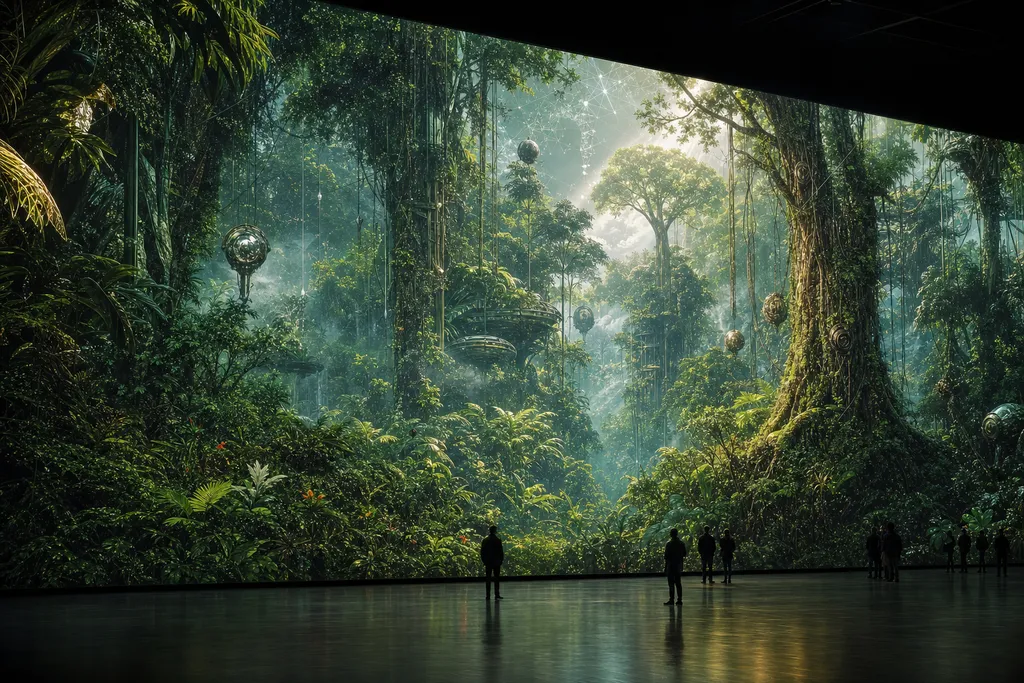
Google has teamed up with artist Refik Anadol to create the AI art museum Dataland in Los Angeles, which will open on June 20. The opening exhibition is powered by the Large Nature Model, featuring a 1.2‑billion‑pixel hyperreal rainforest driven by the Gemini Enterprise Agent Platform, orchestrating a hybrid architecture of GANs, diffusion models, and Gemini.
World’s First AI Art Museum Dataland Opens Tomorrow, 1.2-Billion-Pixel Display Running on Gemini
Yesterday (June 18), Google officially announced: The world’s first AI art museum Dataland, in collaboration with Turkish-born artist Refik Anadol, will open tomorrow (June 20) at The Grand LA in Los Angeles. The location is remarkable—the complex was designed by Frank Gehry, directly facing the Disney Concert Hall. The 2,500-square-meter venue is divided into five immersive exhibition halls.
This is not just another “AI + Art” concept show, but a permanent museum. The opening exhibition, titled Machine Dreams: Rainforest, runs on Anadol’s team’s open-source Large Nature Model (LNM). The entire rendering pipeline is hosted on Google Cloud, with image resolution pushed to 1.2 billion pixels—some reports even say 1.5 billion, the discrepancy coming from different stitching methods in the halls. But the scale is consistent: each frame consumes workstation-cluster-level compute power.
1. Not Video Playback, but a Real-Time “Breathing Rainforest”
If you think this is an 8K video loop, you’re wrong.
The Anadol team didn’t take the shortcut of pre-rendering this time. The entire rainforest is generated in real time—meaning, the glowing orchid, the floating spore clouds, the insect calls pulsating with your footsteps that you see today will not be exactly the same tomorrow. This “continuous generation” experience is technically supported by two things:
- Data side: Training the Large Nature Model involved over 500 million nature environment images, 50 million audio recordings, and massive amounts of climate and geographical structured data, sourced from museums, research institutions, and field expeditions worldwide;
- Inference side: Using Google Cloud’s Compute Engine as the compute base, orchestrated by a hybrid pipeline of GAN + diffusion model + Gemini, with scheduling handled by the Gemini Enterprise Agent Platform.
This hybrid architecture is interesting: pure diffusion models produce high-quality images but slowly; GANs are fast but stylistically unstable; Gemini acts more like a “director”—dispatching different models to produce different elements based on visitor behavior, sounds, and temperature changes. In other words, large scenes in the image are handled by diffusion, texture details by GAN, while semantic layers like “what mood this rainforest should have now” are decided by Gemini.
Developers will find this arrangement familiar: it’s similar to many current multi-agent workflows, except Anadol made it a spatial installation instead of SaaS.
2. Not Just Viewing—The Gallery Dialogues With You
In traditional art museums, works are objects “to be viewed”. Dataland reverses this: the exhibition hall senses you.
According to Google’s official blog post, several feedback channels are described—though not all technical details are revealed, we can guess:
- Visual: Cameras + human pose recognition. Visitor density and movement paths directly affect image density;
- Dynamic soundscape synthesis: Generates ambient soundtracks in real time based on crowd noise and site atmosphere—not mixing or switching, but actual generation;
- Emotion perception: Coarse-grained emotion classification based on facial expressions and movements to adjust color temperature and rhythm;
- Scent algorithm enhancement: The most curious part—a scent-diffusing system releases appropriate smells based on AI model-identified “scenes”: damp soil, floral fragrance, post-rain air, proportionally blended according to algorithm weights.
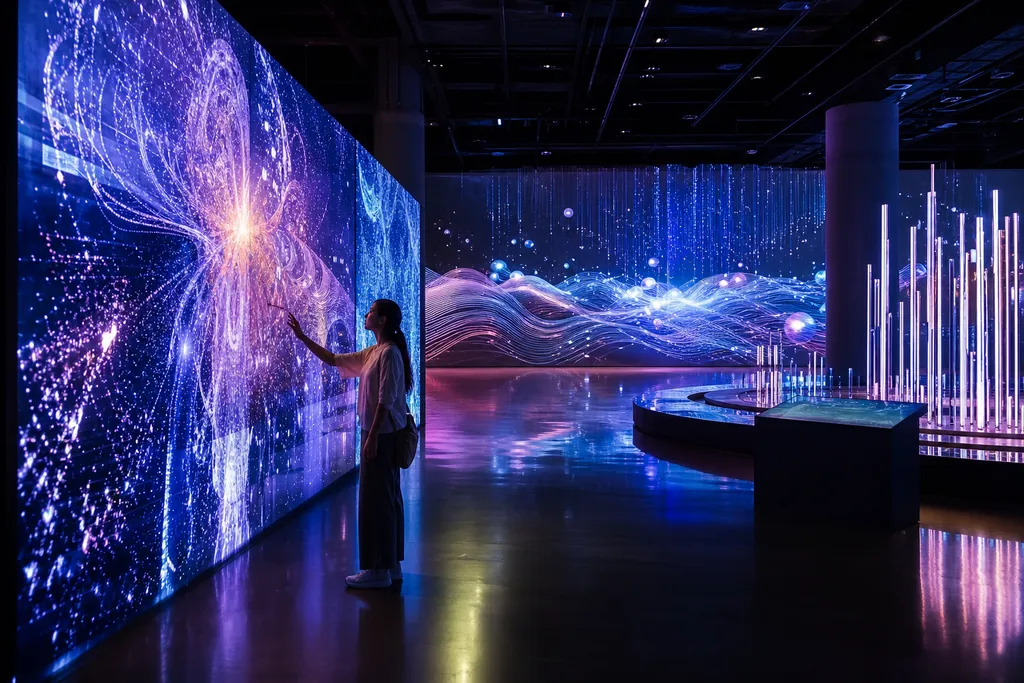
This is no longer one-way output. The exhibition hall’s state is a Markov process: you are the input, the model is the state machine, and the rainforest’s next frame depends on your previous actions. Anadol describes this system as a “full sensory ecosystem”; though it sounds mystical, it’s essentially a closed loop of multimodal input and generative output.
3. Large Nature Model: Open-Source, Focused Solely on the Natural World
The Large Nature Model (LNM) isn’t new; Anadol’s studio has been working on it for nearly two years, but this time it’s being formally spotlighted alongside Dataland, which is significant.
Its features warrant developer attention:
- Pure focus on the natural world: Training set includes only ecological, climate, geographic, and biological data, deliberately avoiding human-made objects. This “narrow-domain large model” concept is increasingly popular in research—general models’ capabilities involve trade-offs, but vertical specialization can outperform SOTA in specific tasks;
- Open-source: Model weights and datasets will be gradually released through Dataland’s online platform—more generous than Google’s own Imagen series;
- Built for generation, not recognition: Unlike most nature datasets (such as iNaturalist or GBIF), LNM’s goal is not to classify a tree species, but to generate a tree that “might exist but doesn’t in reality”.
Many plants in the exhibition don’t exist in reality—they’re “plausible variants” sampled within the latent space of the Amazon rainforest’s data distribution. This addresses an old question: how deeply does a generative model understand natural laws? If what it generates appears “plausible” to ecologists, then the model is not just an image generator but something of an early world model.
Anadol also emphasizes that the inspiration for the inaugural exhibition came from the team’s field expedition to the Amazon rainforest for data collection. This is crucial: most generative nature imagery today is learned from internet datasets like LAION, carrying strong “human perspective bias”—people standing before trees and posing. LNM uses field research data, with distributions closer to ecology itself.
4. 87% Green Energy, Compute Engine as the Backbone
Google made a point of noting a detail that could be overlooked: the entire system runs on Google Cloud’s high-efficiency computing infrastructure, with 87% powered by carbon-free renewable energy.
The significance is less environmental PR and more about sustainability. A 1.2-billion-pixel, real-time multimodal generative permanent exhibition, open 8 hours a day, consumes enormous compute power. On pay-as-you-go public cloud, electricity costs alone could bankrupt a museum. So Dataland is practically a supersized Google Cloud demo—to prove to potential immersive AI installation clients that this setup can be commercialized, run 24/7, and keep bills under control.
Architecture-wise, visible components include:
- Gemini Enterprise Agent Platform for multi-agent orchestration (decision-making, scheduling, visitor interaction dialogues);
- Compute Engine providing GPU/TPU compute pools;
- GAN + diffusion + Gemini models running inference in parallel, results stitched and rendered at the front end;
- From ticketing to wall pixels, all run on the same infrastructure, even entrance flows are part of the data system.
For developers, the most valuable reference here is that “Agents are not for chatting—they’re for orchestrating the physical world.” Gemini’s role here is less like ChatGPT and more like a director AI in a traditional game engine—except it manages real-world lighting, sound, scent, and visuals.
5. Relationship With NVIDIA, and Jensen Huang’s Shadow
Worth noting: Anadol has long been a regular guest of Jensen Huang; his works have been showcased at NVIDIA’s GTC conference multiple times as examples of AI creativity. Yet this Dataland collaboration is with Google, not NVIDIA—a subtle bit of industry politics.
One interpretation: NVIDIA provides chips + CUDA stack, Google offers cloud + models + deployment—different scopes, with Anadol partnering with different providers at various stages. More intriguingly, top-tier generative art projects’ affiliation is shifting from “GPU vendors” to “cloud vendors”—the hardware race is over; now the competition is in end-to-end deployment capability.
6. Insights for Developers
Some practical takeaways: the Dataland project evidences several trends:
- Vertical-domain large models + general LLM scheduling will become a standard paradigm. LNM delivers outputs; Gemini makes decisions—this division mirrors the near-future shape of enterprise AI applications;
- Multimodal closed loops are not gimmicks: visual input → emotion recognition → generative adjustment → scent/sound output. Each step already has mature open-source/commercial solutions; assembled together they can create stunning experiences;
- Continuous generation is replacing “on-demand generation”: formerly, users clicked to generate a single image; now systems run continuously, with user intervention simply altering the state machine’s distribution;
- The engineering value of multi-model hybrid inference is underestimated: GANs are not obsolete; in low-latency, high-FPS scenarios they remain irreplaceable—the key is how you use them.
By the way, OpenAI Hub currently supports Gemini series, Claude, GPT, DeepSeek, and other mainstream models, with domestic direct connection and OpenAI-format compatibility—developers wanting to experiment with multi-model hybrid orchestration like Anadol’s approach needn’t worry about basic “Gemini won’t connect” issues.
7. Finally
Back to Dataland itself: its true value lies not in producing a beautiful rainforest, but in pushing “AI art” from static prints on gallery walls into physical space, real-time generation, and sensory closed loops.
By 2026, generative AI tools are largely mature; the next competition is how to embed them into the real world—into malls, galleries, and corners of cities. Dataland is the first permanent case with a complete answer, far more instructive than its box office potential.
Opening June 20, address: 200 South Grand Avenue, Los Angeles. Developers unlikely to visit soon can watch for the upcoming online learning platform and open-source LNM weights—those will be more practical for us.
References
- World’s first AI art museum: Google collaboration generates 1.2-billion-pixel surreal imagery - IT Home: IT Home’s initial report on Dataland’s opening and Large Nature Model technical architecture


