
Gemini CLI officially shuts down today, Google pushes developers toward Antigravity
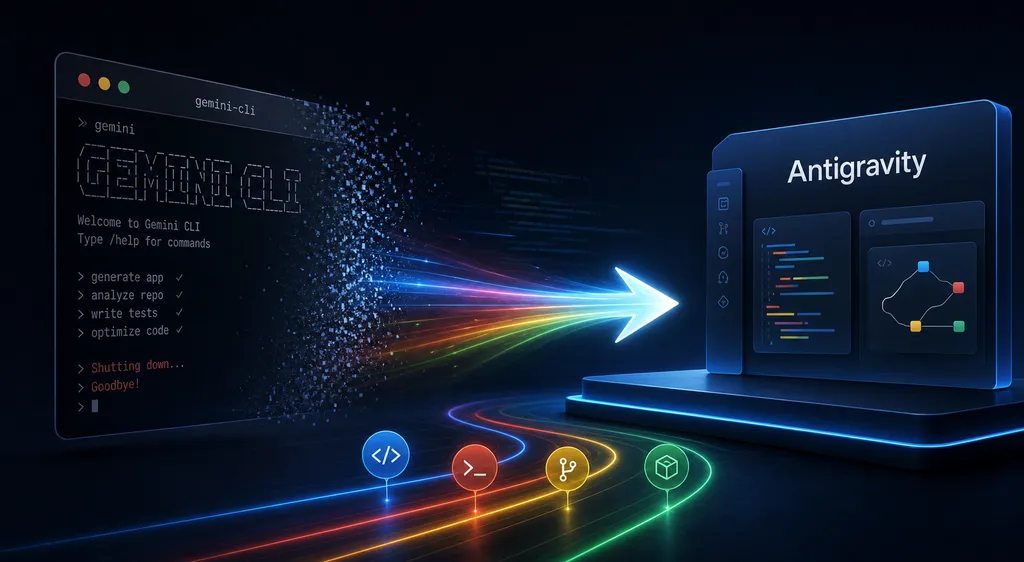
At 2:59 PM Beijing time today, Google officially shut down the old Gemini CLI service. OAuth requests from free and personal paid users will no longer receive responses. This three-month “transition” has been a reckoning by Google against traffic abuse, and also a key step in incorporating the CLI entry point into the Antigravity ecosystem.
Gemini CLI Officially Shut Down Today, Google Pushes Developers Toward Antigravity
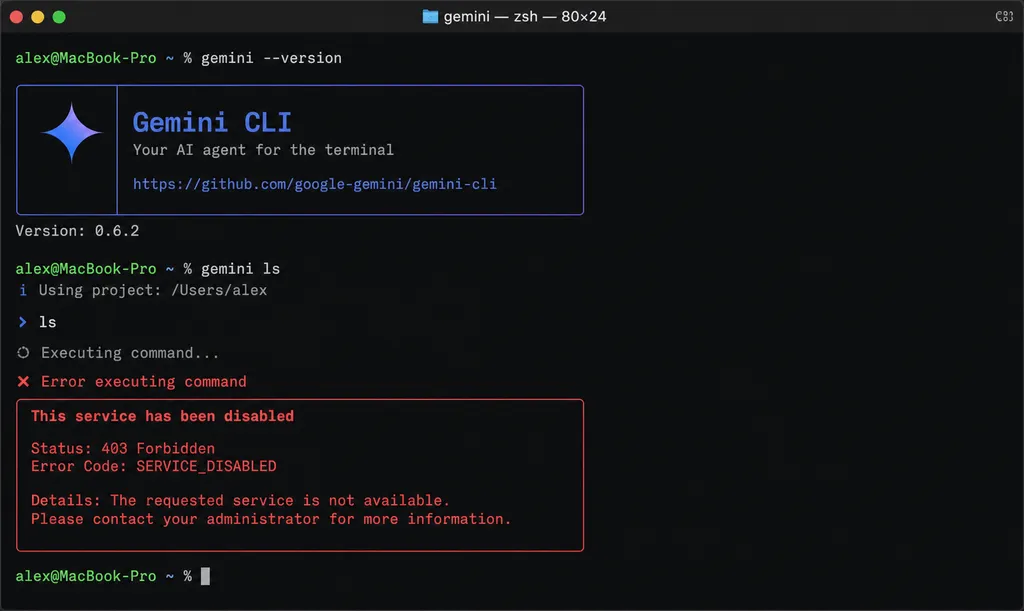
At 14:59 Beijing time today (PT June 18 23:59), Google’s Gemini CLI legacy backend officially stopped responding to requests. This means that from now on, all developers still using the gemini command to directly invoke models via Google account OAuth will gradually start seeing authentication failures or service unavailable messages.
This wasn’t a surprise attack. Google issued an announcement back in March, and June 18 was simply the pre-determined deadline. But when the shutdown day actually arrived, the community reaction was still explosive — especially among domestic developers who had repackaged Gemini CLI into APIs for their own projects; chances are they’ll need to urgently switch solutions today.
What Happened
According to Google’s official statement, starting today:
- The legacy Gemini CLI will no longer serve individual users, regardless of whether you are a Google AI Pro/Ultra subscriber or a free-tier Gemini Code Assist user.
- Gemini Code Assist’s IDE extensions will also be taken offline, along with their corresponding backend channels.
- Google recommends migrating to Antigravity CLI, or directly using the AI Studio / Vertex AI API Key.
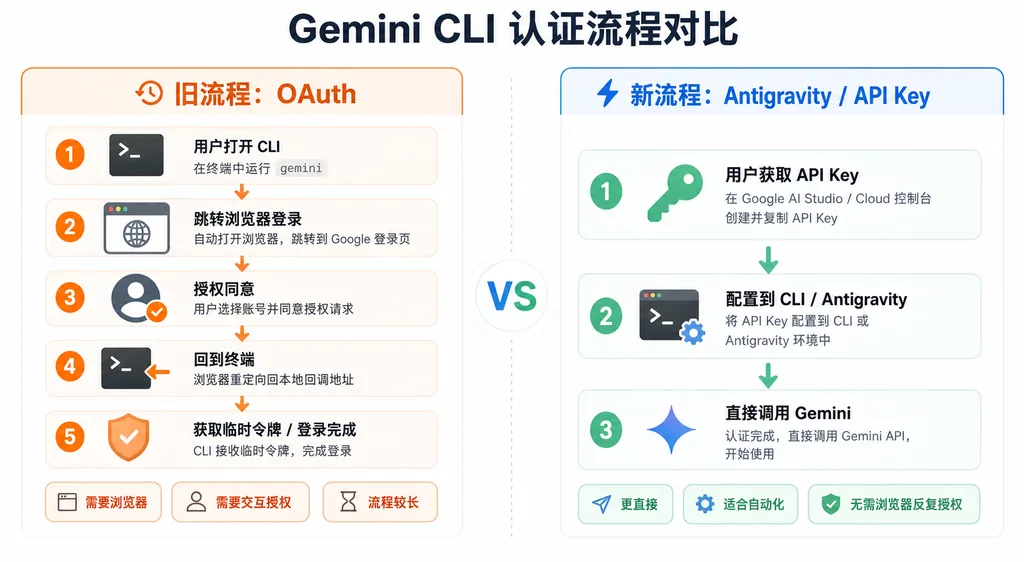
In other words, Google hasn’t completely eliminated the command-line entry point — they’ve just changed the name, brand, and backend authentication entirely — from “Gemini CLI” to “Antigravity CLI,” and from direct OAuth connections to a more controllable API Key approach.
This is not the same as an open-source project version upgrade. The Gemini CLI code itself is still on GitHub, but the “Cloud Code Private API” channel it depends on has been shut down by Google. Running the old code locally or forking it yourself won’t help, because there’s no one responding on the other end.
Why the Shutdown
Google’s official explanation was straightforward: reduce abuse and prioritize paid accounts.
Anyone familiar with the AI scene knows that over the past year, Gemini CLI has become a gray-area phenomenon. It was originally designed to provide individual developers with a lightweight entry point, allowing even free users to access Gemini models. But soon it was discovered: the CLI uses OAuth, has looser quotas than API Keys, and — crucially — is free. As a result, a flood of repackaged projects emerged:
- Projects like
gemini-cli-to-apithat reverse-wrapped OAuth into an OpenAI-compatible interface — no fewer than dozens on GitHub. - Integrating the CLI into third-party Coding Agents like Cline and OpenCode as a free backend.
- Using scripts to rotate accounts in bulk, generating industrial-grade volumes of free Gemini Pro calls.
Google was definitely aware. In its March announcement, items like “strengthen abuse detection,” “prioritize traffic by license,” and “free tier only gets Flash” were clearly aimed at these practices. But at the time it was about restrictions, not shutdowns, so many projects kept pushing through. Today’s move effectively seals off that route entirely.
Frankly, from Google’s commercial logic perspective, this makes sense. An entry point theoretically meant to serve paying subscribers sees over 60% of traffic coming from third-party free-use packages — without cutting off the leak, the user experience for paying customers will only deteriorate further. After March, Pro users were already complaining loudly about rate limits during peak times.
From the developer perspective, however, this is yet another standard “use free access to build an ecosystem, then tighten once it’s built” playbook. Anthropic’s early Claude.ai web-to-API tools were shut down once, and OpenAI has gone after projects reverse-engineering ChatGPT. This time, Google is simply applying the same moves to the CLI.
Migration Paths — None Are Exactly Comfortable
Google’s migration suggestions come in three flavors:
1. Switch to Antigravity CLI
This is the option Google most wants to promote. Antigravity is its rebranded developer tools suite from earlier this year, with the CLI as one component. Functionally it’s broadly compatible with the old Gemini CLI, but with some notable changes:
- Authentication still supports Google accounts, but with more detailed checks on account type and region.
- Some capabilities (such as accessing Gemini 2.5 Pro / Ultra models) require binding to Pro/Ultra subscriptions.
- A usage dashboard has been added, making it easier for Google to track and bill.
For developers already on Pro subscriptions, this is the smoothest path. But if you’ve been relying on the free tier, after migrating you’ll find: all you can use is Flash.
2. Switch to AI Studio / Vertex AI API Key
Google now prefers this route. The benefits of API Keys are transparent quotas, billing, and error codes, making production system stability more controllable. The downside — it costs money, and burns cash per token.
For enterprise users and serious product teams, this was always the route to take. The CLI’s OAuth channel was more of a developer-experience perk, never intended for use as a production backend.
3. Use Third-Party Aggregators
This is what many people are doing today. With Gemini CLI shut down, demand will spike for platforms that integrate multiple models into one API endpoint. OpenAI Hub is a typical example — one key can call Gemini, Claude, GPT, DeepSeek; connects directly from China; OpenAI-compatible format; for developers suddenly blocked by Google, it’s a ready-made replacement.
The benefit is eliminating the hassle of multi-account management, multi-vendor billing, and multi-SDK adaptations. The caveat: aggregators fundamentally forward requests upstream, so Google’s policy boundaries will also tighten on their end — for example, models requiring Pro/Ultra subscriptions will still require corresponding channels.
Immediate Issues To Address
If you or your project still relies on Gemini CLI, today’s priorities are:
- Check whether your CI/CD includes the
geminicommand. I’ve seen more than one project using Gemini CLI for code reviews or commit message generation — from today those pipelines will all fail. - Check IDE extensions dependent on Gemini CLI. The old Gemini Code Assist extension will also stop working; clicking its icon in VS Code will do nothing.
- If you use a third-party API wrapping the CLI (such as self-hosted
gemini-cli-to-api), as of today responses should be 401 errors or timeouts — switch your backend elsewhere urgently. - If you’ve previously been subject to account controls — such as receiving “This service has been disabled in this account for violation of Terms of Service” — then even after switching to Antigravity CLI, the account flags may remain. In such cases, using an API Key is the cleaner option.
What This Means
Looking at the bigger picture, Gemini CLI’s shutdown isn’t an isolated incident. This year, major model vendors have been tightening policies on “semi-free” access points:
- Anthropic’s Claude Code has long drawn a clear line between subscription and API use.
- OpenAI has been restricting API-like use of ChatGPT Plus.
- Now Google has joined in.
Model vendors need free entry points to build ecosystems, but when they’re undermined by free exploitation, they inevitably redraw the boundaries. Google’s approach this time — keeping the code and brand (just renaming), but cutting the backend — is a relatively restrained way to leave a fallback.
For developers, the takeaway is pragmatic: any OAuth-based “semi-free” channel should not be considered production infrastructure. Choose a subscription, an API Key, or an aggregator — one of the three; in the long term, any of them will be more reliable than betting the vendor will never tighten access.
By the way, today OpenAI Hub still has Gemini series models (including full sets of 2.5 Pro, Ultra, Flash) online, with OpenAI-compatible invocation methods — for developers just switching from CLI, migration costs are almost zero. That’s one of the few pieces of good news in this shutdown.
References
- Gemini CLI to shut down June 18, 2026, 23:59 PT - linux.do: Community discussion on shutdown timing and scope.
- Service update: mitigating abuse and prioritizing traffic - GitHub Discussion #22970: Google’s official March transition announcement.
- June 18, 2026 Gemini CLI stops - GitHub Issue #616: Third-party wrapper project discussions on handling the shutdown.
- Emacsclient landed in Gemini CLI and why I won't… - Reddit r/emacs: The open-source community’s perspective on Gemini CLI’s transition to Antigravity.


