
Galaxy Universal Releases AstraBrain-WBC 0.5: Humanoid Robots Usher in Their GPT Moment

Galactic Universal today released the world’s first general-purpose cerebellum GPT model for humanoid robots, AstraBrain-WBC 0.5, with 80.4 million parameters and 20,000 hours of human motion data. This is the first time the Scaling Law has been verified in the motion control field, and it is fully open-sourced.
This morning (June 19), Galaxy General officially released AstraBrain-WBC 0.5—what they call the "world’s first general-purpose cerebellum GPT base model for humanoid robots." This is worth talking about because it drags a field long considered a “control engineering problem” into the large model paradigm: 80.4 million parameters, trained on 20,000 hours of human motion data, and redefining whole-body control as a “continuous sequence prediction” problem.
More importantly—the paper, code, and weights are all open-sourced.
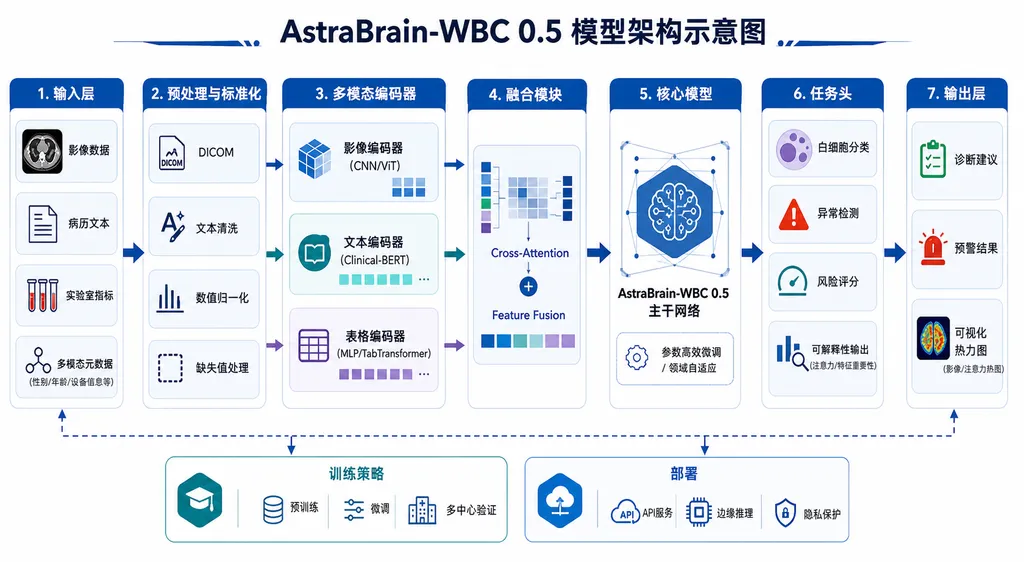
Not just another embodied "brain," but a "cerebellum"
Over the past year, nearly all publicly shared work in the embodied intelligence track has focused on the “brain” layer: VLA, world models, long-horizon task planning, the vision–language–action trio. Figure, 1X, Unitree, Zhiyuan, and Galaxy General themselves have all been competing on the brain front.
But a humanoid robot’s most painful problems were never there. Keeping a 1.7-meter-tall bipedal robot from falling, twitching, and enabling it to jump, carry weight, and hold objects depends on millisecond-level whole-body coordination—that’s the cerebellum’s job. The traditional approach is MPC + RL + lots of manual reward shaping. Tweaking one action for a week is normal, and cross-platform reuse is practically impossible.
AstraBrain-WBC 0.5 tackles exactly this: turning real-time control of dozens of degrees of freedom in the whole body into a unified, generalizable base model. Galaxy General positions this model in the “cerebellum” spot of their "Galaxy Star Brain (AstraBrain)" technical framework—WBC stands for Whole-Body Control.
Writing whole-body control as "next frame prediction"
The architecture choice is itself a statement. AstraBrain-WBC 0.5 uses a GPT-style causal Transformer, taking historical action sequences as input and outputting future motion trends. In other words, how the robot steps its legs, twists its waist, applies counterbalance to its arms—all is modeled as next-token prediction—only here, the tokens are action frames.
This approach has had scattered attempts in autonomous driving and robotic manipulation, but taking it to real-time, whole-body WBC at GPT-1 scale (80.4M parameters) is the first time. GPT-1 scale sounds small? In motion control, it’s already a dimensionality reduction blow—previous similar work mostly stayed around the million-parameter range and were more like policy networks than “base models.”
The training data is another highlight: 20,000 hours of human motion capture data, which Galaxy General claims is the largest-scale motion dataset in the humanoid robot industry. Judging from the expanded 2 billion frame scale, this volume was accumulated from motion capture, video reconstruction, and online sports material—impossible relying solely on MoCap studios.
The first time seeing a Scaling Law in motion control
The most informative figure in this work is the curve of dataset size versus zero-shot tracking success rate:
- 2 million frames: success rate 83.26%
- 200 million frames: steadily rising
- 2 billion frames: success rate 92.58%, with zero-shot tracking error continuing to decrease
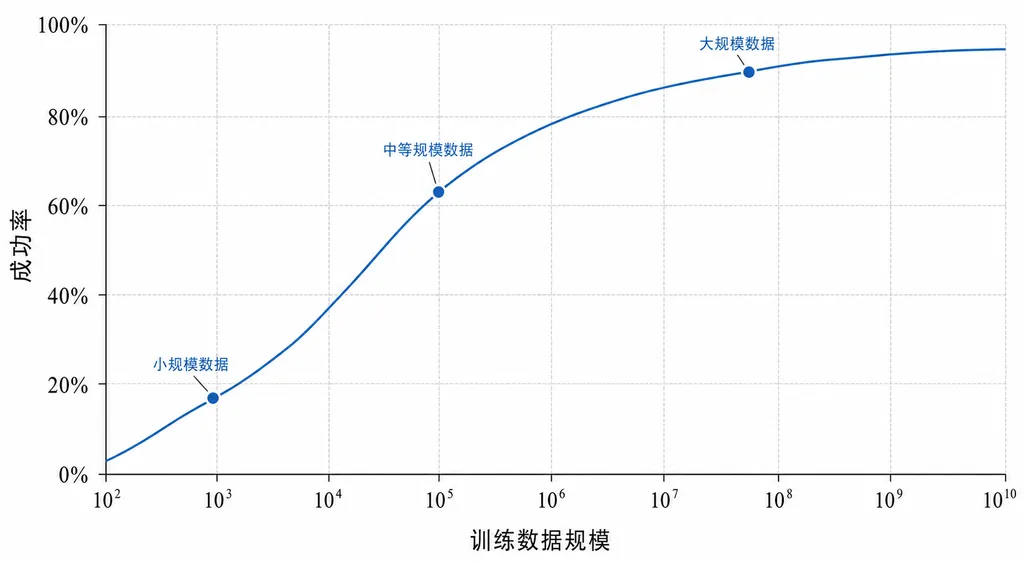
Nine percentage points may not sound dramatic, but for motion control, going from 83% to 92% means failure rate drops from 17% to 7.4%—the turning point from “working in demo videos” to “safe to use in commercial demos.” More importantly, the curve shows no sign of saturation.
This is the first time someone has proven in a serious experiment: a GPT-style Scaling Law exists in robot motion control. If this holds true, the paradigm of “tuning reward—tuning controller—building actions one by one” might be overturned. The language model story may repeat: rather than finely handcrafting, just stack up data and compute.
Real-world zero-shot: basketball, boxing, dance, rollover
Numbers alone aren’t exciting—Galaxy General also released real robot demonstrations. In the test set, AstraBrain-WBC 0.5 zero-shot completed many high-dynamic actions never seen in the training set, including:
- Basketball shooting and dribbling—requiring coordinated whole-body force
- Quick punches and weight shifts in boxing
- Dance moves
- Rolling over to get up—a killer feature; before, falling essentially ended the task, now the robot can get up by itself
- Cooperative carrying tasks, involving multi-body contact
Zero-shot is the keyword—not pre-recorded, not fine-tuned, but generalized directly from having seen similar data distributions. Compare this to Boston Dynamics’ traditional paradigm of “tuning one action for a year,” and the difference is clear.
Of course, the 0.5 version number indicates their attitude: this is not the end. 80.4 million parameters is still far from a true “motion-control GPT-3.” The current complexity of runnable actions and robustness in real-environment interaction still have a gap before practical deployment. But the path is now validated.
The brain + cerebellum puzzle is being completed
Placed in the industry context, this gets more interesting.
Over the past half year, the embodied brain side has become a red ocean: Physical Intelligence’s π0, Figure’s Helix, Zhiyuan’s GO-1, and Galaxy General’s own GraspVLA. But all these brains rely on an implicit assumption—a sufficiently stable, sufficiently general actuator at the lower layer. In reality, this actuator has never existed.
The result: the brain can think “put the cup on the table,” but the robot might fall due to poor body coordination, or require a specialized low-level policy for each type of body to perform a water-carrying task. Without a cerebellum layer, no matter how smart the brain is, it can’t run.
AstraBrain-WBC 0.5 tries to fill this gap. If later it can generalize across different body configurations (different joint setups, leg lengths, upper limb degrees of freedom), the significance grows—it would mean the embodied field finally has the “general base” equivalent to LLMs in NLP.
Open-source strategy: a window for copycats
The paper, code, and technical results are fully open-sourced, which deserves praise. Considering this is the first clearly defined base model for motion control in the industry, open sourcing is like giving newcomers a big gift: you can directly replicate or improve based on their corpus organization method, training curve, and architecture hyperparameters—without starting from scratch.
For developers, this means we’ll likely see a wave of secondary work based on the AstraBrain-WBC architecture in the coming months. Whether you’re making quadrupeds, wheeled robots, or upper-limb manipulators, this “action sequence prediction” paradigm can be borrowed.
By the way, OpenAI Hub mainly aggregates APIs for language/multimodal large models; cerebellum motion-control models deployed on robots aren’t in scope for now. But on the embodied brain side (the vision–language reasoning part of VLA models), many will use multimodal models like GPT-4o, Claude, Gemini. OpenAI Hub lets you call these mainstream models with one Key, which is still useful for developers building embodied pipelines.
My assessment
My view: AstraBrain-WBC 0.5 itself won’t immediately reshape the industry landscape—80.4M parameters and a 0.5 version say it plainly. But it has done three structural things:
- First serious application of the large model paradigm to WBC, proving the Transformer approach works in motion control;
- First validation of Scaling Law in motion control, pointing the track toward something more worth competing on than reward tuning;
- First to open source this—bringing follow-up costs down to a reasonable range.
Each of these alone is worthy of a paper; together they mean—the GPT-1 moment for the robot cerebellum has arrived. What to look forward to next is someone building a GPT-3 for the cerebellum. That moment would be the critical point when humanoid robots can truly step out of the lab.
Judging by this curve’s slope, it might not be far off.
References
- IT Home: World’s first general-purpose humanoid robot cerebellum GPT model AstraBrain-WBC 0.5 released — initial report, includes model scale, architecture, and Scaling Law data
- Zhihu: World’s first general-purpose humanoid robot cerebellum is here! Largest-scale 20,000 hours of human motion data — background of Galaxy Star Brain technical framework and cerebellum model positioning analysis


