
Ambani puts AI into phones: Jio Call Agent covers 500 million users

Reliance Industries announced Jio Call Agent at the annual shareholders' meeting, embedding the AI assistant directly into the telecom network, covering 500 million mobile users in India. Ambani also declared: India cannot be only a consumer of AI.
Ambani Puts AI Directly Into the Phone: Jio Call Agent to Serve 500 Million Indian Users
On June 19, Mukesh Ambani, India’s richest man, unveiled his most significant move of the year at Reliance Industries’ annual shareholders meeting — Jio Call Agent, an AI call assistant that isn’t packaged as an app, doesn’t require a separate download, but is instead embedded directly into the telecom network. With a simple “Hey Jio,” the AI joins your ongoing call to transcribe, summarize, book a ride, order food, reserve a hotel — all handled within the same call.
According to Reliance, the system will launch later this year and will be available by default to Jio’s over 500 million mobile users. To put that in perspective — that’s a market 50% larger than the entire U.S. population, instantly plugged into the same AI call infrastructure. OpenAI’s ChatGPT has a comparable global weekly active user base, but it requires people to actively open a webpage or app, whereas Jio goes directly via the carrier network.
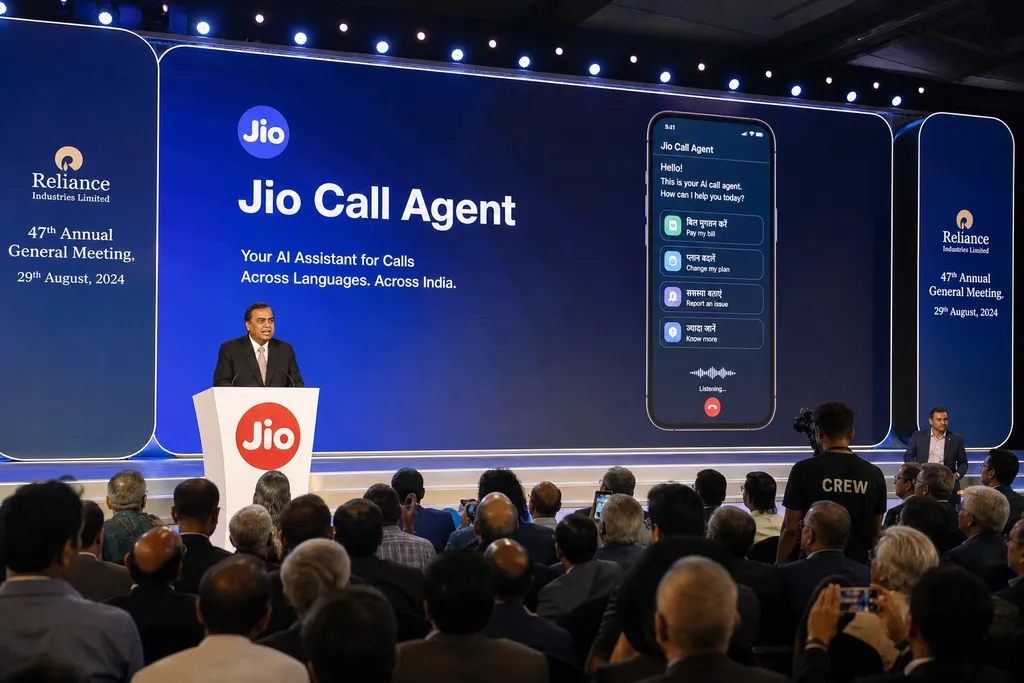
1. Not Just Another App, but a Native Calling Feature
AI call assistants aren’t new. Google has Call Screen and Duplex, Samsung’s One UI has built-in live translation, and Chinese carriers have experimented with AI call secretaries. But they share the same limitation: they are all “layered” on top of calls — relying on OS-level hooks from the phone manufacturer or IVR call forwarding by the user. No matter how polished the experience, there’s still a layer in between.
Jio Call Agent is different — it’s tied directly into the telecom network layer. In other words, no matter what phone you use, what Android version, or whether you’ve installed the latest MyJio app — as long as you have a Jio number, you can theoretically use it. Only a telecom operator can do this.
From the product description, here’s what it can roughly do:
- Meetings/Call level: automatic transcription, summary generation, key point extraction;
- Local lifestyle: directly book Ola/Uber, order food, reserve hotels, book flights — all within the call;
- Activation: say “Hey Jio” during a call, and the AI joins the conversation.
This design is very “Indian.” India is a market where voice input is more common than text, with 22 official languages — many of which have high writing barriers. For everyday users, calling to get something done is far more natural than tapping through an app. Jio Call Agent was built for this real user habit — not a Silicon Valley conversational UI simply translated into Hindi.
2. Ambani’s Real Play is Distribution
Looking only at the product, Jio Call Agent isn’t magical — large model capabilities are becoming a commodity. Jio’s true killer advantage has never been technology, but distribution.
Recall Reliance’s playbook over the past decade: In 2016, Jio launched 4G with free data and cheap plans, leapfrogging India from a 2G/3G country straight into the 4G era; in 2020, during the pandemic, it pushed JioMart, JioCinema, and JioSaavn onto users. By 2025, Jio’s mobile subscriber base had stabilized at around 500 million, making it India’s largest and one of the world’s largest single operators.
What does that mean? Any third-party AI call assistant — whether from Google or a startup — would have to cross Jio’s distribution moat to reach 500 million Indian users. Jio’s own AI assistant, on the other hand, is by default a feature of those 500 million phones.
This is a textbook “infrastructure-driven AI product” mindset. Don’t fight on model performance, compete on channels.
As an aside, last year Google and Jio announced deep cooperation, giving Jio users free expanded access to Gemini 2.5 Pro and NotebookLM. So, it’s reasonable to assume the model powering Jio Call Agent isn’t from a single provider — Gemini, Reliance’s in-house models, and potential open-source models are all on the table. For Jio, the model is a back-end replaceable part; the user-facing entry point is the true asset.
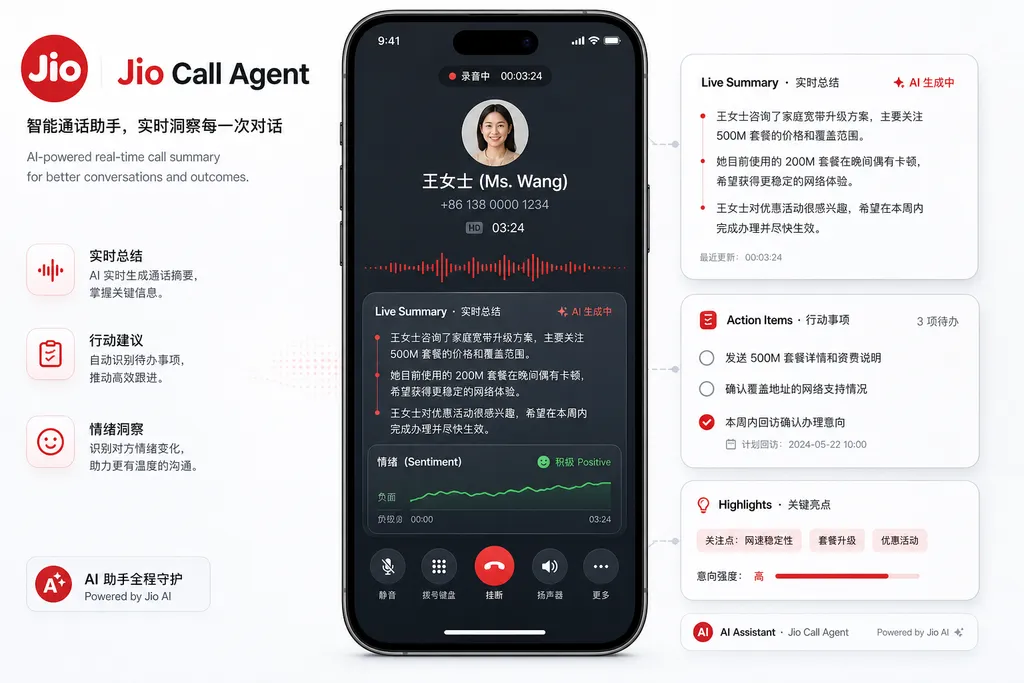
3. Beyond Calls: MyJio Makeover and TeleFrame Smart Home Device
The shareholders meeting had more to reveal than just Jio Call Agent.
AI-powered MyJio: Reliance’s own super app, previously used mainly for plan management and billing, has been rebuilt into a natural language interface. You can just say “activate Southeast Asia roaming” or “switch to a 5G plan,” and the AI executes it — essentially turning deeply buried carrier functions into an LLM-powered, natural language callable toolset.
This is a classic agentification redesign. Early on, ChatGPT’s Plugins and OpenAI’s GPTs aimed to do the same thing. But in consumer apps, the real challenge isn’t the model — it’s exposing internal business systems as callable APIs. MyJio, being part of Reliance, avoids organizational friction — which is why this transformation works more smoothly in a carrier context.
TeleFrame: A smart home hardware device, positioned as a desktop/living room terminal that proactively “talks to you,” displaying weather alerts, family schedules, reminders. It’s positioned against Amazon’s Echo Show and Google’s Nest Hub, but emphasizes the “proactive agent” narrative — pushing relevant content without you asking.
To be honest, Amazon and Google have tried this segment multiple times, and the “proactive multi-modal home display” has yet to truly take off. Whether TeleFrame succeeds will depend on how well it fits into real Indian home contexts — for example, being a shared family assistant, integrating with Indian TV, radio, and religious/festival calendars.
4. Reliance Intelligence: Infrastructure Ambition
More importantly, Reliance Intelligence, founded last year, is the foundation for all this.
Its mission is straightforward: to build India’s AI infrastructure, covering all 22 official languages and serving consumers, enterprises, and government. As Ambani said on stage:
India should not be merely a consumer of AI developed elsewhere. India must become an AI creator, adopter, and global leader.
In industry terms: We don’t intend to be just a reseller of OpenAI or Google in India.
The backdrop: The Indian government has been driving the IndiaAI Mission, funding compute centers and subsidizing domestic large language model projects. Ambani stepping up essentially ties Reliance’s strategy to the national one: using its 500 million-user distribution power to secure government backing for Reliance Intelligence. This corporate–state coordination is not uncommon in India.
5. Key Points for Developers to Note
Beyond the big-picture story, here are some developer-relevant signals from this move:
- Carrier-level agent entry points are becoming a new battleground. Jio’s approach will likely be followed by China’s big three carriers, Southeast Asia’s Singtel, and Europe’s Vodafone. If AI is built into the phone network itself, the value of having an AI assistant in an app drops significantly.
- Multilingual, low-resource environments are the next big model opportunity. India’s 22 languages and Southeast Asia’s 10+ languages are areas where mainstream models still underperform badly. Whoever nails these will hold the keys to billions of users.
- The “Hey Jio” call-trigger design is intriguing. Without leaving the ongoing conversation, AI joins in — redefining the “assistant” presence. It’s more like a colleague you can pull into the call anytime than a separate tool you have to open elsewhere.
- Models are replaceable, entry points are not. The model powering Jio Call Agent could be Gemini today, in-house or open-source tomorrow — users won’t notice. This reinforces the point: for developers and product owners, controlling the entry point is more important than controlling the model.
As a side note, for developers working on multi-model integrations, solutions like OpenAI Hub (openai-hub.com) — enabling GPT, Claude, Gemini, DeepSeek via a single API key — share the same philosophy as Jio’s: treat the foundational model as a swappable component, and focus on the top-layer experience. Demand for such “model routing” will only grow this year.
6. In Closing
The real significance of Jio Call Agent isn’t in how accurate its transcripts are or how polished its summaries look — it’s in rewriting the AI distribution model: not making users go out of their way to find AI, but having AI sit inside the calls they’re already making, waiting to be invoked.
If it launches as planned later this year and even 10% of the 500 million users actively use it, that’s over 50 million DAUs for a single AI assistant. In today’s AI industry, that’s a number near the top globally.
Ambani also said something worth pondering: India must become an AI creator. For the past decade, India’s story has been about IT service providers like Infosys and TCS doing back-end work for the world. This time, Reliance wants to own the front-end, the entry point, the platform. Whether that ambition can be realized — June 19 is just the starting point.
References
- India’s richest man Ambani: India must become an AI creator and global leader - ITHome: Chinese-language coverage of Reliance Industries’ annual shareholders meeting with key details on Jio Call Agent, AI-powered MyJio, TeleFrame, etc.


