
Magic Atom Dual-Model on the table: VLA K02 paired with Magic-Mix World Model, robots begin to learn to "think before they act"
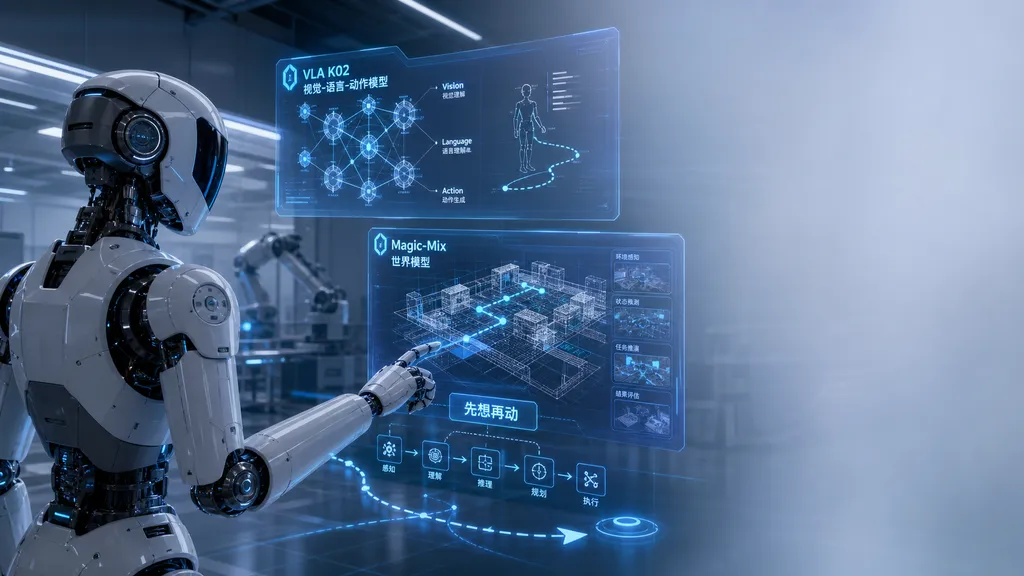
At the Shanghai Exchange, Magic Atom (MagicLab) presented a live demonstration of the Magic-VLA K02 large model combined with the Magic-Mix world model, seamlessly accomplishing tasks from stacking hoodies to long-range task reasoning, pushing embodied intelligence from “copying what it sees” to the level of “understanding the physical world.”
Magic Atom Brings Two Models to the Table
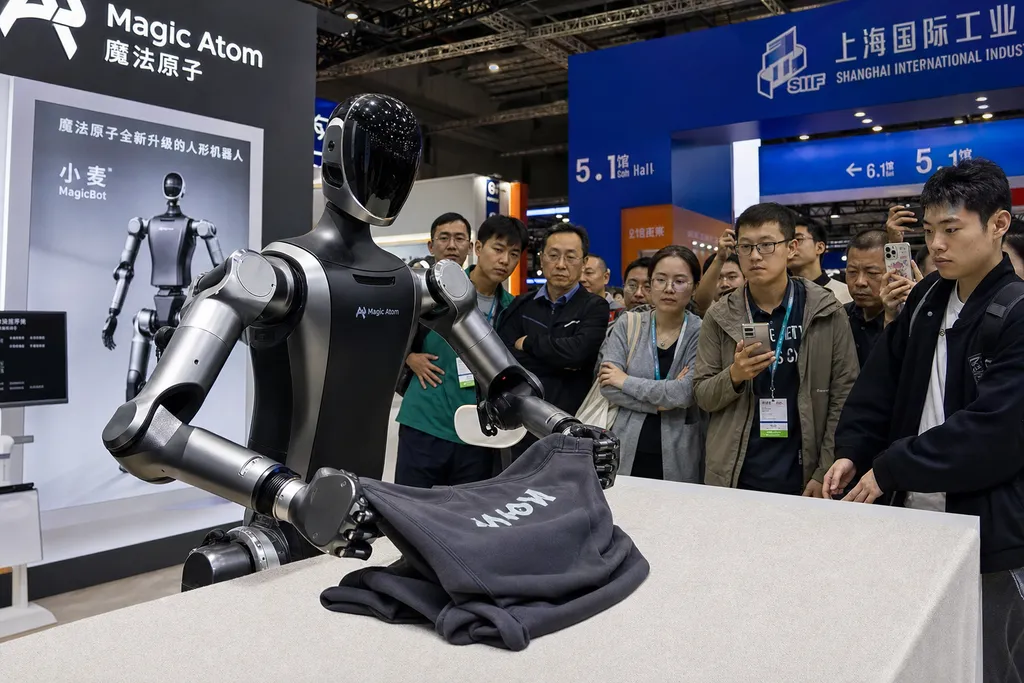
At the Shanghai International Trade Fair in mid-June, Magic Atom (MagicLab) had crowds at their booth for several days in a row. The reason was simple—they showcased their Magic-Mix world model, first released at GEIS in Silicon Valley in April, alongside their latest generation embodied intelligence large model Magic-VLA K02, for the first time in a live domestic demonstration. On-site, the robot folded a hoodie without any preprocessing—the hood, drawstrings, and irregular hem were all variables—yet it folded it neatly in the end. While the developers applauded, they were more concerned about one question: how exactly does the technical path of these two models working together differ from mainstream VLA approaches?
This wasn’t an ordinary product launch. Over the past year, the embodied intelligence sector has been stuck in an awkward bottleneck: VLA (Vision-Language-Action) large models perform excellently in the lab, but often fail in real-world scenarios—change the floor material, tweak the lighting, throw in an unexpected obstacle, and the robot may freeze or behave erratically. Magic Atom’s solution this time is to provide the VLA with a “world model” as a foundation, so the robot first understands the physical world before executing actions.
Magic-VLA K02: Making “Long-Horizon Task Reasoning” a Reality
Let’s start with K02. In the past two years, VLA models have been highly competitive, with increasingly small differences between them. K02’s standout feature isn’t the parameter scale, but long-horizon task reasoning—breaking down a vague instruction into dozens of executable sub-actions and refining each step based on visual feedback.
The hoodie at the demo was a good example. Ordinary VLA models, when faced with irregular clothing shapes, tend to get stuck repeatedly trying the same step. What did K02 do? It broke down “fold sleeves” into over a dozen substeps: identify sleeve positions → smooth sleeves → fold sleeves → verify fold crease → … This ability to autonomously layer tasks means it wasn’t just running a memorized demo—it was actually performing task planning.
Simply put, K02 is like giving embodied intelligence a “mental model”—it knows what it’s doing, what to do next, and how to roll back if it messes up a step. This capability is highly valuable in industrial production settings, where tasks are rarely as simple as “pick up and place” and more often involve dozens of sequential complex operations.
Magic-Mix: Dual-Expert Joint Modeling + Gradient Isolation
If K02 is the “execution brain,” then Magic-Mix is the “cognitive brain.” The core idea of this world model is dual-expert joint modeling—a video expert module responsible for “foreseeing the future” and an action expert module responsible for “planning actions.” The two are deeply coupled yet independently focused.
The video expert module is essentially a temporal generative model dedicated to building world representations—where an object is, how far it is, whether it’s interactable, whether its physical state is stable. The action expert module is a high-precision action diffusion model that, after receiving world representations from the video expert, then plans motion trajectories.
Sounds straightforward, but there’s a long-standing engineering headache: during dual-expert joint training, errors from the action expert backpropagate into the video expert, skewing its understanding of physical commonsense. This is a well-known pain point in the industry—many teams’ world models collapse during training because of this.
Magic Atom’s solution was to introduce a gradient isolation mechanism—essentially building a firewall between the two modules:
- The world representation built by the video expert can be shared forward with the action expert
- The action expert’s behavioral errors are not allowed to backpropagate into the video expert
- The video expert’s underlying understanding of physical laws and environmental logic remains stable and undisturbed
The result is 100% preservation of the video expert’s future temporal video generation capability, and a significant improvement in overall training stability. From an engineering standpoint, this move is elegant—it’s essentially acknowledging that “action-side training” and “cognition-side training” shouldn’t share the same gradient pool.
Short-Term Memory, Consistency Loss, Sub-Goal Images: Three Clever Tweaks
Besides gradient isolation, Magic-Mix has a few details worth developers’ attention:
Short-Term Memory Module
Traditional embodied intelligence models are criticized for “having no memory of failure”—making the same mistake over and over. Magic-Mix adds a short-term memory module at the video expert input, encoding failed behaviors and incorrect poses during training into standardized historical failure image features, and feeding them back as contextual priors. The result is that the model can recognize “I’ve fallen here before” and proactively avoid repeating mistakes.
Consistency Loss Supervision
If the dual expert modules operate independently, their outputs often misalign—the action expert says “move left,” while the video expert predicts the scene as shifting right. This “vision-action mismatch” pollutes the model’s understanding of physical causality. Magic-Mix introduces consistency loss to force the two modules to align at the physical logic level—the action expert’s instructions must be reflected in the video expert’s predicted temporal changes, and vice versa.
Sub-Goal Image Constraint
Long-horizon video prediction has the age-old problem of cumulative errors causing “hallucinations” as frame count increases, breaking the whole reasoning logic. Magic-Mix addresses this by generating an extra key frame at the video expert output as a sub-goal anchor, constraining the evolution of future video predictions. Deployment is even cleverer—cutting the full long-sequence generation chain and outputting only the key sub-goal image to guide decision-making. This single-frame decision mode significantly boosts inference efficiency.
While none of these mechanisms alone are groundbreaking, together they do push the engineering implementation of world models forward.
Magic-Mix Creator: The Real Solution for Synthetic Data
Talking about embodied intelligence inevitably means talking about data. Real-machine data collection is costly, inefficient, and has limited coverage—this bottleneck is built into the industry’s DNA. Magic Atom’s solution is Magic-Mix Creator—an offline synthetic data engine.
The engine’s core data recipe is counterintuitive: 99% low-cost human first-person perspective data + 1% high-precision real-machine data. The former is cheap and plentiful, the latter ensures physical accuracy. Combined as unlabelled data, they feed into the offline generation engine to diffuse into large high-quality labeled datasets.
Technically, Magic-Mix Creator uses a video diffusion model as the main network for data generation, with the standard add-noise/remove-noise paradigm to simulate future video sequences that respect physical constraints. Then it applies an inverse dynamics model for data amplification—during inference, no extra action input is needed, only the video sequence, enabling automatic extraction of action labels from unlabelled video. That means one video goes in, multiple labeled training samples come out, exponentially increasing dataset size.
Current operation scale:
- Collecting 16,000 data items daily
- Over 1 million hours of high-quality dataset accumulated
- Covering multiple scenarios, robot types, and task categories, supporting cross-model capability transfer
This closed loop—“low-cost first-person data diffusion → feed into large model training → reinforcement learning → human intervention in data generation → data pool storage → drive next round of diffusion”—is sound in terms of mechanism design. Whether it can become a flywheel depends on the data quality evaluation system—Magic Atom hasn’t disclosed many details here, but judging from the on-site demo, at least for flexible-object tasks like folding clothes, it works.
Compared to Mainstream Players, Where Magic Atom Fits
Frankly, there are plenty of players worldwide building embodied intelligence world models: Google DeepMind’s RT-2 series, Tesla Optimus’s end-to-end approach, Figure’s Helix, and domestic firms Unitree and Galaxy General each have their own routes. Magic Atom’s dual-model combination stands out mainly in two areas:
First, the world model isn’t just a gimmick. Many teams tout world models but in reality just swap the visual encoder. Magic-Mix’s dual-expert architecture + gradient isolation + sub-goal constraint show they’re genuinely solving engineering problems.
Second, their data flywheel is running. One million hours of high-quality labeled data, with a daily capacity of 16,000 new samples, puts them at the top of China’s embodied intelligence track in dataset scale—a moat harder to replicate than model architecture.
Of course, there are challenges. World models may perform well in demo scenarios, but in truly open household environments or complex industrial production lines, we’ll need to see deployment feedback six months from now. Folding a hoodie is a nice demo task, but industrial clients care more about “assembling 1,000 parts without errors.”
Ecosystem Positioning: The Thousand-Scene Co-Creation Plan
At the trade fair, Magic Atom casually launched the “Thousand-Scene Co-Creation” open ecosystem plan, inviting partners to co-develop scenario-based applications. Sounds like PR, but paired with Magic-Mix Creator, it gets interesting—it essentially outsources their data collection network, with every partner’s real-scene data feeding back into the data pool.
Consultations on site spanned intelligent manufacturing, smart logistics, home services, special inspections, and educational research. A comment from a Hangzhou robotics startup was representative: “What we lack most are high-quality training data and underlying model interfaces.” These happen to be exactly what Magic-Mix Creator and Thousand-Scene Co-Creation aim to provide.
Final Thoughts
As of early 2026, the embodied intelligence sector is clearly entering a phase of “competing on foundational models.” Hardware alone isn’t enough, nor are single-task demos—whoever can get world models + VLAs + data flywheels running simultaneously has a chance to place robots across industries.
Magic Atom’s dual-model showcase is at least a complete answer in terms of technical narrative and engineering implementation. The next six months of real deployment data will be the true test.
For developers, what may be even more worth watching is whether Magic-Mix’s weights or inference interfaces will be opened—if external teams can use this world model for secondary development, China’s embodied intelligence ecosystem may see a wave of new innovations.
References
- Magic Atom’s Move into Silicon Valley: World Model Ambitions and Ecosystem Positioning - Zhihu: An analysis of Magic Atom’s positioning and ecosystem strategy in world models from an industry perspective


