
GPT-5.6 Launches Next Week: 1.5M Context, OpenAI Poised to Start a Price War

OpenAI’s internal codename *iris-alpha* for the GPT-5.6 series is expected to be released on June 23, with the context window expanded from 1.05 million to 1.5 million tokens, agent capabilities surpassing Claude Mythos, and pricing at only one-third of the competitor’s.
Three days remain until the OpenAI event that hasn’t been officially announced but is tacitly understood in industry circles.
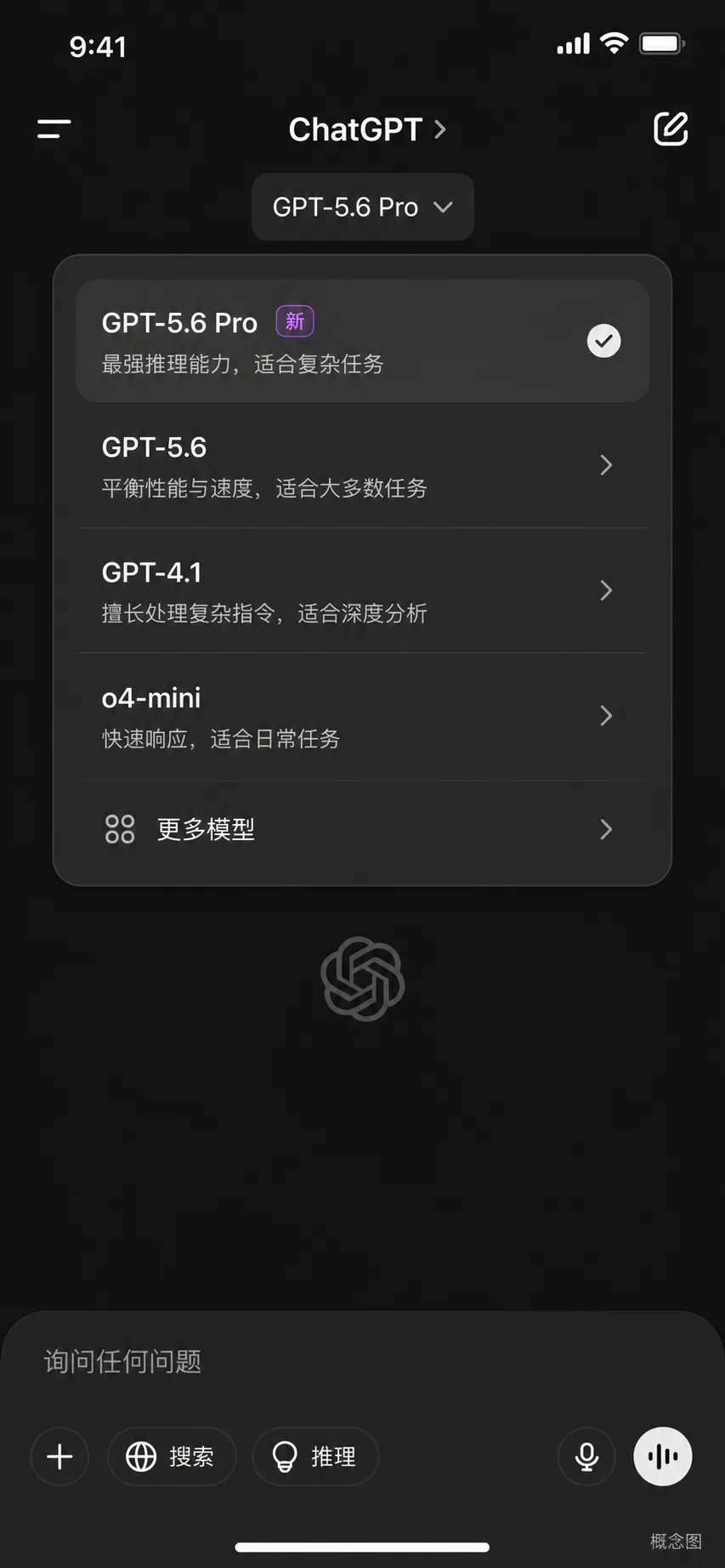
According to leaks from testingcatalog on June 19, and the current 78% probability on prediction markets, OpenAI will officially launch the GPT‑5.6 series on June 23, covering three tiers: mini, standard edition, and Pro. Some ChatGPT Pro subscribers have already posted screenshots on X—GPT‑5.6 Pro has appeared in their model selector. The pace here feels almost identical to the gradual rollout of GPT‑4 Turbo back in the day.
But this time, the point of interest is not the decimal in the version number—it’s that OpenAI has made a decisive cut: 1.5 million token context window, agent coding capabilities surpassing Claude Mythos, and pricing slashed to one‑third of the competitor’s. Taken together, those three moves essentially target Anthropic head‑on.
1.5 million tokens: From “can fit” to “actually usable”
First, the context window. GPT‑5.5’s API limit is 1.05 million tokens, and less via Codex OAuth (only 400k). GPT‑5.6 raises the ceiling directly to 1,500,000 tokens, an increase of roughly 43%.
This number alone isn’t mind‑blowing—Gemini 2.0 once claimed 2 million—but in practice attention decays sharply after 500k. What makes GPT‑5.6 noteworthy is its real usable range. Developers recently stress‑tested it in OpenCode, and even with 900k tokens input, the model consistently responded well; above 1.05 million, it still held up. In other words, this isn’t just marketing the window size—this is flattening the long‑range attention decay curve.
This difference is crucial for engineering. 1.5 million tokens equals roughly:
- An entire mid‑sized source code repo (Python/TS project, 30–50k lines)
- A 1,200‑page English PDF contract + attachments
- Dozens of agent work logs + tool invocation history
Previously, Claude users running agentic workflows often had to do context compaction mid‑process—compressing, summarizing, dropping redundancy—which introduces information loss. Complex tasks would start “forgetting” around step 15. If GPT‑5.6 can truly maintain precision in the 900k token range, agents could run through a whole sprint cycle without intermediate archiving.
Coding ability: Directly challenging Claude Mythos
Anthropic’s Claude Mythos series, launched in April, has been the developer community’s go‑to for agent coding. Mainstream tools like Cursor, Cline, and Aider all default to Mythos Sonnet. The GPT‑5.6 leaks include a striking claim: “In agent coding tasks, GPT‑5.6 has surpassed Anthropic’s Mythos series.”
Whether that’s OpenAI seeding the news or developer testing isn’t 100% certain, but several clues cross‑validate it:
First — long‑cycle coding task duration. Early testers report that running the same complex project on GPT‑5.6 Pro takes 20–40 minutes. This isn’t short, but the output’s “cognitive depth” is distinctly higher than GPT‑5.5—meaning the model pauses to think, reviews its work, corrects course. This used to be Mythos’ strongest advantage.
Second — Codex response speed. OpenAI has also upgraded the Codex pipeline. Codex has long been criticized for slow cold starts and jittery streaming. GPT‑5.6 reportedly optimizes batching and scheduling under the hood. In latency‑sensitive scenarios like IDE plugins and inline completions, this is a visible improvement.
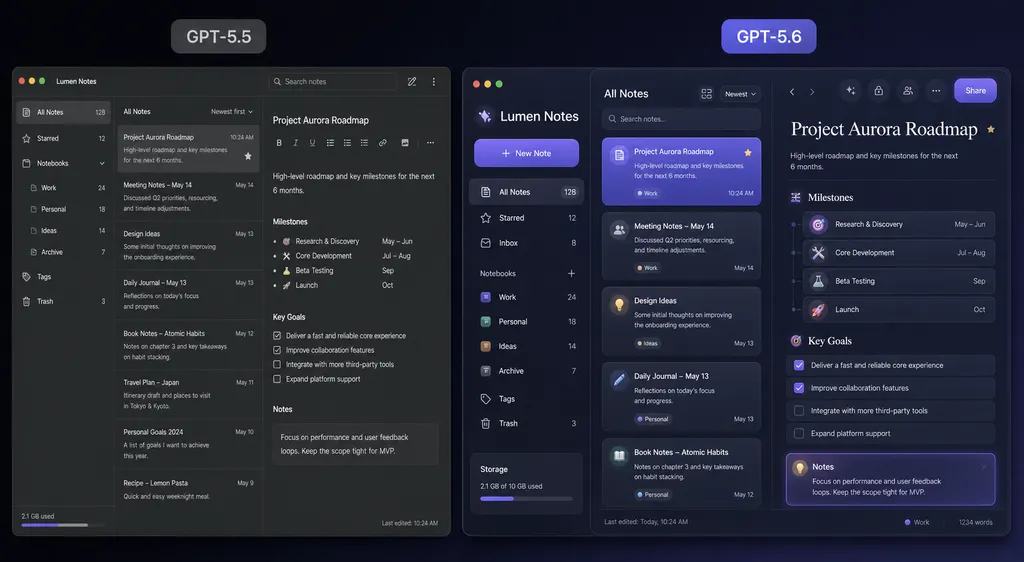
Third — frontend generation. Screenshots show GPT‑5.6 generating a minimal note app called Lumen Notes without a detailed prompt: neat grid layout, restrained color scheme, clear typography hierarchy—and notably, it doesn’t look “AI‑generated.” Past frontend outputs from models were often cluttered or poorly styled; few were directly usable. If this generation can reliably produce commercial‑grade UI, many small SaaS MVP teams could indeed skip the designer role.
Price war: OpenAI means business this time
The most explosive leak is pricing. Quote: “OpenAI’s current token price is about half of Anthropic’s, and OpenAI will directly launch a price war—further lowering prices while boosting performance.” Prediction market info is even bolder—GPT‑5.6’s API price is around one‑third of Claude Fable 5’s.
The timing is precise. Anthropic launched Claude Fable 5 on June 9, but on June 12 the U.S. Department of Commerce urgently pulled it due to a security vulnerability, leaving users in forced transition. OpenAI striking during this window is effectively a preemptive blow before the competitor patches.
Industry‑wise, this sends a clear signal: competition in frontier models has shifted from “showing off” to “grabbing market share”. Over the last two years, players competed on benchmarks, parameter counts, and flashy demos. Starting this year, capability curves among top models have converged; the real deciding factors are now: per‑token cost, context throughput, and agentic task completion rate.
GPT‑5.6 is essentially defining itself around these three factors.
Integration: OpenAI Hub ready to connect
Once GPT‑5.6 is officially released, OpenAI Hub (openai‑hub.com) will go live in sync, still using the OpenAI‑compatible format—direct connection in China without proxy hassles. Here’s a minimal example to prep scaffolding in advance:
from openai import OpenAI

client = OpenAI(
    api_key="your-openai-hub-key",
    base_url="https://api.openai-hub.net/v1"
)

response = client.chat.completions.create(
    model="gpt-5.6-pro",
    messages=[
        {"role": "system", "content": "You are a senior frontend engineer."},
        {"role": "user", "content": "Use Next.js 14 + Tailwind to write a Linear-style kanban component with drag-and-drop and real-time collaboration hooks."}
    ],
    max_tokens=8192,
    temperature=0.3
)

print(response.choices[0].message.content)
For long agentic tasks, it’s best to increase max_tokens, lower temperature to 0.1–0.2, and handle ultra‑long context with streaming:
stream = client.chat.completions.create(
    model="gpt-5.6",
    messages=conversation,  # can include 1M+ tokens of history
    stream=True,
    max_tokens=16384
)

for chunk in stream:
    if chunk.choices[0].delta.content:
        print(chunk.choices[0].delta.content, end="", flush=True)
The benefit of OpenAI Hub is you can switch between GPT, Claude, Gemini, and DeepSeek with the same key for comparison testing—no multiple account registrations or key maintenance. In a GPT‑5.6 vs Mythos vs Gemini 3.5 Pro benchmark, this switching cost is negligible.
Three‑tier positioning guess: mini / standard / Pro for different users
Leaks say GPT‑5.6 will, as usual, have three tiers. Based on internal codenames iris‑alpha, ember‑alpha, beacon‑alpha, here’s the likely mapping:
- GPT‑5.6 mini: likely for low‑latency, high‑concurrency scenarios, similar to GPT‑4o‑mini. Pricing will be aggressive, aiming to take down Haiku and Gemini Flash.
- GPT‑5.6 (standard): mainstay for everyday conversation, medium‑complexity code tasks, and RAG. The full 1.5M context will probably be included.
- GPT‑5.6 Pro: long reasoning, complex agents, research‑grade tasks. The 20–40 minute runtimes are Pro—essentially maxing out the reasoning budget.
This tiering continues the “o series” approach—splitting “fast,” “accurate,” and “deep” into separate products, letting developers match models to workloads instead of defaulting to the most expensive one.
The hard fight this June
Broadly speaking, the dense releases of June 2026 were long anticipated. Anthropic’s Claude Sonnet 4.8, Google’s Gemini 3.5 Pro, xAI’s Grok 5, and now GPT‑5.6—all four flagships in one month. This isn’t coincidence; training cycles have aligned with the launch of next‑gen H200/B200 clusters.
What’s interesting is: no one treats launch events as a stage for showing off anymore. Anthropic’s Fable 5 crashed over security issues; Gemini 3.5 is pursuing differentiation with deep integration in products like NotebookLM; Grok 5 focuses on real‑time data access via X. OpenAI is choosing the simplest yet most lethal tactic—max context, lowest price, strongest coding ability.
For developers, this is tangible benefit. Higher performance ceiling, lower price—workflows that needed rotation among three providers to reduce costs might now be handled by a single GPT‑5.6 mini.
One caveat: these are leaks. The 1.5M context and one‑third pricing will need official confirmation from OpenAI’s launch. If it’s indeed released next Monday (June 23), OpenAI Hub will integrate immediately and publish live comparison data—worth keeping an eye on.
References
- ITHome: OpenAI’s most powerful AI model GPT‑5.6 series may debut next week — testingcatalog’s latest leak, including Pro user feedback and price war preview
- ITHome: OpenAI GPT‑5.6 model may launch next month with 1.5M token context window — earliest report at end of May from Codex backend logs revealing iris‑alpha codename


