
Netflix Engineers Open Source Headroom: Equipping AI Agents with a “Compressor”
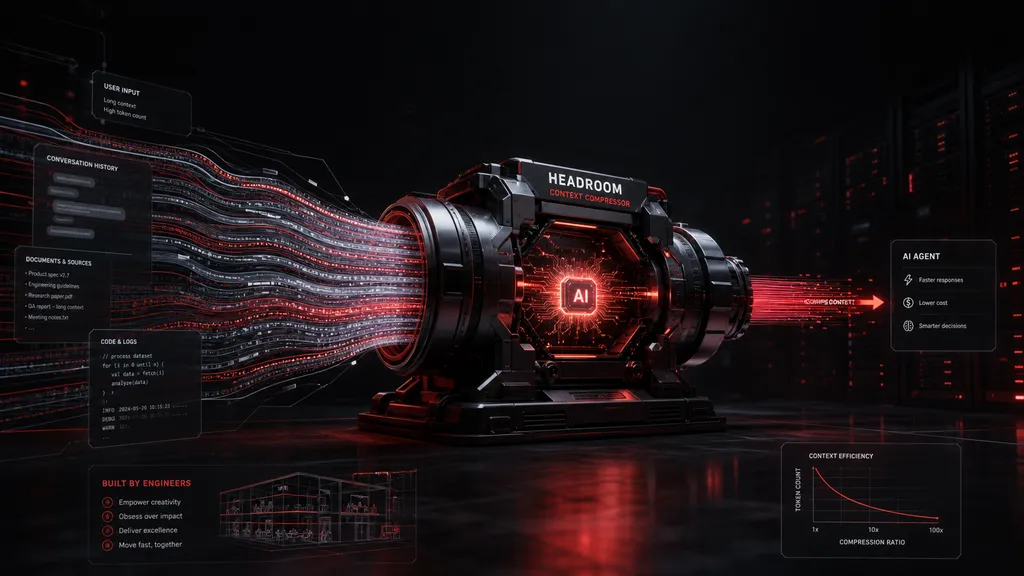
Netflix Senior Engineer Tejas Chopra open-sourced **Headroom**, which performs reversible compression at the LLM input stage. In real-world tests, token consumption was reduced by 60%–95%. The GitHub repository has soared to 39,600 stars, and it has recently gone viral in the AI community both domestically and internationally.
A $287 Bill Smashed the Illusion of AI Agent Costs
Netflix senior engineer Tejas Chopra probably didn’t expect that a small tool he casually uploaded to GitHub at the beginning of the year would suddenly become a hot topic in the global developer community by June. As of today, the project Headroom has reached 39,600 stars, with nearly 10,000 stars gained just in the past week. According to his own stats, this tool has so far saved users about $700,000 in API bills, compressing over 200 billion tokens in total.
The story’s beginning isn’t exactly legendary: while working on a personal project, Chopra received a $287 API bill at the end of the month. He wasn’t new to LLMs, but as an engineer who spends years dealing with distributed storage, his first reaction was to check the logs—only to find that the real cost wasn’t his written prompts, but all the “garbage” that the Agent automatically stuffed into the context: deeply nested JSONs, repeated API responses, thousands of lines of logs, and whole swaths of documents pulled in during RAG recall.
He later cited a figure at an open source summit: about 76% of tokens in AI applications are consumed on “reading input” rather than generating useful responses. This ratio may sound exaggerated, but anyone who has ever integrated Claude Code, Cursor, or Codex Agent would agree after glancing at a trace.
What Headroom Actually Does
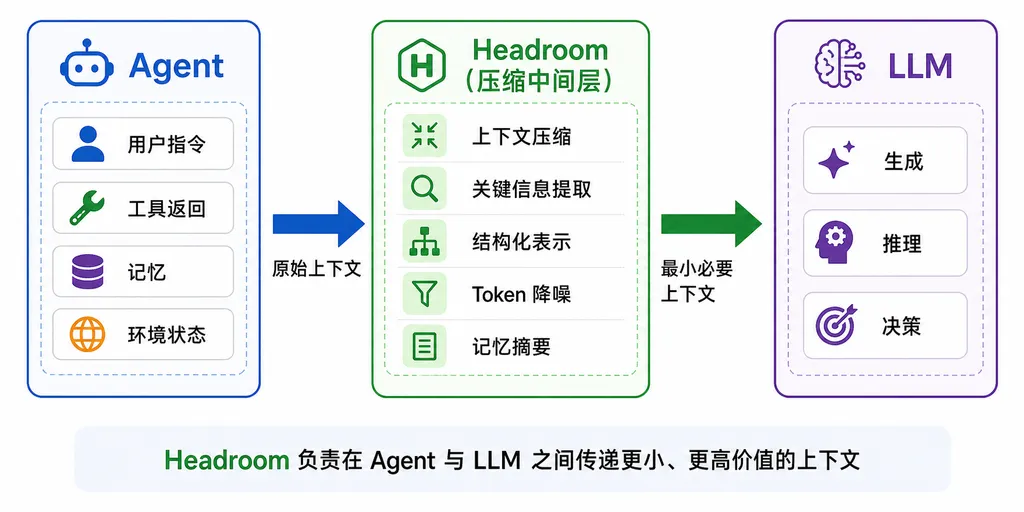
In a single sentence: Before your Agent sends context to the LLM, it first performs reversible local compression.
This sounds like adding gzip to HTTP, but the LLM world isn’t that simple—you can’t expect GPT-4 or Claude to decompress a binary stream; the model has to read “language” it understands. Headroom identifies structured, semi-structured, and plain text in the context, and applies different semantics-level slimming strategies for each type:
- Tool output (tool call returns): the typical JSON nesting hell → deduplicate, extract skeleton, use references
- Logs: template extraction, normalize timestamps, fold repeated blocks
- RAG recall fragments: summarization + key sentence retention
- Conversation history: use references to placeholder old tool outputs
- Code: AST-based structural compression
After compression, the content is still “human-readable” or semi-structured text the model can understand, but the size may be only 10% of the original. The full original data isn’t lost—it’s cached locally in Redis or SQLite, and when the LLM really needs details, it retrieves them via Headroom’s proprietary CCR (Compress, Cache and Retrieve) mechanism. In other words, the model sees “index + summary” and expands only when needed.
This idea is essentially in the same family as columnar compression and query pushdowns in databases, just moved from the OLAP battlefield to the LLM context window. Given Chopra’s storage background, no wonder he went straight for this route.
Under the Hood: Six Compression Algorithms and a 10-Stage Pipeline
Headroom lists its internal components openly in the README, with nothing hidden. Here are the core modules worth detailing:
1. ContentRouter: Content Type Identification
This is the entry point to the entire compression pipeline. Its job is simple to describe—determine if the current input segment is JSON, code, logs, Markdown, or plain natural language. But in practice it’s tricky—many Agent tool returns are “Markdown-wrapped JSON with embedded code.” The router needs the ability to peel layers and classify. Headroom uses a heuristic rules + lightweight classifier combo, way more reliable than pure regex.
2. SmartCrusher: The JSON Killer
This is the most discussed component in Headroom. For a multi-level nested API JSON with field names repeated hundreds of times, the model only needs the schema skeleton and concrete values—SmartCrusher extracts the schema once, and expresses the rest compactly via references. In their published code search tests, 17,765 tokens were reduced to 1,408, saving 92%. In SRE incident debugging logs with stacks and metrics, 65,694 tokens dropped to 5,118—also saving 92%.
3. CodeCompressor: AST-Aware
Many have tried code compression, but often at the naive level of “remove blank lines and comments.” Headroom takes the AST route: parse code into a syntax tree and decide, based on the problem context, which nodes are “trunk” (expand) and which are “branches” (collapse to signatures). This shines with large files in the thousands of lines, but the trade-off is obvious—multi-language support requires many parsers. Current coverage is solid for Python, TypeScript, Go, and Rust; obscure languages fall back to rule-based strategies.
4. Kompress-base: Small Model Compressing Large Model Inputs
This is one of Headroom’s more aggressive plays. They trained a small-scale language model dedicated to compressing natural language paragraphs while preserving meaning as much as possible. This “use a small model to save money for the big one” approach is reminiscent of Microsoft’s LLMLingua, but Kompress-base is reportedly retrained for Agent scenarios, with higher fidelity for “semi-structured natural language” like tool outputs and logs.
5. CacheAligner: Squeezing the KV Cache
This one is pure cost-saving black magic. Providers like OpenAI, Anthropic, and DeepSeek now offer KV Cache discounts for prompt prefixes; hitting cache can save 50%-90% of input costs. CacheAligner ensures that compressed prompt prefixes remain as stable as possible across turns, avoiding cache invalidation from trivial changes like timestamps or IDs. This is an engineering detail with direct bill impact.
Test Data: Is the 60%-95% Range Realistic?
Many in the community have run comparison tests. One representative case: in Claude Code integrated with Headroom, accuracy retention was about 97%, with token savings concentrated in the 70%-90% range. The 95% upper limit is real but mostly in ultra-redundant scenarios like JSON and logs; for pure natural language dialogue, savings are more in the 30%-50% range.
Even at the lower bound of 60%, for an Agent burning tens of dollars in tokens per day, that’s hundreds saved monthly. Gartner predicted in March that trillion-parameter model inference costs will drop 90% by 2030, but no one can wait that long—monthly bills are ballooning now.
Three Integration Methods—Pick What Works for You
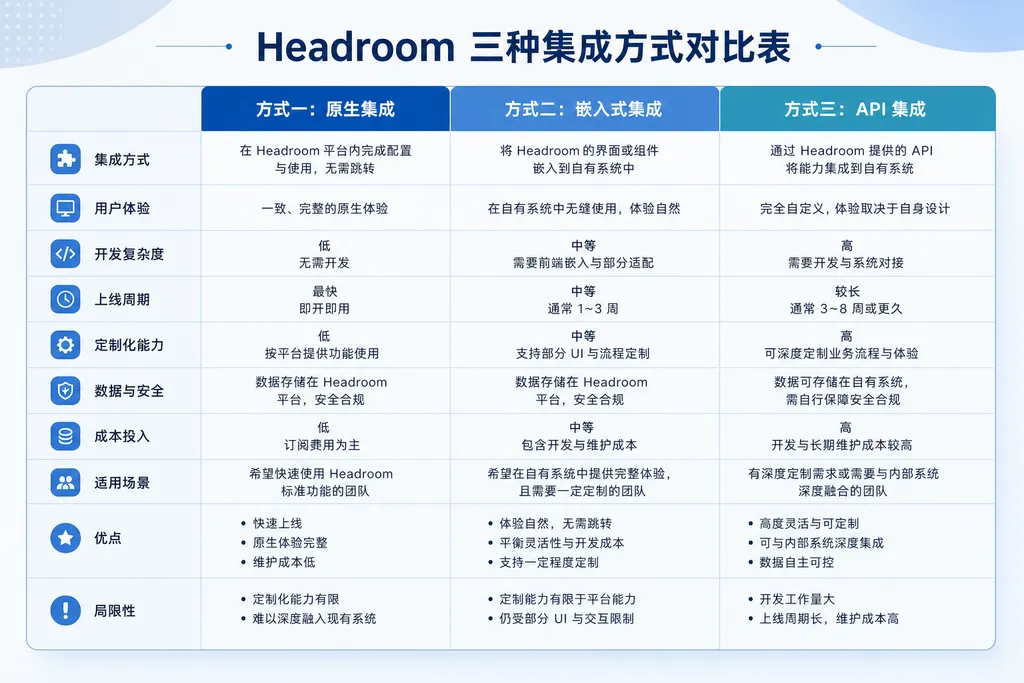
Headroom’s engineering is polished and doesn’t force code rewrites. It offers three integration approaches:
# Method 1: Proxy mode, zero intrusion
headroom proxy --port 8787
# Then just point your LLM base_url to localhost:8787

# Method 2: Agent Wrap, one-line wrapping
headroom wrap claude
headroom wrap cursor

# Method 3: As an MCP Server
headroom mcp --stdio
Proxy mode is best for evaluation—change one base_url and leave the rest of your code untouched, and you can see savings instantly. Wrap mode is for CLI Agents like Claude Code, Cursor, Codex; the author seems especially attentive to Claude Code users, with automatic conversation history compression after wrapping. MCP mode exposes Headroom as a standard MCP service, callable by any MCP-compatible client for compression/decompression.
Both Python and TypeScript SDKs are provided—for fine-grained control over compression strategies (e.g., forcing certain fields to keep original text), you can use the SDK.
Solving an Underestimated Problem
In AI Agent engineering over the past half year, focus has been on prompt engineering, tool use, reasoning loops, while the “how much junk is in the context” issue is underappreciated. Tools like Cursor and Claude Code seem magical, but open Anthropic Console and check token consumption—you’ll see 90% of costs in input tokens, with over half being repeated tool call results.
Headroom’s real hit isn’t “fancy compression tech” but the recognition that Agent context is a resource requiring dedicated management. Before this, developers either manually truncated or used crude sliding windows—essentially “cut info to save tokens.” Headroom is “save info and save tokens,” which reflects a different engineering philosophy.
Of course, it’s not without flaws. Local caching means maintaining a Redis or SQLite instance, raising deployment complexity; the Kompress-base model itself consumes resources; for highly structured binary protocols (e.g., protobuf as strings), compression gains are limited. But for the vast majority of Agent scenarios “stuffed with JSON and logs,” it’s the most pragmatic solution currently.
As a Side Note
If you want to directly test Headroom’s compression effects across different LLM providers, OpenAI Hub (openai-hub.com) lets you call GPT-4, Claude, Gemini, DeepSeek, and others with a single key. Point the Headroom Proxy upstream there for side-by-side bill comparisons—compression rate, KV cache hit rate, accuracy retention—in one go.
AI cost has never been a single-point issue; every link in the chain can be optimized. Headroom focuses on the context segment, and whether it saves you 60% or 95% depends on how wasteful your Agent was before.
References
- ITHome: AI Bills Soaring? Netflix Engineer’s Open Source Project Headroom Goes Viral — Chinese report on Headroom’s background, technical principles, and test data
- Software Home Related Coverage Summary — More updates on the Headroom project


