
Four Mac Studios Running Trillion-Parameter Models: LM Studio’s Hardcore Demo at WWDC
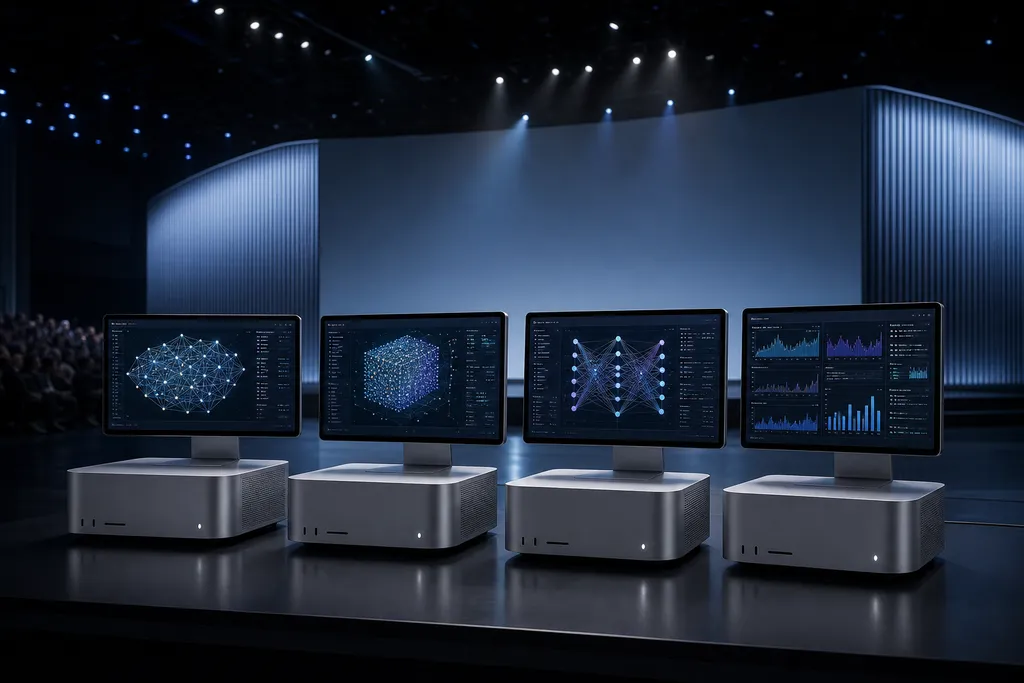
At the grand finale of WWDC 2026, LM Studio teamed up with Apple to form a cluster of four Mac Studios, running the 1-trillion-parameter Kimi K2.6 model from Moonshot AI locally. It can even be accessed remotely from the MacBook Neo and iPhone. This marks the first time consumer-grade hardware has reached the threshold of cutting-edge models.
Apple Puts a Trillion-Parameter Model in the Living Room
WWDC 2026 has been over for a few days, but the community is still replaying that final scene: four Mac Studios stacked on a table, locally running Kimi K2.6 — a trillion-parameter MoE model released by Moonshot AI in April. The presenter connected remotely via LM Link using a MacBook Neo and iPhone, with all data staying within the local network.
This wasn’t a benchmark demo — it was more of a statement: cutting-edge open-source models can now run inside a studio, without an H100 cluster, without an IDC, and not even requiring a single 10Gbps cable.
What’s the Deal with This Setup?
First, let’s crunch the numbers. Kimi K2.6 has a total of 1T parameters, MoE architecture, 32B activated. To load all parameters into VRAM (or unified memory in Apple’s case), even with 4-bit quantization you need at least 500GB; add KV cache and long context buffers and you’re looking at a baseline of 1TB to run properly.
The current top-spec Mac Studio has up to 384GB of unified memory per machine. Four units give you about 1.5TB of unified memory. That’s why it’s “four” and not two or eight — Apple sliced the model to fit exactly into the smallest possible container.
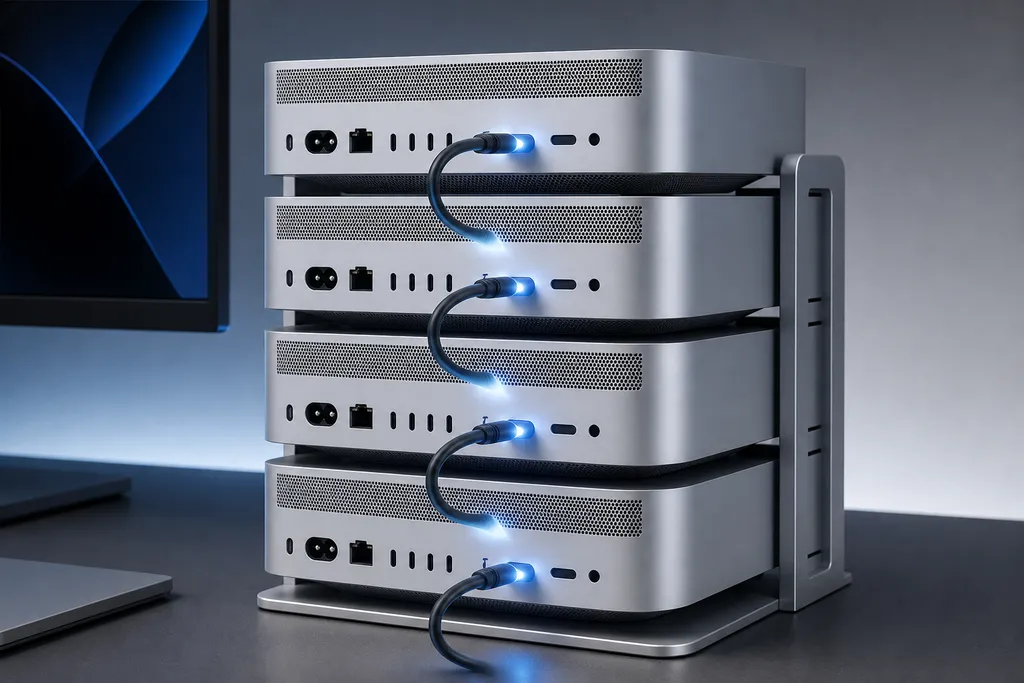
The key technology is RDMA over Thunderbolt 5, a new feature Apple introduced in macOS Tahoe 26.2. In short, it lets multiple Macs read and write each other’s unified memory as if it were local, with microsecond latency. This was previously only possible with interconnects like InfiniBand or NVLink.
- Interconnect bandwidth: Thunderbolt 5 single port 80Gbps; in symmetric mode can reach 120Gbps
- Latency: RDMA bypasses the kernel protocol stack, keeping end-to-end latency under 10μs
- Topology: Four machines in a fully connected topology, each using 3 TB5 ports
Developer testing shows this setup runs K2.6 at about 28 tokens/s in specific inference modes. This isn’t an impressive number — an 8×H100 rig runs the same model at 100+ — but look at the power draw: four Mac Studios fully loaded consume just over 1500W, compared to the 8–10kW typical of GPU clusters — an order of magnitude less.
What LM Studio Did This Time
LM Studio has always been a local model runtime platform, mainly for single-machine users. This collaborative preview version with Apple did several things they hadn’t done before:
- Model sharding and scheduling: Splitting MoE expert layers by machine, routing as needed during activation. MoE’s nature activates only a few experts per token, reducing inter-cluster communication pressure compared to dense models — this is key to running Kimi K2.6 on this setup.
- Unified memory abstraction: The 1.5TB memory across four machines appears as a single contiguous space to the model, with the routing layer handling cross-machine access.
- LM Link remote access: iPhones and MacBooks connect to the cluster via end-to-end encrypted channels, essentially turning the Mac Studio cluster into a private OpenAI-compatible endpoint.
LM Link was updated in early June in the Mac app and Locally AI’s iOS version. Originally designed to let users access their home models while away, it was repurposed by Apple as the WWDC closing showpiece, perfectly showcasing the entire “distributed inference + remote access” pipeline.
Why Kimi K2.6
Apple is deliberate when choosing a model for WWDC. The last two years were Llama; this year’s finale is Moonshot AI — an interesting shift.
Kimi K2.6, released April 20 by Moonshot AI, focuses on three things compared to K2: enhanced coding ability, long-run task execution, and agent cluster collaboration. Its MoE design is “engineering native,” built for agent workflows rather than leaderboard scores — aligning perfectly with Apple’s new Apple Intelligence toolchain demo at WWDC (a single prompt generating a full app with 3D animation and Visual Intelligence).
There are two practical reasons for choosing K2.6:
- Open-source for commercial use: Closed-source models wouldn’t allow Apple to do deep integration demos in their keynote.
- MoE adapts to clustering: Sparse activation suits distributed deployment; running dense trillion-parameter models at usable speed is nearly impossible.
Put simply: right now, K2.6 is pretty much the only trillion-parameter model that fits in 1.5TB unified memory, runs at usable speed, and can be publicly demoed by Apple.
What This Means for Developers
Optimistically, this signals that “private frontier models” are becoming feasible. Until now, running local models above 100B required multi-GPU servers or enduring extremely slow CPU inference. Now, four Mac Studios — priced at around RMB 250k–300k — can run a 1T model, offering new options for small teams and data-sensitive sectors like finance, healthcare, and law.
But don’t get too excited — there are real-world issues:
- 28 tokens/s speed is fine for single-user chat or asynchronous agent tasks, but struggles with high concurrency
- RDMA over Thunderbolt requires macOS Tahoe 26.2+, and is picky about cables and topology
- Quantized Kimi K2.6 needs more testing for long-context accuracy losses; the demo didn’t show results for 200K+ context
- Maintenance cost: Cluster scheduling and fault recovery across four machines — LM Studio’s current preview doesn’t expose enough ops interfaces
A more practical approach: run Kimi K2.6 on the local cluster for sensitive data processing, and use cloud APIs for general tasks — in parallel.
By the Way
If you just want quick access to Kimi K2.6 for evaluation, you don’t need your own cluster. OpenAI Hub has integrated Kimi K2.6’s API, sharing a key with GPT, Claude, Gemini, and DeepSeek, compatible with the OpenAI format, and directly accessible from within China. Use the API first to validate model capability for your business, then decide if a Mac Studio cluster for private deployment makes sense — that’s the safer route.
A Little Assessment
Technically, Apple’s demo didn’t introduce entirely new concepts — RDMA, unified memory, and MoE sharding are familiar ideas. What’s worth noting is the productization completeness: from hardware interconnect (Thunderbolt 5 RDMA), OS support (Tahoe 26.2), application-level scheduling (LM Studio), to endpoint access (LM Link iOS/Mac), the whole chain is fully integrated.
NVIDIA is deeply entrenched in the data center, but on the consumer side for local large models, Apple’s unified memory architecture in M-series chips offers a totally different path. The same playbook Apple used to disrupt laptop performance expectations with M1 is now being applied to AI inference.
Running trillion-parameter models locally was just a paper concept three years ago; today it’s a live demo at WWDC. The next question isn’t “Can it run?” but “What will we do once it runs?” — that’s what developers really need to answer.
References
- ITHome: LM Studio teams up with Apple to successfully run trillion-parameter Kimi K2.6 model on four Mac Studios — Original report with technical configuration and performance data
- Zhihu: Trillion-Parameter MoE Private Deployment in Practice – Kimi Hardware Selection and Implementation Path Analysis — Analysis of private deployment for the Kimi model series, for further reading


