
WeChat Native AI Assistant "Xiaowei" Soft Launch: Control WeChat with a Single Sentence, Can Also Generate Mini Programs
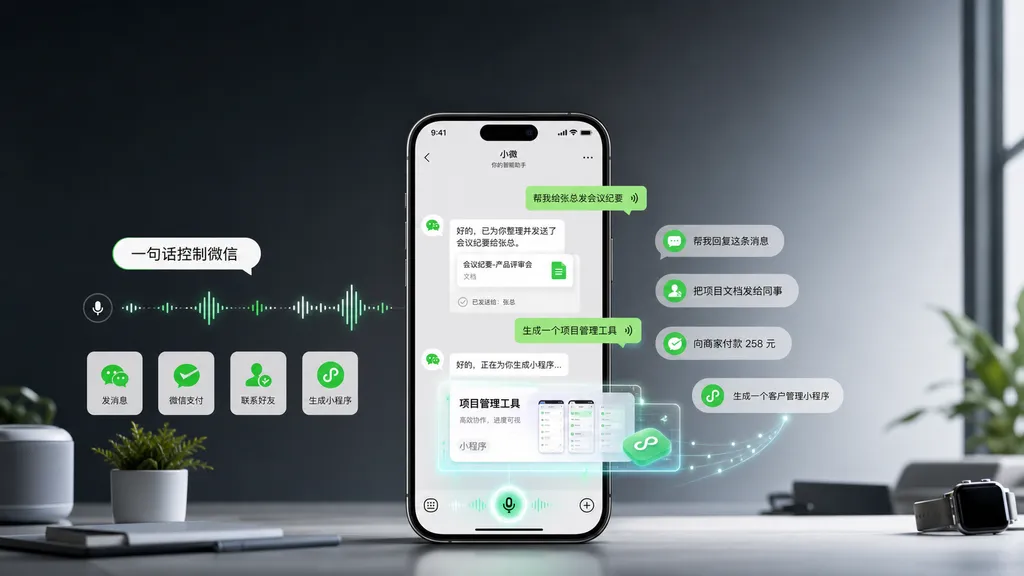
On June 20, WeChat’s native AI assistant “Xiaowei” expanded its beta testing, supporting voice/text control of WeChat’s native functions and integrating the capability of “one-sentence mini program generation.” It is regarded as a key step for WeChat in connecting AI with its billion-user ecosystem.
WeChat Native AI Assistant “Xiaowei” Beta Goes Live: Control WeChat with One Sentence, Even Create Mini Programs
On June 20, WeChat’s native AI assistant “Xiaowei” began expanding its beta test. On multiple social media platforms, users who received beta access have posted screenshots — the main WeChat interface now has a green-eyed robot icon in the top-left corner, which opens a dialog box with the word “Beta” prominently displayed.
This is not just another wrapper for a chatbot. Tencent’s customer service told IT Home quite directly: Xiaowei supports controlling WeChat’s native functions via text or voice conversations — including adjusting settings, sending messages, making calls, ordering food, and generating images. In other words, for the first time, WeChat has embedded an AI Agent in its core interaction layer, granting it permission to operate WeChat itself — and that significance outweighs the importance of the model itself.
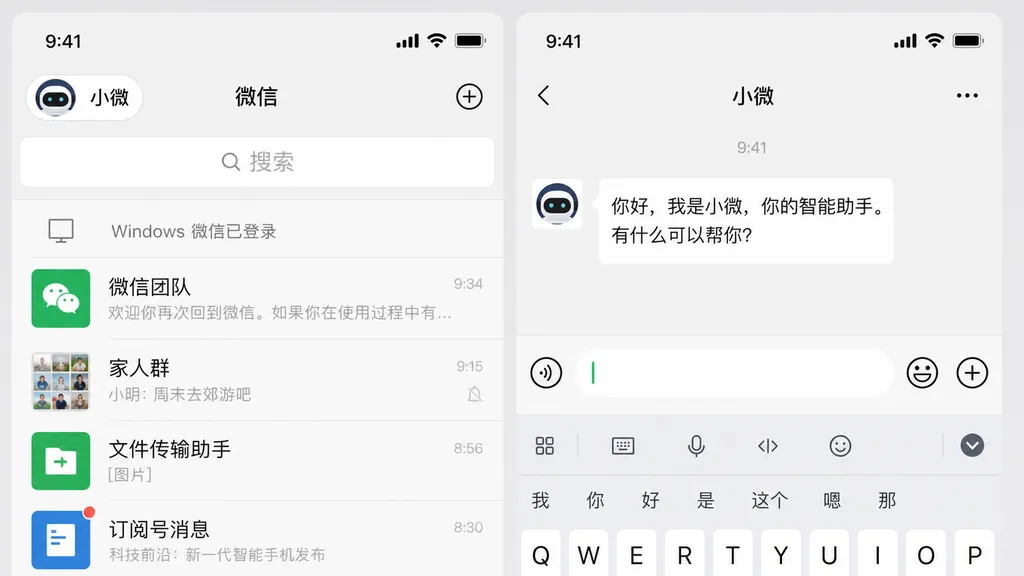
1. What exactly can Xiaowei do?
Judging from the current feature list that has leaked, Xiaowei’s abilities go far beyond those of a standard AI assistant. Combined information from Tencent customer service and the WeChat team suggests it can be grouped into three layers:
First layer: Voice/Text control of WeChat native functions. This is the easiest to overlook but has the most potential. Previously, to send a message to someone, mute notifications, or make a call, you had to tap multiple times; now it’s done with a single sentence. This “natural language control of OS-level apps” experience was previously only seen in system assistants like Siri or Google Assistant — third-party apps couldn’t do it due to permission limits. Since WeChat is Tencent’s own, it can integrate AI deep within.
Second layer: Information processing and generation. Summarizing files, setting reminders, recommending music, searching for information, generating images — these are standard features for any modern AI assistant. WeChat’s differentiator is context: it can directly read the PDFs you receive in chats, extract information from official account articles, and send generated images directly within your conversations. This “data right at hand” advantage is impossible for external products like ChatGPT or Kimi to match.
Third layer: One-sentence mini program creation. This is Xiaowei’s most talked-about feature on social platforms. On Xiaohongshu, user @iPhysicist described a need in natural language, and Xiaowei produced a runnable mini program prototype, allowing for multi-turn style adjustments — commands like “Make it more cartoonish” were understood. However, there’s a restriction: currently, generated mini programs are only for personal use and cannot be shared with others.
This restriction is key — it shows Xiaowei’s generated programs are “personal tools” rather than “public products,” avoiding unregulated mini programs from flooding the ecosystem and sidestepping content review issues. Conversely, if sharing is opened, the supply side of mini programs would be completely rewritten — this is likely Tencent’s real big move in the making.
2. Why Xiaowei is more important than it seems
When discussing AI Agents, one phrase the industry often mentions is “the last mile.” No matter how powerful a model is, without the ability to touch the real world, it’s essentially just a chat box. OpenAI is working on Operator, Anthropic on Computer Use — all aiming to give AI “hands.”
But these approaches face the same awkward problem: they operate from outside the system, relying on screenshots and click coordinates — which is slow, costly, and error-prone.
WeChat is different. It operates via internal API calls. This means when Xiaowei triggers a payment, initiates a call, or launches a mini program, it’s done through native interfaces, not simulated clicks. Latency, success rate, and stability are on an entirely different level.
The ecosystem depth is also crucial. On June 8, 2026, the WeChat Open Platform enabled AI ecosystem integration for developers, allowing WeChat AI to directly “call, access, and operate mini programs.” Integration methods include:
- Automatic mode: The platform automatically analyzes mini program page structures; developers don’t need to act
- Developer mode: Developers actively adapt their programs according to specifications, exposing their capabilities to WeChat AI
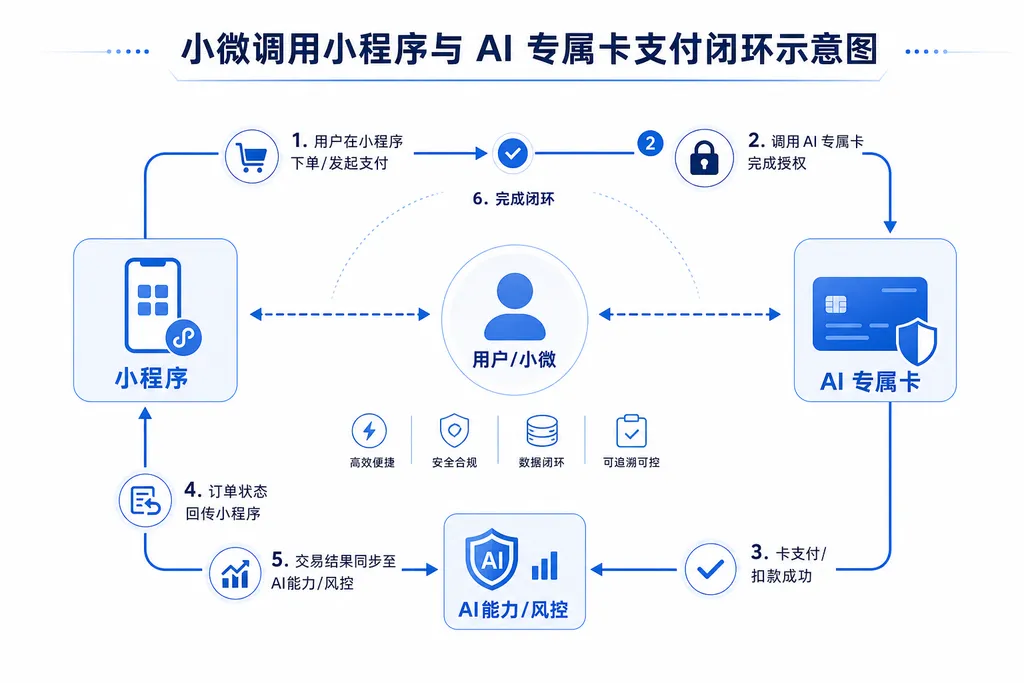
Combined with WeChat Pay’s newly released “AI Exclusive Card” — a payment credential designed specifically for AI Agent payment scenarios — the entire chain is already in place:
User speaks → Xiaowei understands intent → Calls the appropriate mini program → AI Exclusive Card completes payment → Feedback returned
This forms a complete Agent loop. Ask Xiaowei to “Order a Luckin iced Americano,” it calls the Luckin mini program, uses the AI Exclusive Card to pay, and the order is placed — without you opening any app.
3. Compared to Yuanbao, Doubao, and Kimi — what’s different?
This comparison is inevitable. Tencent already has Yuanbao, ByteDance has Doubao, Moonshot AI has Kimi — all building AI assistants. Why Xiaowei?
The core difference is simple: Xiaowei is not an app, it is WeChat itself.
No matter how powerful Yuanbao is, you must open it separately; Doubao must be tapped from the home screen; Kimi is a standalone product. They all battle user “open cost.” Xiaowei sits at the top-left of WeChat’s main interface and can be accessed with a left swipe — WeChat’s DAU is in the billions, and this entry point’s value is unmatched by any other Chinese AI product.
The second difference is “data loop.” Yuanbao can’t read your chat logs (privacy wall), Doubao ordering food involves multiple jump screens. Xiaowei, native in WeChat, can theoretically:
- See who you’ve chatted with and what was said (with user consent)
- Directly call mini programs you’ve already logged into
- Pay using your bound WeChat Pay
- Send results to the person you’re chatting with
This end-to-end experience is unattainable for other standalone AI assistants.
Of course, there’s a trade-off. Xiaowei’s model capabilities are likely not top-tier. Tencent customer service stated Xiaowei currently uses “multiple AI models, including Tencent’s own and high-quality open-source models.” This is pragmatic — for tasks like “send messages, adjust settings, call mini programs,” GPT-5-level reasoning isn’t needed; latency, cost, and stability matter more. Heavy tasks go to cloud large models, lighter ones are routed to small models — this is the mainstream Agent architecture in 2026.
4. Key points for developers
If you’re a mini program developer, Xiaowei’s beta launch signals:
- Adapt to WeChat AI ecosystem ASAP. The June 8 integration means a mini program’s “AI-callability” will become a new traffic entry point. If Xiaowei can’t correctly parse and call your mini program, you’ll be invisible in the natural language interface — similar to SEO or ASO logic.
- One-sentence mini program creation will disrupt some markets. Low-code platforms and template providers will be hit first. If ordinary users can create personal tools via natural language, the middle service layer’s value will be re-evaluated.
- AI Exclusive Card will foster new SaaS models. A payment credential designed for Agents shows Tencent is seriously considering risk isolation, limit control, and reconciliation rules for “machine automated consumption.” This provides reliable infrastructure for teams doing AI automation.
- Memory and privacy handling. In “Settings > Memory & Privacy > Memory,” Xiaowei lets users manage conversation history — similar to ChatGPT’s Memory feature. Balancing the experience boost from memory with privacy compliance under domestic regulations is worth ongoing observation.
5. Timing prediction
According to The Information, Xiaowei is led by Zhou Hao, WeChat Group’s technical architecture head, and plans to roll out to more users in Q3 2026. Today’s beta expansion means there’s still a 1–2 month window before full launch.
The timing is noteworthy — OpenAI and Anthropic are developing Agents to control operating systems, domestic companies are betting on on-device large models + Agents, and the whole industry is gambling on “the next form of AI deployment.” WeChat’s answer is very Eastern: Don’t build a new OS — grow AI inside the biggest super app.
If done right, this will be one of the few commercialized Agents in China able to complete a real closed loop. If done wrong, it becomes an awkward “WeChat Siri” with negligible presence. Judging from today’s functional completeness, the team is at least serious.
As a side note, for AI app developers who want to compare GPT, Claude, Gemini, DeepSeek, and other models’ real-world Agent performance, you can use OpenAI Hub (openai-hub.com) to query all mainstream models with one key, compatible with the OpenAI format and directly accessible domestically — no need to wrestle with proxies and multiple accounts.
Will Xiaowei become WeChat’s entry point for the next decade? No one can conclude yet. But what’s certain is: when a billion-DAU app decides to put AI in its most prominent position, the ripple effects will be more tangible and deeper than any model release.
References
- IT Home: WeChat AI Assistant “Xiaowei” Beta Goes Live — Control WeChat’s native functions via text or voice — First report, includes Tencent customer service responses and feature list


