
DVD-JEPA Open Source: A Minimal World Model That Can Predict
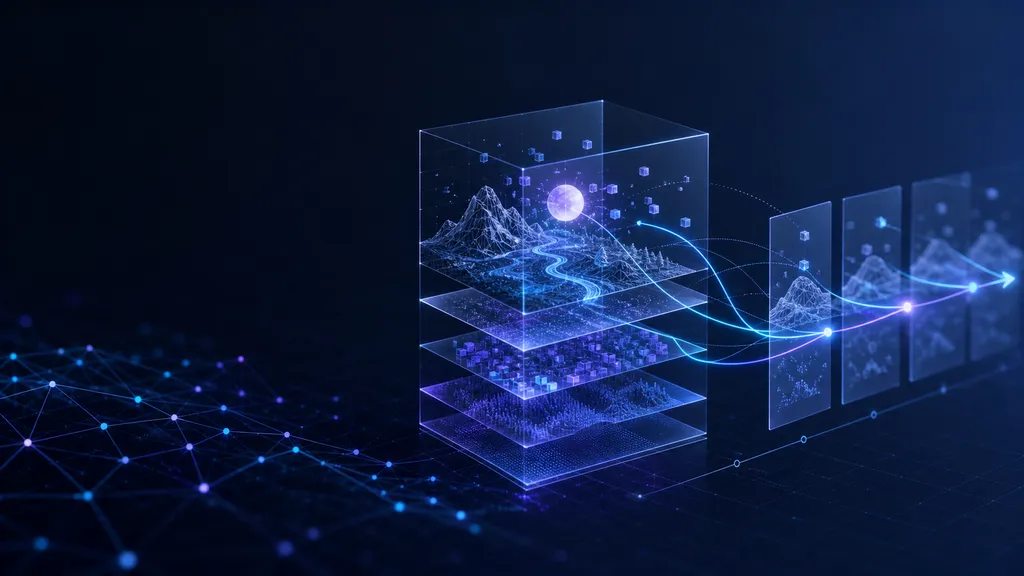
A 16×16 pixel bouncing DVD logo, fully modeled in a 32‑dimensional latent space. DVD‑JEPA uses the simplest possible experiment to clearly explain LeCun’s JEPA concept — and the entire process is fully reproducible.
A 16×16 "World" That Makes JEPA Clear
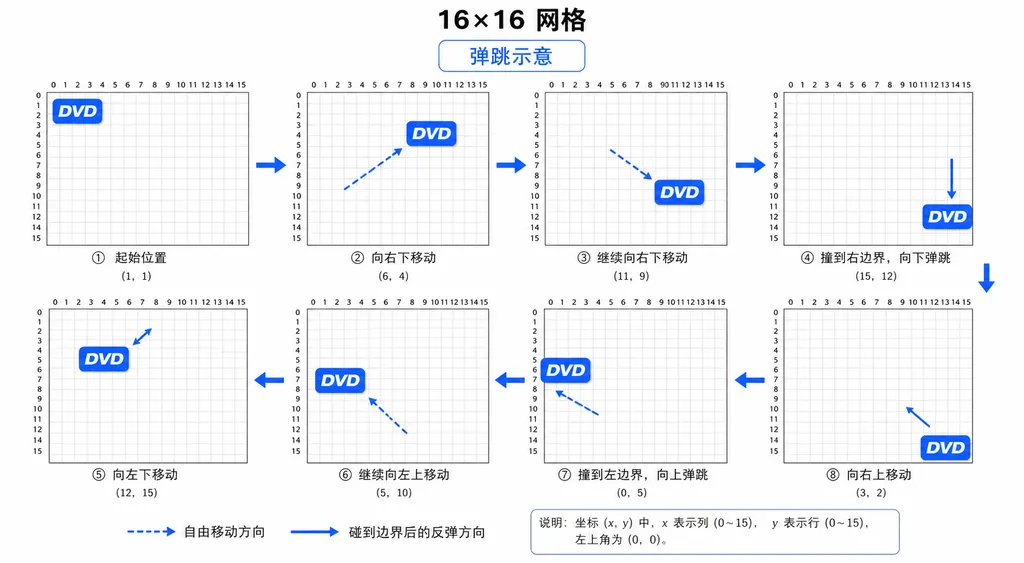
Over the past two days, a project called DVD-JEPA suddenly surfaced on r/MachineLearning, while also appearing on paperswithcode’s trending list for Anomaly Detection. The author describes it as “the smallest but most faithful demonstration of the JEPA concept we can build” — the “world” is just a DVD logo bouncing around a 16×16 grid, with no labels, no decoder, and only a 32-dimensional latent space to predict the next frame’s representation rather than its pixels.
It sounds like a toy, but that’s exactly what makes it interesting. Over the past two years, discussion around “world models” has been increasing, from V-JEPA, V-JEPA 2, to Meta’s VL-JEPA at the end of last year — Yann LeCun has been heavily promoting the entire JEPA approach. The problem is, nearly all public reproductions require hundreds of GPUs, hundreds of millions of parameters, and massive video datasets. Ordinary researchers have almost no entry point to truly understand what “predict representations, not pixels” actually means. DVD-JEPA lowers this barrier to the point where it can run on a laptop.
First, Make JEPA’s Bet Clear
The traditional approach to video world models is to predict the future frame-by-frame, pixel-by-pixel. Given the first t frames, the model outputs the RGB for frame t+1. The biggest problem with this route is not computing power, but that the very objective function itself is wrong.
Imagine a video of leaves shaking in the wind. From a physics standpoint, the precise motion of each leaf in the next second is unpredictable — it depends on turbulence, temperature, even insect disturbances. A pixel-level objective forces the model to fit such noise, which results in the model wasting capacity “guessing leaves” while overlooking truly important high-level structures (like noticing that someone is about to walk past).
JEPA’s bet is: Don’t predict pixels, predict representations. Let the encoder freely discard anything it can’t predict, keeping only what’s predictable. LeCun explained this clearly in his 2022 paper A Path Towards Autonomous Machine Intelligence, but papers are papers — there has never been a minimal working example that could both run and explain it clearly. I-JEPA and V-JEPA are too heavy — after reading them, you still don’t know if the core mechanism really works, or if scale is masking flaws.
DVD-JEPA is meant to fill this gap.
How It’s Built
The architecture is a standard JEPA three-part setup:
- Context Encoder: takes current observation, outputs a 32-dimensional latent vector
- EMA Target Encoder: an exponential moving average copy of the context encoder, used to label the “future”
- Latent Predictor: in 32-D latent space, predicts the next-time-step vector from the current one
The training objective is simply to make the predictor’s output match the target encoder’s output. No decoder, no reconstruction loss, no labels. This is JEPA’s hallmark: the loss function lives entirely in the embedding space.
To prevent representation collapse (cheating by mapping all inputs to the same vector), DVD-JEPA uses the same method as V-JEPA: EMA target network + asymmetric architecture. This is the most subtle yet critical engineering detail of the JEPA family — lost in the noise of large models, but crystal clear in a small 16×16 world.
obs_t   ──► ContextEncoder ──► z_t  ──┐
                                      ├──► Predictor ──► ẑ_{t+1}
                                      │                     │
obs_{t+1} ──► TargetEncoder(EMA) ──► z_{t+1}  ◄──── L2 loss ─┘
The world’s physics are ultra-simple: a logo that bounces off walls, moving at constant speed. In other words, the true world state can be fully described by 4 numbers (x, y, vx, vy). This gives a very solid validation baseline: if your 32-D latent space truly learns the world, those 4 degrees of freedom should be decodable linearly.
Results: Full Physics Hidden in 32 Dimensions
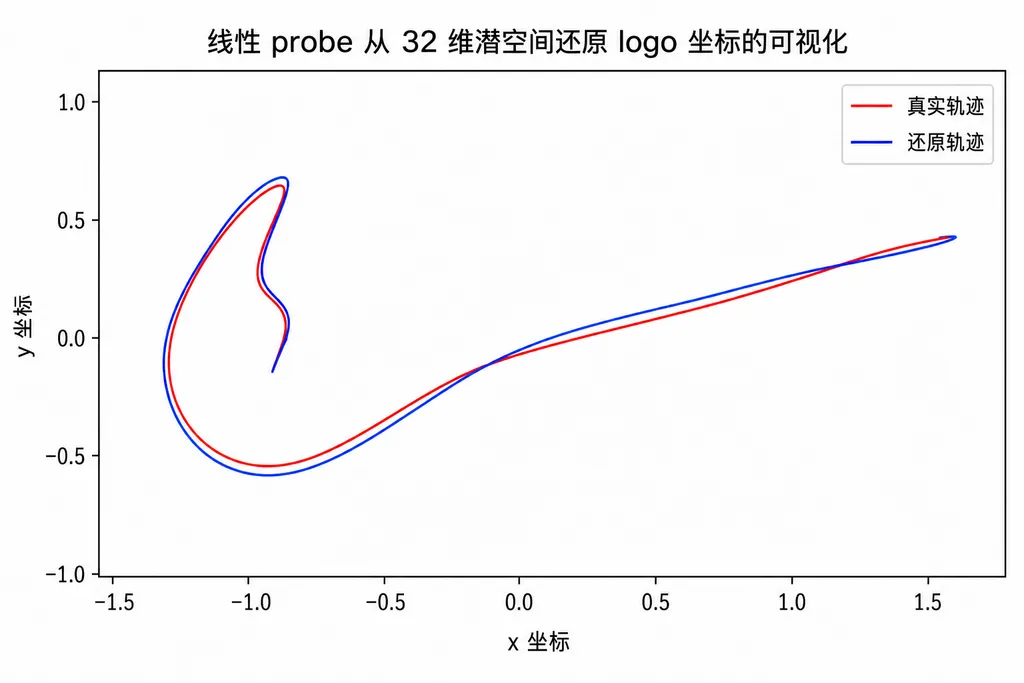
After training, the author freezes the encoder and attaches a linear probe to the 32-D latent vector to regress the logo’s true (y, x) coordinates.
The result: 0.73 pixel average error.
Note a few points:
- No coordinate labels were given during training — the model is entirely self-supervised.
- A linear probe means the positional information is almost linearly separable in latent space — this is as clean as representation learning results get, stronger than an MLP probe.
- 0.73 px in a 16×16 grid is about 4.5% relative error. Given the logo’s own size, this basically means “it learned it”.
Furthermore, the velocity components (vx, vy) can also be decoded from a single-frame latent vector — meaning the encoder remembers not just “where things are” but also “where they’re going,” because only with that can the predictor forecast the next frame. This was also mentioned in the V-JEPA paper, but in a 16×16 toy world it becomes especially convincing.
Why This Toy Deserves Serious Attention
If it were just “JEPA works in a small world,” it would be a tweet at most. DVD-JEPA merits a full write-up because it turns JEPA from a slogan into a dissectable experiment.
There are several longstanding pain points in reproducing JEPA:
- Collapse is hard to detect. In large models, the loss appears to drop, but you don’t know if the encoder is slacking. DVD-JEPA gives a hard metric via a linear probe — if you can decode coordinates, it learned something real.
- Effects of EMA momentum, predictor capacity, latent dimension are masked by noise in large models. In a 32-D world, changing a hyperparameter shows immediate differences.
- Extremely low reproduction cost. Readers can run the full training in minutes — vital for teaching and early research.
Such “minimal interpretable experiments” have always been scarce in ML. The last similar wave was toy transformers in mechanistic interpretability, breaking down attention heads clearly. DVD-JEPA plays a similar role for world models.
Its Relationship to V-JEPA 2 and VL-JEPA
Let’s quickly trace the lineage, since readers have likely seen these names in different contexts:
| Model | Date | Scope | |---|---|---| | I-JEPA | 2023 | Images, single-frame representation prediction | | V-JEPA | 2024 | Video, introduces spatio-temporal masking | | V-JEPA 2 | 2025 | Adds robot interaction data, enables planning | | VL-JEPA | Late 2025 | Vision-language integration, comparable to VLM | | DVD-JEPA | 2026.06 | Minimal reproduction, teaching/research friendly |
V-JEPA 2 can perform planning on real robots; VL-JEPA merges V-JEPA 2 + Llama 3.2 to produce a vision-language model trained 2.85× faster than traditional VLMs. Engineering value along this line is clear — but so is the rising barrier to entry. DVD-JEPA takes the opposite path, shrinking the architecture to its essence. From a product standpoint, it has no downstream utility; but for the goal of “helping more people truly understand what JEPA does,” its value might exceed any 7B reproduction.
A Few Questions Worth Pursuing
After seeing the author’s demo, I have several immediate questions — also directions worth extending:
1. How does latent space change when physics become unpredictable?
Currently the DVD logo is deterministic — given the state, the next frame is uniquely fixed. This means JEPA’s ability to “discard unpredictable information” hasn’t truly been tested. If we add random perturbations (e.g., small Gaussian noise on velocity each frame), can the encoder remain stable? In theory, JEPA should automatically ignore precise noise values, keeping only “general direction.” That would be a very clean test of LeCun’s slogan.
2. Is 32-D overparameterized?
The real world’s degrees of freedom here are only 4. If we shrink latent space to 4, 6, or 8 dimensions, can the model still learn? When does it collapse? Such “information bottleneck” experiments are almost impossible in large models but in DVD-JEPA are a one-line change.
3. Is the predictor learning physics?
This is the most interesting question. If you isolate the predictor and run it iteratively for N steps, does the latent trajectory match real physics? This is the true test of a “world model.” If the predictor can run stably for many steps in latent space, then this 32-D space isn’t just a representation space — it’s itself a learned physics engine.
The Real Stance of an Open-Source Project
In AI, most “open source” actually means “release weights.” Code is often incomplete, data prep scripts missing, hyperparameters undisclosed, reproducibility abysmal. DVD-JEPA takes another path — fully reproducible. The README emphasizes you can run the full pipeline from scratch, including data generation (the DVD logo is procedurally generated), training, and evaluation. This stance is commendable in itself.
Such “teaching-grade open source” may be more valuable to developers than another 7B model. If you want to figure out whether LeCun’s world model theory holds water, instead of reading a 100-page paper, spend an afternoon running DVD-JEPA, then change EMA momentum from 0.99 to 0.5 and see what happens. That’s where intuition grows.
A Word to Developers
If you work in RL, robotics, or any form of video understanding, the JEPA line is worth following seriously. Philosophically, it diverges from mainstream LLMs: LLMs bet that “predicting the next token is enough to reach AGI,” JEPA bets that “the essence of the world is representation, not data.” Neither route has proven victorious yet. But in tasks tied to the physical world, JEPA’s inductive bias is clearly more fitting.
DVD-JEPA will not directly help you build a product, but it will demystify “world models” for you. In 2026, with everyone shouting about world models, having a 16×16 toy that explains the core mechanism clearly is a rare breath of fresh air.
References
- DVD-JEPA: an open-source, fully-reproducible JEPA world model (Reddit r/MachineLearning) — original project post, complete explanation of architecture, experimental setup, and linear probe results
- Meta World Model V-JEPA 2: Self-supervised video models for understanding, prediction, and planning (Zhihu) — Chinese interpretation of V-JEPA 2, useful for comparing engineering choices in large-model versions


